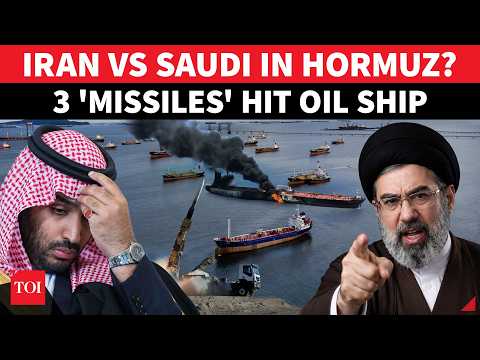
Iranianhttps://youtu.be/0lz0WaPU37E state television announced on Friday that three foreign oil tankers attempted to pass through the Strait of Hormuz “without authorization.” A TV correspondent shared that Iran’s Islamic Revolutionary Guard Corps (IRGC) Navy issued a warning at around 4 am local time, declaring that a new transit route announced by some authorities without coordination with Iran was “illegal, unacceptable and highly dangerous.” According to the correspondent, following the IRGC warning, tankers that had planned to use the southern corridor through the Strait stopped and “changed their course toward the Persian Gulf.”
Ship Struck in Hormuz as Oil Supertankers Turn Back Again
- A ship was hit by an unknown projectile in the Strait of Hormuz, sustaining damage to the bridge, according to UK Maritime Trade Operations.
- The incident occurred after several freighters turned around while attempting to cross the waterway, reportedly after hearing warnings from the Iranian Navy.
- The attack may undermine the rapid reopening of the energy chokepoint and has led UKMTO to advise vessels to “transit with caution”.
A ship was hit by an unknown projectile in the Strait of Hormuz, just hours after several freighters turned around while attempting to cross the vital waterway, developments that may undermine what had been a rapid reopening of the energy chokepoint. The unidentified cargo ship was hit on its side and sustained damage to the bridge while it was sailing to the southeast of Oman, UK Maritime Trade Operations said. UKMTO, which liaises between merchant shipping and the military, advised vessels to “transit with caution.” If Iran is found to be behind the incident, which UKMTO classified as an attack, it would hit shipowners’ and crews’ fragile confidence that they can once again sail through the oil corridor safely. Tehran has repeatedly said that ships can’t pass Hormuz without its permission and a handful of tankers turned around earlier in the day after reportedly hearing warnings from the Iranian Navy that they shouldn’t cross. Vessels had been racing out of Hormuz since an interim peace deal between the US and Iran came into effect last week, quickly adding millions of barrels of supply. Gulf energy producers have begun ramping up production as flows through Hormuz appeared to be holding up. Two key exit routes through Hormuz have emerged over the past several weeks because the normal one through the middle is thought to have been mined. One is near Iran, while the other hugs Oman’s coastline and is protected by the US.
A few hours earlier, at least three commercial vessels, including two oil supertankers, appeared to turn around while attempting to cross Hormuz outbound on the Oman side. Shipping intelligence company Windward Maritime said the u-turns came after Iran’s Revolutionary Guard Corps instructed vessels to turn around using radio calls and social media platforms.
Not all ships U-turned around the same time as those that turned back, according to tracking data compiled by Bloomberg. Some continued their exits. Iranian media also reported that Tehran was reasserting its control over transits. Thursday’s tumult comes two days after the International Maritime Organization, the UN’s global shipping regulator, said it had received assurances that passage through Hormuz was safe. The IMO canceled a media briefing on Thursday minutes before it was due to start, due to unspecified urgent matters. Traffic through Hormuz quickly picked up after an interim peace deal between the US and Iran took effect last week. However, there have been glitches, including when Iran said at the weekend that the waterway was shut. Tehran’s Persian Gulf Strait Authority said last week that no ships are allowed to transit Hormuz without its permission. Oil prices turned higher after the incident in Hormuz was reported. Earlier in the day Brent futures had wiped out all of their gains from the Iran war, trading as low as $72.09. They rose closer to $75 after the UKMTO report. In addition to three outbound U-turns, a fourth ship appeared to turn around after sailing toward Hormuz from the Gulf of Oman, the vessel tracking data show.
NN: Iran is still negotiating terms of trumps hamulating surrender. As a point in fact Trumps blames his generals, Sectary of War and Israel. Much more on this later!
Trump: Oil firms in big trouble if they gouge prices
United States President Donald Trump said on Wednesday that the oil companies will be “in big trouble” if the investigation by the US Department of Justice determines that they are gouging prices.
“It’s ExxonMobil, it’s Chevron, it’s Shell, it’s BP, it’s a lot of them. The gasoline, or the oil prices, have come down so much. We’re not seeing anything at the pump, by comparison to what it should be,” Trump said. “The oil companies are possibly gouging. I hope they’re not, otherwise they’re gonna be in big trouble. We’re not gonna play games,” he added.
The US president claimed that the oil companies are not reducing prices according to the latest developments, reiterating that 19 million barrels of oil came out of the Strait of Hormuz yesterday.
Chevron: Doing everything we can to reduce prices
Chevron Corp. CFO Eimear Bonner said on Thursday that major oil companies are “doing everything [they] can” to bring gasoline prices down as tanker traffic through the Strait of Hormuz continues to normalize. However, she told CNBC that “it’s going to take time,” pointing to a lag between a drop in oil prices and gas prices at the pump. “We’ve optimized through the conflict and continue to optimize the levers that we have to deliver the energy the world needs and to deliver products to consumers,” she said. Yesterday, United States President Donald Trump warned that oil majors will be in “big trouble” if they engage in price gouging.
NN: Translation Its all about the elections. Pollsters have told Trump he must have gasoline under $3.00 a gallon. In order to avoid Big Bubba in cellblock C and about a hundred pardons
IEA Weekly Petroleum Data
for the week ending June 19, 2026
U.S. commercial crude oil inventories (excluding those in the Strategic Petroleum Reserve) decreased by 6.1 million barrels from the previous week. At 412.1 million barrels, U.S. crude oil inventories are about 7% below the five-year average for this time of year. U.S. crude oil refinery inputs averaged 17.1 million barrels per day during the week ending June 19, 2026, which was 81 thousand barrels per day less than the previous week’s average. Refineries operated at 96.1% of their operable capacity last week. Gasoline production decreased last week, averaging 9.5 million barrels per day. Distillate fuel production increased, averaging 5.2 million barrels per day. U.S. crude oil imports averaged 5.6 million barrels per day last week, increased by 436 thousand barrels per day from the previous week. Over the past four weeks, crude oil imports averaged about 5.7 million barrels per day, 4.1% less than the same four-week period last year. Total motor gasoline imports (including both finished gasoline and gasoline blending components) last week averaged 647 thousand barrels per day, and distillate fuel imports averaged 135 thousand barrels per day. Total motor gasoline inventories increased by 2.1 million barrels from last week and are 5% below the five-year average for this time of year. Both finished gasoline and blending component inventories increased last week. Distillate fuel inventories increased by 3.1 million barrels last week and are about 10% below the five-year average for this time of year. Propane/propylene inventories increased by 2.6 million barrels from last week and are 35% above the five-year average for this time of year. Total commercial petroleum inventories decreased by 0.5 million barrels last week. Total products supplied over the last four-week period averaged 20.5 million barrels per day, up
by 2.1% from the same period last year. Over the past four weeks, motor gasoline product supplied averaged 8.8 million barrels per day, down by 3.0% from the same period last year. Distillate fuel product supplied averaged 3.6 million barrels per day over the past four weeks, up
by 3.2% from the same period last year. Jet fuel product supplied was up 0.9% compared with the same four-week period last year.
Gen. Jack Keane: We CANNOT let this happen
Gold drops below $4,000 for first time since November
![]()
Precious metals plummeted on Wednesday, with spot gold falling below $4,000 per ounce for the first time since November 2025 as investors assessed market expectations for interest rates and the US dollar. The gold spot price declined 2.72% to trade at $3,998.99 per ounce at 2:57 pm CET. Silver dropped 4.70%, changing hands at $58.68 per ounce at the same time. Meanwhile, platinum also traded with losses, down 3.91% at $1,600.30 per ounce at 2:57 pm CET, while palladium slipped 3.53% to $1,174.98 per ounce.
NN: I guess they did not get the memo. Gold is the barbaric relic of the past. Its on its way to $1500 and silver to $10 and gold and Bitcoin hucksters jail
Oil down WTI goes below $70 as supply fears ease
Crude oil prices continued to fall on Wednesday as investors’ supply concerns eased after the shipping through the Strait of Hormuz was restored. Oman announced that it had established a temporary corridor through the maritime route in coordination with the UN’s International Maritime Organization (IMO), to ensure toll-free navigation. Meanwhile, United States President Donald Trump said that Iran told the US that it is not seeking to charge tolls for the passage through the strait, but also warned that negotiations with Tehran would end “if this is false information.”
WTI for August deliveries plunged 3.82%, going for $69.92 per barrel at 9:35 am ET. A minute later, Brent for the same month’s settlements dropped 4.10%, selling at $73.72 a barrel.
TotalEnergies: Hormuz bypass an ‘absolute priority’
TotalEnergies Chief Executive Officer Patrick Pouyanne said on Tuesday that building pipelines that bypass the Strait of Hormuz should be an “absolute priority.” “The reality is that the Strait of Hormuz represents a genuine threat,” Pouyanne said during an energy conference in Paris. “To ensure it doesn’t remain a threat, there is only one solution: we must invest in pipelines to bypass the strait; that is an absolute priority,” he stressed. Pouyanne pointed to alternative export routes through Abu Dhabi, Iraq, Syria, and Turkey. He added that TotalEnergies helped build an Iraq-Syria pipeline nearly a century ago, saying: “If our predecessors did it 100 years ago, I believe we should be capable of doing it again today.” Earlier this month, Adnoc Executive Vice-President for Trading Philippe Khoury said the company was considering new fuel export pipelines that would allow Gulf producers to bypass the Strait of Hormuz.
NN: Pipelines are the solution to Iranian control of the Straights
Majority of US bases wiped out in Gulf
At least 16 American military sites have been damaged in Iranian strikes, making up the majority of US positions in the Middle East. The damage includes high-value targets, raising questions about America’s footprint in the region.