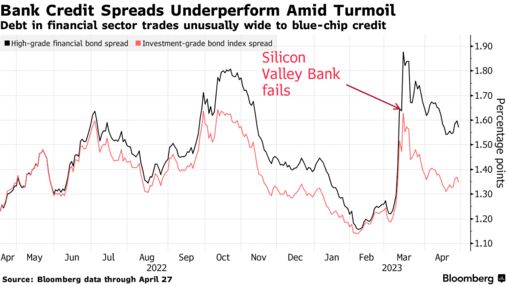
The third domino is falling First Republic Bank has lit up the radar screen. Like most dump shit bankers they locked in their capital at 1% interest rates… To show how fucked in the head they are as they sought gender equality and rescue people trapped in the wrong body. They forgot their job was to manage a bank. They saw inflation soar and the FED raise rates at the fastest rates in 50 years they were caufght at climate change rally. Think about it… Did they say to theselves mabe we should hedge our interest rate wise exposure? SO they locked in their capital for 10 years at under 1 percent. And lent long avaerage 7 years at 3%. Now their cost of funs is 5% an not only are they under water but they are 1000 feet underwater. Their solution is to increased emergency borrowing from the Federal Reserve for the second week in a row in a sign of the ongoing stress in the system. Last week, the New York Fed reported that financial conditions in its region had deteriorated sharply. This is proof that a credit crunch is underway. And it further complicates the plan for next week’s Fed policy meeting, where officials have to figure out how to balance the risks of tighter borrowing conditions against stubbornly high inflation. Below are six charts that help explain why and how borrowing is getting harder in vast parts of the economy: “Lending from U.S. banks is poised to contract over the next few quarters,” Amanda Lynam, head of macro credit research at BlackRock Financial Management wrote in a note on Thursday. Headwinds to profitability including higher deposit costs have seen bank spreads underperform relative to non-financials, she wrote.
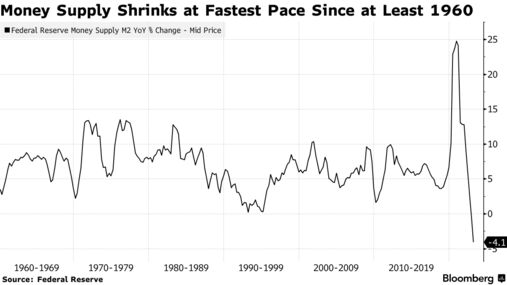
The blow to credit availability comes as the money supply shrinks, a sign that the spike in interest rates by the Fed is causing money to exit the banking system, shrinking the availability of loans. That could slow the economy, with monetarist economists suggesting it could herald a crash and deflation. The Dallas Fed and the San Francisco Fed last week reported pressure on funding in their geographic regions, with projects being canceled and nonperforming loans expected to increase.
Banks that posted quarterly results this month said they boosted provisions on bad consumer loans to levels not seen since the early days of the pandemic. For example, Capital One Financial Corp. increased its provision for credit card losses by more than 300% to $2.26 billion compared with a year earlier. The firms have generally said the rising provisions are just consumers returning to pre-pandemic norms.
Banks are writing off bad debt and setting aside additional reserves amid worsening macroeconomic conditions
Source: Bloomberg data
Capital One also set aside more money to cover souring office loans, as vacancies rise and many workers choose to work from home. Morgan Stanley has previously estimated that office property valuations could fall as much as 40% from peak to trough, increasing the risk of defaults.
The lenders are the biggest credit provider in each real estate category
Source: MSCI
Another emerging source of stress in credit is the leveraged loan market as corporate borrowers with floating-rate debt struggle to keep pace with higher borrowing costs. The amount of loans trading at distressed prices, defined as below 80% of face value, has jumped 26% to about $127 billion since the end of February, according to data compiled by Bloomberg. That compares with a 10% increase for bonds to about $488 billion. “We believe the loan market, which has historically had a lower default rate than the high yield bond market, will record a higher rate during this cycle,” Armen Panossian and Danielle Poli, managing directors at Oaktree Capital Management LP, wrote in a memo last week. “This is due to the covenant-lite nature of most loans and the rising prevalence of loan-only capital structures.”
You can expect defaults to rise especially in leveraged loan market
Sources: Moody’s Investors Service, Bloomberg
Company executives worldwide, meanwhile, are talking about credit on conference calls at the highest rate since the pandemic hit, according to data compiled by Bloomberg News. Some mentions include Evercore Inc.’s Chief Executive Officer John Weinberg noting an increase in restructuring and liability management business and Peabody Energy Corp. investor relations vice president Karla Kimrey saying the company has positioned itself to avoid uncertain credit markets.
Bosses Are Talking About Credit Like They Did at Start of Pandemic
Source: Bloomberg analysis of calls including earnings, sales and M&A
| What to watch in the days ahead: |
|---|
|
|