President Joe Biden has authorized Ukraine to use U.S.-supplied missiles to strike deeper inside Russia, easing limitations on the longer range weapons as Russia deploys thousands of North Korean troops to reinforce its war, according to a U.S. official and three other people familiar with the matter. The decision allowing Kyiv to use the Army Tactical Missile System, or ATACMs, for attacks farther inside Russia comes as President Vladimir Putin positions North Korean troops along Ukraine’s northern border to try to reclaim hundreds of miles of territory seized by Ukrainian forces. Biden’s move also follows the presidential election victory of Donald Trump, who has said he would bring about a swift end to the war and raised uncertainty about whether his administration would continue the United States’ vital military support for Ukraine. The irst reaction from Ukraine to the long-awaited decision from the U.S. to use U.S.-supplied long-range missiles to strike deeper inside Russia was notably restrained. The official and the others knowledgeable about the matter were not authorized to discuss the U.S. decision publicly and spoke on condition of anonymity. Ukrainian President Volodymyr Zelenskyy’s reaction Sunday was notably restrained. NN: Things ae heating up. Biden will do anything to undermine all Trumps programs..
Ukraine’s Allies Are Leaning on Zelenskiy for a Way to End the War
- Turkish leader wants Ukraine to delay NATO bid for 10 years
- Zelenskiy says Ukraine must do everything to end war in 2025
After almost 1,000 days resisting the Russian invasion, Ukraine’s allies are pushing Volodymyr Zelenskiy to consider new ways to lure Vladimir Putin to the negotiating table as they seek an end to the fighting.
Donald Trump will return to the White House in January pledging a quick end to the war. German Chancellor Olaf Scholz urged Putin to engage in peace talks during a phone call on Friday. France’s Emmanuel Macron said Sunday that he’ll speak to the Russian leader when the time is right.
Two European officials said there is an increasingly recognition that Zelenskiy will have to compromise with Putin because it has become clear that neither side can secure a decisive victory.
On the eve of the G-20, which will be President Joe Biden’s last in office, the US decided to authorize long-range missile strikes on Russian territory. The idea behind that shift is that it will help bolster Zelenskiy’s position before Trump takes office so that he can approach eventual negotiations with a strengthened hand.
Allowing Ukrainians to use those Western-made weapons — known as Army Tactical Missile Systems — would mark a serious escalation, but it’s unlikely to dramatically change the course of the conflict, according to Ruslan Pukhov, head of the Moscow-based Center for Analysis of Strategies and Technologies, a privately owned defense think tank. Meanwhile, Turkish President Recep Tayyip Erdogan is the latest NATO member to want to get in on the discussion. He’s set to present his proposal to freeze the conflict on current lines when Group of 20 leaders meet in Rio de Janeiro Monday, according to people familiar with his plans. The sudden clamor for a settlement shows the renewed urgency from Ukraine’s allies who are trying to get ahead of Trump’s return and the possibility of drastic cuts in US support. With North Korean troops entering the fray on the Russian side, there is growing appetite to halt a conflict which has brought destruction to vast tracts of Ukraine, consumed hundreds of billions of dollars in financial aid and foreign weapons and upended geopolitical relationships in Europe and around the world.
Only Trump can negotiate peace in Ukraine, aide says
United States President-elect Donald Trump is the only one who can help negotiate a diplomatic settlement of the conflict in Ukraine, his presidential transition team communications director Stephen Cheung told CNN. According to Cheung, only Trump will be able to bring together both Ukraine and Russia to the negotiating table and stop the killing in the war-torn country. Shortly after several media outlets reported that the US, France, and the United Kingdom decided to allow Kiev to use their long-range weapons to strike targets deep inside Russia, an unnamed representative of Trump’s transition team stated that the President-elect may reconsider Biden’s decision once in office.
UK, France allegedly let Ukraine use their missiles in Russia
The United Kingdom and France have allegedly greenlighted Ukraine’s use of long-range air-launched cruise missiles, Storm Shadow, inside the Russian territory, La Figaro reported on Sunday. The New York Times broke the news that outgoing United States President Joe Biden authorized the use of Washington-supplied weapons in Russia in response to Moscow’s decision to deploy North Korean soldiers into combat against Ukraine. The Pentagon declined to make any comments following the reports in the US media, while sources told Reuters that Ukraine could attack Russia using the weapons “in the coming days.” Ukrainian President Volodymyr Zelensky has spent months urging Western allies to lift their restrictions on using weapons for strikes within Russian territory, emphasizing that it would help bring an end to the war “as soon as possible.” Russian President Vladimir Putin previously warned that Ukraine’s use of Western-provided long-range weapons against Russia would mean NATO’s direct participation in the conflict.
IEA Says Global Oil Market Faces a Million-Barrel Glut Next Year
Global oil markets face a surplus of more than 1 million barrels a day next year as Chinese demand continues to falter, cushioning prices against turmoil in the Middle East and beyond, the International Energy Agency said. Oil consumption in China — the powerhouse of world markets for the past two decades — has contracted for six straight months through September and will grow this year at just 10% of the rate seen in 2023, the IEA said in a monthly report on Thursday. The global glut would be even bigger if OPEC+ decides to press on with plans to revive halted production when it gathers next month, according to the agency.
It’s possible that China’s oil demand has peaked, IEA Head of Oil Industry and Markets Toril Bosoni said in an interview with Bloomberg TV on Thursday.
“It’s not just the economy and the shift, the slowdown in the construction sector,” Bosoni said. “It’s the transition to electric vehicles, high speed rail and gas in trucking that is undermining Chinese oil demand growth.” Amid this extended weakness in Chinese demand, crude prices have retreated 11% since early October despite ongoing hostilities between Israel and Iran, as traders focus growing output in the Americas, the Paris-based IEA said. The decline foreshadows a “well-supplied market in 2025,” it added. Brent futures traded near $72 a barrel on Thursday. Global oil consumption will increase by 920,000 barrels a day this year — less than half the rate seen in 2023 — to average 102.8 million per day, it said. Next year, demand will grow by 990,000 barrels a day. “The sub-1 million barrel-a-day growth pace for both years reflects below-par global economic conditions with the post-pandemic release of pent-up demand now complete,” according to the report. “Rapid deployment of clean energy technologies is also increasingly displacing oil in transport and power generation.” The agency, which advises major economies, predicted earlier this year that world demand will stop growing this decade amid a shift away from fossil fuels toward electric vehicles and renewable energy. While demand growth cools, supplies from producers such as the US, Brazil, Canada and Guyana is set to grow this year and next by 1.5 million barrels a day, the agency predicts. As a result, world supplies will exceed demand next year by more than 1 million barrels a day, even if the 23-nation OPEC+ cartel abandons plans to restore output. The Organization of Petroleum Exporting Countries and its allies have been seeking to restart production halted since 2022, but has been forced to delay the move twice because the market remains so fragile. It currently plans to begin a series of modest monthly increases with a hike of 180,000 barrels a day in January, and will gather on Dec. 1 to review the decision. OPEC’s secretariat has belatedly recognized the demand slowdown, cutting its forecasts for this year by 18% during four consecutive monthly downgrades. Nonetheless, its projection of 1.8 million barrels a day of growth remains roughly double the rate seen by the IEA, and higher than most other market observers. NN: $50 Brent here we come. Drill baby drill and Trump peace in the Middle East and Ukraine brings more Russian oil to market.
Iran Loath to Be Drawn Into New Clash With US as Trump Returns
- Tehran and Washington may focus on stabilizing relationship
- Iran-backed militant groups are at war with US ally Israel
The last time Donald Trump was US president it spelled disaster for Iran — he walked away from a landmark nuclear deal, derailed the country’s economy with sanctions and killed its most revered general. This time around, the signals from the Trump camp are more mixed. The president-elect has suggested he wants to stabilize the relationship, yet he and some of his Cabinet nominees have also called for Israel to bomb Iran’s nuclear facilities and return to the “maximum pressure” campaign of his first term. The New York Times reported Thursday that billionaire Elon Musk — a confidante of Trump who has sat in on at least one call with foreign leaders — met with Iran’s ambassador to the United Nations, Amir Saeid Iravani, to discuss easing tensions between Washington and Tehran. Iravani’s office in New York declined to comment on the story, which has been re-published in Iranian state media and hasn’t yet been denied by Iranian officials. It put out a statement later Friday saying cease-fires could be achieved in Gaza and Lebanon if Israeli Prime Minister Benjamin Netanyahu is “dethroned or restrained.’ On the surface, there seems to be little for the US and Iran to discuss. Under Trump, the US assassinated a top Iranian general, Qassem Soleimani. And the US Justice Department last month detailed an alleged Iranian plot to assassinate Trump in the runup to the election. Get the Morning & Evening Briefing Europe newsletters. Even so, the meeting could suggest that Trump — or the people around him — are at least willing to talk, and consider the possibility of a softer stance. It also suggests Tehran may realize it can’t afford another major standoff with a longtime nemesis. The Islamic Republic is struggling with economic challenges brought about by years of sanctions, while its allied militant groups are embroiled in an ongoing and punishing war with US ally Israel.
“There are currently more trial balloons in the air from Tehran than there are at a country fair,” Naysan Rafati, senior Iran analyst at the International Crisis Group, told a call on US-Iran relations held by the Stimson Center think tank.
At the core of the Islamic Republic’s regional policy is its unflinching hostility and opposition to the state of Israel — which has only increased since the Oct. 7 attacks by Hamas that triggered the ongoing war in Gaza. Israel has since expanded the conflict to target Lebanon-based Hezbollah, another Iran-backed group. Both Hamas and Hezbollah are designated terrorist organizations by the US. The Islamic Republic’s leaders are trying to figure out what Trump and his Cabinet nominees mean for US policy. On the one hand, Trump himself has said he wants a new deal with Iran as long as it doesn’t seek a nuclear weapon. “We’re not looking to do damage to Iran, but they have — they can’t have a nuclear weapon,” Trump told reporters the day after the election. But before the Nov. 5 vote, Trump said President Joe Biden had been wrong to tell Israel not to target Iranian nuclear sites. “When they asked him that question the answer should have been, ‘Hit the nuclear first and worry about the rest later,”’ he told a rally in North Carolina. And Trump has nominated some politicians — including Marco Rubio for secretary of state, Pete Hegseth for defense secretary and Elise Stefanik for United Nations ambassador — who have called for a return to “maximum pressure” and suggested Israel should be given the green light to bomb Iran. “Israel should respond to Iran the way the US would respond if some country launched 180 missiles at us,” Rubio wrote in a social media post after Iran attacked Israel in October.
“There is a sense here that the approach to the US may have softened,” said Saeed Laylaz, an economist and one-time advisor to former Iranian President Mohammad Khatami. “We have some major domestic and economic challenges to deal with that the public needs to be prepared for.”
NN: Iran is toast… its defense systems have been comprised. Its hyper sonic missile systems defeated and its surrogates Hamas, Hezbollah and Houthi’s are ineffective and under constant attack. and the final blow… the man they most fear happens to just have been crowned the most powerful in the world.
nn audio file Iran on fire
Israel destroyed Iranian Taleghan 2 nuclear facility in October strike
The Israeli attack on Iran in late October destroyed an active top secret nuclear weapons research facility in Parchin, according to three U.S. officials, one current Israeli official and one former Israeli official. The strike — which targeted a site previously reported to be inactive — significantly damaged Iran’s effort over the past year to resume nuclear weapons research, The Taleghan 2 facility in the Parchin military complex, about 20 miles southeast of Tehran. The facility was part of the Iranian Amad nuclear weapons program.It was used for testing explosives needed to set off a nuclear device, according to the Institute for Science and International Security. One former Israeli official briefed on the strike said it destroyed sophisticated equipment used to design the plastic explosives that surround uranium in a nuclear device and are needed to detonate it. Iran has denied it is pursuing nuclear weapons. Iranian Foreign Minister Abbas Araghchi said in a statement last week that “Iran is not after nuclear weapons, period.”
High-resolution satellite imagery acquired by the institute after the Israeli strike showed the Taleghan 2 building was completely destroyed.


Behind the scenes: Israeli and U.S. officials said the activity that took place recently at the Taleghan 2 facility was part of an effort inside the Iranian government to conduct research that could be used for the development of nuclear weapons but could also be presented as research for civilian purposes. “They conducted scientific activity that could lay the ground for the production of a nuclear weapon. It was a top secret thing. A small part of the Iranian government knew about this, but most of the Iranian government didn’t,” a U.S. official said. Israeli and U.S. intelligence began detecting research activity at Parchin earlier this year, including Iranian scientists conducting computer modeling, metallurgy and explosive research that could be used for nuclear weapons. A U.S. official said that in the months before the Israeli attack “there was concern across the board” about the Iranian activity at the Taleghan 2 facility. The Iranian nuclear weapons research even led the U.S. Director of National Intelligence (DNI) to change its assessment about the Iranian nuclear program. When Israel prepared its retaliation for Iran’s massive Oct. 1 missile attack, the Taleghan 2 facility was chosen as a target. President Biden asked Israeli Prime Minister Benjamin Netanyahu not to attack the Iranian nuclear facilities in order not to trigger a war with Iran, U.S. officials said. But Taleghan 2 was not part of Iran’s declared nuclear program so the Iranians wouldn’t be able to acknowledge the significance of the attack without admitting they violated the nuclear non-proliferation treaty. “The strike was a not so subtle message that the Israelis have significant insight into the Iranian system even when it comes to things that were kept top secret and known to a very small group of people in the Iranian government,” a U.S. official said. NN: Every war the Islamic fucks have started against Israel they have lost.
the next jew bastard surprise
The Onion buys Alex Jones’ Infowars out of bankruptcy
NEW YORK, Nov 14 (Reuters) – The parody news website the Onion bought conspiracy theorist Alex Jones’ Infowars brand and website in a bankruptcy auction, according to court documents filed on Thursday. Jones filed for bankruptcy protection in 2022 after courts ordered him to pay $1.5 billion for defaming the families of 20 students and six staff members killed in the mass shooting at Sandy Hook Elementary School in Newtown, Connecticut. Jones, unable to pay those legal judgments, was forced to auction his assets, including Infowars, in bankruptcy. The Connecticut families of eight victims of the school shooting backed the Onion’s bid, saying it would put “an end to the misinformation machine” that Jones operated.
The Onion said it aims to replace “Infowars’ relentless barrage of disinformation” with the Onion’s “relentless barrage of humor.” “The Onion is proud to acquire Infowars, and we look forward to continuing its storied tradition of scaring the site’s users with lies until they fork over their cold, hard cash,” the Onion CEO Ben Collins said in a statement. Everytown for Gun Safety, the largest gun violence prevention organization in the country, said it will serve as the exclusive advertiser on the new Infowars.
The Onion will acquire Infowars’ intellectual property, including its website, customer lists and inventory, certain social media accounts and the Infowars production equipment, the families said in a statement. “They’re shutting us down,” Jones said on social media site X. “I’m going to be here until they come in here and turn the lights off.” NN: At one time we worked with Infowars. we warned him at the time that a lot of his conspiracy theories wee over the top. It got to the point we would not let him broadcast Radio Free Wall Street which was in syndication in 7 major markets. As you know we were taken off the air because we warned about the 2007/2008 real estate and stock market crash. We watched as Alex went further off the deep end. in conspiracy theory mania. He lost labial suits and got judgements against him that was over the moon. So much for free speech.
EIA Weekly Petroleum Report for November 8

Summary of Weekly Petroleum Data for the week ending November 8, 2024
U.S. commercial crude oil inventories (excluding those in the Strategic Petroleum Reserve) increased by 2.1 million barrels from the previous week. At 429.7 million barrels, U.S. crude oil inventories are about 4% below the five year average for this time of year. U.S. crude oil refinery inputs averaged 16.5 million barrels per day during the week ending November 8, 2024, which was 175 thousand barrels per day more than the previous week’s average. Refineries operated at 91.4% of their operable capacity last week. Gasoline production increased last week, averaging 10.3 million barrels per day. Distillate fuel production decreased
last week, averaging 5.0 million barrels per day. U.S. crude oil imports averaged 6.5 million barrels per day last week, increased by 269 thousand barrels per day from the previous week. Over the past four weeks, crude oil imports averaged about 6.3 million barrels per day, 0.2% less than the same four-week period last year. Total motor gasoline imports (including both finished gasoline and gasoline blending components) last week averaged 628 thousand barrels per day, and distillate fuel imports averaged 108 thousand barrels per day. Total motor gasoline inventories decreased by 4.4 million barrels from last week and are about 4% below the five year average for this time of year. Both finished gasoline and blending components inventories decreased last week. Distillate fuel inventories decreased by 1.4 million barrels last week and are
about 5% below the five year average for this time of year. Propane/propylene inventories decreased by 2.1 million barrels from last week and are 9% above the five year average for this time of year. Total commercial petroleum inventories decreased by 6.5 million barrels last week.
Total products supplied over the last four-week period averaged 20.8 million barrels a day, up by 1.8% from the same period last year. Over the past four weeks, motor gasoline product supplied averaged 9.1 million barrels a day, up by 0.6% from the same period last year. Distillate fuel product supplied averaged 3.9 million barrels a day over the past four weeks, down by 4.0% from the same period last year. Jet fuel product supplied was down 4.6% compared with the same four-week period last year.
Iran to reportedly hold off on retaliation to Israeli strike….. IRGC chief warns about Iran’s retaliation
Iran has reportedly chosen to delay its response to last month’s Israeli airstrike on Tehran, Israeli officials told Kan correspondent Amichai Stein on Wednesday. Rumors that Tehran may hold off on retaliation to Israel’s attack come following Republican Donald Trump’s re-election, with American media reporting that the president-elect intends to continue his “maximum pressure” strategy toward Iran. Previously, Iran warned that the Trump administration should “avoid any path” that does not align with the country’s interests, emphasizing that Tehran will persist in protecting its country and people.
IRGC chief warns about Iran’s retaliation
Islamic Revolutionary Guard Corps (IRGC) Commander-in-Chief Hossein Salami (pictured) said on Thursday that Iran’s enemies should expect its retaliation, promising that they “will receive painful blows.” “Today, we are witnessing a confrontation between light and darkness. Wherever light appears, darkness is doomed to destruction. The essence of our enemy is darkness and falsehood, and falsehood is doomed to destruction,” Major General Salami said while speaking at a security and combat maneuver, adding that “Muslims will never surrender.” Israel Defense Forces (IDF) attacked Iran’s capital city of Tehran last month in a series of airstrikes. According to previous reports from Israeli officials, Iran chose to delay its response to the attack, although Salami warned about “bitter consequences. “NN: The last thing Iran wants is to go to war with the US.
EIA revises down WTI, Brent 2025 price forecast
| Overview | ||||
|---|---|---|---|---|
| 2022 | 2023 | 2024 | 2025 | |
| Note: Values in this table are rounded and may not match values in other tables in this report. | ||||
| Brent crude oil (dollars per barrel) |
101 | 82 | 81 | 76 |
| Gasoline retail price (dollars per gallon) |
4.00 | 3.50 | 3.30 | 3.20 |
| U.S. crude oil production (million barrels per day) |
12.0 | 12.9 | 13.2 | 13.5 |
| Natural gas spot price (dollars per million BTU) |
6.40 | 2.50 | 2.20 | 2.90 |
| U.S. LNG exports (billion cubic feet per day) |
11 | 12 | 12 | 14 |
- Global oil consumption. India has emerged as the leading source of growth in global oil consumption in our forecast. Over 2024 and 2025, India accounts for 25% of total oil consumption growth globally. We expect an increase of 1.0 million barrels per day (b/d) in global consumption of liquid fuels in 2024. We expect even more growth next year, with global oil consumption rising by 1.2 million b/d.
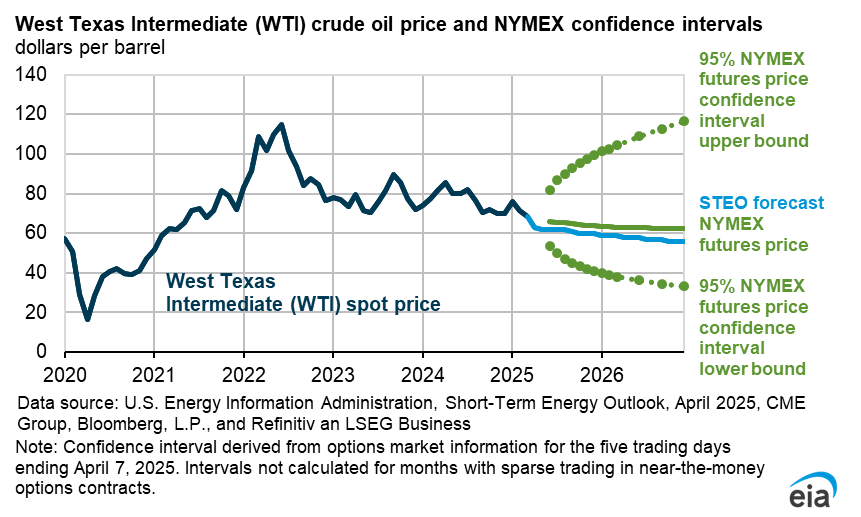
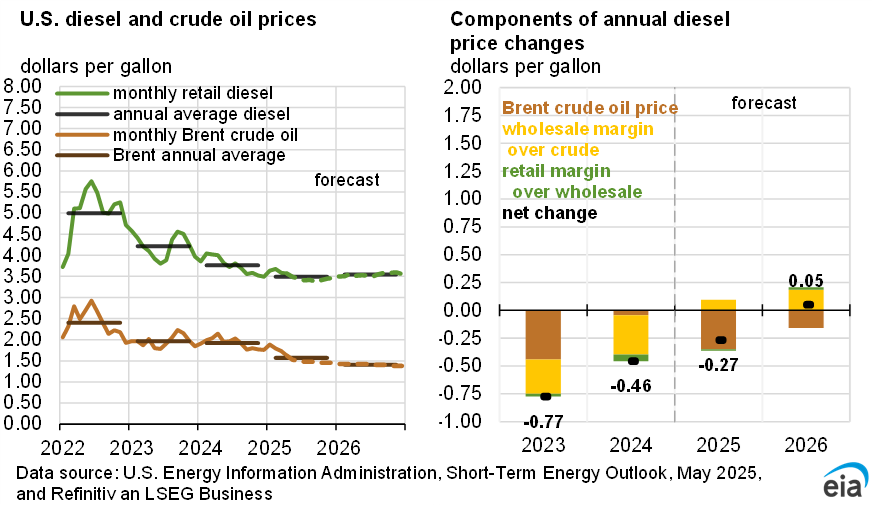
- Global oil inventories and prices. We expect that ongoing geopolitical risks and withdrawals from global oil inventories stemming from OPEC+ production cuts will place upward pressure on oil prices over the next few months, with the Brent crude oil price averaging $78 per barrel (b) in the first quarter of 2025 (1Q25). However, we forecast that global oil production growth means inventories will begin building in 2Q25, reducing crude oil prices through the end of the year. We expect the Brent price will fall to an average of $74/b in the second half of 2025.
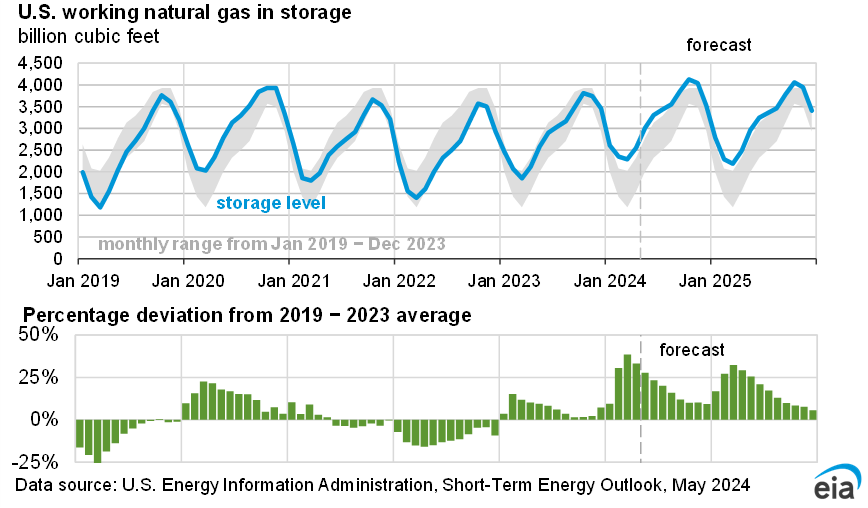
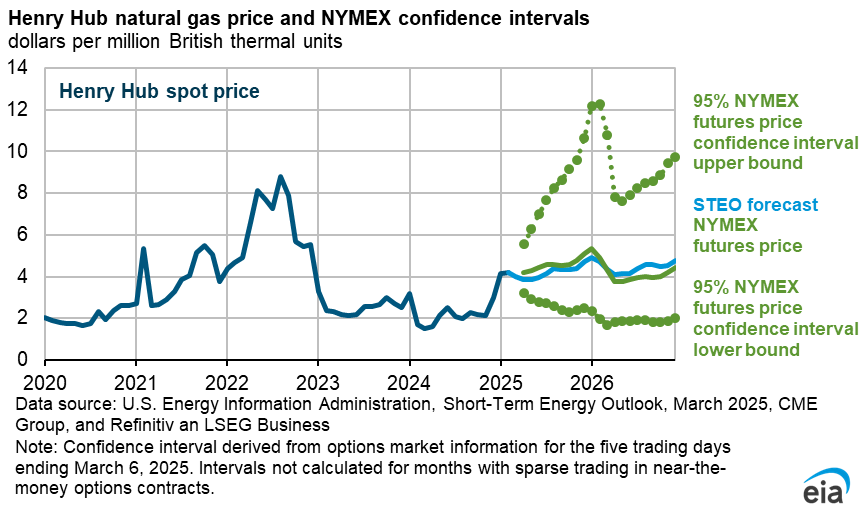
- Natural gas prices. We expect the Henry Hub natural gas spot price to rise in the coming months to average $2.80 per million British thermal units (MMBtu) in 1Q25, following seasonal patterns during which prices typically rise during the winter. The monthly average Henry Hub daily spot price fell to $2.20/MMBtu in October and below $2.00/MMBtu in early November. Low prices reflected warm temperatures, which could delay the beginning of withdrawals of natural gas from storage until mid-November. We expect the Henry Hub price to average around $2.90/MMBtu in 2025, as global demand for U.S. liquefied natural gas exports, a component of U.S. natural gas demand, continues to increase.
- Natural gas production. Marketed U.S. natural gas production in our forecast averages 113 billion cubic feet per day (Bcf/d) in 2024. Production in 2024 is relatively unchanged from 2023, a contrast to the production growth in the previous three years, as low natural gas prices curtailed production in some regions. We expect U.S. marketed natural gas production to increase by 1% next year, averaging 114 Bcf/d, led by a 6% increase in the Permian region.
- Electricity generation. We expect U.S. electric power sector generation to increase by 3% in 2024. The increase in generation is mostly to supply increased air-conditioning demand compared with last year, driven by hotter summer temperatures this year. The increase in consumption in 2024 is being supplied primarily from growth in use of natural gas (up 3% from 2023) and solar power (up 34%). We forecast that U.S. solar generation will continue growing by another 31% in 2025 as solar generating capacity expands, while higher natural gas prices reduce electricity demand from the natural gas sector.
-
-
Forecast overview
- Global oil consumption. India has emerged as the leading source of growth in global oil consumption in our forecast. Over 2024 and 2025, India accounts for 25% of total oil consumption growth globally. We expect an increase of 1.0 million barrels per day (b/d) in global consumption of liquid fuels in 2024. We expect even more growth next year, with global oil consumption rising by 1.2 million b/d.
- Global oil inventories and prices. We expect that ongoing geopolitical risks and withdrawals from global oil inventories stemming from OPEC+ production cuts will place upward pressure on oil prices over the next few months, with the Brent crude oil price averaging $78 per barrel (b) in the first quarter of 2025 (1Q25). However, we forecast that global oil production growth means inventories will begin building in 2Q25, reducing crude oil prices through the end of the year. We expect the Brent price will fall to an average of $74/b in the second half of 2025.
- Natural gas prices. We expect the Henry Hub natural gas spot price to rise in the coming months to average $2.80 per million British thermal units (MMBtu) in 1Q25, following seasonal patterns during which prices typically rise during the winter. The monthly average Henry Hub daily spot price fell to $2.20/MMBtu in October and below $2.00/MMBtu in early November. Low prices reflected warm temperatures, which could delay the beginning of withdrawals of natural gas from storage until mid-November. We expect the Henry Hub price to average around $2.90/MMBtu in 2025, as global demand for U.S. liquefied natural gas exports, a component of U.S. natural gas demand, continues to increase.
- Natural gas production. Marketed U.S. natural gas production in our forecast averages 113 billion cubic feet per day (Bcf/d) in 2024. Production in 2024 is relatively unchanged from 2023, a contrast to the production growth in the previous three years, as low natural gas prices curtailed production in some regions. We expect U.S. marketed natural gas production to increase by 1% next year, averaging 114 Bcf/d, led by a 6% increase in the Permian region.
Notable Forecast Changes 2024 2025 Note: Values in this table are rounded and may not match values in other tables in this report. Percentages are calculated from unrounded values.
The current STEO forecast was released November 13.
The previous STEO forecast was released October 8.Mont. Belvieu propane spot price(dollars per gallon) $0.80 $0.80 Previous forecast $0.80 $0.70 Percentage change 3.4% 13.4% Henry Hub spot price(dollars per million British thermal units) $2.20 $2.90 Previous forecast $2.30 $3.10 Percentage change -4.8% -5.2% -