Israel rejects US-backed Lebanon ceasefire proposal…….. Hezbollah Releases Video Of ‘Qader-1’ Missile That Hit Tel Aviv

 Israel rejected proposals on Thursday for a ceasefire with Hezbollah and conducted a military exercise simulating manoeuvres in Lebanon, defying allies including the United States which had called for an immediate halt in fighting.
Israel’s relentless pressure on Iran-backed Hezbollah in Lebanon, including intense airstrikes and assassinations of some of its senior commanders raised concern that it will mount a ground invasion which would lead to a wider war in the region. The military, which has vowed to secure Israel’s northern border and return thousands of its citizens to their communities there, said the exercise of its 7th brigade took place a few kilometres from the Lebanese border.
Shortly afterwards the Israeli military said it was carrying out precise strikes in Beirut, where the sound of a blast was heard and smoke was seen rising in the southern suburbs, a Hezbollah stronghold.
“There will be no ceasefire in the north,” Foreign Minister Israel Katz said on X. “We will continue to fight against the Hezbollah terrorist organization with all our strength until victory and the safe return of the residents of the north to their homes.” The comments dashed hopes for a swift settlement, after Lebanese Prime Minister Najib Mikati had expressed hope that a ceasefire could be reached soon, Hundreds of thousands of people have fled their homes seeking safety in the face of the heaviest Israeli bombardment since a 2006 war. World leaders have voiced concern that the conflict – running in parallel to Israel’s war in Gaza – was escalating rapidly. Hezbollah has faced off against the Israeli military since the Shi’ite Muslim movement was created by Iran’s Revolutionary Guards in 1982 to counter an Israeli invasion of Lebanon. It has since evolved into Tehran’s most powerful Middle East proxy. The United States, France and several other allies called for an immediate 21-day ceasefire across the Israel-Lebanon border. They also expressed support for a ceasefire in Gaza following intense discussions at the United Nations. Israeli Prime Minister Benjamin Netanyahu, heading to New York to address the U.N., said he had not yet given his response to the truce proposal but had instructed the army to fight on. Hardliners in his government said Israel should reject any truce and keep hitting Hezbollah until it surrenders. Hezbollah has fired hundreds of missiles at targets in Israel including, for the first time, its commercial hub Tel Aviv, although Israel’s aerial defence system has ensured that the damage has been limited.

gold hits new all-time high

Gold rose to a fresh all-time high on Thursday as precious metals continued to record gains. The upward trend reflected wider market confidence as central banks started easing their tight monetary policy stances, coupled with a safe-haven appeal of precious metals in an uncertain geopolitical environment. Gold added 0.57% at 6:38 am ET, selling for $2,672.34 per ounce, while silver jumped 1.82% and went for $32.40 per ounce. Platinum surged 2.43% at 6:40 am ET, going for $1,015.62 per ounce and palladium grew by 1.70% and sold for $1,051.33 per ounce. NN: I can’t wait to short the shit out of this insanity.

Israel rejects U.S.-backed Lebanon ceasefire proposal

  • LATEST DEVELOPMENTS:
  • Thousands seek shelter in Beirut schools
  • Israeli strike hits border crossing between Lebanon and Syria
BEIRUT/JERUSALEM, Sept 26 (Reuters) – Israel rejected proposals on Thursday for a ceasefire with Hezbollah, defying allies including the United States which had called for an immediate three-week halt in fighting to allow for diplomacy to avert a wider war.
“There will be no ceasefire in the north,” Foreign Minister Israel Katz said on X. “We will continue to fight against the Hezbollah terrorist organization with all our strength until victory and the safe return of the residents of the north to their homes.”
The comments dashed hopes for a swift settlement, after Prime Minister Najib Mikati had expressed hope that a ceasefire could be reached soon in Lebanon, where hundreds of thousands of people have fled their homes seeking safety. World leaders voiced concern that the conflict – running in parallel to Israel’s war in Gaza – was escalating rapidly. The heaviest fighting in nearly two decades between Israel and the Iran-backed Hezbollah group has raised fears of a new Israeli ground offensive across the Lebanese-Israeli frontier. Israeli Prime Minister Benjamin Netanyahu, heading to New York to address the U.N., said he had not yet given his response to the truce proposal but had instructed the army to fight on. Hardliners in his government said Israel should reject any truce and keep hitting Hezbollah until it surrenders.
 Israel has launched the heaviest air strikes against Lebanon since a 2006 war over the past week, killing more than 600 people, as months of cross-border fire with the Iranian-backed Hezbollah movement spiralled close to all-out war.
 Hezbollah has fired hundreds of missiles at targets in Israel including, for the first time, its commercial hub Tel Aviv, although Israel’s aerial defence system has ensured that the damage has been limited. On Wednesday, Israel’s army chief made the most explicit public comment yet on the possibility of a ground assault on Lebanon, telling troops near the border to be prepared to cross.

A map of Israel's airstrikes on Lebanon from Sep. 21-23.
A map of Israel’s airstrikes on Lebanon from Sep. 21-23.
Israel’s airstrikes sharply intensified since Monday, when more than 550 people were killed in Lebanon’s deadliest day since the end of a 1975-1990 civil war. The bombing follows attacks last week when pagers and walkie talkies exploded across Lebanon, killing scores of people and wounding thousands including Hezbollah members.

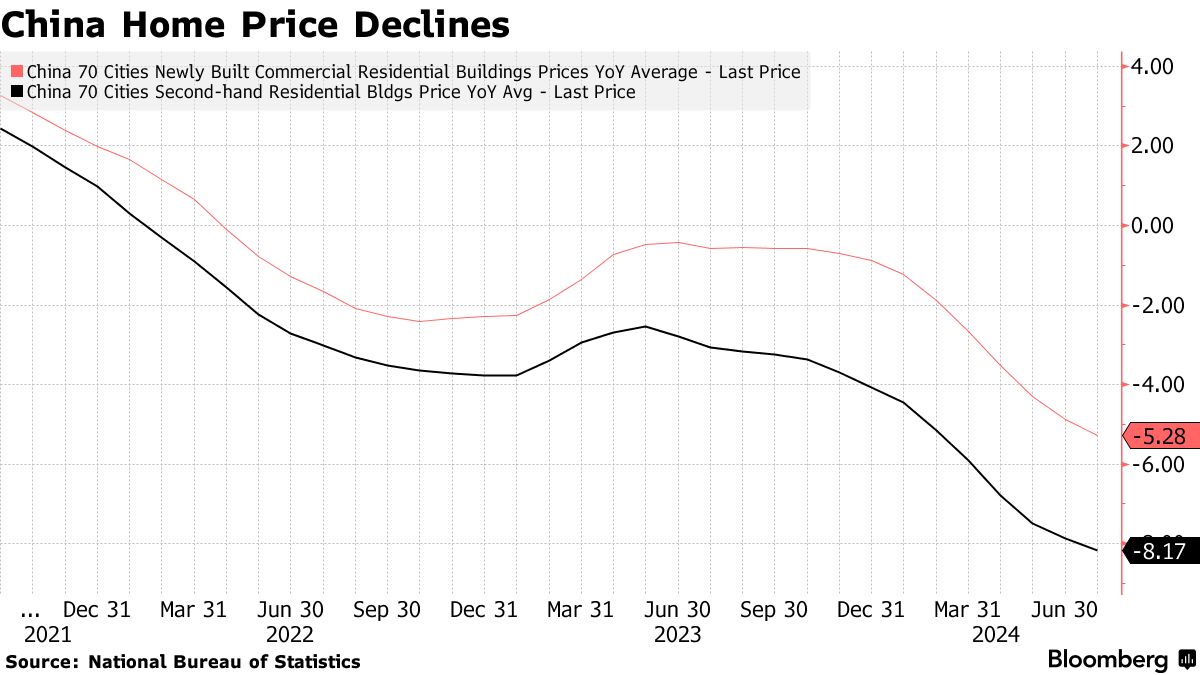
China’s Politburo Supercharges Stimulus With Housing, Rates Vows

  • Politburo calls for measures to stop property market decline
  • Pledge to ensure fiscal spending among steps signaling urgency

The readout came hours earlier than normal, just as afternoon trading began. After its release, China’s CSI 300 Index — a gauge of onshore Chinese stocks — extended gains to 4.2%, erasing losses for the year, while a gauge of developers tracked by Bloomberg jumped 15.9%. The focus on the economy in the Politburo meeting this month — the first time since 2018 — was unusual and speaks to officials’ desire to allay rising economic anxiety after China’s growth slowed to the worst pace in five quarters. “This stimulus package endorsed by today’s Politburo meeting represents a strategic shift in macro policy,” said Bruce Pang, chief economist for Greater China at Jones Lang LaSalle Inc. “If there are more substantial fiscal supports and a pick-up in government spending, it will probably be sufficient to drive a turnaround in business confidence, market sentiment and economic activities.”

Israel: Targeting Hezbollah sites in Lebanon……. Netanyahu: No easing of fights in north

The Israel Defense Forces (IDF) announced on Thursday it is launching another series of attacks on what it described as “terror targets” belonging to Hezbollah in Lebanon. The news came just moments after Prime Minister Benjamin Netanyahu denied his cabinet was close to agreeing to a proposal of a ceasefire with the aforementioned organization. Previously, France said it was working with the United States on a scheme of a 21-day ceasefire between Israel and Hezbollah.

Netanyahu: No easing of fights in north

Israeli Prime Minister Benjamin Netanyahu on Thursday said that he did not order the military to moderate attacks on Hezbollah sites in Lebanon, denying previous media reports, according to his office’s statement. “The prime minister instructed the IDF to continue fighting with full force, and according to the plans that were presented to him,” the Prime Minister’s Office said. Additionally, Netanyahu’s office said that media reports claiming that the Israeli government is about to accept a proposal for a 21-day ceasefire with Hezbollah. “This is a US-French proposal to which the prime minister did not even respond,” the statement read.

NN Audio Note:

My my how the worm has turned

US: 30% of oil production shut-in in Gulf of Mexico due to hurricane

The Bureau of Safety and Environmental Enforcement (BSEE) in the United States reported on Wednesday that approximately 29.18% of current oil production and 16.85% of natural gas production in the Gulf of Mexico has been shut-in due to Hurricane Helene. The BSEE said that 17 production platforms, or 4.58% of the 371 manned platforms in the Gulf, have evacuated. Additionally, one non-dynamically positioned rig, representing 20% of its type, has also evacuated, while three dynamically positioned rigs have relocated to safety, accounting for 14.3% of those currently operating. BSEE is coordinating with operators and agencies to ensure a safe return to normal operations post-hurricane.

Biden warns of possible all-out war in Middle East

US President Joe Biden said an all-out war in the Middle East is possible but did not rule out the chance for a peaceful settlement during an interview on ABC’s The View on Wednesday. In the same interview, Biden also addressed his decision to step back from the 2024 presidential race, saying he is “at peace” with the choice despite his confidence that he would have beaten former President Donald Trump. Biden labeled Trump a “loser” and criticized his disregard for democratic norms, calling him “the most unusual president.” Biden expressed faith in Vice President Kamala Harris. “But working with Kamala, she is tough, she’s honorable. And the thing I like about her, and one thing we share in common, is that we have an optimistic view of the future.”

Israeli army: We must prepare for ground op in Lebanon

The chief of the Israel Defense Forces (IDF) Northern Command, Major General Ori Gordin, claimed on Wednesday that the military has to be prepared for the ground offensive against Hezbollah in Lebanon. “We need to change the security situation, we need to be very strongly prepared to enter in a [ground] maneuver,” Gordin told Israeli troops, adding that the operation started “with a very significant strike on Hezbollah’s capabilities” and leadership. Previously, the IDF said that it intercepted a missile near Tel Aviv launched by Hezbollah from Lebanon, the first one to reach close to the city since the beginning of the militant group’s continuous attacks on Israel in October 2023.

Oil Moves Higher on Significant drop in Crude Oil Inventories

Crude oil prices ticked higher today, after the Energy Information Administration reported an inventory decline of 4.5 million barrels for the week to September 20. The change compares with a draw of 1.6 million barrels for the previous week, which in turn followed a small inventory build of less than 1 million barrels that nevertheless weighed on price Oil prices, meanwhile, declined earlier today as initial enthusiasm about Chinese economic stimulus appeared to have fizzled out, replaced by now chronic pessimism about demand in the world’s largest oil importer. Right after the stimulus announcement, the benchmarks gained close to 2% but the gains did not last. On the other hand, the American Petroleum Institute’s weekly inventory report injected some bullishness into the market, as the API estimated crude oil inventories to have declined more than expected in the week to September 20, by 4.34 million barrels. Prices also got some temporary support from the latest storm barreling through the Gulf of Mexico, which forecasters said may interfere with normal operations in the region. Some production of crude and natural gas has already been shut in ahead of the storm. OPEC also had a bullish message for markets in its latest report, the World Oil Outlook. In it, the cartel revised up its long-term demand for oil, saying it would top 120 million barrels per day by 2050. This projection is driven by strong demand from non-OECD countries, which are expected to see the bulk of this growth, OPEC said.

IEA Weekly Petroleum Fir September 20, 2024

Weekly Petroleum Data for the week ending September 20, 2024

U.S. commercial crude oil inventories (excluding those in the Strategic Petroleum Reserve) decreased by 4.5 million barrels from the previous week. At 413.0 million barrels, U.S. crude oil inventories are about 5% below the five year average for this time of year. U.S. crude oil refinery inputs averaged 16.4 million barrels per day during the week ending September 20, 2024, which was 124 thousand barrels per day less than the previous week’s average. Refineries operated at 90.9% of their operable capacity last week. Gasoline production increased last week, averaging 9.8 million barrels per day. Distillate fuel production decreased last week, averaging 4.9 million barrels per day. U.S. crude oil imports averaged 6.5 million barrels per day last week, increased by 135 thousand barrels per day from the previous week. Over the past four weeks, crude oil imports averaged about 6.4 million barrels per day, 9.5% less than the same four-week period last year. Total motor gasoline imports (including both finished gasoline and gasoline blending components) last week averaged 746 thousand barrels per day, and distillate fuel imports averaged 102 thousand barrels per day.  Total motor gasoline inventories decreased by 1.5 million barrels from last week and are about 1% below the five year average for this time of year. Finished gasoline and blending components inventories both decreased last week. Distillate fuel inventories decreased by 2.2 million barrels last week and are
about 9% below the five year average for this time of year. Propane/propylene inventories decreased by 1.5 million barrels from last week and are 9% above the five year average for this time of year. Total commercial petroleum inventories decreased by 14.6 million barrels last
week. Total products supplied over the last four-week period averaged 20.3 million barrels a day, down by 1.4% from the same period last year. Over the past four weeks, motor gasoline product supplied averaged 8.8 million barrels a day, up by 2.1% from the same period last year. Distillate
fuel product supplied averaged 3.8 million barrels a day over the past four weeks, down by 1.3% from the same period last year. Jet fuel product supplied was up 0.2% compared with the same period last year.