Several meetings held at Capitol Hill between the United States and Israel’s representatives did not manage to alleviate the former’s concerns about some of the latter’s recent moves against Hamas, which includes a ground operation in Rafah and a risk of causing civilian casualties, Axios reported on Wednesday. Israel Defense Forces (IDF) General Eliezer Toledano had a conversation with both Democratic and Republican members of the House Foreign Affairs Committee. Meanwhile, Israeli Ambassador to the US Michael Herzog set with several Jewish House Democrats. According to people familiar with the matter, Toledano was questioned about the transfer of humanitarian help to the Gaza Strip and Israel’s use of 2000-pound bombs, with his responses labeled “technical” and “uninformative.” In the meantime, Herzog talked about the operation in the Gazan city of Rafah but was also described as not giving any useful information. NN: Hamas is a cancer. And the sooner the tumor is removed the better
The United States paused a bomb shipment to Israel last week to signal its concern over Israel approaching its plan to launch a full-scale invasion of Gaza’s southern city of Rafah, the Associated Press reported, citing a senior administration official. The shipment consisted of “1,800 2,000-pound bombs and 1,700 500-pound bombs,” according to the official, who clarified that the primary concern of the US was the scope of the damage those bombs could cause in a dense urban environment as more than one million civilians are currently taking shelter in Rafah after fleeing other parts of the Gaza Strip. The official told the news agency that the decision to halt the shipment was made last week adding that no final date has been chosen for the shipment as of yet. The US is worried about the damage the large bombs could inflict on dense urban areas like Rafah, where around 1.4 million Palestinians are sheltering from Israel’s war with Hamas. Washington has not made a final decision on whether to proceed with the shipment, according to the official. Washington has stepped up its criticism of Israel in recent months, saying it’s not doing enough to protect civilians and allow aid into the besieged Palestinian territory, parts of which the United Nations says are on the verge of famine. At the same time, Biden’s said his support for Israel is ironclad and he’s defended its right to pursue a strategy of destroying Hamas, an Islamist group backed by Iran.
Biden’s decision, reported earlier by the Associated Press, marks one of the most significant moments of discord between Israel and its most important ally since Hamas’s Oct. 7 assault, which started the war. Hamas, designated a terrorist organization by the US, killed 1,200 people and abducted roughly 250 when its fighters stormed into southern Israel from Gaza. Israel’s retaliatory bombardment and ground offensive on the Mediterranean enclave have killed almost 35,000 people, according to the Hamas-run health ministry. Biden told Netanyahu last month, following the killing of aid workers in an Israeli strike, that ongoing US support for its war would depend on new steps to protect civilians. Last month, the US signed a foreign-aid package that contained billions of dollars of fresh assistance for Israel. The paused bomb shipment was not connected to those funds, according to the administration official. Arms transfers that are under review were drawn from previously appropriated money and the White House is committed to ensuring Israel gets all the new national security aid, the official said. The US has urged Israel not to attack Rafah unless it can move out the civilians first. American officials have serious doubts that can be done quickly and safely. This week, Israel told residents in some parts of eastern Rafah to move out immediately in a possible prelude to an assault. It urged them to travel north to a “humanitarian area” near the Gazan city of Khan Younis, much of which has been destroyed. Israel’s said it’s working to ensure there will be enough tents, food and medicine for the civilians. For now, Israeli officials are saying it’s a limited operation and are downplaying the notion an full-on offensive of Rafah has begun.
The US is the biggest supplier of arms to Israel. It was the source of almost 70% of imports between 2014 and 2018, according to the Stockholm International Peace Research Institute. Jordan Fabian
The prime minister’s office declined to comment and it’s unclear if this delay will have much impact on the military’s operations in Gaza. Still, it speaks to growing tensions between Biden and Israeli Prime Minister Benjamin Netanyahu. The report has been confirmed by the US President Joe Biden’s administration, the Times of Israel said. NN: Iran supplies its cold bloodied murders all the weapons they want. And if they spill a lot of innocent they get the weapons for free.
Israeli Prime Minister Benjamin Netanyahu said Tuesday that despite Hamas’ attempt to “torpedo” the Israeli military offensive in Rafah by agreeing to a ceasefire deal, the group failed to achieve its goal. In a statement, Netanyahu reaffirmed that as demonstrated on past occasions, “military pressure” against Hamas is necessary to achieve the release of more hostages. The prime minister insisted on stressing that the Rafah operation which has received global criticism intends to “eliminate” the militia. “Israel will not allow Hamas to restore its evil rule in the Gaza Strip, Israel will not allow it to restore its military capabilities to continue striving for our destruction. Israel cannot accept a proposal that endangers the security of our citizens and the future of our country. Therefore, I instructed the labor ranks that went to Cairo: continue to stand firm on the conditions necessary for the release of our abductees, […] for guaranteeing Israel’s security”, he noted.
Hamas warns ceasefire talks are ‘last chance’
The upcoming round of ceasefire negotiations between Israel and Hamas in Cairo is the “last chance” for the Israeli government to retrieve hostages held in Gaza, an unnamed Hamas official told the Times of Israel on Tuesday. Earlier today, Hamas’s military wing said an Israeli hostage died as a result of Israel’s shelling of Gaza. Despite previous signs that ceasefire talks could lead to a deal, diplomatic efforts took a hit when Israel decided to proceed with the widely condemned Rafah offensive, capturing a vital border crossing with Egypt and cutting off one of the main aid routes into Gaza.
Lebanon-based Hezbollah struck Israeli forces’ sites in five different locations on Tuesday as a response to earlier strikes in south Lebanon, and to continue to support Palestinians, the group said on Telegram. From the five locations, the group claimed to have left “dead and wounded” when striking Israeli military forces in two areas, the Yiftah and Ramot Naftali barracks using drones. In the Zibdin barracks, Al-Raheb, and Al-Samaqa site, Hezbollah is said to use guided missile weapons to target spy equipment and military staff.
Israel claims Hamas attacked it from Rafah
Israeli Defense Forces (IDF) said on Tuesday that Hamas launched four mortar shells and two additional rockets from the Rafah area in Gaza toward Israeli territory. The IDF added that sirens sounded in the Kerem Shalom area amid the attacks. “These launches are further evidence of Hamas’ systematic exploitation of the area of Rafah for terrorist purposes. We will continue to operate and eliminate every threat against Israeli civilians,” the IDF stated in a post on X. The attacks come after Israel launched a ground military operation in Rafah after rejecting a ceasefire proposal brokered by Qatar and Egypt that Hamas accepted. The Israeli cabinet claimed the plan was “far from Israel’s obligatory demands.”
The Israel Defense Forces (IDF) confirmed on Tuesday the capture of the Rafah crossing with Egypt. According to the 401st Armored Brigade, the crossing is now disconnected from the Salah a-Din road in Western Rafah, which the Givati Brigade also captured during overnight operations. The announcement comes after reports that the army was conducting operations in the area. In this regard, the army announced the killing of 20 gunmen and the discovery of three “significant” tunnel shafts. As part of the same operations, the Air Force attacked more than 50 Hamas sites in Rafah during the night. As of now, there have been no reports of any casualties on the Israeli side during the operation.
Israeli ground forces allegedly enter eastern Rafah
Israeli tanks and other ground forces supposedly entered the eastern outskirts of Gaza’s southern city of Rafah, Axios reported, citing Israeli officials. The officials told the news agency that the move marks the first phase of Israel’s military operation in Rafah and that the tanks started moving from Israel toward Rafah approximately at the same time Hamas announced it had accepted the ceasefire deal brokered by Egyptian and Qatari mediators. A senior Israeli official told the news agency that there are noticeable gaps between the deal that was originally discussed and the Hamas response, stressing that a delegation will be sent to Cairo in an attempt to bridge these gaps nonetheless. NN: Audio File:
Hamas informed Egypt and Qatar it accepted the proposal for a new ceasefire deal with Israel those two parties created, Al Jazeera reported on Monday, citing what it described as a leading source from the organization. The group’s leader Ismail Haniyeh was said to have phoned Qatari Prime Minister Mohammed bin Abdulrahman bin Jassim Al Thani and Egyptian General Intelligence Service (GIS) Director Abbas Kamel to pass on the decision. The report came after the allegations Hamas froze the negotiations, with the organization and Israel blaming each other for the lack of a deal.
Israel allegedly cautious about Hamas’s ceasefire move
Israel does not take Hamas’s apparent agreement to a ceasefire proposal tabled by Egypt and Qatar as it seems to be a different offer than the one the Middle Eastern country said yes to, Kan, Channel 12 and 13 reported on Monday, citing a source familiar with the matter. The source said Israel for the time being considers the organization’s response unilateral and that it will review that decision. They added the document Hamas agreed to seems to include “far-stretched solutions” Israel disapproves of. The news came following the report Hamas agreed to a ceasefire suggestion created by Egypt and Qatar.
Hamas has decided to freeze the latest round of negotiations over a ceasefire with Israel and, henceforth, postpone its delegation’s trip to Cairo, Al-Araby Al-Jadeed or The New Arab reported on Monday. Citing a source from the organization, the outlet added that Egypt advised Hamas to return to the talks and not to escalate the tensions. The report came amid the allegations Israel and Hamas were close to reaching a new ceasefire deal.
if isreal is forced to stand alone israel will stand alone
JERUSALEM — This morning, Israelis stopped for two minutes of silence to remember the six million Jews butchered by the Nazis and their allies during World War II. The moment of contemplation came a day after Prime Minister Benjamin Netanyahu rejected international pressure to halt the war in Gaza in a fiery speech. “If Israel is forced to stand alone, Israel will stand alone,” he said yesterday, amid calls for restraint from a growing chorus of world leaders who have criticized the heavy toll caused by Israel’s military offensive against Hamas in Gaza. His message was delivered in a setting that typically avoids politics on one of the most solemn dates on the country’s calendar.
“I say to the leaders of the world: No amount of pressure, no decision by any international forum will stop Israel from defending itself,” he said, speaking in English. “Never again is now.”
Israel’s order for Palestinians to evacuate eastern Rafah is a “dangerous escalation that will have consequences,” a senior Hamas official warned this morning. The official, Sami Abu Zuhri, told the Reuters news agency that the U.S. also “bears responsibility for this terrorism,” in an apparent reference to Washington’s support for Israel. Meanwhile, Israel accused the militant group of having “sabotaged” a possible cease-fire deal. In a statement released this morning, the Israeli prime minister’s office appeared to strike out at comments from top Hamas political leader Ismail Haniyeh yesterday accusing Israel of torpedoing efforts to reach a deal. “The claim that Prime Minister Netanyahu and not Hamas is the one who sabotaged the hostage release deal is a complete lie and a deliberate deception of the public,” the statement said. “The truth is completely the opposite. Hamas is the one that sabotages every deal by not moving a millimeter from its extreme demands that no government in Israel can accept.”Video captured by NBC News’ crew on the ground in Gaza this morning showed families leaving eastern Rafah, with their few possessions in tow.Cars and trucks could be seen driving away from the area, their roofs loaded with stacked mattresses, rolled-up blankets and other necessities.
Some could be seen walking, carrying backpacks and hauling large plastic bags on their backs. Other families were just beginning to pack, filling the trunks of their cars with suitcases and boxes. The city has been crowded with people for months, many of them displaced from elsewhere in Gaza after fleeing the Israeli military’s assault further north in the Palestinian enclave.
Israeli Defense Minister Yoav Gallant told United States Secretary of Defense Lloyd Austin in a phone call overnight that “there was no choice left and this meant the start of the Israeli operation in Rafah,” The Times of Israel reported on Monday. Gallant informed Austin of “the many efforts that the State of Israel is making to reach a [agreement] for the release of hostages and a temporary ceasefire, and said that at this stage Hamas refuses any proposal that would allow this.” The move was made following the failure of Israel and Hamas to reach a ceasefire agreement on Sunday and the raid and closing of Al-Jazeera’s Jerusalem station.
Israel’s military has begun moving civilians out of Rafah, a possible prelude to a long-expected attack on the city in Gaza.
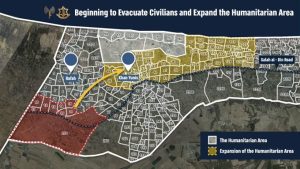
The Israel Defense Forces “will act with extreme force against terrorist organizations in your areas of residence,” a spokesman said on X on Monday morning. He urged residents of eastern Rafah to go north to an “expanded humanitarian area” near Khan Younis, another city in Gaza.
The move comes after cease-fire talks between Hamas and Israel in Cbbairo seemed to stall. Hamas also killed three Israeli soldiers with a rocket barrage on Sunday on the border crossing of Kerem Shalom. Kan News, Israel’s main broadcaster, said the IDF was preparing a ground operation in Rafa.
Israel forces is asking civilians in several Rafah areas to move out of the city, the military’s Arabic spokesman says on X.
Israeli Prime Minister Benjamin Netanyahu has for months said that civilians in Rafah would be moved out before any attack. There are roughly 1.4 million in the city, most of whom fled there after the outbreak of the Israel-Hamas war in October. It’s unclear how long it would take for the bulk of the civilians to leave. Israeli officials privately admit it could take weeks, while the US has expressed doubts that it can be done safely. Most Arab and many European states have said Israel should not attack Rafah, fearing it would cause a mass of casualties. Many civilians may choose to remain in Rafah if they’re unsure of the conditions where they’re going — Khan Younis, several miles from Rafah, has largely been destroyed since the war began on Oct. 7. Hamas, considered a terrorist organization by the US and European Union, may also prevent some of them from leaving.
Israel says Rafah is the last bastion of Hamas, with about 5,000 to 8,000 of its fighters and senior leaders lodged in the city, as well as many Israeli hostages.
The war erupted when Hamas attacked southern Israel from Gaza, killing 1,200 people and taking 250 hostage. Israel’s bombardment and ground attack on the Palestinian territory has killed almost 35,000 people, according to the Hamas-run health ministry.
Israel publishes evacuation map for Gazans
The Israeli Defense Forces (IDF) unveiled an evacuation map on Monday for Rafah residents. Disseminated through flyers, text messages, and phone calls, the map provided instructions to evacuate specific neighborhoods in the eastern neighborhoods of Rafah and not the entire city in southern Gaza.
The messages added that “in accordance with the approval of the government, an ongoing situation assessment will guide the gradual movement of civilians in the specified areas in eastern Rafah to the humanitarian area.”
As per the military’s statement, the expanded humanitarian zone encompassing the al-Mawasi and Khan Younis areas includes provisions such as field hospitals and tent camps for displaced Palestinians. Despite the closure of the Kerem Shalom Crossing, the military affirms its commitment to sustaining the distribution of humanitarian aid at its current level.