Israeli officials and Palestinian representatives refuted the earlier report by Al-Qahera News, which claimed “remarkable progress” in the ongoing ceasefire negotiations between the two parties in Cairo, as reported by local media on Monday. “We still don’t see a deal on the horizon … The distance [between the sides] is still great and there has been nothing dramatic so far,” Israeli news outlet Ynet reported, citing senior Israeli officials. Hezbollah-affiliated Al-Mayadeen news quoted a senior Palestinian official in Gaza expressing frustration with Israel’s “obstinance” and adds that “so far there is no progress.”
Fed’s Bowman sees higher rate ‘risk’ in the future
United States Federal Reserve Governor Michelle Bowman stated Friday that she still sees several “upside risks” and “uncertainties” related to the inflation levels for what she considers it is still not the time “where it is appropriate to lower the policy rate.” “While it is not my baseline outlook, I continue to see the risk that at a future meeting we may need to increase the policy rate further should progress on inflation stall or even reverse […] Reducing our policy rate too soon or too quickly could result in a rebound in inflation, requiring further future policy rate increases to return inflation to 2 percent over the longer run,” she said during a speech in New York. She added that “the level of the federal funds rate consistent with low and stable inflation” may end up being higher than before the pandemic. NN: rates are going up. So is inflation.
Iran Tells US to Step Aside as It Readies Response to Israel
Iran said it asked the US to “step aside” as the country prepares a response to a suspected Israeli attack on its consulate in Syria while Hezbollah, its main proxy in the Middle East, warned the Jewish state it’s prepared for war.In a written message to Washington, Iran “warned the US not to get dragged into Netanyahu’s trap,” Mohammad Jamshidi, the Iranian president’s deputy chief of staff for political affairs, wrote on X, referring to Israeli Prime Minister Benjamin Netanyahu. The US should “step aside so that you don’t get hit.”“In response, the US asked Iran not to hit American targets,” Jamshidi said.The US hasn’t commented on the alleged message Iran had sent. CNN reported that the US is on high alert and is preparing for a “significant” response from Iran against Israeli or American targets in the region. The network cited an unnamed US official. NBC, citing two unnamed US officials, said President Joe Biden’s administration is concerned any attack could be inside Israel, specifically against “military or intelligence targets, rather than civilians.” The Biden administration did take the unusual step of communicating directly to Iran that the US was unaware Monday’s strike in Damascus would happen, Bloomberg reported. That suggested the US was trying to prevent its own forces and bases in the Middle East being attacked. The Islamic Republic has said it will deliver a “slap” to Israel, its arch enemy. Still, it’s unclear when that would happen or whether Iran would try to attack Israel directly or through one of its proxy groups such as Hezbollah, based in Lebanon. The airstrike hit the Iranian consulate in Damascus, killing at least seven Iranians, including two generals. While Israel has repeatedly targeted Iran-linked assets in Syria over the past few months, this was the first time an attack struck an Iranian diplomatic building.Israel has been on alert since then, canceling home leave for combat troops, calling up reserves and bolstering air defenses. Its military scrambled navigational signals over Tel Aviv on Thursday to disrupt GPS-navigated drones or missiles that might be fired at the country. Hezbollah’s leader, Hassan Nasrallah, on Friday said a response from Iran is undoubtedly coming. But, he said, his group won’t “interfere in such decisions.” “And after that, how Israel will behave, the region would enter in a new phase,” Nasrallah said in a televised speech. Nasrallah, who lives in hiding, highlighted the coordinated work of Iran’s so-called resistance groups in the region.Hezbollah, the Middle East’s most powerful militia, said the group hasn’t used “its primary arsenal” in the daily skirmishes with Israel along the southern border of Lebanon since the start of the Israel-Hamas war on Oct. 7. Hezbollah is “completely prepared and ready” for any war with Israel, Nasrallah said. NN: Its a big b bet. I believe Iran is NOT ready for all out war.
Extreme Market Swings Dominate as Hot Economy, Oil Feed Anxiety
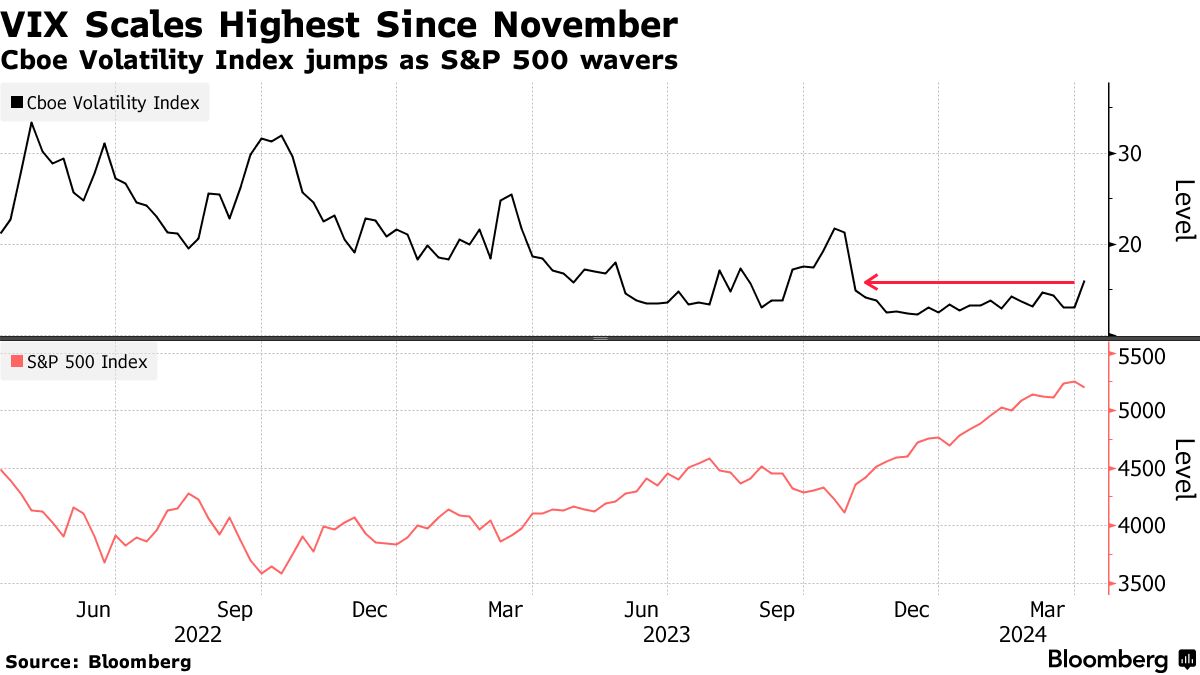
A steady march higher in markets was snapped by a stretch of jarring volatility as traders gave hints there’s a limit to their appetite for hot economic data. While a Friday rally in equities spared cross-asset investors their worst week since 2022, it capped a series of extreme market moves. Stocks and bonds staged their worst synchronized drop of the year on Monday and Tuesday, while Thursday saw the biggest reversal of an S&P 500 rally since August. An exchange-traded fund tracking long-dated Treasuries suffered its worst week since October as 10-year yields reached the highest in more than four months. Rather than recession anxiety, the culprit was robust reports on job openings and factory output — as well as a surge in oil — that raised doubts the Federal Reserve has room to cut interest rates anytime soon. An emerging issue for bulls is the impact of markets themselves on the economy, according to Torsten Slok, the Apollo Global Management economist who has repeatedly warned that gains in asset prices are working against central bankers’ goals. “The tailwind from easing financial conditions is overwhelming and neutralizing the rate hikes from last year,” Slok, who in March predicted no rate cuts this year, said in a phone interview. “It’s not surprising that the economy is re-accelerating and, therefore, rates will have to stay higher.” The broad rally across assets that has added $13 trillion in financial wealth since October looked shakier this week as inflation angst resurfaced, with Brent crude climbing above $90 a barrel. Another solid jobs report Friday on the heels of an unexpected expansion in manufacturing triggered a hawkish repricing in bonds. Traders are now pushing back bets on when the Fed will start cutting rates to September, paring odds for June or July.The ICE BofA MOVE Index, which tracks expected turbulence in US bonds via options on interest-rate swaps, bounced from a two-year low to snap a six-week slide. Subtle shifts in investor behavior appeared in the stock market, marking a switch after traders spent months buying the dip and piling in to bullish options. On Thursday, when the S&P 500 wiped out a 0.8% gain to end the session more than 1% lower, the Cboe Volatility Index, a gauge of options cost known as VIX, jumped to its highest since November. “Clearly, the market is getting anxious about what the Fed is going to do,” said Raphael Thuin, head of capital market strategies at Tikehau Capital. “The Goldilocks market that investors are hoping for may not be a reality.”
In the eyes of contrarians who have watched asset gains spread to risky corners from cryptocurrencies to meme stocks, a sweeping retreat is overdue. Bolstered by optimism that the Fed will be able to bring inflation toward its 2% target without snuffing out growth, $176 billion of fresh money was poured into fixed income and equity ETFs in the first quarter, more than doubled from a year ago, data compiled by Bloomberg Intelligence show.
And Citigroup Inc.’s Levkovich Index — which tracks reams of data from retail sentiment to options trading and fund positioning — recently entered euphoria territory for the first time in more than two years.
Stretched sentiment in and of itself may not be reason enough for equity gains to reverse. But as the bull camp gets crowded, weak hands can be quickly vanquished. Hedge funds, for instance, stepped up bearish wagers against individual stocks, with short selling rising at the fastest pace in six months, according to data from Goldman Sachs Inc.’s prime brokerage unit.
Adding to trepidation is a chorus of policymakers including Fed Chair Jerome Powell signaling that they are in no rush to lower interest rates. Most notable was Minneapolis Fed President Neel Kashkari, who — though not a voter on monetary policy this year — still managed to raise eyebrows by saying interest-rate cuts may not be needed this year at all if progress on inflation stalls. Dallas Fed President Lorie Logan on Friday said it’s too soon to consider cutting interest rates, citing recent high inflation readings. “This is definitely a ‘good is bad’ environment,” said Michael O’Rourke, chief market strategist at JonesTrading. “Although Chairman Powell said that recent hot inflation and economic data do not ‘materially change the overall picture,’ there is some change. Several more hot data points are likely to tip that balance and push rate cut expectations further out.”
Israeli intel services said to go to Cairo for hostage talks
Mossad Chief David Barnea, Shin Bet Director Ronen Bar, and Israel Defense Forces (IDF) negotiator amid the conflict between the country and Hamas, Nitzan Alon, will travel to Cairo this weekend to discuss hostage release and exchange with the group, The Times of Israel reported on Friday, citing a source familiar with the matter. The date of the visit has not been specified, however, it was said it will likely be on Saturday. Earlier, Axios reported that United States Central Intelligence Agency (CIA) Director Bill Burns will go to Cairo to attend the negotiations between Israel and Hamas, held with the help of Egyptian and Qatari mediators.
Oil Prices Set for a Second Weekly Gain After Brent Breaks $91
Crude oil prices were on track to book their second weekly gain in a row, driven higher by geopolitics and supply concerns. Early on Friday morning, Brent was trading above $91 per barrel and West Texas Intermediate was closing in on $87 per barrel. The rally came amid reports that Russia may have temporarily lost as much as 15% of its refining capacity because of Ukrainian drone attacks and Iran vowed to exact revenge on Israel for the strike of its consulate in Damascus .“Oil prices look set for further upside in the short term as a more positive economic backdrop is joined by ongoing supply tightness and rising geopolitical risks,” analysts from ANZ said, as quoted by Reuters, revising their three-month price forecast for Brent crude to $95 per barrel. The wider Mideast tensions stemming from the Gaza war are probably at the highest in months,” Vandana Hari, founder of Vanda Insights, told Bloomberg. “Crude is reflecting that Mideast conflagration fear premium.” The latest from the Middle East is the news that the UAE is growing cold to Israel after several years of normalized relations. The reason for the change in attitude was the Israeli strike that killed seven aid workers in Gaza. Some reports said the Emirates were “outraged” with the event. Demand for oil, meanwhile, remains quite healthy, with the latest U.S. weekly inventory report revealing declines in both gasoline and middle distillate stocks. This demand is set to rise further, especially in middle distillates as the manufacturing industry in the country gathers momentum, Reuters’ market analyst John Kemp wrote in a recent column. While this is happening, OPEC+ reaffirmed its commitment to production limits at its latest meeting earlier this week. Even though there were overproducers again, prices rose after the meeting because the group signaled it was about to get those overproducers in line, demanding compensation for their excess production.
NN AUDIO FILE
Take A Dep Breath

Biden urges Netanyahu to reach ‘immediate ceasefire’
United States President Joe Biden called on Israeli Prime Minister Benjamin Netanyahu to conclude a deal on a ceasefire in the Gaza Strip “without delay” during their telephone conversation on Thursday. “Immediate ceasefire is essential to stabilize and improve the humanitarian situation and protect innocent civilians,” the White House shared in the statement citing the president’s remarks in the call with the Israeli prime minister. Biden stressed that attacks on “humanitarian workers” and “the overall humanitarian situation” are “unacceptable,” urging Israel to take “concrete” steps to address “civilian harm, humanitarian suffering,” and the “safety of aid workers.” The US president emphasized that Washington’s policy on Gaza would be contingent upon its evaluation of Israel’s prompt implementation of these measures.
U.S. Gasoline Prices Hit Highest Level in Six Months
Rising seasonal demand and higher crude oil prices have resulted in the highest average U.S. gasoline prices in nearly six months, with the national average at $3.58 per gallon as of April 4. The national average hit a new multi-month high on Thursday morning, rising to $3.58 per gallon, the highest since October 14, Patrick De Haan, head of petroleum analysis at GasBuddy, noted. The national average is now 7.2 cents per gallon higher than at this time last year, De Haan added. The current average price of a gallon of regular gasoline is some 20 cents higher than the $3.352 average one month ago, according to data from AAA. At this time last year, the national average price was at $3.507 per gallon. The rise in prices this week follows a week of barely changed prices. After climbing for four straight weeks, the national average was unchanged on Monday compared to a week ago at $3.51 per gallon, GasBuddy’s De Haan wrote earlier this week. “While we seem to be nearing a short-term peak, one word of caution for those in the Mid-Atlantic and Northeast: you haven’t yet finished the transition to summer gasoline, so you may experience some sticker shock in a few weeks,” the analyst said. This week, WTI Crude prices topped $85 per barrel amid signs of tightening global crude supply. Moreover, demand continued to rise with the warmer weather and the Easter weekend. The EIA’s weekly report on Wednesday showed a draw in gasoline stocks, implying stronger demand. Gasoline inventories shed 4.3 million barrels in the week to March 29, with production averaging 10 million bpd. These figures compared with an inventory build of 1.3 million barrels for the previous week, when production stood at an average of 9.2 million barrels daily. Friday U.S. gasoline demand surged some 8.3% from the previous Friday. Week-to-date (Sun-Fri), U.S. gasoline demand was 1.7% above the previous week and 3.5% above the four-week average for the same range, De Haan said this weekend. NN: THE last thing Biden needs is inflation driving voter sentiment.
Israel: New terror attacks, Ben-Gvir murder prevented
Israel’s security agency Shin Bet announced on Thursday it prevented a terrorist cell from conducting a series of terror attacks across the country and the West Bank and assassinating National Security Minister Itamar Ben-Gvir. Shin Bet said in a statement the cell comprised four Palestinians and seven Israeli Arabs, who planned to create a weapon manufacturing facility in the south of the country and then contact Hamas’s leaders in the Gaza Strip for financial and strategic backing. The sites they intended to attack included various Israel Defense Forces (IDF) posts, David Ben-Gurion Airport, and governmental institutions in Jerusalem. Shin Bet added the suspects will be prosecuted at the Beersheba District Court in southern Israel.
US forces intercept anti-ship Houthi missile
The United States Central Command (CENTCOM) stated that its forces intercepted one inbound anti-ship ballistic missile (ASBM) along with two unmanned aerial systems (UAS) launched by the Yemen-based Houthis toward the USS Gravely (pictured) in the Red Sea. Additionally, US forces neutralized a mobile surface-to-air missile system in a Houthi-controlled area of Yemen, CENTCOM stated on Thursday. There were no injuries or damage reported by US vessels.
NN AUDIO NOTE
HOW MANY TIMES ARE THEY GOING TO FUCK UP