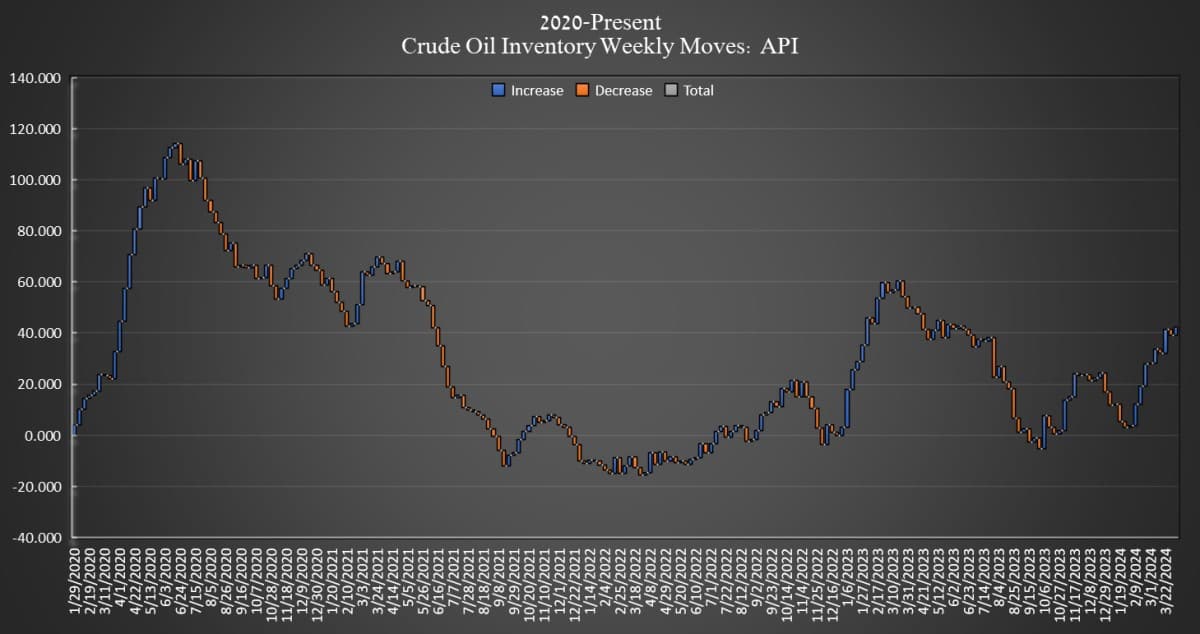
Crude oil inventories in the United States rose this week by 3.034 million barrels for the week ending April 5, according to The American Petroleum Institute (API). Analysts had expected an inventory build of 2.415 million barrels. On Tuesday, the Department of Energy (DoE) reported that crude oil inventories in the Strategic Petroleum Reserve (SPR) rose by another 0.6 million barrels as of April 5. Inventories are now at 364.2 million barrels—the highest point since last April.
Oil prices were trading down ahead of the API data release on Tuesday as ceasefire talks continue, with losses capped by the failure to make significant progress in reaching a deal that would end the conflict. At 4:13 pm ET, Brent crude was trading down 0.96% on the day at $89.51, although still up nearly $1 per barrel from this time last week. The U.S. benchmark WTI was also trading down on the day by 1.26% at $85.34, up roughly $.30 per barrel compared to last Tuesday. Gasoline inventories fell this week by 609,000 barrels, after falling 1.416 million barrels in the week prior. As of last week, gasoline inventories were about 3% below the five-year average for this time of year, according to the latest EIA data. Distillate inventories rose this week by 120,000 barrels, after last week’s 2.548-million-barrel loss. Distillates were 7% below the five-year average for the week ending March 29, the latest EIA data shows. Cushing inventories saw a build this week, rising 124,000 barrels after falling by 781,000 barrels in the previous week. NN: Its all about OPEC production cuts. They can not stand much more pain.
Hamas is said to be rejecting Israel’s demand to free 40 hostages as part of a potential ceasefire agreement, Israeli public broadcaster Kan reported. According to the report, Hamas is refusing to release any male soldiers and claims it does not have 40 living elderly or female hostages remaining. On the other hand, Israeli officials insist the Palestinian group does have 40 hostages who meet the required criteria. Meanwhile, a report by Haaretz said that some Israeli cabinet ministers would likely oppose any ceasefire deal that does not include the release of all hostages held by Hamas as they believe such an agreement would give a signal to Hamas that Israel is willing to make big concessions in talks.
Biden says Netanyahu making ‘mistake’ in Gaza
United States President Joe Biden said that he considers Israeli Prime Minister Benjamin Netanyahu’s handling of the war between Israel and Hamas a “mistake,” NBC News reported. “I think what he’s doing is a mistake. I don’t agree with his approach,” Biden said, referring to Netanyahu’s approach to the conflict, during an interview with Univision that aired late Tuesday. Reiterating his previous statement on the Israeli strike that killed seven aid workers in central Gaza, he called the incident “outrageous,” sharing that Israel should “just call for a ceasefire, allow for the next six, eight weeks, total access to all food and medicine going into the country.” “There’s no excuse to not provide for the medical and the food needs of those people. It should be done now,” Biden stressed, adding that he spoke with Saudi Arabia, Jordan and Egypt who are “prepared to move this food in.”
IA Director Bill Burns presented a new proposal to try to bridge the gaps in ongoing negotiations to broker a deal to bring about a ceasefire in the war between Israel and Hamas in Gaza and the release of the Israeli hostages held by the group, according to a source familiar with the discussions. The latest US proposal was made in Cairo over the weekend and includes pushing Israel to release a higher number of Palestinian prisoners in exchange for the expected 40 Israeli hostages who would be freed during the first phase of a three-stage ceasefire deal. A second source, a diplomat, said the US proposal is for Israel to release 900 Palestinian prisoners in the first phase of a deal. Prior to this round of talks, CNN had reported that negotiators had discussed the release of around 700 Palestinian prisoners, including many with life sentences. Qatari, Egyptian and Israeli officials, along with Burns, were in Cairo over the weekend for the negotiations. Hamas also met officials from Egypt’s Intelligence Service in Cairo, Egyptian state media said. The US would also like Palestinian residents of northern Gaza who have fled south to be allowed to return home to the north without restrictions, the source said. So far, Israel has rejected the Hamas demands of an unrestricted return of Gazans to the north and the redeployment of IDF troops away from central Gaza. Israel has insisted on inspections of Palestinians moving north, a diplomat familiar with the talks told CNN.
On those two thorny points the sides are still “way off,” the diplomat said. “We’re not anticipating resolving these issues in the next couple of days.”
Earlier on Monday, Al Jazeera reported that the latest proposal put to Israel and Hamas included the release of 900 Palestinian prisoners. Everyone agreed to study the new US proposal, the first source said, and it will be communicated to Hamas leadership in Gaza which ultimately makes the decisions for the group. Given the difficulties of communicating with Hamas leaders who are believed to be hiding in Gaza’s vast underground tunnel system, getting a response can take several days. A senior Hamas official speaking to CNN said the group will return to Cairo “as soon as the opportunity presents itself,” but could not place a firm timeframe on when that would happen. The official added that the latest proposals presented by Israel during the talks in Egypt did not address the unrestricted movement of Palestinians in the south to the north – a key demand for the group. “The [Israeli] proposal does not respond to the questions that [Hamas] has asked in its original proposal, and that is that any agreement should clearly include a ceasefire, a complete withdrawal of [Israeli] troops – even if it happens through stages – and the return of the displaced in complete freedom to their homes,” the official told CNN.
Israeli negotiators have shown a willingness in recent weeks to negotiate the return of Palestinians to northern Gaza but have continued to insist on some degree of security oversight by Israeli forces along the so-called Netzarim corridor which cuts across the middle of Gaza and a limited number of people moving north per day.
Mediators have been trying for months to seal an agreement between Hamas and Israel for a ceasefire and the release of hostages. But the prolonged negotiation has been marred by disagreements. On Monday, Israeli Prime Minister Benjamin Netanyahu said he’d been updated on the negotiations but underlined his determination to send troops into Rafah, saying he’d set a date for the operation in a video released on his Telegram account. The US has set out its opposition to such a move. “Today I received a detailed report on the talks in Cairo. We are constantly working to achieve our goals, primarily the release of all our hostages and achieving a complete victory over Hamas. This victory requires entry into Rafah and the elimination of the terrorist battalions there. It will happen, there is a date,” Netanyahu said.
Earlier, a Qatari representative voiced optimism about the state of the talks.
“We are by no means at the last stretch of these talks, but if you ask me if I am more optimistic today than I was a couple of days ago, then I would say yes,” Qatar’s foreign ministry’s spokesperson Majed Al-Ansari told the BBC. Ansari said mediators are waiting for replies from Hamas and Israel over proposals from different parties, including the United States. “I can’t go into the details of these proposals, but I can tell you it bridges the gap in a way that hasn’t been done in the last couple of months,” Ansari said.
Oil prices retreated at the start of the week on signs that there is a possibility of a ceasefire between Hamas and Israel. “It appears the catalyst is Israel saying it has withdrawn all troops except one brigade from the Southern Gaza strip, likely in response to growing international pressure and to deescalate tensions after it killed senior Iranian commanders in Syria last week,” IG analyst Tony Sycamore told Reuters. The Iranian response to the Israeli strike on Tehran’s consulate in Damascus, however, is still a factor for prices, and a bullish one, at that, after President Ebrahim Raisi vowed there would be revenge. Fundamental factors are also very much still in play, with one Mizuho Bank analyst telling Bloomberg that geopolitical developments have only served to highlight the tight supply situation in oil markets. “Oil’s upside volatility remains very much present, and that’s to a large part thanks to geopolitics amplifying supply shortfalls elsewhere,” Vishnu Varathan said. The price decline also comes in anticipation of three closely watched reports about the state of the global oil market coming out this week. The Energy Information Administration’s Short-Term Energy Outlook is first, due out on Tuesday. Then comes OPEC’s latest Monthly Oil Market Report, scheduled for Thursday, and the International Energy Agency’s Oil Market Report a day later. The latter two reports will probably attract the most attention due to their growing divergence that led to vocal criticism of the IEA by senior OPEC figures. They accused the agency of betraying its original purpose and turning into a “cheerleader” for the energy transition as a group of U.S. Republican lawmakers called it.
Partial troop withdrawal may be signal to Hamas on deal
Far-right coalition partners express alarm and threats
Partial troop withdrawal may be signal to Hamas on deal
Far-right coalition partners express alarm and threats
Senior Israeli officials said progress has been made in negotiations for a cease-fire in Gaza that would include the release of hostages and Palestinian prisoners. Hamas, designated a terrorist organization by the US and European Union, said on Monday there’d been no progress in the talks.
Israel reportedly ready to strike Iran if attacked
Israel stands prepared to retaliate against Iran by targeting sites within the country if it is attacked as a response to the recent strike on the Iranian consulate in Damascus, the London-based Elaph News reported on Tuesday, citing a “Western security official.”
Furthermore, the media stated that Israel has been conducting air force exercises in recent days, focusing on preparing to strike Iranian nuclear facilities and other critical infrastructure.
While Syria and Iran hold Israel responsible for the strike that resulted in the deaths of seven officials from the Islamic Revolutionary Guard Corps (IRGC), Israel has not confirmed its involvement in the attack.
White House National Security Communications Advisor John Kirby announced on Monday that a proposal for the hostage release with Israel has been presented to Hamas and that the parties involved are now waiting for the group’s response. Speaking to reporters, Kirby confirmed that Central Intelligence Agency (CIA) Director William Burns was a member of the US’s delegation on the negotiations in Cairo. Furthermore, he insisted that Washington found “no signs” Israel is planning an “imminent” and “major ground operation” in Rafah. Earlier in the day, Qatar, one of the mediators in the talks, expressed optimism about Israel and Hamas reaching a new deal.
The United States Department of State’s spokesman Matthew Miller said on Monday that Washington was not briefed about Israel’s plan to launch a ground operation in the Gazan city of Rafah and voiced his country’s stance against it. “We have made clear to Israel that we think a full-scale military invasion of Rafah would have an enormously harmful effect on those civilians and that it would ultimately hurt Israel’s security,” Miller said at a press conference. “We have made clear to them that we think that there is a better way to achieve what is a legitimate goal, which is to degrade and dismantle and defeat the Hamas battalions that still remain in Rafah.” Miller’s comments came after Israeli Prime Minister Benjamin Netanyahu announced a date for the ground operation in Rafah has been determined.
Israeli Defense Minister Yoav Gallant emphasized on Monday that he sees Israel “at an opportune moment” to negotiate a hostage agreement with Hamas and “bring our captives back home.” During a speech addressed to new soldiers, Gallant stated that the recent conflict in Gaza has “enabled us to be flexible, to act freely and to make difficult decisions in order to bring back the abductees. I believe we are at an opportune moment, but there’s another side that must agree to it.” On the same matter, Israeli Foreign Minister Israel Katz told Army Radio that the parties “have reached a critical point in the negotiations. If it works out, then a large number of hostages will come home.”
CAIRO (Reuters) – A Hamas official told Reuters on Monday that no progress was made at a new round of Gaza ceasefire talks in Cairo also attended by delegations from Israel, Qatar and the United States.
“There is no change in the position of the occupation and therefore, there is nothing new in the Cairo talks,” the Hamas official, who asked not to be named, told Reuters. “There is no progress yet,” he added.
Earlier on Monday, Egypt’s state-affiliated Al-Qahera News TV channel quoted a senior Egyptian source as saying progress had been made in the talks, after a deal was reached among participating delegations on issues under discussion.
Israel and Hamas sent teams to Egypt on Sunday after the arrival on Saturday of CIA Director William Burns, whose presence underlined U.S. pressure for a deal that would free hostages held in Gaza and ease the humanitarian crisis there. Israel and Hamas, at war in the Gaza Strip since October, have failed so far to resolve disagreements over their main demands. Hamas wants an end to Israel’s offensive and a full Israeli withdrawal from the shattered territory, while Israel wants a deal to free hostages from Gaza in exchange for a number of Palestinians in its jails without a commitment to end the war.
Israel to reportedly know proposal feasibility by Tuesday
The Israeli party involved in negotiations with Hamas for a ceasefire and hostage exchange will know the feasibility of progressing with the new proposal by Tuesday evening, Sky News Arabia reported on Monday. “Washington and Cairo put forward a new proposal that includes signals related to the return of Gaza residents to the northern Gaza Strip,” the media added. This aspect is one of the key points emphasized by Hamas in the agreement. In response to this development, Israeli Finance Minister Bezalel Smotrich urged Prime Minister Benjamin Netanyahu to convene an urgent expanded government meeting. NN: Obviously talks are at a critical stage. The global pressure is intense. I believe a deal is close.
Oil prices retreated at the start of the week on signs that there is a possibility of a ceasefire between Hamas and Israel .Benchmarks began the week shedding some $1 per barrel, which pushed Brent crude below $90 and West Texas Intermediate below $86, after Israel moved some troops out of Gaza during the weekend. “It appears the catalyst is Israel saying it has withdrawn all troops except one brigade from the Southern Gaza strip, likely in response to growing international pressure and to deescalate tensions after it killed senior Iranian commanders in Syria last week,” IG analyst Tony Sycamore told Reuters. The Iranian response to the Israeli strike on Tehran’s consulate in Damascus, however, is still a factor for prices, and a bullish one, at that, after President Ebrahim Raisi vowed there would be revenge. Fundamental factors are also very much still in play, with one Mizuho Bank analyst telling Bloomberg that geopolitical developments have only served to highlight the tight supply situation in oil markets.
“Oil’s upside volatility remains very much present, and that’s to a large part thanks to geopolitics amplifying supply shortfalls elsewhere,” Vishnu Varathan said.
The price decline also comes in anticipation of three closely watched reports about the state of the global oil market coming out this week. The Energy Information Administration’s Short-Term Energy Outlook is first, due out on Tuesday. Then comes OPEC’s latest Monthly Oil Market Report, scheduled for Thursday, and the International Energy Agency’s Oil Market Report a day later. The latter two reports will probably attract the most attention due to their growing divergence that led to vocal criticism of the IEA by senior OPEC figures. They accused the agency of betraying its original purpose and turning into a “cheerleader” for the energy transition as a group of U.S. Republican lawmakers called it.