UBS agrees to buy Credit Suisse for more than $2 billion, Financial Times reports….. They dodged another bullet for now!

It’s a DONE DEAL

March 19 (Reuters) – UBS (UBSG.S) has agreed to buy Swiss banking giant Credit Suisse (CSGN.S) after increasing its offer to more than $2 billion, the Financial Times reported on Sunday, as authorities bid to stave off turmoil when the markets reopen.Officials have been racing to rescue the 167-year-old bank, among the world’s largest wealth managers, after a brutal week that saw the second- and third-largest U.S. bank failures in history. As one of 30 global banks seen as systemically important, any deal for Credit Suisse could ripple through global financial markets. At least two major banks in Europe are examining scenarios of contagion possibly spreading in the region’s banking sector and looking to the Federal Reserve and the European Central Bank to step in with stronger signals of support, two senior executives with knowledge of the discussions told Reuters. A person with knowledge of the talks earlier told Reuters that UBS sought $6 billion from the Swiss government as part of a possible purchase of its rival. The guarantees would cover the cost of winding down parts of Credit Suisse and potential litigation charges. NN: As the markets digest this deal I believe the depression is now fears come out  of the oil markets.. They did the deal just in time for Sunday Dibber…… No need to be savages!

UBS Offers to Buy Credit Suisse for up to $1 Billion: FT

UBS Group AG is offering to buy Credit Suisse Group AG for up to $1 billion in an all share deal to take over the stricken lender, according to the Financial Times.  Swiss authorities plan to change the country’s laws to bypass a shareholder vote on the transaction as they rush to finalize a deal before Monday, the newspaper reported on Sunday, citing four people with direct knowledge of the situation.   The offer was communicated on Sunday morning with a price of 0.25 francs a share to be paid in UBS stock, according to the report. UBS has also insisted on a material adverse change that voids the deal if its credit default spreads jump by 100 basis points or more, the people said. Credit Suisse closed down 8% to 1.86 francs at the close on Friday. A government-brokered deal would address a rout in Credit Suisse that sent shock waves across the global financial system over the past week when panicked investors dumped its shares and bonds following the collapse of several smaller US lenders. A liquidity backstop by the Swiss central bank briefly arrested the declines, but the market drama carries the risk that clients or counterparties would continue fleeing, with potential ramifications for the broader industry. The complex discussions over what would be the first combination of two global systemically important banks since the financial crisis have seen Swiss and US authorities weigh in, according to people with knowledge of the matter. Talks accelerated Saturday, with all sides pushing for a solution that can be executed quickly after a week that saw clients pull money and counterparties step back from some dealings with Credit Suisse. The two banks have had limited contact, with terms heavily influenced by the Swiss National Bank and regulator Finma, the Financial Times reported. The situation is very fast moving and there’s no guarantee a deal will be reached or that the terms will remain the same, the newspaper reported. The government is preparing emergency measures to allow the takeover to proceed at pace and plans to introduce legislation that will bypass the normal six-week consultation period required for UBS shareholders, the newspaper reported. NN: Sunday rumors are a deal is very very close. If the  problem child banks are saved the markets will breath a sigh of relief. Next its the FED on tap….. Tuesday

Credit Suisse shares tumble – sending US and Europe markets and Oil into red Crunch time for Credit Suisse talks as UBS seeks Swiss assurances

Shares in crisis-hit Credit Suisse have fallen as much as 12pc on Friday afternoon as concerns continued to swirl about the lender’s future. The Zurich-listed bank’s stock led a broader decline in European markets, as analysts continued to warn of a “crisis of confidence” in a turnaround plan laid out by bosses. Credit Suisse was plunged into crisis this week as bets that the bank would default on its debts hit a record high, following the collapse of Silicon Valley Bank and two other smaller US lenders over the weekend.  On Thursday, Switzerland’s central bank stepped in to make £44.5bn available to the troubled business in a bid to stabilise the situation.  That initially appeared to have eased concerns, with shares rebounding, but they remained lower than before and have sunk lower today. Its US-listed shares tumbled 8pc shortly after the opening bell on the New York Stock Exchange, and it is down about 10pc in trading in Zurich. Investor concerns centre on the viability of a plan to spin off Credit Suisse’s investment banking division to focus on its domestic and wealth management operations.

Some analysts have suggested the situation can only be resolved through a takeover by Credit Suisse’s arch-rival, UBS.

As the bank’s shares continued to slide, stock indexes across Europe slipped into the red, with the continent-wide Stoxx 600 down 0.4pc, London’s FTSE 100 down 0.6pc and the CAC 40 in Paris down 0.4pc.

the 100 year event has officially begun

China’s domestic car sales jump 37.3% in February

Sales of Chinese-brand cars on the domestic market soared 37.3% in February compared to the same month in 2022, according to data from the China Association of Automobile Manufacturers. 873,000 passenger vehicles made by Chinese manufacturers were sold in China last month. The domestic market share of Chinese-brand vehicles increased by 52.8%, representing a rise of 10.1 percentage points year-on-year. For the first two months of 2023, domestic brand cars sold in China amounted to 1.63 million, representing a market share of 52.3%. Vehicle production is up 11.9% for the month to 2,032,000 and down -14.5% year-to-date to 3,626,000. Despite the end of the national NEV purchase subsidies, a slew of regional policies favouring NEV has triggered very strong NEV sales in February at +59.9% year-on-year to 525,000 units. This represents 26.6% of the PV market, up from 24.7% in January. In contrast, ICE PV sales drop -9.8% to 964,000. NEV production is up 48.8% to 552,000. Sales of Chinese-brands PV soar 37.3% year-on-year to 873,000 and 52.8% share, an exceptional improvement on the 42.6% of February 2022. Exports surge 82.2% year-on-year to 329,000 units including 271,000 Passenger Vehicles (+85.8%). 87,000 NEV were exported (+79.5%). Year-to-date exports are up 52.9% to 630,000.  NN: China has turned the lights back on. Its the heart of the binary oil trade. All those factories and cars and people run on energy…

Oil Prices Set For A Quick Comeback……. Energy is oversold and tech is being overbought

  • WTI crude fell from $80.46 per barrel just 10 days ago to the $67 range.
  • Whereas the U.S. government has ruled out a bailout for SVB, its Swiss peer, Credit Suisse, has been more lucky.
  • Energy markets could quickly recover after the dust settles. 

The energy markets are going through one of their worst selloffs in recent times as fears of a new global crisis continue to roil financial markets. Oil prices have crashed spectacularly, with WTI crude falling from $80.46 per barrel just 10 days ago to the $65 range, while Brent has declined from $86.18 per barrel to the $71 range. Oil prices are now trading at levels they last touched in December 2021. “The oil market is going to be stuck in a surplus for most of the first half of the year, NB: The first half of the year is over in two months,,,, then look out! but that should change as long as we don’t see a major policy mistake by the Fed that triggers a severe recession. Now near the mid-$60s, WTI crude’s plunge is at the mercy of how much worse the macro picture gets,” Ed Moya, senior market analyst at Oanda.

According to Moya, a retest of October’s lows is likely to add increased downward pressure on WTI crude, meaning energy stocks could struggle given the surplus and weakening demand outlook likely to persist in the short-term. The energy sector has been badly hammered amid the banking saga, with energy stocks suffering the largest decline among the S&P’s 11 industry sectors on Wednesday.

The bigger question here is whether the recent spate of bank failures and crises, including the sudden collapse of Silicon Valley Bank and liquidity crisis at banking giant Credit Suisse, can be written off as “idiosyncratic” events or mark the unfolding of another global financial crisis. The good news: at this juncture, the banking outlook is actually good.

The sudden collapse of Silicon Valley Bank  (NB: what you need to understand their were no bad loans. The village people did not know how to manage interest rate risks….. Namely how to hedge their government bond portfolio bought at the lowest yields ever…. incompetence under the rainbow flag).has sent shockwaves through the entire financial sector and marked the biggest bank failure since the 2008 financial crisis. Being the only publicly traded bank focused on Silicon Valley and startups for four decades, the swift collapse has particularly rattled the venture capital community and left climate tech startups in a crisis. SVB’s website says it has committed $3.2 billion to innovation projects in clean energy, was leading or participating in 62% of financing in U.S. developments and had more than 1,550 customers in the broader climate technology and sustainability sector. BloombergNEF has estimated that between 2020 and 2022, SVB financed ~$357 million of residential solar, excluding community solar, by no means an insignificant amount. SVB’s demise is, therefore, going to be keenly felt by the clean energy sector. But the good news is that whereas the U.S. government has ruled out a bailout for SVB, its Swiss peer has been more lucky after the troubled lender was offered a lifeline after the Swiss National Bank agreed to loan the struggling lender up to 50B francs ($54B). The bank also announced public tender offers by Credit Suisse International to repurchase certain OpCo senior debt securities for cash of up to ~3B francs. Previously, the Saudi National Bank, which owns almost 10% of Credit Suisse, declared that it would not provide further support to the group, days after the bank disclosed ‘material weakness’ in its financial statements just weeks after reporting a net loss of £6.6 billion for FY 2022. Credit Suisse shares tanked more than 30% to 1.55 francs ($1.68B) on Wednesday after its top shareholder ruled out offering further financial assistance amid growing concerns over its liquidity. The bank desperately tried to calm panicking depositors and shareholders but its five-year credit default swaps, which gauge the cost of insuring against its bonds, still soared to a record high. Luckily, the latest deal has helped the shares pare back losses and climb by a similar margin on Thursday’s session.  As a Global Systemically Important Bank, the plight of Credit Suisse has been a much bigger concern for the global markets due to the sheer scale of its balance sheet and the much bigger potential for contagion from the bank’s global reach. But the fact that shares of Credit Suisse and those of European banks have recovered swiftly suggests that the markets do not view the banking crisis as being systemic or likely to unravel on a wider scale.  Indeed, the U.S. financial sector’s popular benchmark, the Financial Select Sector SPDR Fund (XLF), has declined less than 1% over the past five trading sessions, suggesting that there’s no real crisis of confidence and the markets are not too worried about the potential of another financial crisis on the scale of the 2008 crash. As UBS Wealth chief investment officer Mark Haefele has said, the swift action by the FDIC to guarantee deposits and by the Fed to lend to banks that require funds will solve liquidity-related risks for U.S. banks and also for the U.S. branches of foreign banks.Early Wednesday was another rout for mid-cap regional banks stocks, but then reports emerged that big banks would come to their aid. At around 12:00 p.m. EST on Wednesday, regional bank stocks started to rally, recouping a fair amount of losses from earlier in the day. The SPDR® S&P Regional Banking ETF (NYSE:KRE) turned positive, climbing 0.2%. That suggests that energy markets could quickly recover after the dust settles. BlackMask Blog:

Take a deep breath and chill
Banks Borrow $164.8 Billion From Fed in Rush to Backstop Liquidity

  • Discount-window borrowing surged to record $152.85 billion
  • New facility usage totaled $11.9 billion in first three days

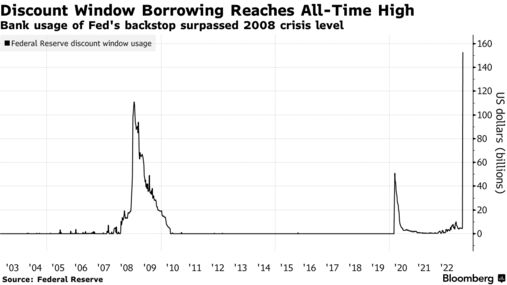
Banks borrowed a combined $164.8 billion from two Federal Reserve backstop facilities in the most recent week, a sign of escalated funding strains in the aftermath of Silicon Valley Bank’s failure. Data published by the Fed showed $152.85 billion in borrowing from the discount window  — the traditional liquidity backstop for banks — in the week ended March 15, a record high, up from $4.58 billion the previous week. The prior all-time high was $111 billion reached during the 2008 financial crisis.

Discount Window Borrowing Reaches All-Time High | Bank usage of Fed's backstop surpassed 2008 crisis level

The data also showed $11.9 billion in borrowing from the Fed’s new emergency backstop known as the Bank Term Funding Program, which was launched Sunday.  Taken together, the credit extended through the two backstops show a banking system that is still fragile and dealing with deposit migration in the wake of the failure of Silicon Valley Bank of California and Signature Bank of New York last week.  Other credit extensions totaled $142.8 billion during the week, which reflects lending by the Federal Deposit Insurance Corp. to bridge banks for SVB and Signature Bank. On the other side, EPFR Global data cited by Bank of America Corp. showed money-market funds attracted $113 billion of inflows, the most since April 2020, while Treasuries drew the biggest inflows since May 2022 with $9.8 billion in the week through March 15.  All told, the emergency loans reversed around half of the balance-sheet shrinkage that the Fed has achieved since it began so-called quantitative tightening — allowing its portfolio of assets to run down — in June last year.

And the central bank’s reserve balances jumped by some $440 billion in a week — which “basically reversed all the Fed’s QT efforts,” according to Capital Economics. 

“It is about in line with what we expected,” said Michael Gapen, head of US economics for Bank of America Securities in New York. Gapen said the higher rates of discount-window borrowing over the new Bank Term Funding facility may reflect the broader set of collateral that banks are able to pledge at the window. On Thursday afternoon, the nation’s biggest banks agreed upon a plan to deposit about $30 billion with First Republic Bank in an effort orchestrated by the US government to stabilize the battered California lender.

Fed’s Emergency Lending Reverses Months of QT

Source: Federal Reserve

Oil’s Tumble to 15-Month Low Accelerated by Algos, Options Moves…….. Crude Oil Inventories Build But Products Take A Tumble……. Significant Bottom in oil!?!

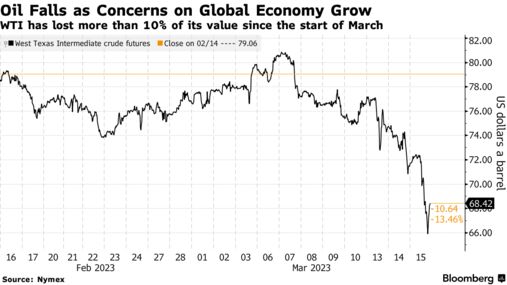
Oil closed at a 15-month low as a wave of technical selling and options covering accelerated a three-day slide. The US benchmark plunged more than 5% Tuesday, plagued by banking-sector turmoil that’s eroding oil-demand optimism. Adding to the chaos, financial firms trying to limit their exposure to falling prices in the options market began dumping crude futures in a strategy known as delta hedging.  West Texas Intermediate crude has lost 10% of its value in March, prompting analysts to wonder how far prices must fall before OPEC+ adjusts output quotas. While the cartel has said it’ll keep production unchanged this year, headwinds are bearish: US crude stockpiles are expanding again, Russian exports remain resilient in the face of sanctions and the International Energy Agency expects a surplus in the first half of the year.

Oil Falls as Concerns on Global Economy Grow | WTI has lost more than 10% of its value since the start of March

“The path of least resistance is clearly to the downside for oil,” Fawad Razaqzada, a market analyst at StoneX, said in a note. As long as oil prices stay below $70 a barrel, he added, “the sellers will remain in control.” Until recently, oil was stuck in a $10 range with traders balancing aggressive monetary tightening with optimism around China’s demand recovery.

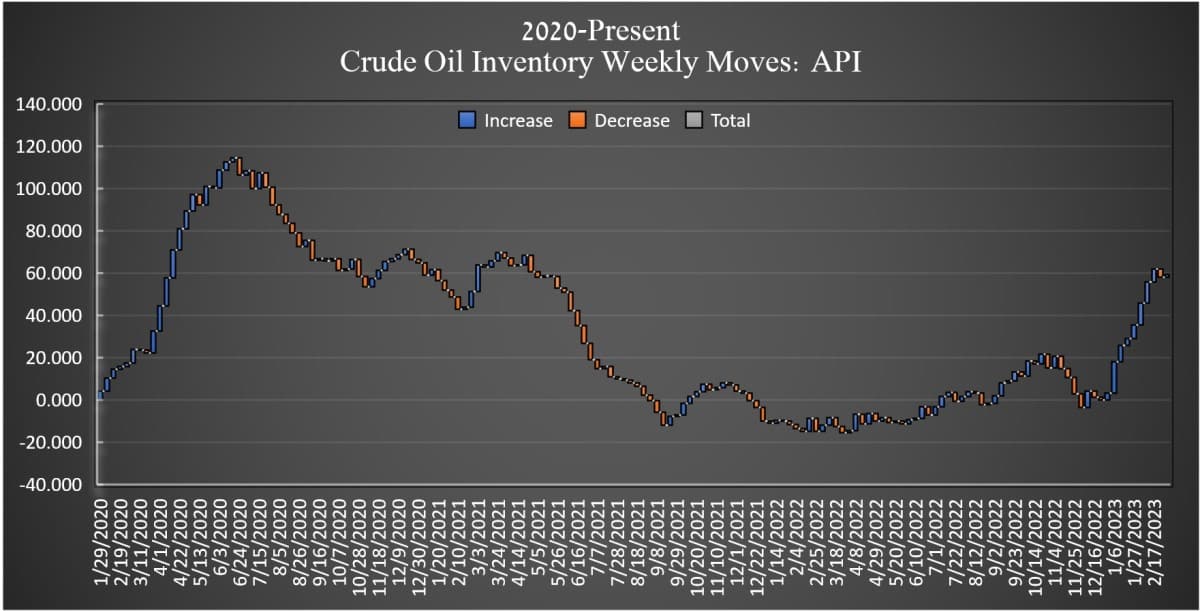
Crude Oil Inventories Build But Products Take A Tumble

Crude oil inventories in the United States rose this week, with a 1.155 million barrel build, the American Petroleum Institute (API) data showed on Tuesday, bringing the total number of barrels gained so far this year to more than 56 million barrels. NB: Biden has released 260 million barrels from the strategic stock pile. This week, SPR inventory held steady for the ninth week in a row at 371.6 million barrels—the lowest amount of crude oil in the SPR since December 1983. Oil prices traded down on Tuesday in the run-up to the data release, with the collapse of Silicon Valley Bank spooking the markets. At 2:25 p.m. EST, WTI was trading down $2.90 (-3.88%) on the day to $71.90 per barrel, a dip of nearly $6 per barrel on the week. Brent crude was trading down $2.89 (-3.58%) on the day at $77.88—down roughly $5.50 per barrel from this same time last week. It is the lowest price this year.

U.S. crude oil production fell to 12.2 million bpd for week ending March 3. U.S. production is now 900,000 bpd lower than the peak production seen in March 2020.

While crude oil saw a build, it was the only build this week, with product inventories falling.

Gasoline inventories fell by 4.587 million barrels after last week’s data showed the fuel inventories rose by 1.840 million barrels. Distillates fell by 2.886 million barrels after increasing by 1.927 million bpd in the week prior. Inventories at Cushing, Oklahoma, decreased by 946,000 barrels more than undoing the 24,000 barrel hike reported last week. Refineries operated at 88.2% of their capacity. BlackMask Pod Cast:

Fucked By Algoes… Lets Fuck them Back

\

Russia Expects Its Oil And Natural Gas Production To Drop In 2023

Russia expects its oil and gas production to fall this year compared to 2022, partly due to the production cuts announced for March, Russian Energy Minister Nikolai Shulginov told lawmakers on Wednesday.  “For 2023, we expect oil production levels to be slightly lower, also because of the voluntary reduction in output,” Shulginov was quoted as saying by Russian news agency Interfax “Gas production volumes will continue to decline both due to the abandonment of the European market and the timing of the re-routing of energy flows to the East,” the Russian energy minister added. Russian Deputy Prime Minister Alexander Novak said  that Russia, a member of OPEC+, would voluntarily cut its oil production by 500,000 bpd in March as a result of the Western sanctions and the price cap on Russian oil.   Russia’s decision to reduce its oil production this month will help balance the global oil market, which is in a surplus now, Alexander Dyukov, chief executive of Russian oil company Gazprom Neft, said later in February. The Russian production cut could be “a sign that Moscow may be struggling to place all of its barrels,” or “may be an attempt to shore up oil prices,” the International Energy Agency (IEA) said in its Oil Market Report for February.  In the report for March published today, the IEA said, “It remains to be seen if there will be sufficient appetite for Russian oil products now that the price cap is in place or if its production will start to fall under the weight of sanctions.” “Revenues are already dwindling,” the agency noted. The Kremlin does not and will not recognize any price cap on its oil, Kremlin spokesman Dmitry Peskov said last week. Earlier in the week, U.S. Energy Envoy Amos Hochstein had said that the price cap on Russia’s crude oil and oil products was working well.

Saudi Energy Minister: OPEC+ Will Stick To Cuts Through 2023……. S. Arabia will not sell oil to nations imposing price caps

The OPEC+ group will keep its oil production targets unchanged until the end of the year in view of the high level of uncertainty on the global markets and with global economic growth, Saudi Arabia’s Energy Minister, Prince Abdulaziz bin Salman, told Energy Intelligence in an interview this week.   “There are those who continue to think that we would adjust the agreement before the end of year. For those I say they need to wait until Friday, Dec. 29, 2023 to demonstrate to them our commitment to the current agreement,” the energy minister of OPEC’s top producer and the world’s largest crude oil exporter told Energy Intelligence.   Last October, the OPEC+ alliance decided to cut their collective production quota by 2 million barrels per day (bpd), although the actual cut is estimated at around half of that volume, due to many members of the pact under-producing compared to their targets. Many bullish and bearish factors are currently at play in the oil market, influencing sentiment, the Saudi energy minister told Energy Intelligence in the interview. China’s recovery is underway, but there is uncertainty about how long it would take. The global economy will grow, although the pace of growth is uncertain, Prince Abdulaziz bin Salman said.  “The interplay of these and other factors limits clarity, and the sensible and only course of action in such an uncertain environment is to maintain the agreement we struck last October for the rest of this year and that is what we intend to do,” he said. “We need to ascertain that the positive indicators are sustainable.” China’s reopening is set to add momentum to global economic growth, OPEC said in its Monthly Oil Market Report (MOMR) this week, and revised up its forecast for Chinese oil demand growth this year.  “In the emerging economies, China’s reopening, following the lifting of the strict zero-COVID-19 policy, will add considerable momentum to global economic growth,” OPEC said in the report.

S. Arabia will not sell oil to nations imposing price caps

Saudi Arabian Energy Minister Abdulaziz bin Salman Al-Saud (pictured) stated on Tuesday that the Gulf country will not deliver its oil to states that introduce price limits. Addressing a hypothetical situation where a price cap was imposed on Saudi oil, the minister assessed that Riyadh will not sell oil to any country that imposes a price cap on the country’s supply, and will reduce oil production instead. He concluded that he expects other nations to act in the same way, stressing that price caps on any commodity lead to “counter-responses with intolerable consequences in the form of massive volatility and instability.”

Carl Icahn says our economy is breaking because of inflation and poor corporate leadership

Famed investor Carl Icahn believes the U.S. economy is in trouble because of poor corporate leadership and stubbornly high inflation. “The system is breaking down, and we absolutely have a major problem in our economy today,” Icahn said “One of the worst countries in the world as far as corporate governance.”

Carl Icahn: “Our System Is Breaking Down”

Billionaire investor Carl Icahn says the collapse of Silicon Valley Bank and others shows that the U.S. issues ‘too much capital,’ and too much money causes inflation. “our system is breaking down,” noting that “we absolutely have a major problem in our economy today.” While refraining from opining on bank bail outs or not, Icahn “you can’t have the country feeling that it doesn’t matter if they save, it doesn’t matter, because they could spend all the money they want.” Icahn says one major reason for the break down is “that you don’t have good corporate leadership.” That’s a problem, Icahn says. “If you don’t have good corporate leadership, companies, you know, when the tide is high, and things are great, it doesn’t matter, and all these guys that are running these companies are partying and having a good time and giving themselves bonuses.” Icahn also revealed why he and Warren Buffet do so well. “Because we go into companies and clean them up. There’s so much to clean up and it’s getting much worse now. One of the worst countries in the world as far as corporate governance goes, and I can go on and on about that.”