SINGAPORE, Feb 6 (Reuters) – Oil prices inched up on Monday after falling 8% last week to more than three-week lows as concerns that slower growth in major economies may limit fuel consumption outweighed signs of a demand recovery in China, the world’s top oil importer. Strong U.S. jobs data raised concerns that the Federal Reserve would keep raising interest rates, which in turn boosted the dollar. The stronger greenback typically reduces demand for dollar-denominated oil from buyers paying with other currencies. While recession fears dominated the market last week, on Sunday International Energy Agency (IEA) Executive Director Fatih Birol highlighted that China’s recovery remains a key driver for oil prices. The IEA expects half of global oil demand growth this year will come from China, where Birol said jet fuel demand was surging. He said depending on how strong that recovery is, the Organization of Petroleum Exporting Countries (OPEC) and allies, together called OPEC+, may have to reassess their decision to cut output by 2 million barrels per day through 2023. “If demand goes up very strongly, if the Chinese economy rebounds, then there will be a need, in my view, for the OPEC+ countries to look at their (output) policies,” Birol told Reuters on the sidelines of a conference in India. Higher interest rates, however, are checking price gains, as they are likely to curtail economic growth and increases in fuel demand, say analysts. “We are not seeing any big evidence of a China domestic demand rebound yet, though mobility numbers are encouraging. Hence, concerns about central banks’ rate hike cycles and higher for longer interest rates remains the key drag on oil prices after falling more than 7% last week,” said Suvro Sakar, lead energy analyst at DBS Bank. Price caps on Russian products also took effect on Sunday, with the Group of Seven (G7), the European Union and Australia agreeing on price limits of $100 per barrel on diesel and other products that trade at a premium to crude, and $45 per barrel for products that trade at a discount, such as fuel oil. NN: Interest rates have nothing to do with oil prices. Its a matter of supply and demand. Supply is falling by design as world leaders work day and night to keep Russian oil out of the market… How smart is that especially when you consider demand. No matter how hard they try to soft pedal the facts, demand is soaring.
Goldman Sachs Warns Of An Imminent Oil Supply Shortage……. Saudi minister warns sanctions, underinvestment may cause energy shortages
Crude oil could soon swing into a deficit that will make next year a difficult one, Goldman Sachs said, as spare production capacity dwindles and underinvestment threatens future supply. Speaking on the sidelines of an event in Saudi Arabia, Goldman’s top commodity analyst Jeffrey Currie said, as quoted by Bloomberg, that the industry is not spending enough to secure future production and that spare capacity globally is declining. This could tip the oil market into a serious supply problem next year, but the price for a barrel of Brent could top $100 before then. According to Currie, rising demand from China and sanctions on Russian oil will contribute to the deficit, which he expects to manifest in the second quarter of this year. In response, producers will tap their spare capacity, leaving it lower than it was before. Eventually, this will lead to a serious imbalance between supply and demand. “Right now, we’re still balanced to a surplus because China has still yet to fully rebound,” Currie told Bloomberg. “Are we going to run out of spare production capacity? Potentially by 2024 you start to have a serious problem.”
Saudi minister warns sanctions, underinvestment may cause energy shortages
DUBAI, Feb 5 (Reuters) – Saudi Energy Minister Prince Abdulaziz bin Salman warned on Saturday that sanctions and underinvestment in the energy sector could result in a shortage of energy supplies. The European Union has imposed a series of sanctions against Russia, reducing Russian energy exports, and other Western powers have also imposed measures as they seek to further limit Moscow’s ability to fund its war in Ukraine. In response to a question on how the sanctions environment would affect the energy market, bin Salman told an industry conference in Riyadh: “All of those so-called sanctions, embargoes, lack of investments, they will convolute into one thing and one thing only, a lack of energy supplies of all kinds when they are most needed”. The prince did not specifically mention Russia in his remarks. He said Saudi Arabia was working to send Ukraine liquefied petroleum gas (LPG), which is most commonly used as a cooking fuel and in heating. Asked what lessons had been learnt from energy market dynamics in 2022, Prince Abdulaziz said the most important one was for the rest of the world to “trust OPEC+”. “We are a responsible group of countries, we do take policy issues relevant to energy and oil markets in a total silo and we don’t engage ourselves in political issues,” the prince said. NN: OPEC will not raise production. they are getting ready to squeeze the markets. They are in the Catbird seat….
‘Shadow Fleet’ of Tankers Hauling Russian Oil Swells to 600 Ships, Trafigura Says
The “shadow fleet” of ships that transport Russian oil around the world has expanded to around 600 tankers, according to trading giant Trafigura. About 400 crude oil vessels, or 20% of the global fleet, have “switched” from mainstream trades to “ostensibly do Russian business,” co-head of oil trading Ben Luckock said in an interview on Bloomberg Television. For oil product tankers, the company sees the level at 200 tankers, or 7% of the world total. “You had the old days of Iran and Venezuela, and there was a shadow fleet that was relatively small — it would manage the sanctioned barrels,” Luckock said. “This Russian flow is vastly different – it’s huge.” The European Union will ban almost all seaborne imports of Russian refined fuels from Sunday, two months after imposing a prohibition on crude oil. The measures will come in conjunction with a cap on the price of Russian petroleum for anyone wishing to access key western services like insurance. The ban will eventually lift crude and products prices as shipping mileages increase and routes take longer, Luckock said. “There’s a lot of people talking about how they can be clever and get rid of Russian oil. But it is a vast volume that needs to find a new home,” Luckock said. “I think in the early days maybe that’s okay, but as time progresses there will be difficulties in the products markets.” Oil prices have edged lower this year amid robust Russian production and weaker-than-expected Chinese crude demand. Many buyers and shippers remain willing to do business with Moscow despite tightening international sanctions. Brent crude futures traded near $80 a barrel in London on Friday. Crude will trade in a range of $80 to $100 barrel, heading above $90 this summer as Chinese demand recovers, though futures may struggle to break triple-digits, Luckock said. “We are building a deep inefficiency into an oil market that has spent decades becoming incredibly efficient,” Luckock said. “This will get worse over time.” Trafigura is doing “very little” Russian oil-products business, in line with current regulations, but the company — which is one of the world’s biggest commodity traders and until recently had investments in projects with Russia’s Rosneft PJS — will be keeping an eye on what the EU announces on Sunday. “We’ve got a group of compliance people and lawyers waiting to see what the rules are,” he said. NN: the oil market is under supplied and in turmoil. Distribution of oil and distillates is a very complicated business. No one knows the new rules. No one understands how record breaking demand for oil and sanctions will work. Or better put not work. The same people that banned oil drilling and pipelines and legislated technologies they were not ready for prime time are now writing sanctions laws. They do this with little understanding of how the oil market works. Janet Yellon Treasury sectary took a victory lap on sanctions the US and EU rammed through, With no understand that in the middle of a energy crises they are cutting off supplies to Europe. All this on a lick and a prayer that something will happen and all this will work out in the end…
Oil Prices Crash on Jobs Data…… Real Story is worlds largest oil trading platform hacked by Russians
Oil prices fell to over three-week lows on Friday in a volatile session,the spin is strong U.S. jobs data raised concerns about higher interest rates. REALITY IS THE WORLDS LARGEST OIL TRADING PLATFORM ION WAS HACKED BY THE RUSSIANS
Crude oil prices fell on Friday afternoon following morning reports of strong U.S. jobs data, with WTI crashing by more than 2.5% to $73.88. The U.S. January jobs report indicates that the jobs market is stronger than expected, with employers adding 517,000 in January. The unemployment rate in the United States is at 3.4%–the lowest rate since 1969, despite the round of tech layoffs. The Fed’s aggressive interest rate hikes are not slowing hiring as some would have expected, with fears lingering that this could still lead to a recession. Still, wage growth seemed to slow. With the ever-looming recession still looming, traders were slow to respond to Friday’s job data. WTI rose $0.55 per barrel to $76.43 (+0.72%) following the report, while Brent rose $0.46 to $82.63 (+0.56%). But prices quickly took a turn for the worse, with WTI falling $2 per barrel by 1:13 pm ET to $73.88 (-2.64%) per barrel. Brent had fallen by nearly the same amount to $80.21 (-2.39%) per barrel. Both the WTI and Brent benchmarks are set for a sharp weekly decline.
Both benchmarks have slumped about $7 per barrel so far this week, despite signs that China’s crude oil demand could be recovering and the EU’s ban on Russian crude oil product imports, which goes into effect this Sunday WILL LIMIT SUPPLIES.
Oil prices had already fallen earlier in the week as the United States Energy Information Administration data showed major builds in crude oil and crude products inventories, OPEC stuck to its guns and decided there wouldn’t be any changes to its output strategies at this time, and the Federal Reserve raised its target interest rate—and promised to continue those increases. Meanwhile, ANZ analysts noted a sharp jump in traffic in China’s 15 largest cities after the Lunar New Year holiday but said that Chinese traders had been “relatively absent.” Traders got nervors because of the U.S. Commodity Futures Trading Commission said on Thursday that as a result of the ransomware attack on ION Trading UK, the CFTC’s weekly Commitments of Traders report will be delayed until all trades can be reported. ION Group, the financial data firm’s parent company, said the disruption could take days to fix, leaving scores of brokers unable to process derivatives trades.
Over half of the world’s crude oil volume is traded and tracked on ION products
Many automated computer Algos use this data and the ION platform.. No data no derivatives no trades processed…… Which means the computers automatically pull their bid.
NN BlackMask Blog:
What The Fuck is Going On Here
The blowout jobs report is actually three times stronger than it appears
How can 443,000 net hires by businesses actually understate the demand for labor? Because businesses have two options if they need more labor: They can hire more workers, or they can work their existing staff harder.In January, businesses did both — in spades.
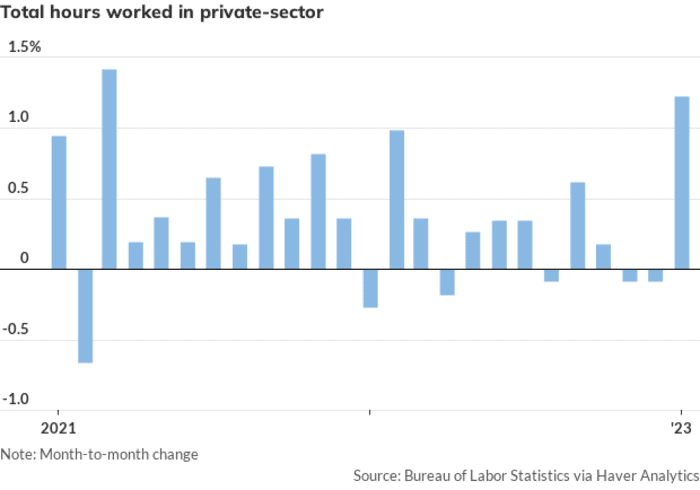
It’s a lot easier to add a shift than it is to add a worker, so businesses boosted the average workweek by about 18 minutes, from 34 hours and 24 minutes to 34 hours and 42 minutes. That might not seem like such a big change, but if you multiply it by 132 million private-sector workers, it adds up to a lot of extra hours on the job. How many hours? About 160 million over the course of the month. The increase in hours worked will help reduce labor supply shortages in exactly the sectors where inflation is most threatening: restaurants, hotel rooms, rents, healthcare and energy. The government says that the total number of hours worked in the private sector rose by 1.2% in January after declining slightly in November and December. If businesses had had to hire new employees to work those extra hours instead of giving their current workers extra shifts, they would have had to create 1.6 million new jobs. Instead, they hired those 443,000 new private-sector workers, and asked the 132 million workers who were already on the payroll to work longer hours. What this means for working families is good news. The amount of wages paid in January rose by 1.5% (a 20% annual rate). For the Federal Reserve (and thus for investors) this increase in weekly pay is seen as a headache. It means the Fed may choose to ratchet up interest rates instead of cutting them later in the year, as the markets have come to expect. The Fed is trying its best to slow the demand for labor by raising interest rates. The Fed believes that the labor market may be getting so tight that companies will be forced to increase wages to attract and retain the workers they need, and in turn that would mean that companies would raise their selling prices to cover their wage bills, creating a dreaded wage-price spiral. Fed chief Jerome Powell promised that his fight against inflation would be painful. But who will bear that pain? Workers have borne the brunt of the impact of higher prices, and now, just when they seem to be pulling their heads above water, they are being told they’ll also need to bear the pain of the cure — unemployment. NN: The key to inflation is wage push inflation. The way the system works is the ED raises rates high enough to drive the economy into a recession. AND said interest rates incrases kills the job market as business shuts down and fire people. And wages decrease and this ends the wage push inflation. But what is happening is the jobs market has gone hog wild and wages are INCREASING. The amount of wages paid in January rose by 1.5% (a 20% annual rate). This means the FED has got a crises on its hands and must must continue to raise rates until the jobs market collapses.
Yellen: Oil cap to make Russia choose war or economy
United States Treasury Secretary Janet Yellen said on Friday in a statement that the latest move regarding the price ceiling on seaborne Russian refined oil products will force Russian President Vladimir Putin to “choose between funding his brutal war or propping up his struggling economy.” She praised the G7 price cap coalition adding that “today’s agreement builds on the price cap on Russian crude oil exports that we set in December and helps advance our goals of limiting Russia’s key revenue generator in funding its illegal war.” Yellen underlined that Russian officials have already admitted the price cap has affected “their most important source of revenue” and hit Moscow’s “troubled fiscal outlook.” She noted that the global energy market proceeds to be “well-supplied” and that crude importers are using these measures “to drive steep bargains on Russian oil imports.” NN: “choose between funding his brutal war or propping up his struggling economy.” Proven stupid! Putin for sure will chose war. Its not like he is suffering. Russian oil revenues because the price has gone up from $40 a barrel are enormous.
Fed’s Daly: Far too early to declare victory against inflation
San Francisco Federal Reserve Bank President Mary Daly said in an interview with Fox Business News on Friday that it is “far too early” to declare victory against inflation despite encouraging data seen recently. Daly explained that the trajectory of Fed’s monetary policy is heading towards additional tightening and is projected to remain in restrictive territory until inflation rate drops down to its 2% objective. “The rate decisions will depend on inflation,” Daly stressed, pointing out that even while she anticipates a steady drop in inflation this year, it is doubtful that it will achieve the target. “The jobs number was a ‘wow’ number, but the trend is not surprising,” the Fed official also commented on the latest data, adding that recent figures have showed a “strong labor market.”
EU agrees on price ceiling for Russian oil products
EU members have agreed to support a price cap level of $100 per barrel on Russian diesel sales to third-party countries, people familiar with the matter told Bloomberg on Friday afternoon. The EU’s ban on Russian seaborne crude oil products imports, including diesel and naphtha, is scheduled to go into effect on February 5. The EU’s proposal, submitted last week, called for capping the price of Russian diesel sold to third countries at $100 per barrel for products that trade at a premium and $45 for those that sell at a discount. Similarly to the price cap on Russian crude, buyers outside the EU would continue to have access to Western insurance and financing for cargoes if they comply with the price cap. The proposal also included setting a price cap of $45 per barrel for discounted products such as fuel oil, which sources suggest has also been approved. The goal of the price caps is to limit Russia’s revenues derived from crude oil and its refined products, while keeping the market supplied with Russian energy. Despite the ban and price cap mechanism that are set to go into effect on Sunday, Russia’s energy minister said he saw no reason to reduce the country’s output on petroleum products, nor was it considering a reschedule for its refinery maintenance to make use of possible reduction in Russian demand. Although the price cap goes into effect on Sunday, there is a grace period for cargoes loaded before the cap was agreed to that runs until April. Russian diesel prices were about $90 earlier this week, below the cap. Wood MacKenzie said earlier this week that a $100 cap would not have a significant effect on Russian refiners, but could bring its diesel exports down about 200,000 bpd. NN: Let me see if i understand this. Europe is oil and for that matter energy starved. So the way they solve the problem is prohibit all oil exploration, shut in the production they do have AND embargo their main source of oil for the past 30 years….. Ok and to make it more absurd they believe price caps will bring them more oil at lower prices…….
Fed seen hiking policy rate above 5% as hiring surges
The U.S. Federal Reserve is likely to need at least two more interest-rate hikes, lifting the benchmark rate to above 5%, to slow an unexpectedly strong labor market seen as contributing to high inflation. That was the betting in financial markets on Friday after the U.S. Labor Department reported employers added more than half a million jobs last month, far more than expected, and the unemployment rate fell to 3.4%, the lowest in more than 50 years. The Fed earlier this week increased its benchmark rate by a quarter-of-a-percentage-point to 4.5%-4.75%. Fed Chair Jerome Powell said that with the labor market still tight he expects to need “ongoing” increases to get monetary policy “sufficiently restrictive” to engineer a more balanced job market and bring down too-high inflation. Interest-rate futures prices, initially skeptical of that view, now reflect that expectation, with a better than even chance seen that the Fed will continue get its policy rate to the 5%-5.25% range by June, if not by May. Financial markets had earlier heard Powell’s repeated references to the start of a disinflationary trend as signaling that just one more rate hike, in March, could suffice. “This is the kind of report that you want to see when coming out of a recession to signal strength in the economy, not when the futures market is looking at the Fed finishing its rate hike cycle,” said Quincy Krosby, chief global strategist at LPL Financial. Traders still expect the Fed to cut rates later in the year, despite Powell saying he does not expect inflation to fall fast enough to allow such a thing. The Fed targets 2% inflation, now running at 5% by the Fed’s preferred measure, the personal consumption expenditures price index. Friday’s Labor Department report did show slower growth in average hourly earnings to a 4.4% pace, from an upwardly revised 4.8% in December. “While the Fed welcomes any signs of easing wage pressures, the pace of growth in average hourly earnings is still too strong to help lower inflation,” Oxford Economics’ Ryan Sweet wrote. NN: Today reports namely the monthly jobs report an the ISM manufacturing index prove the FED is far from done. Its going to take a 6% Fed Funds rate at least to put out this inflationary fire
US Service Gauge Tops Estimates in Biggest Advance Since 2020
-
ISM index rebounds with six-point gain in January to 55.2
-
Orders measure matches highest since beginning of 2022
A gauge of US services snapped back in January after an end-of-2022 slump, suggesting a resurgence in consumer demand that leans against concerns of an imminent economic slowdown. The Institute for Supply Management’s non-manufacturing index rose 6 points to 55.2 in the largest monthly advance since mid-2020, data showed Friday. Readings above 50 signal growth and the January figure topped all estimates in a Bloomberg survey of economists.
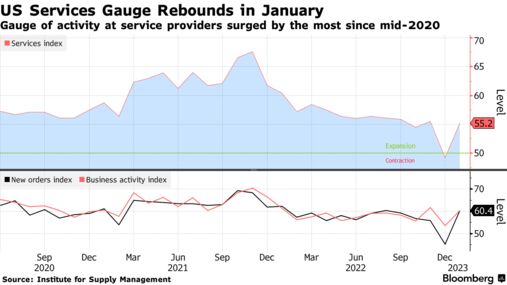
The group’s gauge of new orders surged more than 15 points and a measure of business activity strengthened. Both indexes stand at 60.4, with the orders gauge matching the highest level since the start of 2022. Business activity, which parallels the ISM factory production gauge, jumped to the second-highest reading in a year. The figures show the pullback in consumer activity at the end of last year was likely more of a hiccup than the start of a sustained retrenchment in household demand. When paired with a shockingly strong January jobs report, the data indicate the labor market, cooler inflation and rising wages continue to support consumption, at least for now. “Although responses varied by industry and company, the majority of panelists indicated that business is trending in a positive direction,” Anthony Nieves, chair of the ISM Services Business Survey Committee, said in a statement. “Some companies still find it difficult to fill open positions, while others are facilitating staff reductions.” Ten industries reported growth last month, including agriculture, utilities, and management of companies and support services. Eight industries reported a decrease, led by transportation and warehousing. The report also showed a rebound in demand abroad, likely a reflection of China reopening its economy after three years of strict Covid-19 restrictions on activity. NN: The notion that the economy is slowing and inflation is moderating is nothing more then WallStreet (who is scared to death about the coming crash) desperate spin.