How can 443,000 net hires by businesses actually understate the demand for labor? Because businesses have two options if they need more labor: They can hire more workers, or they can work their existing staff harder.In January, businesses did both — in spades.
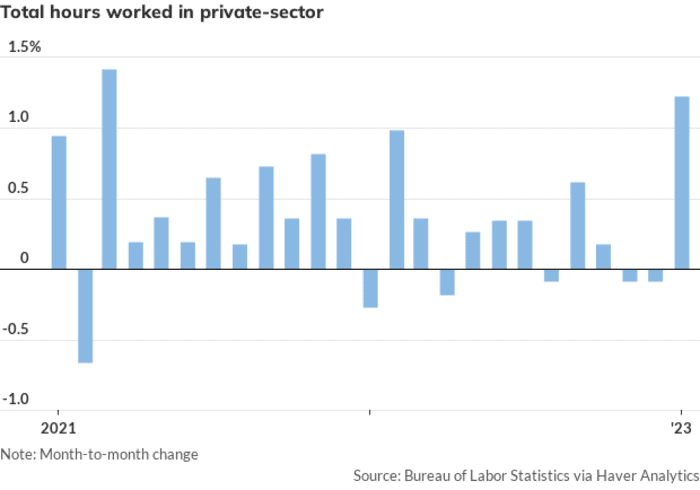
It’s a lot easier to add a shift than it is to add a worker, so businesses boosted the average workweek by about 18 minutes, from 34 hours and 24 minutes to 34 hours and 42 minutes. That might not seem like such a big change, but if you multiply it by 132 million private-sector workers, it adds up to a lot of extra hours on the job. How many hours? About 160 million over the course of the month. The increase in hours worked will help reduce labor supply shortages in exactly the sectors where inflation is most threatening: restaurants, hotel rooms, rents, healthcare and energy. The government says that the total number of hours worked in the private sector rose by 1.2% in January after declining slightly in November and December. If businesses had had to hire new employees to work those extra hours instead of giving their current workers extra shifts, they would have had to create 1.6 million new jobs. Instead, they hired those 443,000 new private-sector workers, and asked the 132 million workers who were already on the payroll to work longer hours. What this means for working families is good news. The amount of wages paid in January rose by 1.5% (a 20% annual rate). For the Federal Reserve (and thus for investors) this increase in weekly pay is seen as a headache. It means the Fed may choose to ratchet up interest rates instead of cutting them later in the year, as the markets have come to expect. The Fed is trying its best to slow the demand for labor by raising interest rates. The Fed believes that the labor market may be getting so tight that companies will be forced to increase wages to attract and retain the workers they need, and in turn that would mean that companies would raise their selling prices to cover their wage bills, creating a dreaded wage-price spiral. Fed chief Jerome Powell promised that his fight against inflation would be painful. But who will bear that pain? Workers have borne the brunt of the impact of higher prices, and now, just when they seem to be pulling their heads above water, they are being told they’ll also need to bear the pain of the cure — unemployment. NN: The key to inflation is wage push inflation. The way the system works is the ED raises rates high enough to drive the economy into a recession. AND said interest rates incrases kills the job market as business shuts down and fire people. And wages decrease and this ends the wage push inflation. But what is happening is the jobs market has gone hog wild and wages are INCREASING. The amount of wages paid in January rose by 1.5% (a 20% annual rate). This means the FED has got a crises on its hands and must must continue to raise rates until the jobs market collapses.