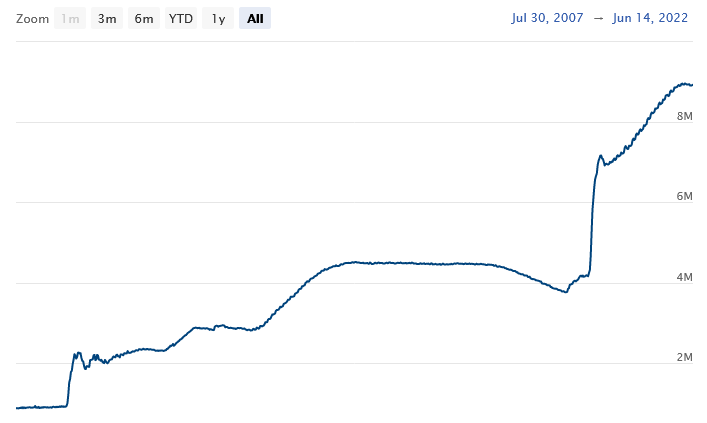
United States Federal Reserve Chair Jerome Powell predicted on Thursday that the central bank balance sheet will be reduced by up to $95 billion by September. The Fed’s asset portfolio is currently being scaled down by half of that number. There is no clear connection between a concentrated economy and inflation, he told the US House of Representatives Financial Services Committee. The effects of increasing interest rates will be felt in financial conditions, economic demand, asset prices and the exchange rate, Powell explained. NN: people hear what they want to hear. The Fed announced it will double the rate will reduce the balance sheet. That means liquidity will be drying up at a even faster rate. Bottom line this is the death knoll for the stock market,,,,,, Let me help you understand this. In the past few years the FED has purchased half 50% of the total government issued. it has also bought most of the home mortgages paper issued and a huge hunk of corporate debt. The feds balance sheet stands as of June 14, 2022, a eye popping 8.93 trillion U.S. The Federal Reserve increased 1000% since 2007, when it stood at roughly 0.9 trillion U.S. dollar. This year the FED will reduce its balance sheet buy a trillion dollars. Net when you consider they were increasing their balance sheet by a trillion dollars a year will be 2 trillion less liquidity they last year. The markets from housing to bonds to corporate debt markets will be devastated.
United States President Joe Biden called Congress on Wednesday to suspend the federal gas tax for “the next 90 days.” During his televised speech on gas prices and Putin’s price hike, Biden said that the collaboration of the companies was also necessary to reduce the cost of fuel amid the crisis caused by the war in Ukraine. In this regard, he called on the industry to refine more oil into gasoline, thus lowering its price. Finally, he also expressed his desire for oil companies to use their profits to increase refining capacity instead of buying back shares. NN: with what is left of the free market i am SURE those Federal gas tax savings will not be passed along in full. Lets say they are its only 18 cents per gallon. lets take the average and mean of US motorists gasoline consumption per month. Its between 50 to 100 gallons a month, that’s $9.00 to $20.00 a month. What a sick fucking joke. He should have been laughed out of the room. I am shocked!! That is a solution to run away inflation. How about unchaining the US oil industry. Do that and the US balance of trade would be surplus and crude oil would be $50 a gallon and gasoline $2.50 a gallon.
United States Federal Reserve Chair Jerome Powell said on Wednesday that the bank anticipates ongoing rate increases “will be appropriate” to bring inflation down, but that the pace of hikes will continue to depend on the incoming data. “We will make our decisions meeting by meeting, and we will continue to communicate our thinking as clearly as possible. Our overarching focus is using our tools to bring inflation back down to our 2 percentgoal and to keep longer-term inflation expectations well anchored,” we cannot fail on this task to bring inflation down to 2%, (NB: its the impossible without a depression it cannot be down because the inflation drivers are not financial in nature. He is wrong again and will overtighten the economy and bring on not only a recession but a full blown depression) Powell told the Senate Banking Committee. He conceded that inflation has “surprised to the upside” and that “further surprises could be in store,”assuring the Fed will be “highly attentive to inflation risks and determined to take the measures necessary to restore price stability” and that the US economy is “very strong and well positioned to handle tighter monetary policy.” NN: He is concentrating on inflation. Stock market and recession be damned. He will over tighten. Look its the biggest FED fuck up ever. Do you think he became smart all of a sudden.
June 22 (Reuters) – JPMorgan Chase & Co (JPM.N) is laying off hundreds of employees in its home-lending business and reassigning hundreds more this week, Bloomberg News reported on Wednesday, citing people familiar with the matter. More than 1,000 employees will be affected, the report said, and about half of them will be moved to different divisions with the bank. “Our staffing decision this week was a result of cyclical changes in the mortgage market,” a spokesperson for the bank said. JPMorgan has 273,948 employees worldwide, according to its latest quarterly filing with the U.S. Securities and Exchange Commission. “We were able to proactively move many impacted employees to new roles within the firm and are working to help the remaining affected employees find new employment within Chase and externally,” the spokesperson added. Last week, the Federal Reserve hiked interest rates by three-quarters of a percentage point, the largest increase since 1994, after official data just a few days earlier showed inflation rose despite expectations it had peaked. Real estate brokers Compass Inc (COMP.N) and Redfin Corp (RDFN.O) also said last week they would cut jobs as homebuying demand was slowing due to rising mortgage rates and surging inflation. In May, U.S. existing home sales tumbled to a two-year low as median house prices jumped to a record high – topping the $400,000 mark for the first time. NN: Mortgages will refix at twice the payment this year and double again next year….. Another hosing crash is in the making. You know the drill. Stand back and wait and you will buy the real estate of your dreams at steep discounts. This will be the biggest real estate bust we have ever seen……..
Federal Reserve Chair Jerome Powell gave his most explicit acknowledgment to date that steep rate hikes could tip the US economy into recession, saying one is possible and calling a soft landing “very challenging.” “The other risk, though, is that we would not manage to restore price stability and that we would allow this high inflation to get entrenched in the economy,” Powell told lawmakers on Wednesday. “We can’t fail on that task. We have to get back to 2% inflation.” The Fed chair was testifying before the Senate Banking Committee during the first of two days of congressional hearings. In his opening remarks, Powell said that officials “anticipate that ongoing rate increases will be appropriate,” to cool the hottest price pressures in 40 years. “Inflation has obviously surprised to the upside over the past year, and further surprises could be in store. We therefore will need to be nimble in responding to incoming data and the evolving outlook,” he said. Powell’s remarks reinforced comments at a press conference last week after he and his colleagues on the Federal Open Market Committee raised their benchmark lending rate 75 basis points — the biggest increase since 1994 — to a range of 1.5% to 1.75%. While Powell told reporters then that another 75 basis-point increase, or a 50 basis-point move, was on the table for the next meeting in late July, Wednesday’s text made no reference to the size of future rate hikes. Fed Governor Christopher Waller said Saturday that he would support a 75-basis-point rate increase in July should economic data come in as he expects. “We understand the hardship high inflation is causing,” Powell said Wednesday. “We are strongly committed to bringing inflation back down, and we are moving expeditiously to do so.” Investors expect the US central bank to keep raising rates to a peak around 3.6% by the middle of next year, according to interest-rate futures. “Financial conditions have tightened and priced in a string of rate increases and that’s appropriate,” Powell said in response to a question following his opening remarks. “We need to go ahead and have them.”
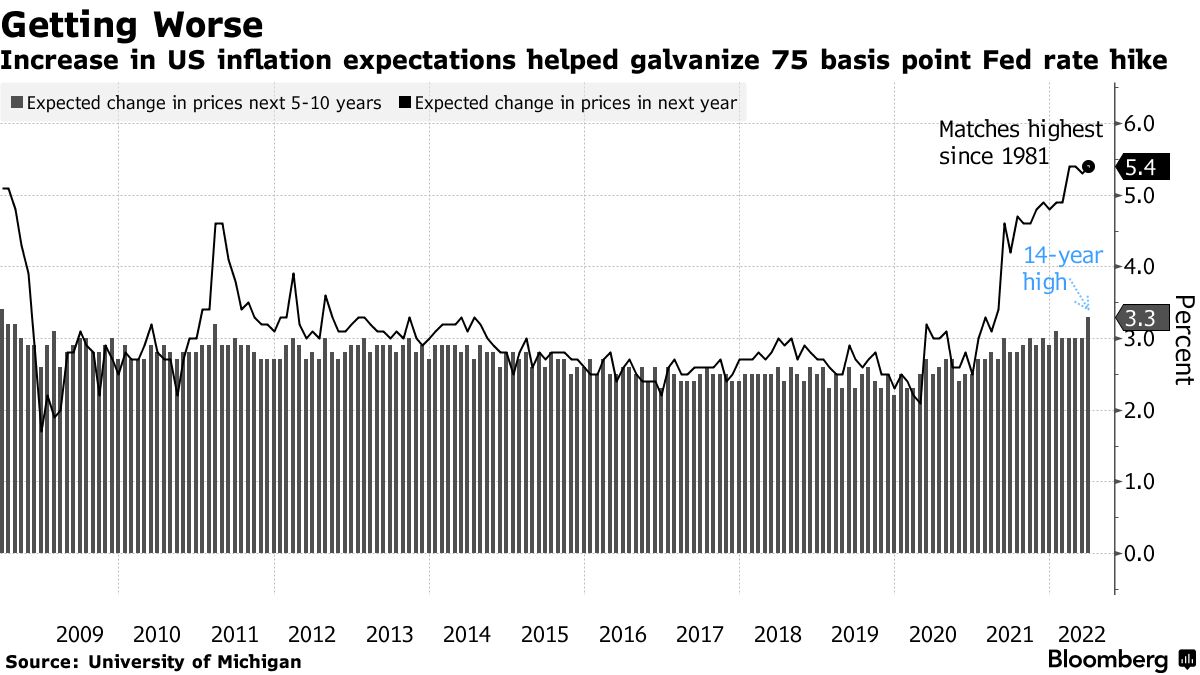
The Labor Department’s consumer price index rose 8.6% last month from a year earlier, a four-decade high. University of Michigan data showed US households expect inflation of 3.3% over the next five to 10 years, the most since 2008 and up from 3% in May.
Fed officials have admitted that they were too slow to tighten and are now trying to front-load rate increases in the most aggressive policy pivot in decades.
While a recession isn’t in the Fed’s forecast, economists are increasingly flagging the likelihood of a downturn sometime in the next two years.
“The American economy is very strong and well positioned to handle tighter monetary policy,” Powell said in his opening remarks.
While he said that he did not see the likelihood of a recession as particularly elevated right now, he said that it was “certainly a possibility. It is not our intended outcome at all,” noting that events in the last few months have made it harder for the Fed to lower inflation while sustaining a strong labor market.A soft landing “is our goal. It is going to be very challenging. It has been made significantly more challenging by the events of the last few months — thinking there of the war and of commodities prices and further problems with supply chains.” Powell called the labor market “extremely tight.” “The tightening in financial conditions that we have seen in recent months should continue to temper growth and help bring demand into better balance with supply,” he said. Policy makers’ latest forecasts, released last week, show the level of rates roughly doubling in the second half of the year to a target range of 3.25% to 3.5%. They saw rates peaking next year at 3.8%. Officials have also begun shrinking their massive balance sheet. The combined impact of higher borrowing costs and so-called quantitative tightening is expected to come at some cost to jobs.
A recession is coming within 12 to 18 months as the Fed focuses on curbing inflation.
Bill Dudley, a Bloomberg Opinion columnist and senior adviser to Bloomberg Economics, is a senior research scholar at Princeton University’s Center for Economic Policy Studies. He served as president of the Federal Reserve Bank of New York from 2009 to 2018, and as vice chairman of the Federal Open Market Committee. He was previously chief U.S. economist at Goldman Sachs.
If you’re still holding out hope that the Federal Reserve will be able to engineer a soft landing in the US economy, abandon it. A recession is inevitable within the next 12 to 18 months. In their latest set of projections, Fed officials laid out a benign scenario, in which the economy keeps growing at a moderate pace and unemployment increases only slightly, even as the central bank raises interest rates significantly to get inflation under control. While the Fed’s forecasts have become more plausible over time, I see several reasons to expect a much harder landing.
First, persistent price increases have forced the Fed to shift its focus from supporting economic activity to pushing inflation back down to its 2% objective. The central bank’s employment mandate is now subservient to its inflation mandate. This can be seen both in Chair Jerome Powell’s performance at last week’s press conference and in the June FOMC statement, which removed language that the labor market would “remain strong.”
Second, the new focus on price stability will be relentless. Fed officials recognize that failing to bring inflation back down would be disastrous: Inflation expectations would likely become unanchored, necessitating an even bigger recession later. From a risk management perspective, better to act now, whatever the cost in terms of jobs and growth. Powell does not want to repeat the mistakes of the late 1960s and the 1970s.
Third, the current economic expansion is uniquely vulnerable to a sudden stop. In the short term, payroll growth, economic reopening and healthy balance sheets (supported by the vast fiscal stimulus of 2020 and 2021) should support demand, which in several sectors exceeds supply. For example, the two-year cumulative supply shortage in the motor vehicle sector likely amounts to several million units. As a result, it’ll take time and a considerable monetary policy tightening to reduce demand and for that to translate fully into weaker production of goods and services.
But when that time comes, the production adjustment is likely to be abrupt, due to tight financial conditions, restrictive fiscal policy and tapped-out household savings. The broad US equity market is down more than 20%, mortgage rates are up more than 2 percentage points and the dollar is up about 10% against a broad basket of foreign currencies (constraining U.S. exports). The Hutchins Center at the Brookings Institution estimates that fiscal policy shaved more than 3 percentage points off annualized US economic growth in the first three months of 2022 — a drag that is expected to persist through 2023. As inflation outstrips wage growth, the personal savings rate has plummeted, from 26.6% in March 2021 to 4.4% this April, significantly below its long-run average. No wonder consumer sentiment has fallen to levels last reached in the aftermath of the 2008 financial crisis, and Google searches for the word “recession” are hitting new records. Finally, economic history points to a hard landing. The Fed has never tightened enough to push up the unemployment rate by 0.5 percentage point or more without triggering a recession. According to the Sahm rule, when this trigger is reached the next stop is a deeper slump, in which unemployment increases by at least 2 percentage points. Much like Wile E. Coyote heading off a cliff, the US economy has plenty of momentum but rapidly disappearing support. Falling back to earth will not be a pleasant experience. NN: I am adamant their will be a severe recession. Do not buy into the soft landing crap. Sure the rate of inflation MAY slow. But reality inflation running even at a 6% rate is a disaster. REALLY! The Fed is in a tightening mode period end of statement. And i have Never Ever seen a stock market rally when the Fed is taking away the punch bowel. Another even bigger stock market crash is right around the corner
UK inflation rose to a fresh four-decade high in May after broad increases in the cost of everything from fuel and electricity to food and beverages.
The rate accelerated to 9.1%, from 9% a month earlier, the Office for National Statistics said Wednesday.
Retail prices climbed more than expected to 11.7%, and there were also more signs of inflationary pressures building at the wholesale level, with raw material costs increasing the most on record. The BOE says it is ready to ‘act forcefully’ to combat soaring prices While the jump was smaller than seen in recent months, the figures still underline the scale of the inflation crisis facing the UK. Matters will get worse later this year when another energy price hike kicks in, with the Bank of England forecasting price gains will surge above 11% in October.. “The BOE opened the door to moving in bigger steps than 25 basis points by saying signs of more persistent inflationary pressure would be met by ‘forceful action.’ Today’s release will do nothing to allay those fears. We expect inflation to pick up in the months ahead as rising food and fuel prices lift the annual rate. The peak isn’t likely to arrive until October, when Ofgem, the UK’s energy regulator, raises the price cap on energy bills again.” –Dan Hanson, Bloomberg Economics. The increase was driven by rising prices for food and non-alcoholic beverages, which formed a stark contrast to declines a year ago. Rising electricity and gas and other fuel prices, motor fuels and second-hand cars were also big contributors to the headline figure. Energy, food, motor fuel & clothing account for half of the jump in prices
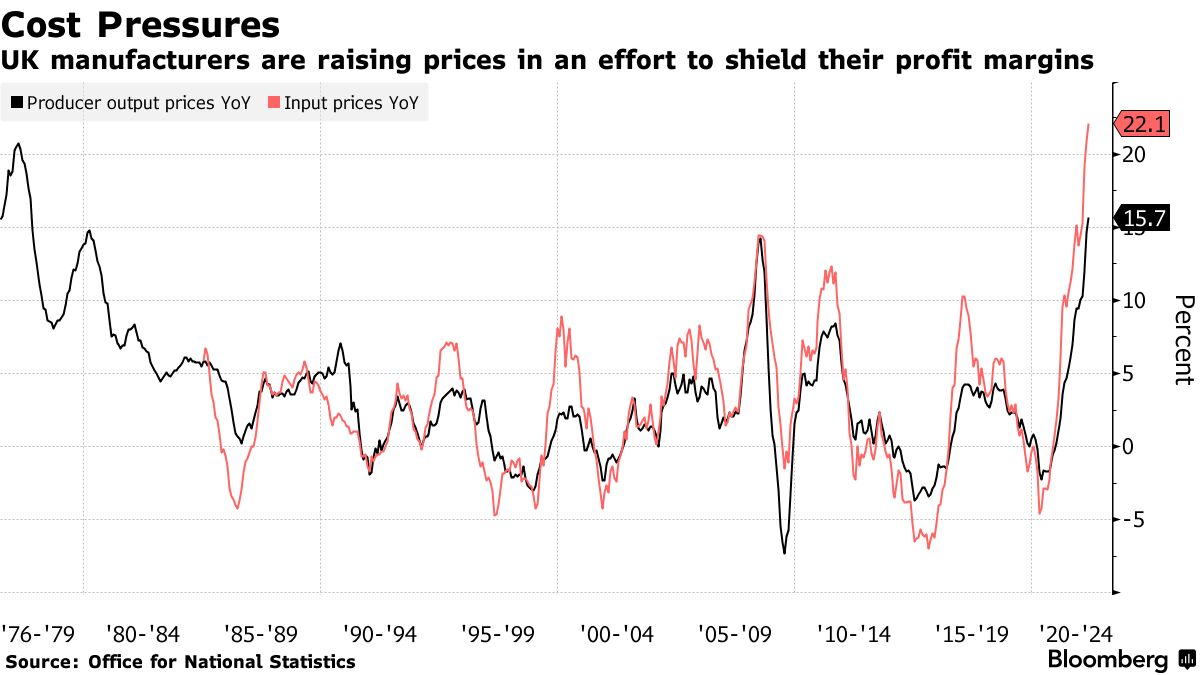
The cost of goods leaving factories rose 15.7% from a year ago, a full percentage point stronger than expected and the most since 1977.
Raw materials prices jumped 22.1%, also more than expected and the most since records started in 1985.
The runaway inflation rate is setting the backdrop for a tumultuous summer for the central bank and Prime Minister Boris Johnson’s government. About 60% of adults report spending less on non-essential items in response to rising costs. “I know that people are worried about the rising cost of living, which is why we have taken targeted action to help families,” said Chancellor of the Exchequer Rishi Sunak. “We are using all the tools at our disposal to bring inflation down and combat rising prices.” Sunak said that “fiscal policy which doesn’t add to inflationary pressures” will be part of the solution, a signal that the government will keep a tight rein on pay settlements with public-sector workers.
The economy is on course to shrink for the first time since the pandemic, consumers are seeing their incomes squeezed at the sharpest pace in two decades, and a series of rail strikes are bringing the nation to a standstill this week.
While Johnson has introduced a package of measures to help offset some of the jump in energy bills, it says increasing pay to match inflation is not an option. Johnson told his cabinet Tuesday that his government seeks to enforce pay restraint on public sector workers or else push prices even higher. Meanwhile the BOE, which says it can do nothing to stop the spike in prices this year, is adding to the short-term pain of some households by hiking rates at an unprecedented pace. More than a fifth of inflation basket is seeing gains of more than 10% Policy makers have already announced five straight hikes, and markets are betting rates will more than double to hit 3% by the end of the year. Chief Economist Huw Pill said policy makers would sacrifice growth in order to bring down inflation in the UK, saying there’s a risk of prices developing a “self-sustaining momentum.” “No signs yet of inflation receding” says Yael Selfin, chief economist at KPMG UK. “Inflation continues to rise, primarily driven by external factors, with price rises spread widely across the economy.” NN: The world has been set on fire by inflation. Central banks the world are coordinating their interest rate rises. Do not let anyone shit you. The same central banker ass holes that kept free money to long and told you inflation is transitory have a new con. That is their will be no recession or at worst a mild one. Fuck Them! Their is a rescission/depression headed for us. Bond funds, retirement funds and real estate are wiping out. And this is the start not the finish.
European Central Bank President Christine Lagarde said that the central bank is monitoring the risks of a recession, particularly the effects of oil supply shortages and excess on the eurozone’s economy. However, the ECB’s president highlighted that “a recession is not a baseline scenario for the euro area,” as European institutions are projected to see growth in the upcoming period, warning that the inflation is expected to exceed previous estimates for the fiscal year. Lagarde stressed the central bank does not intend to “tighten” its monetary policy, but to rather normalize it through gradual interest rate hikes and a cessation of net asset purchases. NN: Their is no “normalization” the world will be plunged into a deep dark depression over the next 2 years. It will not be a straight down plunge. As the markets ratchet back and forth confusion will abound. The monster has been unchained from the pits of hell. It will be our roughest time together yet. I believe we will prevail but the going will be rough and our success is far from guaranteed. I believe we will be tested to our limits. And i believe we will be victorious.
Italy may soon declare a state of alert if natural gas supplies from Russia continue to be limited gas supplies. Before the Russian invasion of Ukraine, Italy sourced around 40% of the gas it uses from Russia. Italy has sought to diversify its gas imports with more supply from North African producers, but it still is a major consumer of Russian gas. The state of alert is the second step in Italy’s gas emergency protocols. The country has been in a state of pre-alert since February, when Russia invaded Ukraine, while the third stage of the protocol is a state of emergency. If reductions persist in the coming days, the Italian Ministry of Ecological Transition could decide next week that Italy move from the current state of pre-alert to a state of alert, sources in the ministry told Italian news agency ANSA on Friday. A state of alert would include rationing gas supply to some industrial users, increased gas imports from other suppliers, and increased production at coal-fired power plants, among others. Throughout this week, Italy has been receiving decreased volumes of gas from Russia, with cuts deepening every day since Tuesday. Earlier this week, Russian supply to Italy was cut by 15%. The cut deepened to 35% of requested volumes for Thursday, and on Friday, Italy’s energy major Eni flagged additional cuts to deliveries. Eni will receive just half of the volumes requested for the day, it said. Commenting on the lower supply from Russia, Italy’s Prime Minister Mario Draghi said on Thursday that the Russian “technical reasons” for reduced deliveries were “lies.” “Germany, we, and others believe that these explanations are lies and that gas is being used as a political tool, just like grain is,” Draghi said. The Russian cuts to supply to Italy, as well as to Germany, coincided with the visit in Kyiv of the leaders of Germany, Italy, and France, who met with Ukraine’s President Volodymyr Zelensky to show support to Ukraine.
The Russian cuts to supply to Italy, as well as to Germany, coincided with the visit in Kyiv of the leaders of Germany, Italy, and France, who met with Ukraine’s President Volodymyr Zelensky to show support to Ukraine. NN: In the past 50 years the world has sold out every country run by or invaded by oppressive dictators or states. Ukraine will be no different. The world will not suffer for long energy inflation and food shortages to save Ukraine. Its NOT going to happen. The screams of the masses energy pain and food inflation are resonating in the ears of every sold out public figure . Politicians are NOT elected by Ukraine “freedom” fighters. But by the teaming middle class who cannot find the Ukraine on a map. And they care about the cost of their hamburger and gasoline more then the Ukraine’s.
Europe biggest buyers of Russian gas are racing to find alternative fuel supplies, and some may even turn back to coal. With Europe and Russia at odds over the Ukraine war, some European leaders face the threat of an energy crisis this winter if gas stores are not refilled. Italy’s Eni said it was told by Russia’s Gazprom it would receive only part of its request for gas supplies Monday (June 20). That has pushed the country closer to declaring a state of alert which could lead to gas saving measures. Germany has also faced lower Russian flows. The country announced Sunday (June 19) it planned to boost gas storage levels. It even said it could restart coal-fired power plants it had aimed to phase out. Economy Minister Robert Habeck called the measure ‘painful’ but a ‘sheer necessity’. Otherwise, he said, Germany could be ‘blackmailable’ at a political level. Habeck is a member of the Green Party that has pushed a for a quicker exit from coal – which produces more greenhouse gases. Russian gas flows to Germany through the Nord Steam 1 pipeline were still running at about 40% of capacity Monday. Russia’s state-controlled Gazprom last week cut throughput along Nord Stream 1 – which is the main route supplying Europe’s largest economy. It blamed the apparent return of equipment being serviced by Germany’s Siemens Energy. But German and Italian officials have said Russia was using that as an excuse to reduce supplies. NN: As reported to you earlier I am VERY concerned about the mental health of the Greeneewinnnies. Take any greenieewinnie you know out to lunch at one of those worm burger restaurants. Drive them out to their favorite tree to hug. Take them to a wind farm for a picnick. And under no circumstances mention coal. Make sure you do not drive by a nuclear reactor with them in the electric car……