UK government does not expect recession….. Yellen says recession is not inevitable……. Biden says a recession is ‘not inevitable’

Chief Secretary to the United Kingdom Treasury Simon Clarke (pictured) told the Times Radio on Monday that the government does not expect a recession. Clarke stressed that the British economy has “considerable underlying strengths” despite “very significant challenges” globally. Earlier, he told Sky News that the pay in the public sector will not be increased over inflation levels as the inflation issue could “either intensify or prolong itself.”

Yellen says recession is not inevitable

REHOBOTH BEACH, Del. — Treasury Secretary Janet Yellen said Sunday that she expects the U.S. economy to slow in the months ahead, but that a recession is not inevitable. Yellen offered a dose of optimism even as economists grow increasingly worried about a recession fueled by skyrocketing inflation and the Russian invasion of Ukraine. Yellen said overall consumer spending in the United States remains strong, while noting that spending patterns are changing, given the impact of rising food and energy prices. Yellen said household savings during the coronavirus pandemic will help sustain spending. The national saving rate has fallen to about 6%, below pre-pandemic levels, after reaching 16.6% in 2020, the highest on record dating to 1948, and 12.7% in 2021.

“I expect the economy to slow,” Yellen said. “It’s been growing at a very rapid rate and the economy has recovered and we have achieved full employment. We expect a transition to steady and stable growth, but I don’t think a recession is at all inevitable.”

The Federal Reserve on Wednesday approved its largest interest rate increase in more than a quarter-century to stem a surge in inflation. The move raised the target federal funds rate by three-quarters of a percentage point to a range of between 1.5% and 1.75% The tightening of monetary policy was accompanied by a downgrade to the Fed’s economic outlook, with the economy now seen slowing to a below-trend 1.7% rate of growth this year, unemployment rising to 3.7% by the end of this year and continuing to rise to 4.1% through 2024. Yellen said it will take “skill and luck” to bring down inflation while maintaining low unemployment. “I believe it’s possible,” she said.

Biden says a recession is ‘not inevitable’

WASHINGTON (AP) — President Joe Biden said Thursday the American people are “really, really down” after a tumultuous two years with the coronavirus pandemic, volatility in the economy and now surging gasoline prices that are slamming family budgets. But he stressed that a recession was “not inevitable” and held out hope of giving the country a greater sense of confidence. Speaking to The Associated Press in a 30-minute Oval Office interview, the president emphasized the battered economy that he inherited and the lingering psychological scars caused by a pandemic that disrupted people’s sense of identity. He bristled at claims by Republican lawmakers that last year’s COVID-19 aid plan was fully to blame for inflation reaching a 40-year high, calling that argument “bizarre.” As for the overall American mindset, Biden said, “People are really, really down.” “Their need for mental health in America has skyrocketed because people have seen everything upset,” Biden said. “Everything they’ve counted on upset. But most of it’s the consequence of what happened, what happened as a consequence of the, the COVID crisis.”  That pessimism has carried over into the economy as record prices at the pump and persistent inflation have jeopardized Democrats’ ability to hold on to the House and Senate in the midterm elections.

Biden addressed the warnings by economists that fighting inflation could tip United States into recession.  “First of all, it’s not inevitable,” he said. “Secondly, we’re in a stronger position than any nation in the world to overcome this inflation.”

As for the causes of inflation, Biden flashed some defensiveness on that count. “If it’s my fault, why is it the case in every other major industrial country in the world that inflation is higher? You ask yourself that? I’m not being a wise guy,” he said. The president’s statement appeared to be about inflation rising worldwide, not necessarily whether countries had higher rates than the U.S. Annual inflation in Japan, for example, has risen in recent months though it’s still at a yearly rate of 2.4%, according to the Organization for Economic Co-operation and Development. Asked why he ordered the financial penalties against Moscow that have disrupted food and energy markets globally, Biden said he made his calculation as commander in chief rather than as a politician thinking about elections. “I’m the president of the United States,” he said. “It’s not about my political survival. It’s about what’s best for the country. No kidding. No kidding. So what happens? What happens if the strongest power, NATO, the organizational structure we put together, walked away from Russian aggression?” Biden spun out the possibility of chaos in Europe if an unimpeded Russia kept moving deeper into the continent, China was emboldened to take over Taiwan and North Korea grew even more aggressive with its nuclear weapon ambitions. NN: the truth is the US is already in a recession just ask the big box store guys. Their consumer shit is NOT selling. My belief the 4th of July weekend will be the last hurrah. People will be shocked at the prices they will have to pay. After the last supper (BBQ) they will hunker down. Their savings is gone and consumer debt is exploding. You damn straight their is going to be a big bag recession. And with the out to lunch clueless leadership that is in power worldwide its damn near hopeless. They will continue to fuck things up royally. Can you believe the head of the FED Reserve with all the resources and tools they have had missed the greatest inflation in 40 years. What good as these Doctoral laureates? And to add insult to injury Chairman Powell got to keep his job……..
BOE Raises Rates to Highest Since 2009 and Warns of Bigger Moves

The Bank of England raised interest rates for a fifth straight meeting and sent its strongest signal yet that it’s prepared to unleash larger moves if needed to tame inflation. The nine-member Monetary Policy Committee voted 6-3 to increase the benchmark lending rate by 25 basis points to 1.25%. A minority of officials maintained their push for a move of double that size. Policy makers led by Governor Andrew Bailey hinted that they may join a growing global trend for larger hikes if inflation continues to soar, saying “it would be particularly alert to indications of more persistent inflationary pressures, and would if necessary act forcefully in response.” Crucially, that language was endorsed by all the BOE’s voters, a departure from May when two declined to sign up to guidance that more hikes were needed. The bank also raised its forecast for the peak of inflation this year to “slightly above” 11%, reflecting the planned increase in the energy price cap in October, and said it now expects the economy to contract in the current quarter. Investors raised their bets for further rate increases this year, pricing in a 3% base rate by the end of the year. That would likely require three half-point rate increases and a further quarter-point one at the remaining four meetings this year, an unprecidented pace of tightening. For now though the BOE, which was first major central bank to hike rates after the pandemic, is moving slower than some of its peers. The U.S. Federal Reserve raised interest rates by 75 basis points on Wednesday, the biggest increase since 1994. The Swiss National Bank also surprisingly hiked rates by 50 basis points earlier Thursday. The BOE “continues to balance the inflationary effects on the economy, with the very real chance that they tighten too much and the UK economy lurches into a full blown recession,” said Alan Custis, managing director at Lazard Asset Management. But while the BOE is grappling with an inflation rate that has already hit a four-decade high of 9%, officials are also concerned about an economic slowdown that is putting the UK at risk of recession. NN: Soon to little to late interest rate increases will turn into to much too soon interest rate increases. Reality is the runaway inflation will soon turn into stagflation and then a full blown depression,

Inflation will not fall to 2% target for two years, Fed’s Mester says

WASHINGTON, June 15 (Reuters) – The Federal Reserve on Wednesday approved its largest interest rate increase in more than a quarter of a century to stem a surge in inflation that U.S. central bank officials acknowledged may be eroding public trust in their power, and being driven by events seen increasingly out of their hands. The widely expected move raised the target federal funds rate by three-quarters of a percentage point to a range of between 1.5% and 1.75%, still comparatively low by historic standards. But the Fed’s hawkish commitment to controlling inflation has already touched off a broad tightening of credit conditions being felt in U.S. housing and stock markets, and likely to slow demand throughout the economy – the Fed’s intent. Officials also envision steady rate increases through the rest of this year, perhaps including additional 75-basis-point hikes, with a federal funds rate at 3.4% at year’s end. That would be the highest level since January 2008 and enough, Fed projections show, to slow the economy markedly in coming months and lead to a rise in unemployment. “We don’t seek to put people out of work,” Fed Chair Jerome Powell said at a news conference after the end of the Fed’s latest two-day policy meeting, adding that the central bank was “not trying to induce a recession.” Yet the Fed chief’s remarks were among his most sobering yet about the challenge he and his fellow policymakers face in lowering inflation from its current 40-year high, to a level closer to its 2% target, without a sharp slowdown in economic growth or a steep rise in unemployment. “Our objective really is to bring inflation down to 2% while the labor market remains strong … What’s becoming more clear is that many factors that we don’t control are going to play a very significant role in deciding whether that’s possible or not” Powell said, citing the war in Ukraine and global supply concerns. “There is a path for us to get there … It is not getting easier. It is getting more challenging,” he told reporters, noting that the rate hikes announced last month and in March so far had not only failed to slow inflation, but allowed it to continue accelerating to a level that recent data indicates have begun to influence public attitudes in a way that could make the Fed’s job even harder.

A survey released on Friday showed consumer inflation expectations jumped sharply in June, a result Powell called “quite eye-catching,” and enough to tilt policymakers towards a larger 75-basis-point hike in hopes of making faster progress on the inflation front and retaining public trust that price increases will slow.

“This is something we need to take seriously,” Powell said of the change in consumer inflation expectations. “We’re absolutely determined to keep them anchored.” The faster pace of rate hikes outlined by officials on Wednesday more closely aligns monetary policy with the rapid shift that took place this week in financial market views of what it will take to bring price pressures under control. NN: its going to take a bog stick to beat back this inflation monster. And i fear the FED has to get a much bigger stick. Like taking Fed Funds rates to 8%……..

Germany to restart coal plants to make up for Russian gas….. Greeneeewenniees on suicide watch

https://youtu.be/n7uCRAeKhFI

Germany must reduce natural gas consumption and increase the burning of coal in order to help fill gas storage facilities for next winter, German Economy Minister Robert Habeck announced Sunday as the country moves away from reduced Russian gas supplies. “The situation is serious,” Habeck said in a statement. “We are therefore continuing to strengthen precautions and taking additional measures to reduce gas consumption. This means that gas consumption must fall further, but more gas must be put into the storage facilities, otherwise things will really get tight in winter.” Germany is heavily reliant on Moscow’s gas to power its homes and heavy industry, but has managed to whittle Moscow’s share of its imports down to 35% from 55% before the start of the war in Ukraine. Habeck said security of supply was currently guaranteed in spite of a “worsened situation on the gas market” in recent days. Soaring prices were “(Russian President Vladimir) Putin’s strategy to unsettle us, drive up prices and divide us,” Habeck said. “We will not allow that. We are fighting back decisively, precisely and thoughtfully,” he said.

Despite Germany’s plans to exit coal-fueled energy production, Habeck, who is a Green Party politician in the center-left ruling coalition, announced a return to “coal-fired power plants for a transitional period” in order to reduce gas consumption for electricity production.

“We are setting up a gas substitute reserve on call. “That’s bitter, but it’s almost necessary in this situation to reduce gas consumption,” Habeck said. In March, German lawmakers passed a gas storage act stipulating gas storage facilities must be almost completely full at the start of the heating period in order to get through the winter safely. “Filling levels have been specified for this purpose: By October 1, the storage facilities must be 80% full, by November 1, 90%, and on February 1, still 40%,” according to the law. Currently at about 56%, gas storage tanks are filled to an above-average level in Germany compared with previous years in spite of storage levels having been at an all-time low at the beginning of the year. “We must and we will do everything we can to store as much gas as possible in the summer and fall. The gas storage facilities must be full towards the winter. That is the top priority,” Habeck said. In March, Putin threatened to cut gas deliveries to “unfriendly” countries that refused to pay in rubles, rather than the euros or dollars stated in contracts. Since then, the Russian state energy giant Gazprom has offered customers a solution. Buyers could make euro or dollar payments into an account at Russia’s Gazprombank, which would then convert the funds into rubles and transfer them to a second account from which the payment to Russia would be made.

But many European companies, including Shell Energy, have refused to comply, prompting Gazprom to shut off its natural gas supplies to Shell’s German customers in June.

On Thursday, Gazprom cut flows through Gazprom’s Nord Stream 1 pipeline – a major artery linking Russia’s gas to Germany – for the second time in days, sending prices rocketing. The Russian energy giant said it reduced gas deliveries because German firm Siemens Energy had delayed the return of turbines needing repairs. Siemens had taken the turbines to one of its Canadian factories for maintenance. It said in a statement on Tuesday that it was “impossible” to return the equipment to Russia because of sanctions Canada had imposed on the country over its invasion of Ukraine. In response to Gazprom’s move, Habeck said the justification for announcing further gas supply cuts to Europe was a “pretext” and a strategy to increase prices. NN: If you read between the lines and do the math you can see they are in deep shit. With less then 3  months top go to the start of gas heating season the tanks should be at least 75% full. Which means Germany will have at best 75% of the gas it need this coming winter at the rate of fill til now. With Russia further cutting gas flows the situation only gets worse. The last thing the green party of Germany wants is to go back to the most polluting fuel know to man coal. And return to coal only solves the electric generation problem. And if the gas flows do not start soon they will have a home heating problem this winter,  because most of the homes in Germany and Europe for that matter heat with gas. If you see or hear about a greeneeewinnie on the ledge (jumper) call the German suicide hot line at 08001810771.

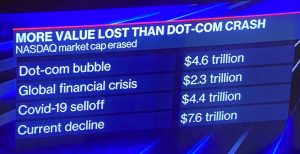
The 2022 tech stock crash is the biggest Yet…But the biggest drop is yet to come

Ten Reason the Stock Market is crashing:

  1. Rising inflation – too much money chasing a reduced number of goods due to supply chain disruptions.
  2. People plunging into more debt. Especially since their stock trading and retirement accounts have now wiped out.
  3. Covid pandemic (Continuing Lockdowns in China) still causing a global supply chain crisis.
  4. China’s economy is slowing down.
  5. The FED (the central bank of the US) starting to raise interest rates. Are about to panic.
  6. Energy crisis with record-high natural gas and rising oil prices. As the west shoots itself in the dick and tit with stupid sanctions.
  7. China cracking down on its biggest tech stocks (Alibaba, Ant, Tencent, and others)
  8. Increased government spending.
  9. War in Ukraine creating food shortages and higher food prices
  10. Potential war in Taiwan.
  11. Crypto crash. Erasing 2 trillion in highly liquid wealth.
Rising inflation

If the inflation rate continues to increase, it could negatively affect the stock market’s returns. Higher interest rates and lower economic growth would lead to lower dividends and lower stock prices.

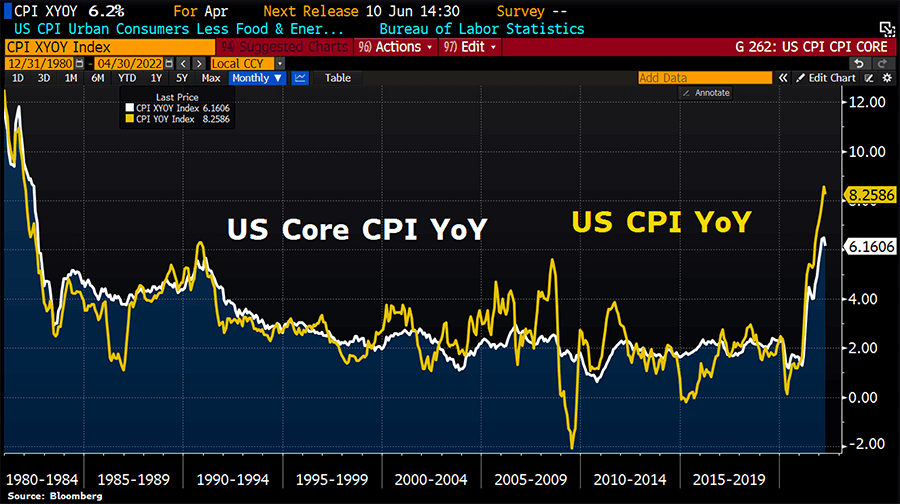
US inflation CPI soars 2022

US inflation rate has risen 8.3% year-over-year. Even removing volatile food and energy prices, the so-called core CPI still rose 6.2%. During the pandemic, governments around the world pumped truckloads of money into their economies to boost the troubled economies. It was a short-term fix that caused the price to skyrocket. The added problem now is that the number of goods did not stay the same. Due to the supply chain crisis, the amount of goods decreased, thus deepening the inflation.

Americans increase credit card and Home equity debt

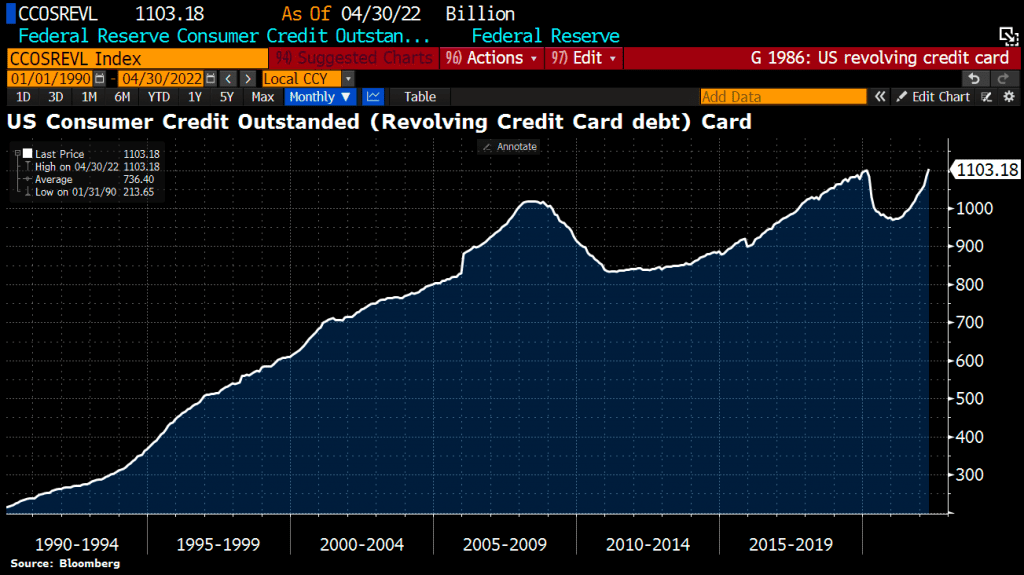
In a healthy situation, when the prices start to increase, people start to save money and limit their spending. What we see in June 2022 is a different picture – Americans dig deeper into credit card debt as inflation continues to rise. Credit card debt grew by 19.6% compared to a year earlier and totaled $1.103 Trillion in April 2022, surpassing the pre-pandemic record of $1.1tn.

americans increase credit card usage - credit card debt USA

Global debt keeps rising as well

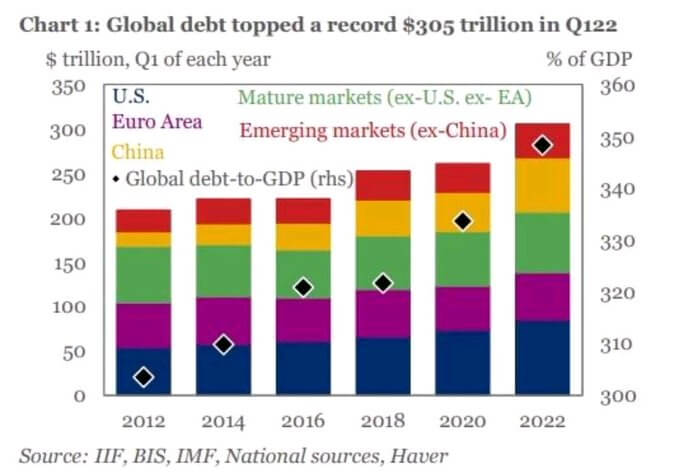
People and companies are diving into more debt all around the world. Total Global debt to GDP hit a record high of 348% in the first quarter of 2022.

global debt credit card spending from 2012 to 2022 (1)

Large and small corporations need more and more debt to produce similar growth rates as they have been used to. This is another strong signal that the central banks around the world will have to raise the interest rates radically. Unfortunately, by raising interest rates they will also create a recession as small businesses won’t be able to borrow money for growth. Such a combination of high inflation and reduced spending leads to stagflation. Stagflation = inflation + stagnation.

Increased government spending

If the government has trouble paying its bills, it can be forced to borrow more money or increase the money supply through quantitative easing (QE) or other methods. The latter boosts inflation and makes interest rates drop, which leads to higher asset prices. If this goes on long enough, it may even lead to an economic crisis—and that’s when you’ll see a stock market crash! In other words, increased federal spending can lead directly from one thing to another until you end up with a bubble, and then eventually all hell breaks loose as stocks tumble down their respective cliffs into oblivion. The federal government stimulus program has created an enormous amount of debt and inflation. The problem with high levels of debt and inflation is that they lead to higher interest rates, lower growth, and even a recession. That’s right: even if your investments grow 10% per year instead of 5%, your wealth won’t increase very much at all because these investments will be worth much less when adjusted for inflation over time—and who wants that?

Energy crisis

Natural gas prices rise 2022


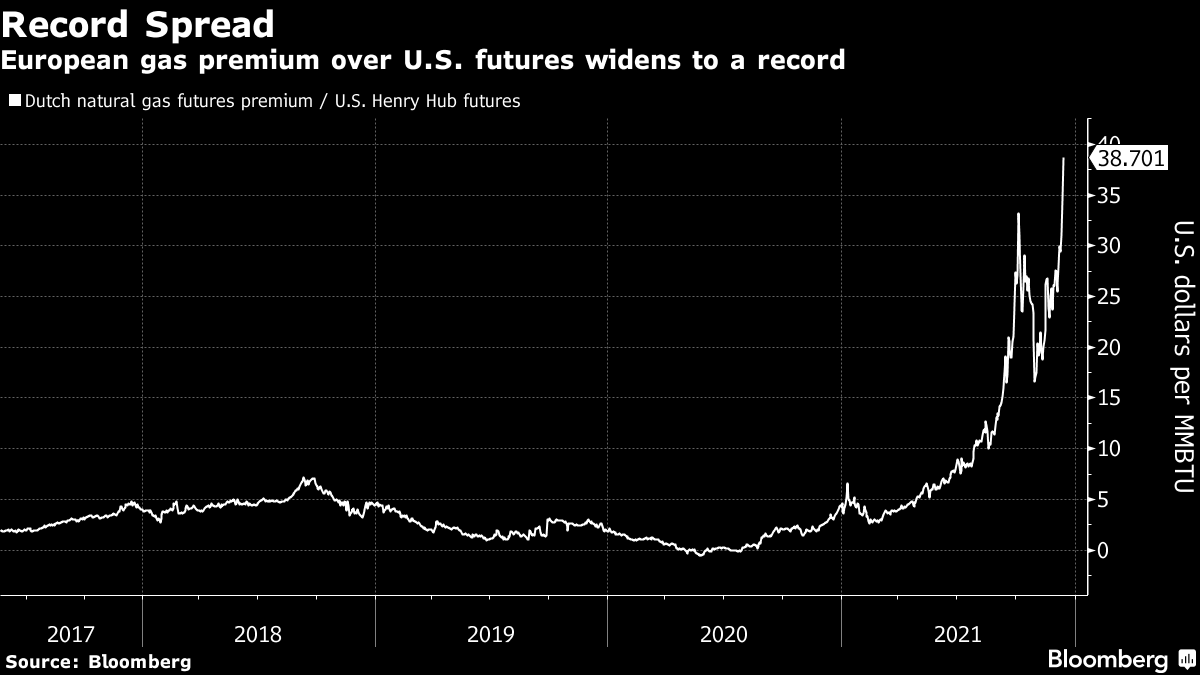
Many countries have adopted new greeneeewinieee energy laws… For example, England shut down North Sea gas production, The US shut down critical pipelines and production from proven oil and gas fields. Germany has shut down most of its Nuclear power plants with the idea that they will gradually move to renewable energy sources. Unfortunately, it doesn’t happen so fast. So in the meantime, they have to use coal and gas, thus driving the demand and price for gas up. Pair it with the fact that China has cut its use of coil and turned to gas (which is significantly cleaner)… …then add the fact that Russia is cutting its gas supplies to Europe as a form of blackmail…

The war in Ukraine

Whenever there is a large military conflict or just a threat of one, investors start to move their assets away from stuff like stocks into safer assets like gold or government bonds. As they sell their tech stocks, the prices of those stocks go down.

The potential war in Taiwan

There have been many signals that China might be considering invading Taiwan already in the autumn of 2022. Big investors are not waiting for it to happen and are taking out their assets from the stock market before it happens. Why? Because such military conflict would likely spill out creating a logistical paralysis for all Chinese<>Western goods. Also because Taiwan is the biggest producer of microchips and a war there would create a shock across all the markets, as everything runs on microchips.

Conclusion

The stock market is a war fought with money instead of bullets. The market has already fallen quite a bit, but nobody knows how far we are from the bottom before the market turns bullish again. Predicting the market bottoms is the hardest thing there is. But my job is to try to do hard thing

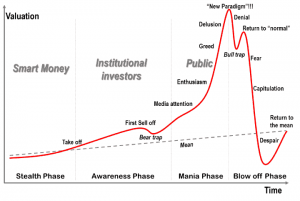
I fell into the Bull trap. I shorted correctly on the low expecting a further drop on May 20th around 11500 on the NASDAQ 100. The quick sharp upside reversal to 12900 fooled me. The bull trap. The drop to 11257 confirms my initial instincts were right. We lost a lot of money. I am now setting us up for the next leg down, which i believe has already started. This next move if we get it is called called capitulation. This should be the biggest drop yet. And IF i can guess lucky it could be worth millions. And if i guess wrong it will wipe out the account. In other words its all on the line.

Bitcoin extends losses, drops below $19,000

The price of Bitcoin slid under $19,000 on Saturday for the first time since December 2020 as evidence of deepening stress within the crypto industry keeps piling up against a backdrop of monetary tightening.The largest digital token by market value tumbled as much as 11% to $18,334 on Saturday, marking a record-breaking 12th consecutive daily decline according to Bloomberg data. Ether breached $1,000 and dropped almost 13% to $951, the lowest since January 2021. The two bellwethers of the crypto market are both down more than 70% from all-time highs set in early November. We are seeing more liquidations driving prices and sentiment lower, which triggers more liquidations and negative sentiment —  said Noelle Acheson, head of market insights at Genesis, one of the largest and best-known lenders in the digital-assets space. The latest leg down pushed Bitcoin below $19,511, the high the coin hit during its last bull cycle in 2017, which it reached at the end of that year. Throughout its roughly 12-year trading history, Bitcoin has never dropped below previous cycle peaks. Altcoins were no exception to soured investor appetite in the wake of Bitcoins fall, with every token on Bloombergs cryptocurrency monitor trading in the red. Cardano, Solana, Dogecoin and Polkadot recorded 24-hour falls of between 9% and 12% on Saturday, while privacy tokens such as Monero and Zcash lost as much as 11%. A toxic mix of bad news cycles and higher interest rates has been deleterious to riskier assets like crypto. The Federal Reserve raised its main interest rate on June 15 by three-quarters of a percentage point — the biggest increase since 1994 — and central bankers signaled they will keep hiking aggressively this year in the fight to tame inflation. Investors are continuing to position defensively following last year’s liquidity-driven digital asset bull market. Alkesh Shah, head of crypto and digital assets strategy at Bank of America Corp., said in a note on Friday. Although painful, removing the sector’s froth is likely healthy as investors shift focus to projects with clear road maps to cash flow and profitability versus purely revenue growth. Broader signs of stress emerged with last month?s collapse of the Terra blockchain, and worsened this week following crypto lender Celsius Network Ltd.’s recent decision to halt withdrawals. Adding to the mood, crypto hedge fund Three Arrows Capital suffered large losses and said it was considering asset sales or a bailout, while another lender, Babel Finance, followed in Celsius’s footsteps on Friday. Even long-term holders who have avoided selling until now are coming under pressure, according to researcher Glassnode. After Celsius, the focus last few days has been Three Arrow  Capital and Babel Finance.  said Teong Hng, chief executive of Hong Kong-based crypto investment firm Satori Research. Su Zhu, the founder of 3AC seems to be missing in action, after purportedly suffering huge losses due to massive drop in crypto this round. Stablecoins  a type of crypto asset pegged to the value of a fiat currency like the US dollar — have also struggled. The top four stablecoins saw exchange net outflows last week that were 4.5 times larger than the prior week, Bank of America’s Shah said, having charted net outflows in eight of the 10 prior weeks. Stablecoins are often relied upon by crypto traders to move funds around the ecosystem without needing to exit into traditional currencies, so persistent outflows indicate that investors remain defensive, he added. The crypto market now stands at a fraction of its heights in late 2021, when Bitcoin traded near $69,000 and traders poured cash into speculative investments of all stripes. The total market cap of cryptocurrencies was around $870 billion on Saturday, down from $3 trillion in November, according to pricing data from CoinGecko. NN: 2.2 trillion dollars gone with the bitcoin wind. This is a colossal failure. It is striking millennial high tech millionaires and billionaires, reducing them to poverty. The US economy cannot stand another  2 trillion dollar wipe out added to  the to 10 trillion lost in the stock market wipe out…… So far

Russian gas deliveries to France interrupted….. Russian gas deliveries to France interrupted…….. Gazprom reduces gas flow via Nord Stream….. Freeport LNG announces Explosion cut operations

French gas operator GRTgaz revealed on Friday that France is no longer receiving gas from Russia from the direction of Germany. The delivery was interrupted on June 15, the company stated. GRTgaz assured France will have no difficulty meeting the needs of consumers during the summer, noting that gas flow from Spain has increased. Current gas storage levels in France stand at 56%, compared to the usual 50% at the same time of year. “However, the proper filling of French storage facilities in anticipation of next winter must remain a priority for all shippers and stakeholders,” the company stated.

Russian gas deliveries to France interrupted

French gas operator GRTgaz revealed on Friday that France is no longer receiving gas from Russia from the direction of Germany. The delivery was interrupted on June 15, the company stated. GRTgaz assured France will have no difficulty meeting the needs of consumers during the summer, noting that gas flow from Spain has increased. Current gas storage levels in France stand at 56%, compared to the usual 50% at the same time of year. “However, the proper filling of French storage facilities in anticipation of next winter must remain a priority for all shippers and stakeholders,” the company stated. This severely affects Germany.

Gazprom reduces gas flow via Nord Stream.

Natural gas prices in Europe rose more than 16% on Wednesday following reports that Gazprom PJSC continues to reduce gas flow via Nord Stream. On Tuesday, it became known that the Russian company was reducing the amount pumped by 40%. And in addition, today, the firm cut about 15% of gas supplies to Italy, a representative of Eni SpA said. UK natural gas futures for delivery in July climbed 16.02% to 230,000 pence per therm at 3:37 pm CET

Freeport LNG announces Explosion

Natural gas soared in Europe after Freeport LNG announced that it will not return to full operations “until late 2022.” Freeport LNG reported on June 8 “an incident” that occurred at the “liquefaction plant on Quintana Island, Texas,” resulting “in the release of LNG, leading to the formation and ignition of a natural gas vapor cloud, and subsequent fire at the facility.” The company is “mindful” of this incident’s impact and the “suspension of operations on our personnel, our surrounding community, and the domestic and international gas and LNG markets.” Freeport LNG is an LNG export company headquartered in Houston, Texas, and it exports nearly 2 billion cubic feet per day of LNG out of the Freeport Terminal…. This is the gas Biden pledged to Europe.

 NN: you may think natural gas flows to Europe are not important this time of years where demand is low. What you need to understand is the fact that Europe needs all the gas it can get in the summer to fill storage tanks for winter. Reality is gas demand in the winter exceeds Russia ability to deliver by pipeline. That is why  Europe also needs the stored gas. Winter time storage so far is virtually non existent. And the US LNG supplies have been cut is half because the Louisianian LNG terminal has a “accident” (it blew up) and will be off line for 3 mouths.


Wall Street is officially in a bear market

The U.S. stock market met popular criteria for a bear market this week as the latest declines by the S&P 500 took the U.S. large-cap benchmark down by more than 20% from its record close in January. Investors, no doubt, are wondering how far stocks might fall from here, and what to do next. The S&P 500 SPX, -3.25% met the bear-market threshold on Monday and has largely remained under pressure this week aside from a Wednesday bounce following the Federal Reserve’s 75-basis-point rate hike, its largest in nearly 28 years. Fears that drastic rate hikes may trigger a recession in the next year are hanging over markets, analysts say. According to George Ball, chairman of the investment firm Sanders Morris Harris, bear markets bring an average 38% decline in stocks from peak to trough, which suggests that there may be further downside ahead. Through Thursday’s close, the S&P 500 was down 23.6% from its Jan. 3 peak close. “Any upward moves we may see in the near term are merely relief rallies. Chasing rallies in this bear-market environment should be avoided.”  Following Wednesday’s decision, Fed Chair Jerome Powell said the door was open for another 75- or 50-basis-point increase in July, but that 75-basis-point moves weren’t likely to become the norm. Analysts are becoming worried that the Fed is going to overshoot. NN: a lot of money has been lost in Bitcoin. I estimate upwards of a trillion dollars. This money fueled a lot of investments in the stock market especially high tech. Liquidation of positions on any upmove in stocks is the hallmark of a distressed market. We have had several surprises along the way. A blow up in crypto coin was not expected. My instincts have told me for a long time to stay away. In fact we had a bit coin mining operation on the table using our excess solar power that i nixed. The numbers looked great  at $50,000 bitcoin. Breakeven in 12 months. But a colossal loser at $20,000. Then you had the Euro and Pound getting slammed. And if that was not enough to make you wish you had gone to med school. The Fed is in danger of raising rates to fast. Remember this inflation for the most part is not financial led….. Money supply has been contacting for over a year now. Its driven by major errors the big retailers made in ordering inventories, China supply change distributions and idiot politicians slitting their throats by sanctioning their food and oil exports from  Russia. These are problems that will right themselves in time and the inflation created will not resolved themselves by throwing the economy into a depression.

Europe Follows U.S. Fed With Record-Breaking Rate Hikes

Following the U.S. Fed’s biggest rate hike since 1994 on Wednesday, which brought oil prices down 1%, central banks across Europe on Thursday raised interest rates by record amounts in an effort to rein in inflation as energy prices soar.   The biggest shocks came from the Swiss National Bank and the National Bank of Hungary. The Swiss National Bank made its first interest rate hike since 2007, increasing rates by 50 basis points, from -0.75% to -0.25%, sending the Swiss franc surging higher.  “We came to a conclusion that it is now better to increase interest rates by 50 basis points and not by 25 points in order to make an initial first step, in order to really also signal that we are fighting inflation so that it will also, over the medium-term, be in the range of price stability,” CNBC quoted the bank as saying.  In Hungary, the central bank raised its one-week deposit rate by 50 basis points, catching the market by surprise.  The Bank of England also raised rates for the fifth time on Thursday, increasing them by 25 basis points to 1.25%, noting that the bank would “take the actions necessary to return inflation to the 2% target sustainably in the medium term”, CNBC reported.  On Wednesday, the European Central Bank paved the way for rate hikes in July and September.  “We are in a new era for central banks, where lowering inflation is their only objective, even at the expense of financial stability and growth,” George Lagarias, Chief Economist at Mazars Wealth Management said, as reported by Reuters.  Inflation across Europe has been caused by soaring oil and gas prices, which surged another 24% on Thursday after Russia further curbed gas flows to the European Union through the Nord Stream 1 pipeline, citing technical issues.  NN:  What we have/are seeing is central bank panic. With the world currency markets crashing to the dollar and global bond markets wiping out they had to do something. They responded with a coordinated round of central bank raising interest rates. They also back door intervened to stop the Pound and Euro from crashing further.  We can see they are in crises mode. They have  signaled their panic. That is why the DOW lost over 700 points and the NASDAQ1100 DROPPED CLOSE TO 500 POINTS. Which means we expect soon to see reports of the start of a global recession. And the stock market plunge is far from over

Huge sell-off rocks Treasury markets, yield curve inverts

June 13 (Reuters) – U.S. two-year Treasury yields rose above 10-year borrowing costs on Monday – the so-called curve inversion that often heralds economic recession – on expectations interest rates may rise faster and further than anticipated. Fears the U.S. Federal Reserve could opt for an even larger rate hike than anticipated this week to contain inflation sent two-year yields to their highest levels since 2007. But a view is also playing out that aggressive rate hikes may tip the economy into recession. The gap between two and 10-year Treasury yields fell to as low as minus 2 basis points (bps), before rising back to around five bps, Tradeweb prices showed . The curve had inverted two months ago for the first time since 2019 before normalising. An inversion of this part of the yield curve is viewed by many analysts as a reliable signal that recession could come in the next year or two.The move follows inversions on Friday in the three-year/10-year and five-year/30-year portions of the Treasury curve, after data showed U.S. inflation continued to accelerate in May , .

Yield curve

Yield curve

Two-year Treasury yields rose to a 15-year high around 3.25% before easing to 3.19%, while 10-year yields touched the same level, the highest since 2018 . Friday’s data showed the largest annual U.S. inflation increase in nearly 40-1/2 years, dashing hopes the Federal Reserve might pause its interest rate hike campaign in September. Many reckon the central bank may actually need to up the pace of tightening. Barclays analysts said they now expected a 75 bps move from the Fed on Wednesday rather than the 50 bps which has been baked in. Money markets are now pricing a cumulative 175 bps in hikes by September and also see a 20% chance of a 75 bps move this week, which if implemented would be the biggest single-meeting hike since 1994 . UBS strategist Rohan Khanna said hawkish European Central Bank communication alongside the inflation print “have completely shattered this idea that the Fed may not deliver 75 bps or that other central banks will move in a gradual pace”. “The whole idea went out the drain … that’s when you get turbo-charged flattening of yield curves. It is just a realisation that peak inflation in the U.S. is not behind us, and unless we are told so, maybe peak hawkishness from the Fed is also not behind us,” Khanna added. Meanwhile bets on the U.S. terminal rate – where the Fed funds rate may peak this cycle – are shifting. On Monday, they priced rates to approach 4% in mid-2023, up almost one percentage point since end-May .

Deutsche Bank said it now saw rates peaking at 4.125% in mid-2023.

Some Fedwatchers are sceptical the Fed will move faster with rate hikes. Pictet Wealth Management’s senior economist Thomas Costerg noted, for instance, that most inflation drivers such as food and fuel remain outside central bankers’ control. “Over the summer, they will be aware of growth data and housing which is starting to look more wobbly,” Costerg said. “I doubt they will do 75 bps … 50 bps is already a big step for them.” The sell-off in Treasuries has set other markets on edge, sending German 10-year yields to the highest since 2014 and knocking S&P 500 futures 2.5% lower. NN: Obviousley the FED is not done. BUT these markets swing are a dog and pony show. We trade not what was, not even what is…..  BUT what will be. And 6 months from now Fed Fends will be close to 5% and our beloved 30 years strips now trading at 3.30%, under the ten year at 3.45%. Meaning the yield curve is inverted…. That will not last long. And it predicts a 30 year strip at 4.5 to 5%.  Oh baby baby come to daddy!