A little pre-summer cheer finally filtered its way into the stock market the week before Memorial Day, but it will likely take more than the Dow Jones Industrial Average’s first winning week since late March to convince rattled investors that the pain is in the past. What happened? Real, or inflation-adjusted, interest rates fell over the past week, corporate credit spreads — the yield premium over U.S. Treasurys demanded by investors to buy bonds issued by companies — tightened, and investor expectations for future Federal Reserve rate increases moderated, noted Mahmood Noorani, chief executive of research firm Quant Insight, in an interview. That gave some breathing room for a bounce. Quant Insight’s model showed the S&P 500 had sunk below fair value but is now right in line with the metric. The S&P 500 SPX, +2.47% had narrowly averted a close in bear-market territory on May 19 after hitting a session low more than 20% below its Jan. 3 record close. It then rose 6.6% over the past week, ending Friday 13.3% below its early January peak as it snapped a streak of seven straight weekly declines. The Nasdaq Composite COMP, +3.33%, which remains solidly in bear-market territory, also broke a run of seven weekly falls, rising 6.8%. The Dow’s DJIA, +1.76% matching 6.8% rise marked the end of an eight-week run of losing weeks, its longest since 1932. Kevin Dempter, an analyst at Renaissance Macro Research, also pointed to a handful of positive factors, including a significant pullback by the U.S. dollar, deeply oversold technical conditions and extremely bearish sentiment, while some stocks, such as that of Nvidia Corp. NVDA, +5.38%, managed to reverse to the upside despite bad news. Neither Noorani nor Dempter were prepared to call a market bottom, however. And there was no shortage of outright bearish expectations. Michael Burry, the founder of Scion Asset Management, rose to fame after anticipating the collapse of the U.S. housing market as chronicled in the Michael Lewis book “The Big Short,” in a since-deleted tweet implied parallels with the 2008 market collapse. In a fresh Friday tweet, he mused about the prospects of a consumer-led recession: That echoes the fears that were raised earlier in May as retailers Target TGT, +2.41% and Walmart WMT, +1.97% reported disappointing earnings, triggering a deepening of the stock-market selloff on worries that inflation pressures were beginning to hit corporate bottom lines. A further pullback in real yields could allow stocks to rise further in the near term, Noorani said, but he argued that it’s unlikely yields have peaked. After all, while data, including Friday’s reading of the core personal consumption expenditure index, the Fed’s preferred inflation indicator, shows inflation is slowing, the job of getting price pressures back under control is far from done, he argued. That leaves uncertainty about how high the federal funds rate, currently at 0.75% to 1%, will ultimately go. Market pricing points to a so-called terminal rate between 2.5% and 3%, but anything that hints it will be higher than that will rattle investors, he said. The single most important driver for yields “is going to be Fed policy,” he said, observing that central bankers “have been spooked by inflation at these historically high numbers.” Even if it’s painful for the real economy, “they have to hit the brakes pretty hard and get those numbers lower.” While the S&P 500 hasn’t technically confirmed that it’s in a bear market, many market watchers view that as a mere formality, observing that stocks have been exhibiting bearlike behavior for much of the 2022 selloff. Dempter, in a Friday note, played down the consumer discretionary sector’s sharp outperformance of the rest of the market in the previous session, acknowledging that, historically, discretionary sees sharp improvement in relative performance about a month before growth troughs. The move was likely an oversold bounce rather than a bottom, he argued, explaining that RenMac would be more optimistic “if growth were weaker, and inflation had peaked.” “History suggests that both growth and inflation need to weaken further before a bottom occurs,” he said, noting that the energy sector’s continued outperformance of healthcare suggests that inflation has yet to peak. NN: obviously inflation has not peeked and the FED burnt by waiting to long to raise rates is not done… Not by a long shot. This rally in time will be proved to be folly.
The Selloff Won’t Be Over Until There’s a ‘Solid Panic’
Stocks have fallen to near-bear market territory. Bonds have suffered big price declines. Foreign currencies have nosedived against the US dollar. Cryptocurrencies, SPACs and other speculations have collapsed. But commodities have been on a tear. The Bloomberg Commodity Spot Index has surged 33% this year, with energy, metals and agriculture prices all showing big gains. Investors, spooked by faster inflation, rising geopolitical risks and accumulating portfolio losses, are pushing into commodity exchange-traded funds to hedge their portfolios. This year through April, $21.4 billion flowed into commodity ETFs in contrast to the $63 billion in outflows in the first four months of 2021, according to Morningstar. Commodities bulls may soon regret their enthusiasm as both demand and supply forces look like they will soon start to depress prices. Covid-19 has led to continuing lockdowns in China, causing dramatic production cutbacks in the world’s second-largest economy, which accounts for 18.1% of global gross domestic product and 23.9% of manufacturing. The pain has spread to China’s imports of commodities from countries such as Brazil, Chile and Australia of oil, copper and iron ore as well as manufacturing exporters like Germany, South Korea and Taiwan. According to Nomura Holdings Inc., Chinese imports of iron were down 13% in April from a year earlier, copper fell 4% and imports of cars and chassis dropped 8%. Russia’s invasion of Ukraine has also disrupted global demand and the robust dollar has curtailed demand for commodities by developing countries since their currencies have fallen 3% on average since April. Of 45 major commodities traded globally, 42 are priced in dollars. The only exceptions are wool (Australian dollars), amber (Russian rubles) and palm oil (Malaysian ringgit). Developing economy commodity imports are also depressed by their growing need to use scarce foreign exchange to service dollar-denominated debts. From 2018 through 2021, Chile’s non-bank dollar debt rose from 34.7% of GDP to 50.3%, Mexico’s from 21.9% to 30.1% and Turkey’s from 23.0% to 28.2%. Commodities also suffer as economic growth favors services over goods. Since World War II, American spending on goods has dropped from 61% of their total outlays to 35% while spending for services rose from 38% to 65%. That’s also true for developing countries like China. On the supply side, the world d continues to face higher commodity prices. NN: Its a dangerous game we play. Shorting the bear market rally back. Their is no doubt in my mind that another sell off in stocks is coming. But we are playing a dangerous game that could blow up in our face. We are selling this rally back. As we often do. AND WE COULD GET CRUSHED…. SO you might rightfully ask WHY DO IT: The simple answer is that’s what we do!. But a better answer is markets this nervous stop on a dime and CAN make stunning reversals. Some of the greatest gains to be made are in markets that are about to see capitulation. Which has not occurred….. yet. The reality is the fed has only just begun raising rates and inflation is out of control. The drivers for inflation becoming more powerful by the day. I still see eenrgy prices soaring, I still see supply chain shortage and material shortages…. I still see Russia pounding the shit out of Ukraine. Embargo and food and energy shortages are growing war is polarizing Europe. Dragging in more participants. With more and more countries taking side and supplying more and more and bigger arms. And do not forget the FED is way behind the power curve on raising rates and has not begun to claw back stimulus…..
US Consumer Sentiment Falls to Fresh Decade Low on Inflation
-
Final May University of Michigan gauge declined to 58.4
-
Views of economic outlook, buying conditions deteriorate
US consumer sentiment deteriorated further in late May to a fresh decade low as escalating concerns over inflation dimmed the outlook for the economy. The University of Michigan’s final May sentiment index decreased to 58.4 from a preliminary reading of 59.1, data released Friday showed. In April, the gauge stood at 65.2.
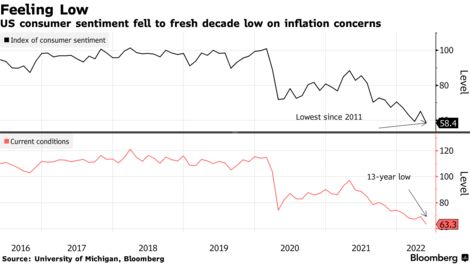
Households turned especially pessimistic in their short- and long-term outlooks for the economy. A gauge of current conditions fell to a 13-year low of 63.3, while a measure of future expectations dropped to 55.2. Consumers expect prices to rise 5.3% over the next year, holding close to a four-decade high. They expect prices will climb at an annual rate of 3% over the next five to 10 years. “This recent drop was largely driven by continued negative views on current buying conditions for houses and durables, as well as consumers’ future outlook for the economy, primarily due to concerns over inflation,” Joanne Hsu, director of the survey, said in a statement.
The university’s index of buying conditions for durable goods dropped in May to the lowest level on record.
Inflation is outpacing wage gains, stressing Americans’ finances and leaving less discretionary income after covering for higher costs of food and gas. And while workers have enjoyed a strong job market, there are signs that pay increases have peaked.A separate report earlier Friday showed inflation-adjusted consumer spending rose in April by the most in three months, indicating households were holding up in the face of persistent price pressures by dipping into savings. President Joe Biden and fellow Democrats are desperate to bring inflation down ahead of midterm elections later this year, and so far Americans are frustrated with their efforts. Opinions on government policies to fight inflation and unemployment are at the lowest since 2014, the university’s report showed. NN: The market is celebrating a stock market bottom and inflation peeking and crises over. I adamantly disagree AND am getting my clocked cleaned. I am still within my loss parameters and eager to see what happens next week when volume returns to the markets…….. Make no mistake about it the growing global and depression is outside the FED’s bailiwick. It is driven by the energy crises, global food shortages and the Russian /Ukraine war… That is sucking in more combatants. Their is little diference in supply troops on the ground and supplying more a bigger weapons.
Swiss to destroy more than 620,000 expired Moderna COVID doses…..
Switzerland will destroy more than 620,000 expired doses of Moderna’s COVID-19 vaccine, health officials said on Friday, as demand for the shots drops dramatically. “It was consciously accepted that under certain circumstances too much vaccine was procured for Switzerland’s needs,” a spokesperson for the Federal Office of Public Health said, confirming a report by broadcaster RTS.
“The aim is to protect the population in Switzerland at all times with sufficient quantities of the most effective vaccines available.” Switzerland, which has ended public health measures designed to curb the spread of the disease, secured a total of 34 million doses of COVID-19 vaccines for 2022 for a population of around 8.7 million.
It said in February https://www.admin.ch/gov/en/start/documentation/media-releases.msg-id-87300.html it would donate up to 15 million surplus doses to poorer countries by mid-year. How many doses can actually be donated is still under discussion. Switzerland said in March it had secured at least 14 million doses of COVID-19 vaccines for 2023 from Pfizer/BioNTech and Moderna, with options to double the order.
It will also buy up to one million doses from another manufacturer. Just over 70% of the population has had at least one shot in Switzerland and tiny neighbor Liechtenstein. Authorities have reported nearly 3.7 million COVID infections and 13,325 deaths.
(This story has not been edited by Devdiscourse staff and is auto-generated from a syndica
BP Reviews North Sea Investments In Wake Of UK’s Windfall Tax
BP Plc said it will look again at its plans in the UK, raising questions about whether a £5 billion windfall tax on oil and gas profits announced by the government included enough incentives to preserve investment.
The statement opens up the possibility of reversal by the London-based oil major, which has previously said that planned investments of £18 billion ($23 billion) in the country by 2030 weren’t contingent on whether or not the government raised taxes.
“Today’s announcement is not for a one-off tax -– it is a multiyear proposal,” BP said in an emailed statement. “We will now need to look at the impact of both the new levy and the tax relief on our North Sea investment plans.” The UK government announced on Thursday that it will impose a 25% windfall tax on oil and gas companies, bowing to mounting pressure to support Britons facing a record squeeze on living standards. Chancellor of the Exchequer Rishi Sunak appeared to try to head off criticism that the measure was anti-business, including in the proposal an 80% new-investment allowance that means energy companies can reduce the amount they pay if they commit to fresh capital expenditure. The major risk to the UK North Sea oil and gas industry is that international companies like BP and Shell, which are scaling back fossil-fuel investments in favor of low-carbon energy, see the UK as less attractive following this announcement, JP Morgan’s Managing Director for Global Energy Christyan Malek said in an interview. A windfall tax “creates unpredictability for projects that take years to develop,” Malek said. While most companies acknowledged that Sunak was responding to an urgent real cost-of-living crisis, the industry reacted with a mixture of caution and disappointment. Shell Plc, BP’s closest peer, said that “a stable environment for long term investment” was fundamental to its plan to invest as much as £25 billion into the UK’s energy system in the next decade. “The chancellor’s proposed tax relief on investments in Britain’s energy future is a critical principle in the new levy,” a Shell spokesperson said. Most analysts expected smaller explorers and producers, so-called E&Ps, to be hit much harder than majors. “Fueled by public anger over BP and Shell’s record profits amid a cost-of-living crisis, the UK’s ‘temporary targeted energy profits levy’ of 25% on North Sea oil and gas earnings will instead disproportionately hit independent E&Ps with far higher relative exposure to British operations,” Bloomberg Intelligence senior analyst Will Hares said in a note. Harbour Energy Plc, a relative minnow globally but the biggest producer in the UK, may face about £840 million in extra costs from 2022 to 2024, Stifel analyst Chris Wheaton wrote in a note. While Harbour’s investments offset some of the tax impact, “this could well incentivise the company to look more closely at acquisitions outside the UK,” he said
EnQuest Plc, which produces more than 90% of its oil and gas in the UK, said it was “disappointed with the implementation mechanics” of the new levy. The industry lobby group was more direct in its criticism.
“The new taxes imposed on the UK’s offshore oil and gas operators are a backward step by a government which, just weeks ago, was pledging to build a greener and more energy-independent nation,” Offshore Energies UK said in a statement. “This is the exact opposite of what was promised in the British energy Security Strategy published just last month.” Shares of EnQuest have fallen more than 15% this week, and Serica is down 23%. Harbour Energy headed for a weekly loss of about 12%. That compares to the StoxxEurope 600 Oil & Gas Index, which is up 3.4%. BP and Shell were poised for a small weekly gain. While it may take years for the long-term impact to emerge, the political necessity of the windfall tax, and the juiciness of the target, are clear. Demands to intervene in the cost-of-living crisis have become overwhelming, with a windfall tax increasingly popular among Britons. The governing Conservative Party has trailed Labour in YouGov polling since December. Sunak’s move also comes as the government tries to shift the narrative from the scandal surrounding illegal parties in Downing Street during the pandemic. Meanwhile, Big Oil is churning out massive profits, largely on the back of higher energy prices due to Russia’s invasion of Ukraine. Shell posted its highest earnings on record in the first quarter. The tax will only apply to profits generated in the UK. The bulk of BP and Shell’s earnings come from operations in other countries, and both companies have scarcely paid any corporation tax in Britain since 2015 because of losses tied to investments in North Sea fields, or dismantling old platforms out at sea. The new levy won’t allow companies to offset such expenses against their tax bill. NN: The reason why Europe and the UK got in this energy crises to begin with is the fact they killed the domestic oil industry. The politicans want to blame oil for their bad decisions…..
US closes higher despite disappointing data
Major stock market indexes in the United Stated jumped on the closing bell despite disappointing data on Thursday, as the National Association of Realtors announced that pending home sales in the United States declined more than expected 3.9% in April compared to the previous month, while the US gross domestic product (GDP) decreased 1.5% on an annual basis. Baidu Inc. announced on Thursday that its total revenue hit 28.4 billion yuan ($4.48 billion) in the first quarter of 2022, up by 1% compared to the same period a year ago. The Dow Jones jumped 1.61% or 518 points at the closing bell with the Boeing Company gaining 4.65%. The Nasdaq rose by 2.79% or 332 points, with Dollar Tree climbing another 21.87%. The S&P500 gained 1.99%. The euro was 0.33% higher against the dollar, selling at $1.07228 at 3:59 pm ET.
US stocks soar further, Dow up 500 pts
Stocks continued to rebound from the lowest levels in over a year as solid outlooks from retailers bolstered confidence in the economy despite supply-chain snags and inflationary pressures. A slide in US mortgage rates by the most since April 2020 and Broadcom Inc.’s $61 billion acquisition of VMware Inc. also boosted risk appetite. Consumer shares led gains in the S&P 500 as giant Macy’s Inc. lifted its profit forecast amid demand for high-end goods, while deep-discount stores Dollar Tree Inc. and Dollar General Corp. raised their sales projections. Megacaps Amazon.com Inc. and Tesla Inc. helped push the Nasdaq 100 up about 3%. Southwest Airlines Co. and JetBlue Airways Group Inc. surged on bullish revenue estimates. Major stock markets in the United States extended gains on Thursday, with Dow Jones soaring 502 points at 11:12 am ET. The investors seemingly reacted positively to Macy’s latest earnings announcement, which overpowered the disappointing data reports. Namely, Macy’s diluted earnings per share for the first quarter of fiscal 2022 more than tripled rising 200% year on year to stand at $0.98. On the other hand, the US gross domestic product (GDP) decreased 1.5% on an annual basis, while the country’s pending home sales reached a two-year low in April. The Dow Jones skyrocketed 1.55% or 502 points at 11:12 am ET. The S&P 500 surged 1.75% a minute later, while the Nasdaq 100 jumped 2.23% at 11:13 am ET. The euro traded 0.31% higher against the dollar at 11:13 am ET, selling for 1.07200.
baha us tech 100
Russian President Putin holding world to ransom over food – UK’s Truss… And oil too… Because the idiot politicians let him
SARAJEVO, May 26 (Reuters) – British foreign minister Liz Truss accused Russian President Vladimir Putin of holding the world to ransom over food, responding to a question about whether she supported lifting sanctions in exchange for grain exports from Ukraine. “It is completely appalling that Putin is trying to hold the world to ransom, and he is essentially weaponising hunger and lack of food amongst the poorest people around the world,” Truss said during a visit to Bosnia on Thursday. “We simply cannot allow this to happen. Putin needs to remove the blockade on Ukrainian grain.” On Wednesday, Russian Deputy Foreign Minister Andrei Rudenko was cited by the Interfax news agency as saying that Moscow was ready to provide a humanitarian corridor for vessels carrying food to leave Ukraine, in return for the lifting of some sanctions. Western countries have coordinated in imposing sanctions on Russia, from its companies and media outlets to businessmen and politicians, to punish Moscow for the war in Ukrainian. “What we cannot have is any lifting of sanctions, any appeasement, which will simply make Putin stronger in the longer term,” Truss said. NN: Putin is not to blame. He is smart enough to take advantage of the Greeninnieewinnie fantasy. The reason why grain prices are so high is because the US mandates 40% of gasoline to be renewables. Since corn grows every year it is indeed a renewable crop and is used for producing alachol to mix with gasoline. At $3.00 a bushel corn was a cheap food feeding the world. Since the US chose to burn food as a fuel corn is at $9.00…. its a luxury item unafordable to the emerging world. Instead of sanctioning Putin which will not work anyway. Simply remove the gasoline mandate and grain prices will crash right down back to earth. Same with oil. Midwest refiners are old and obsolete and can only refine heavy crude. (US has not built a new refinery in 50 years). US light sweet will not work. So the oil is supplied by Canada, Russia or Venezuela. The US stopped construction of the oil pipeline from Canada (in fact Canada is building a pipeline to its west coast to export this oil the US desperately needs, to china) and prohibited existing pipelines from importing Canada heavy crude. Instead of letting the Canadian crude come to America which is as simple as opening a valve the US is turning to another dictatorship Venezuela to supply heave crude…. How do you think that will end up. As far as Europe is concerned it shut down its gas fields, prohibited exploration, Prohibited clean burning thermal coal and shut down clean Nukes and turned to Russia as a 45% supplier of all its energy needs. They did this before solar or wind was a viable option. So they are fucked and blaming Putin…….
Iranian-Russian ‘Oil Smuggling’ Network Hit With U.S. Sanctions
May 25 (UPI) — The United States on Wednesday sanctioned a sprawling international oil smuggling and money laundering network that the Biden administration said is led by Iran’s elite Islamic Revolutionary Guard Corps’ Qods Force and is supported by Russia. The U.S. departments of Treasury and State announced the blacklisting of 10 people from four countries and nine companies based in six nations Wednesday, describing the network as having facilitated the sale of hundreds of millions of dollars’ worth of Iranian oil for the IRGC-QF and Hezbollah, an Iran-backed militant group based in Lebanon. Both groups have been U.S. designated Foreign Terrorist Organizations. The United States said the network is run by two U.S. sanctioned individuals — IRGC-QF official Behnam Shahriyari and former official Rostam Ghasemi — and that there efforts are supported by senior levels of the Russian government as well as state-run organizations. The sanctions were imposed as the Biden administration seeks to resurrect a multination nuclear accord that aimed to deny Tehran from developing an atomic weapon that former President Donald Trump withdrew the United States from in 2018. Ned Price, the State Department spokesman, told reporters during a press briefing on Wednesday that the Biden administration has been clear about its intentions of wanting to implementation the Joint Comprehensive Plan of Action in full but that it will not tolerate the illicit activities of the IRGC-QF or its proxies. “We’re continuing down this dual path to attempt to put these strict limits back on Iran’s nuclear program just as we push back and hold Iran accountable for its other illicit activities, but also knowing that if and when we permanently and verifiably have Iran’s nuclear program once again contained and confined, we are going to be able to take on these other challenges together with our allies and partners … much more effectively,” he said. Among those sanctioned Wednesday include Kamaluddin Gulam Nabizada, a former Afghanistan ministry official in Moscow, who is accused of raising money for the IRGC-QF with the help of senior Russian government and intelligence officials. He was also the manager of Moscow-based RPP Limited Liability Company, which the Biden administration sanctioned on accusations of transferring millions of dollars from Russia for the IRGC-QF. Mihrab Suhrab Hamidi, the current RPP LLC manager of oil sales and transport, was also hit with sanctions. Zamanoil DMCC, a company based in the United Arab Emirates, was also blacklisted for working to ship Iranian oil to Europe with the Russian government and state-owned Rosneft, which was previously sanctioned by the United States. Several Iran-based individuals were targeted for being facilitators for the IRGC-QF as well as as several Turkey-based individuals and companies, including one in South Korea, that the Treasury accused of acting as a money laundering network for the espionage arm of the Iran military. A Hezbollah front company in Lebanon was also sanctioned as were several Chinese companies accused of being involved in the sale and purchase of tens of millions of dollars’ worth of Iranian oil. The sanctions came less than a week after the Treasury sanctioned a Lebanese businessman and his network of associates and companies on accusations he uses it to fund Hezbollah. “While the United States continues to seek a mutual return to full implementation of the Joint Comprehensive Plan of Action, we will strictly enforce sanctions on Iran’s illicit oil trade,” Secretary of State Antony Blinken said in a statement. “We will not hesitate to target those who provide critical support for the IRGC and Hezbollah and facilitate their access to the international financial system.” NN: The bureaucrats are buying their own bullshit. When have sanctions ever stopped anyone from anything. If people want food they will get food, if people want oil they will get oil and if people want drugs they will get drugs. The only question is quantity and price……
Sanctions Have Increased Russia’s Oil And Gas Revenue
- Russia’s oil and gas revenues hit another record high despite sanctions designed to hurt the Russian economy.
- The removal of some Russian oil from markets only served to send oil prices higher, boosting revenues from the oil that it is able to sell.
- There is no way to remove Russian oil from the market entirely without sending oil prices much higher, possibly above $200.
Russia is benefiting from the sanctions on its oil exports.
“Russian sanctions are reducing the available oil supply in a tight market. Russia is still selling all the oil it produces to countries that refuse to abide by the sanctions, it is doing well financially because of the oil price spike.”
We now have data in hand to confirm that the subsequent sanctions on Russia’s oil are in fact boosting Russia’s oil revenues:
New data! #Russia’s oil and gas revenues hit another record high in April. 1.8 trillion rubles in a single month, after 1.2 trillion in March. After only 4 months, Russia’s federal #budget has now already received 50% of the planned oil and gas revenue for 2022 (9.5 trillion). pic.twitter.com/DKUGClchWG
— Janis Kluge
Although the U.S. has stopped buying Russian oil, the challenge remains that Russia is one of the largest global producers and exporters of oil. There is no way to completely remove Russian oil from the market without sending oil prices much higher — perhaps to $200 a barrel. Further, as oil prices go higher it increases the appeal of Russia’s oil. Right now, China and India, for example, have tremendous incentive to buy discounted Russian oil. In other words, it is a classic catch-22. In attempting to punish Russia by keeping its oil off the market, Russia is enjoying a net benefit of higher oil revenues. That’s not to say that other sanctions aren’t having the desired impact. By all accounts, life is becoming more difficult in Russia due to the many sanctions that have been put in place. But in a world that is still heavily dependent on oil, the only way to effectively impact Russia’s oil revenues is to reduce global dependence on oil.