Requests for Russian natural gas deliveries for the EU via Ukraine and Slovakia on Monday reached their highest level since November 2021, sending European benchmark gas prices lower in early trade, despite the ongoing dispute over rubles-for-gas payments and Russia cutting off deliveries to Poland and Bulgaria. Daily nominations for Russian supply through Ukraine and the Slovakian border point of Velke Kapusany hit the highest level since November 30, per data from Slovakia’s transport system operator Eustream cited by Reuters. Russian gas flows via the Nord Stream pipeline to Germany were also up on Monday compared to Friday, according to Reuters estimates. On the Yamal-Europe pipeline, gas flows continue in reverse mode from Germany eastwards to Poland, operator Gascade’s data seen by Reuters showed early on Monday. Poland continues to receive Russian gas – via reverse flows from Germany—after Gazprom cut off direct gas supply to Poland in the middle of last week, Russia’s gas giant said. Last Wednesday, when Russia halted gas supply to Poland and Bulgaria, flows on the Yamal-Europe pipeline from Germany to Poland jumped, according to Gascade cited by Reuters. Gazprom cut off supply to Poland and Bulgaria on Wednesday, saying deliveries were stopped “due to absence of payments in rubles”. Polish Prime Minister Mateusz Morawiecki described the halt of Russian supply as “a direct attack” on Poland and vowed that the country would not give in to “this blackmail”. Bulgarian Energy Minister Alexander Nikolov commented. “It is clear that in the current war in Ukraine, Russia uses natural gas as a political and economic weapon.” The EU is working to ensure alternative gas supply and pledged a coordinated response to what European Commission President Ursula von der Leyen also described as “yet another attempt by Russia to use gas as an instrument of blackmail”. Despite the EU-Russia standoff on gas and the clear and present threat that Russia could cut off deliveries to other EU member states, Europe’s benchmark gas prices at the Dutch TTF hub traded lower early on Monday, amid higher nominations for Russian gas deliveries via Ukraine.
Germany could back IMMEDIATE EU ban on Russian oil
Germany said on Monday it was prepared to back an immediate European Union embargo on Russian oil, a major shift from Moscow’s biggest energy customer that could let Europe impose such a ban within days. Russia’s energy exports – by far its biggest source of income – have so far largely been exempt from international sanctions over the war in Ukraine. Kyiv says that loophole means European countries are funding the Kremlin war effort, sending Moscow hundreds of millions of euros every day. Economy and climate minister Robert Habeck said on Sunday that Europe’s largest economy had reduced the share of Russian energy imports to 12 per cent for oil, 8 per cent for coal and 35 per cent for natural gas. Germany has been under strong pressure from Ukraine and other nations in Europe to cut energy imports from Russia that are worth billions of euro, which help fill Russian president Vladimir Putin’s war chest. “All these steps that we are taking require an enormous joint effort from all actors and they also mean costs that are felt by both the economy and consumers,” Mr Habeck said in a statement. “But they are necessary if we no longer want to be blackmailed by Russia.” Germany has managed to shift to oil and coal imports from other countries in a relatively short time, meaning that “the end of dependence on Russian crude oil imports by late summer is realistic”, Mr Habeck’s ministry said. Weaning Germany off Russian natural gas is a far bigger challenge. Before Russia invaded Ukraine on February 24th, Germany got more than half of its natural gas imports from Russia. That share is now down to 35 per cent, partly due to increased procurement from Norway and the Netherlands, the ministry said. To further reduce Russian imports, Germany plans to speed up the construction of terminals for liquified natural gas, or LNG. The energy and climate ministry said Germany aimed to put several floating LNG terminals into operation as early as this year or next. This was an ambitious timeline that the ministry acknowledged “requires an enormous commitment from everyone involved”. Germany has resisted calls for an EU boycott on Russian natural gas. It also watched with worry last week as Moscow immediately halted gas supplies to Poland and Bulgaria after they rejected Russian demands to pay for gas in roubles. European officials called these moves by Russia “energy blackmail”. Germany’s central bank has said a total cutoff of Russian gas could mean five percentage points of lost economic output and higher inflation. NN: See that part were he says COSTS shared by all. I take that costs to mean $150 a barrel oil……. ZOOM ZOOM ZOOM!
Germany says quitting Russian oil by late summer is ‘realistic’
EU considering embargo of Russian oil; Russian coal to be banned starting in August
U.S. Gas Production Slows At The Worst Possible Time
Growth in natural gas production in the biggest producing regions in the United States is on the decline due to the lack of sufficient pipeline network, as prices soar at home alongside a major uptick in LNG exports destined for gas-thirsty Europe. Since Russia’s invasion of Ukraine in late February, U.S. natural gas prices have increased approximately 50%, Reuters reports, and producers in Appalachia and West Texas are now struggling with a shortage of pipelines to move product to market Appalachia accounted for 37% of total U.S. gas production, while West Texas accounted for another 19%, Reuters said, citing a warning by Bank of America analysts that Appalachia was nearing the limits of its takeaway capacity, heralding a potential halt to production growth. In West Texas, home of the Permian shale play, pipelines are also filling up quickly, according to Reuters. The pipeline shortage could lead to even higher prices for natural gas, which topped $7 per million British thermal units on the spot market at the end of last month. May futures also expired at a price above $7 per mmBtu, the Energy Information Administration (EIA) reported last week. Natural gas prices stood at $7.250 at the time of writing (8:18am EST). The timing of this pipeline shortage comes as Europe is seeking alternatives to Russian gas, with U.S. LNG the preferred replacement. Currently, the U.S. has the capacity to export 9.8 billion cu ft daily, according to Reuters, while Europe’s largest economies import Russian gas at a rate of 18.3 billion cu ft daily. Pandemic demand recovery for natural gas, inflation and energy shortages at home will affect American consumers. NN: I repeat their is no replacement for Russian gas and oil AND US demand will see record increases the rest of the year,,,,,, Revenge tourism.. Its my right to vacation.
OPEC oil output in April barely rises as African outages weigh-survey
The increase in OPEC’s oil output in April undershot the rise planned under a deal with allies, a Reuters survey found, as declines in Libya and Nigeria offset supply increases by Saudi Arabia and other top producers. The Organization of the Petroleum Exporting Countries (OPEC) pumped 28.58 million barrels per day (bpd) in April, the survey found, up 40,000 bpd from the previous month and short of the 254,000 bpd increase called for under the supply deal. OPEC and its allies, known as OPEC+, are slowly relaxing 2020 output cuts as demand recovers from the pandemic. OPEC+ meets on Thursday and is expected to confirm a previously agreed output hike despite the surge in oil prices after Russia’s invasion of Ukraine. “Probably the view is to maintain the plan,” an OPEC delegate said of Thursday’s meeting. The deal called for a 400,000 bpd increase in April from all OPEC+ members, of which about 254,000 bpd is shared by the 10 OPEC producers the agreement covers. Output undershot the pledged hikes from October to March, with the exception of February, according to Reuters surveys, as many producers lack the capacity to pump more crude following insufficient investment, a trend accelerated by the pandemic. As a result, the 10 OPEC members are pumping far less than called for under the deal. OPEC compliance with pledged cuts was 164 percent, the survey found, versus 151 percent in March. The biggest drop in output was in Libya, which at one point in April was losing more than 550,000 bpd from blockades on fields and terminals. Libya is one of the OPEC members exempt from making output cuts. Nigerian output posted a 40,000 bpd decline, the survey found, with lower exports than in March. Force majeure remains in place on the Bonny Light export stream. These outages limited the increase in OPEC’s output as top producers followed through on the pledged hike in supply. The biggest rise in April of 100,000 bpd came from Saudi Arabia, the survey found. Iraq, which reported a month-on-month rise in exports, boosted output by 80,000 bpd. The United Arab Emirates followed through on its higher quota and added 40,000 bpd, while Kuwait’s output edged up by 10,000 bpd. Iran, also exempt from making output cuts, has been shipping more to China in 2022 and production rose in April, the survey found, even as talks on reviving its 2015 nuclear deal with world powers have yet to reach a deal. Production in Venezuela, another exempt producer, edged higher. Production fell or did not increase in Angola, Equatorial Guinea and Gabon, the survey found, because of a lack of capacity to produce more. NN:Reality is gas and oil production is not recovering. Thier is not the spare capacity before the Ukrain crises. And when you take just a little Russian gas and oil out of the market you end up with a no shit full blown energy crises..
EU Ministers Hold Meeting to Discuss Russian Gas
European Union energy ministers are gathering in Brussels today for an emergency meeting. They are discussing options to maintain energy supplies and the fallout from the move by state-owned Gazprom PJSC to cut off Poland and Bulgaria.
NN: we are awaiting the result of this meeting
Oil prices drop amid concerns on China economy….. Poland demands definitive oil embargo dates on Russia
LONDON (Reuters) -Oil prices fell on Monday as concerns about weak economic growth in China, the world’s top oil importer, outweighed fears of potential supply stress from a potential European Union ban on Russian crude. Brent crude futures fell 71 cents, or 0.6%, to $106.43 a barrel at 0801 GMT, while U.S. West Texas Intermediate (WTI) crude futures fell 70 cents, or 0.6%, to $103.99 a barrel. Markets in Japan, India and across Southeast Asia were closed for public holidays on Monday.
Prices fell after China released data on Saturday showing that factory activity in the world’s second-largest economy contracted for a second month to its lowest since February 2020 because of COVID lockdowns.
“A slowing to that extent, when China is already suffering from a property bust and worries about its (until recently) increased regulation, is potentially a major issue for commodity markets and the world economy,” said Tobin Gorey, a Commonwealth Bank commodities analyst, in a note. On the supply side, Libya’s National Oil Corp (NOC) said on Sunday it would temporarily resume operations at the Zueitina oil terminal to reduce stockpiles in storage tanks to avert an “imminent environmental disaster” at the port. NOC in late April declared force majeure on some shipments at Zueitina as political protesters forced a number of oil facilities to suspend operations. Limiting the downside for oil prices is the EU’s leaning towards a ban on imports of Russian oil by the end of the year, two EU diplomats said, after talks between the European Commission and EU member states over the weekend. Around half of Russia’s 4.7 million barrels per day (bpd) of crude exports go to the EU, supplying about one-fourth of the EU’s oil imports in 2020. “In the absence of an immediate EU total oil embargo, eliminating mobility restrictions in China is necessary to drive oil out of its current range,” said SPI Asset Management Managing Partner Stephen Innes. While Western countries have curbed buying Russian oil as sanctions have hit shipping and insurance for the country’s exports, the impact on global supply has been cushioned as India has been picking up heavily discounted Russian cargoes.
Poland demands definitive oil embargo dates on Russia
Polish Climate Minister Anna Moskwa told reporters on Monday, ahead of the EU energy meeting that the country expects “this [sanctions] package to include a very specific and clear date and requirement for all countries” on the oil embargo against Russia. “We will call on the EU forum to impose a special tax on Russian raw materials” stated Moskwa explaining that “this new tax would be a fee, which would depend on the percentage of dependence on Russian raw materials, be it oil, gas or coal.” Moskwa claims that such a tax would encourage states to “accelerate the pace of de-Russification in the energy sector.” She concluded by saying that she hopes Germany’s recent decision was the last “vote that blocked the imposition of sanctions on Russian oil.”
Higher energy prices must be anticipated – Habeck
German Economy Minister Robert Habeck stated on Monday during a press conference that the country “must continue to expect higher energy prices and as an economy” Germany will be able to endure this. The minister asserted that “Germany can handle an oil embargo,” adding, however, that “it won’t leave the country unscathed.” Habeck underscored that should the energy embargo take place now, the situation would be “rough” for the East German area and the Greater Berlin area, as the country still has no definite solution for the oil supply shortages. He further noted that the supply chains “have become fragile again” even more than they previously were “due to the war” as well as the corona crisis and lockdowns in China.
Energy prices to remain sky high for years, experts warn
Energy bills are set to remain at sky-high prices for years new analysis has shown, as many Brits struggle to make ends meet during the cost of living crisis. Analysis by Cornwall Insight’s found the generally held view that energy prices will go down into 2021 next year sharply after the big increases this year was no longer accurate. They said prices will not fall until 2024. The analysis comes amid the tightest squeeze on incomes since records began. The rise in energy bills is being combined with a rise in the price of all essentials. The Office for National Statistics (ONS) said Consumer Prices Index (CPI) inflation rose 7% in the year to March, up from 6.2% in February. It was once more the highest point since March 1992, when inflation stood at 7.1%. The rise was higher than the 6.7% that analysts had expected and was driven by fuel, restaurant and food prices, dealing an added blow to households. Jack Leslie, senior economist at the Resolution Foundation think tank said: “Britain’s cost-of-living crisis – on track to be the biggest squeeze since the mid-70s – will continue to worsen before it starts to ease at some point next year.” Joanna Elson, chief executive of the Money Advice Trust, the charity behind the National Debtline, said many households are already buckling under rising costs. “One in eight UK adults say they have already gone without heating, water or electricity in the last three months,” she said. “With energy, food and fuel price rises showing no signs of easing, and national insurance increases hitting pay packets for the first time this month, there is no respite in sight.” The inflation crisis started before the war in Ukraine, but it has turned a bad situation into a worse one. The sky-high energy prices in Europe have been further impacted by the sanctions placed on Russia and the Kremlin’s retaliatory measures. Ukraine and Russia are also the world’s largest producers of sunflower oil, which has led to a sharp increase in the price of cooking fats, which in turn is driving up the price of food. Lamb that is eaten across the country this weekend will cost around 16% more than last Easter. Things are only set to get worse over the next few months. Cornwall Insight’s analysis predicted prices would not fall soon but they also predicted energy costs would continue to rise sharply throughout this year. Dr Craig Lowrey, Principle Consultant at Cornwall Insight said: “In the space of just two weeks, predictions for the price cap levels due in the Summer and Winter of 2023 have jumped by over £200 a year for an average household.” The price cap rose by more than 50% in February, which came into force this month. NN: A real shit storm is brewing… Their is nothing to stop the energy crises on the near horizon.
Fauci: Details on COVID booster in US by summer
WASHINGTON (Reuters) -Scientists and health officials by this summer should have a better sense of what type of COVID-19 booster will be needed to deal with the next phase of the pandemic and when it should be administered, top U.S. infectious disease expert Dr. Anthony Fauci said on Friday. The National Institutes of Health, where Fauci serves as director of the National Institute of Allergy and Infectious Diseases, is conducting clinical studies to determine if the next COVID booster should be specific to a particular variant of the coronavirus or designed to address more than one variant, known as a bivalent vaccine, ahead of the fall season, he said. “We likely will know over the summer when we’ll be able to, and what we’ll be able to, boost people with,” Fauci said at a virtual event hosted by the National Press Club in Washington. Fauci also said health experts are looking carefully into anecdotal reports that some people after taking a five-day course Pfizer Inc’s oral antiviral treatment Paxlovid have tested positive for the coronavirus or experienced mild symptoms. The government has been encouraging people at risk of severe disease who experience COVID symptoms to get a Paxlovid prescription as soon as possible. While health officials look into whether a viral rebound after Paxlovid is a real phenomenon, Fauci said: “The drug is still clearly very effective in preventing you from progressing to requiring hospitalization, the 90% efficacy seems to be holding strong.” Fauci also said it will be very difficult for the U.S. population to reach classical herd immunity against this virus due to several factors. They include its ability to evolve and mutate into diverse variants, waning immunity from infections and vaccines, and an anti-vaccine movement that has kept millions of people from seeking protection. It is unlikely the United States will ever eliminate COVID-19, he said, but the nation should strive to control the virus and get out of the acute pandemic phase. “When I said we are no longer in that fulminant acute phase, that does not mean that the pandemic is over,” he reiterated. “By no means is it over. We still are experiencing a global pandemic.”
The role of Russia and Ukraine’s transit in Europe’s gas supply
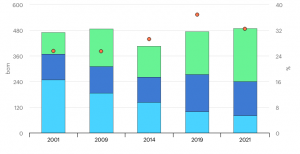
The reliance of the European Union and (indirectly) the United Kingdom on Russian gas supplies has increased over the last decade. Natural gas consumption in the EU and UK remained broadly flat in aggregate over this period, but production fell by a third and the gap has been filled by increased imports. Consequently, the share of Russian gas supplies increased from 25% of the region’s total gas demand in 2009 to 32% in 2021. Meanwhile, the importance of Ukraine as a transit country has lessened due to the build-up of additional transit corridors bringing Russian piped gas to the EU and UK (e.g. Nord Stream). Transit flows via Ukraine accounted for over 25% of Russia’s pipeline deliveries to the EU and UK in 2021, significantly down from more than 60% in 2009. Nevertheless, Ukraine remains an important conduit for Russian gas to Europe (transiting about 8% of the EU and UK combined gas demand) and also relies heavily on imported gas for its own domestic use.
Share of Russia in European Union and United Kingdom gas demand, 2001-2021
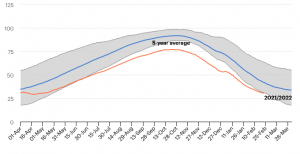
As highlighted by the International Energy Agency in September 2021, Russia has been reducing its piped gas supplies to the EU market, while it did not fill its storage sites in the EU to adequate levels. Pipeline deliveries from Russia declined by 25% year-on-year in Q4 2021. This decrease in Russian pipeline supply to the EU became more pronounced in the first seven weeks of 2022, falling by 37% year-on-year. The last pipeline deliveries to Germany via the YAMAL pipeline (which goes through Belarus) were on 20 December 2021. Gas flows via Ukraine to Slovakia have fallen from an average of over 80 mcm/d in December to just 36 mcm/d in the first seven weeks of 2022. Altogether, Russian gas flows via Ukraine averaged 55 mcm/d during this period, well below the contractually available capacity of around 109 mcm/d. Other pipeline suppliers, including Algeria, Azerbaijan and Norway, increased their deliveries during the heating season to the European market compared with last year, using commercially available supply routes. Lower Russian pipeline flows have been compensated in part by higher liquefied natural gas (LNG) inflows, which increased by 63% year-on-year through October until year-to-date. LNG inflows to the EU and the UK reached an all-time high of 13 bcm in January – almost three times their last year’s levels and about 70% higher compared to Russian pipeline flows that month. Strong supply and milder-than-expected temperatures in Northeast Asia helped to facilitate the redirection of cargoes towards Europe and limit the implications of strong European demand for LNG markets. The United States supplied over half of the additional LNG imported by the EU and UK since the beginning of the heating season, accounting for 37% of total LNG supplies. This highlights the importance of the US LNG export industry and of strong transatlantic ties to European energy security. As a consequence of low inventory levels at the beginning of the heating season, and the sharp decline of Russian piped flows to the EU, gas storage levels fell to 30% below their working storage capacity (and standing 28% below their 5-year average levels for this period of the year). Storage sites owned or controlled by Gazprom had particularly low storage levels at the start of the heating season, filled to just 25% of their working storage capacity. While Gazprom storages account for just 10% of the EU total working storage capacity, they accounted for half of the EU’s 5-year storage deficit. Without the strong increase in LNG imports since October, European storage levels would be below 15% full by now (vs 31% at the moment), leaving Europe in a much more vulnerable position vis-à-vis late cold spells and/or supply disruptions. This demonstrates the complementary role of underground gas storage and LNG regasification capacity in the security of natural gas supply. The security value of gas storage should be more strongly recognised in this context. As the IEA previously stated, minimum storage obligations on commercial operators coupled with robust market-based capacity allocation mechanisms are vital tools that can ensure the optimal use of all available storage capacity.
Inventory levels in EU underground storage sites, 2016-2022
Reduced Russian pipeline flows, together with low storage levels and adverse weather conditions, contributed to strong upward pressure on hub prices in Europe, which averaged more than USD 30/MMBtu in Q4 2021 Natural gas prices moderated down to an average of USD 27/MMBtu in the first seven weeks of 2022. Unseasonably mild weather conditions weighed on distribution-network related demand (declining by 14% year-on-year according to preliminary estimates), while strong wind output (up by 20% year-on-year) reduced gas burn in the power sector, despite the lower nuclear and hydro availability.European gas prices surged by 50% day-on-day on 24 February 2022 to USD 44/MMBtu, following the invasion of Ukraine by Russia. The strong increase in European gas prices supported Asian LNG spot prices which soared by 30% to USD 37/MMBtu. Natural gas flows via Ukraine to Slovakia have not been impacted as of 24 February 2022, with nominations rising to 75 mcm/d for 25 February 2022. Natural gas prices are expected to remain extremely volatile in the current context of market uncertainty. NN: Europe and the UK require massive amounts of gas during the cold European winters. The supplies simply do not exist without Russian gas. That is REALITY!
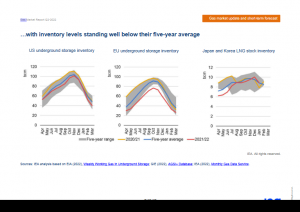
GLOBAL GAS INVENTORIES ARE WELL BELOW THEIR 5 YEAR AVERAGE… LOOK AT THE CENTER GRAPH OF EU GAS STORAGE!