MOSCOW (Reuters) – Russia’s Yamal-Europe gas pipeline switched back into reverse mode on Sunday morning, resuming supplies from Germany to Poland after short intermittent westbound flows overnight, data from German network operator Gascade showed. Markets have been on edge about possible disruptions to energy supplies following Russia’s invasion of Ukraine, although Russian commodity exports have not been seriously affected so far. Russia calls its actions in Ukraine a “special operation”. Gascade data showed eastbound flows at the Mallnow metering point in Germany resumed on Sunday morning at a pace of almost 5 million kilowatt hours per hour (kWh/h). According to renominations, or preliminary bids, the pipeline is expected to stay in reverse mode until at least Monday morning. It had shipped gas in normal mode – westbound, from Poland to Germany – for around 10 hours overnight, mostly at a scale of 12.6 million kWh/h.
Gas in the German-Polish section of the pipeline had been flowing eastward since Dec. 21 as buyers in Poland drew on stored supplies from Germany rather than buying more Russian gas at high spot prices. [NG/EU]
Russian gas giant Gazprom briefly resumed supplies via the link to the West at the start of the weekend amid high demand in Europe, especially from Italy, an industry source told Reuters. The Kremlin-controlled company started to book westbound transit capacity via the pipeline at daily auctions on Friday and Saturday. The source, who sought anonymity because he was not authorised to speak to media, said the prospect for long-term westbound supplies was not clear amid market volatility. The pipeline usually accounts for about 15% of Russia’s westbound supply of gas to Europe and Turkey. Gazprom has not ordered any transit capacity for February and March via the route at monthly auctions, nor has it booked capacity for the second and third quarters of the year. Russia has also recently boosted supply to Europe via Ukraine as a spike in prices has made it cheaper to buy Russian pipeline gas than to make purchases on the spot market, Refinitiv analysts said. NN: As the crises deepens and the more trouble Putin has sub doing Ukraine the more drastic actions he will take. It appears as its only a matter of time before the pipeline through Ukraine to Europe has a accident. That will leave the Nord Stream II pipeline as the only delivery option. That is when things will get very interesting….
MOSCOW (Reuters) – Russian gas exports via Ukraine have continued as normal and are in line with requests from consumers, An oil terminal at a Ukrainian airbase is on fire following a Russian attack on the Vasylkiv Air Base, 30 kilometers southwest of Kiev, Ukrainian media reported. According to reports, Ukrainians in the area were advised to keep windows shut over concerns about hazardous chemical fumes.
Other media reports claimed that Russia also struck a gas pipeline in Kharkiv.
Russian energy giant Gazprom said on Thursday. The company said the requests have been at 83 million cubic metres per day as of Feb. 24, up 31.4% from Feb. 23 . NN: How long do you think it will be until their is a “accident” and the pipeline through Ukraine to Europe gets bombed.
Germany upended years of policy and agreed to supply weapons to Kyiv and look into ways to shut out Russia from the SWIFT financial messaging system, underlining the outrage in Berlin over President Vladimir Putin’s invasion of Ukraine. The German government said in a statement Saturday that it has agreed to the supply of 400 German-made rocket propelled grenades to Ukraine via the Netherlands, along with 14 armored personnel carriers. It will also supply 10,000 tonnes of fuel via Poland. Further supplies to Ukraine are currently being considered, it said. NN: the longer it takes for the EU NATO and the US to belly up to the bar the more costly this becomes.. And at some point NATO will figure out all the former Soviet states are at risk.
A new Chinese alternative might allow Russia to conduct most of its trade in yuan rather than dollars. China’s Cross-Border International Payments System (CIPS), founded in 2015, is still under development and includes only 80 foreign banks. But there is no reason in principle that CIPS can’t substitute for SWIFT. And if Russia successfully shifts its trade payments out of the dollar system, the blow to American prestige and power would be enormous.
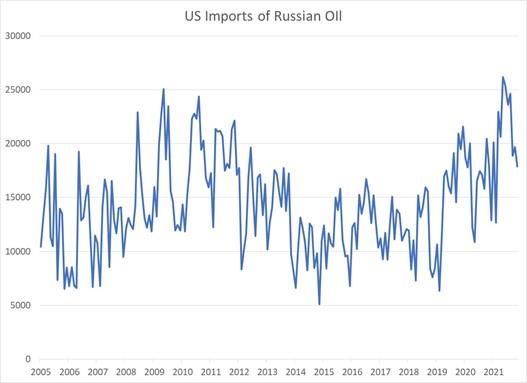
The US still imports massive amounts of Russian oil. De-dollarization of trade is under debate in Western Europe. Germany’s Manager Magazine wrote on February 14,“Exclusion from the international payment system SWIFT is considered the sharpest sword that the West could wield as an economic sanction against Russia. “However, it is a double-edged sword: the economic consequences would not only be serious in Russia, but also in Western Europe. In addition, the decoupling of Russia and China from the US dollar would be accelerated. Both countries are already working on competing payment systems.” Russia also has developed an interbank messaging system, which now covers about 20% of domestic financial payments. China’s yuan has advantages and disadvantages as a dollar substitute. It has gained about 8% against the US dollar since the Covid recession began in early 2020. China’s consumer inflation rate stands around 1% year-on-year vs. 7.5% in the US, and the yuan to some extent has acted as a hedge against dollar inflation, NN: classic pissing contest does Putin need the money more then Europe needs the gas and oil… Answer Russia has many other sources of revenue and huge stockpiles of foreign reserve currencies and gold. And Europe has no other oil or gas suppliers…….. Do not let them shit you. It will take years to restart the nuke reactors and years to run new pipelines form friendly sources in the North Sea and the southern Med….
PARIS (Reuters) – A decision to cut Russia off from the global SWIFT payment system will be taken in a matter of days, the governor of a central bank within the euro zone told Reuters on Saturday. “SWIFT is just a matter of time, very short time, days,” the central bank governor, who asked not to be named, said. “Is it sufficient? No. Is it necessary? Absolutely. Sanctions only make sense if there are costs for both sides and this will be costly,” the central banker added. Financial experts and analysts have warned if that were to happen, can be characterized as a “nuclear option,” and an unprecedented move that could have large negative impacts on the global economy. SWIFT as it’s globally known is the Society for Worldwide Interbank Financial Telecommunication is a cooperative of financial institutions, headquartered in Belgium. It was founded in 1973 under Belgian laws with 239 banks in 15 countries. By 1977, it expanded to 518 institutions in 22 countries. In 2022, there are more than 11,000 financial institutions in over 200 countries and territories. SWIFT is the financial-messaging infrastructure that links world banks and is overseen by the National Bank of Belgium in partnership with other major players such as the U.S. Federal Reserve System, the Bank of England and the European Central Bank. Etc. According to NBC News, SWIFT isn’t a traditional bank and doesn’t get involved in the transfer of funds. Rather, it provides a secure messaging system that informs banks when transactions occur, this platform links financial institutions in various countries and territories of the world. (For instance, U.S. banks have unique SWIFT codes that customers use for incoming wire transfers in U.S. dollars.) SWIFT records an average of 42 million messages daily and over five billion financial messages a year. There was an 11 per cent increase from 2020 when Russia accounted for 1.5 per cent of transactions. SWIFT provides fast, reliable and secure support for businesses worldwide. SWIFT assigns each financial organization a unique code that has either 8 – 11 characters. The code is interchangeably called the bank identifier code (BIC), SWIFT code, SWIFT ID, or ISO 9362 code. Other recognised global message services exist, e.g Fedwire, Ripple, and Clearing House Interbank Payments System (CHIPS), but SWIFT continues to stand out. Its success has been linked to the fact that it continually adds new message codes to makes transmitting different financial transactions seamlessly. The SWIFT system offers many services that assist businesses and individuals to complete seamless and accurate business transactions. Some of the phenomenal services offered by the global platform are business Intelligence, applications, messaging, connectivity, compliance services and software solutions. However, the core of SWIFT business resides in providing a secure, reliable, and scalable network for the smooth movement of messages. Through its various messaging hubs, software, and network connections. Banks, Securities Dealers, Asset Management Companies, Brokerage Institutes and Trading Houses, Depositories, Exchanges, Clearing Houses, Treasury Market Participants and Service Providers, Corporate Business Houses, Foreign Exchange and Money Brokers globally have all turned to SWIFT for one service or the other due to its commendable dominant position in the global processing of transactional messages.
As much as deserving the move to cut Russian access SWIFT financial system feel logically, it’s by far one of the toughest financial steps the U.S. and its European allies could take. This move would have a tangible effect on Russia’s economy immediately and also in the long term. Reports say this move could jeopardize Russia’s participation in most international financial transactions, this includes profits generated from oil and gas production, which contributes about 40% of the country’s revenue. Financial experts have warned that kicking Russia off SWIFT can be characterized as a nuclear option, which could have negative impacts on the global economy. In 2014, the idea of kicking Russia off SWIFT was shelved by allies on both sides of the Atlantic. This was a period when Russia annexed Crimea and backed separatist forces in eastern Ukraine. At that time Russia made it clear that being kicked out of the SWIFT financial system would be tantamount to a declaration of war. As a result of this huge declaration, the idea was immediately shelved. Ever since Russia had invested effort into creating its own financial system with capabilities such as SWIFT but little or no results have been yielded. Although the U.S. once recorded tremendous success in its persuasion to kick out Iran from the SWIFT financial system due to its nuclear ambitions. However, the decision with Russia feels different as it is bound to hurt other economies, including those of the U.S. and a key ally, Germany. In order for Russia to be booted out of the SWIFT system, Biden has noted that he would need the buy-in and support from his European counterparts, who currently appear to be less supportive of such drastic measures. The perception of the European allies is that Russia is a key energy supplier to Europe and support for the SWIFT kick-off ambition would hurt the rest of Europe adversely. In a statement issued in 2014 when it last discussed booting Russia, SWIFT said it is a “neutral global cooperative” and that “any decision to impose sanctions on countries or individual entities rests solely with the competent government bodies and applicable legislators.” For now, the US can choose to act unilaterally by enforcing a move by the Federal Reserve, which clears transactions, to block Russian companies’ access to U.S. dollars. Experts have resolved that if European countries won’t agree with supporting harsher financial penalties for Russia, the U.S. can choose to act unilaterally. But whether the sanctions earlier rolled out will be tougher on Russia than the SWIFT option would be hard to measure because of the backlash that may come along. NN: See next story… SWIFT sanctions may not be all its cranked up to be. Besides do you really think Putin will deliver half of Europes energy and not be paid?
MOSCOW/LONDON (Feb 25): Russian oil exports continued to flow to Europe and onwards on Friday, even as Russian sellers and Western buyers said they struggled with payments, banking guarantees and shipping after the West imposed sanctions on Moscow for attacking Ukraine, according to traders, port agents and shipping data obtained by Reuters. Following Russia’s invasion of Ukraine on Thursday, the European Union and the United States announced measures to curb Moscow’s access to financing, including sanctions targeting its main banks, making it extremely difficult for Russian oil companies to process payments for their goods. Russia has kept its exports of crude oil and refined products going, but sellers said there was no strong guarantee that they will be paid for the volumes as banks were studying the terms of the announced sanctions and the market had no clue what they will decide. “Letter of credit is a bank guarantee, but now it’s quite useless as after sanctions, no Western bank wants to guarantee anything for Russian sellers”, a source with a major Russian oil company said, adding that one may just make payments on “open account” terms as it is not a big difference now. Letters of credit from the bank of the buyer are standard practice in commodities trading and guarantee the seller’s bank that payment will be made in full and on time. Open account is a sale where the volumes are shipped and delivered before payment is due. It is extremely risky for the seller and the best option for the buyer. On Thursday, Western buyers said they had been having issues opening letters of credit for Russian oil volumes. Many of the buyers and shipping companies also have refrained from purchasing Russian oil while they figure out the sanctions. Selling Urals crude for March loading was very difficult, which has pushed its discount to Brent to all-time lows, traders said.
Swedish refiner Preem said that it “had paused all trading in Russian crude oil pending further information on possible sanctions”.
Companies may try to divert their accounts to other banks, not subject to sanctions, which may help a little, another source with a Russian oil company said, but that takes time and not every bank can offer this service. NN: The banking system is a very complicated monster You push at one end it bulges at another. Bankers are whores…. And the days of corrupting them by mere millions are over. Billion can do it. So you can imagine what Putin with hundred of billions can do. Putin is the richest man in the world…. And he use to drive a taxi in his spare time to feed his kids. He did not go from rags to super riches because he is stupid.
The west has a dilemma when dealing with Russia following the invasion of Ukraine this week. So far this week, measures taken to isolate Russia’s economy by the U.S., U.K. and other countries likely will do little to sway the actions of Russia’s president Vladimir Putin. But even harsher efforts could backfire, especially on the wellbeing of European economies. The first issue is that sanctions rarely work to shift behavior. Examples of Venezuela, Iran and Cuba. If that isn’t enough consider the fact that Russia was already being sanctioned by the west before this week’s invasion. Nevertheless, governments are hell-bent on sanctions as a meaningful action. If nothing else they do show the Kremlin how displeased the west is feeling right now. They also have the advantage that sanctions don’t immediately put NATO troops at risk. However, there is now talk in Europe and the U.S. of taking the most severe action of excluding Russia from the global SWIFT payments system. The idea is that if Russia can’t have access to incoming hard currencies such as dollars, pounds and euros, then surely its economy will surely get crippled. That’s correct. Russia’s economy would see huge problems, at least initially. However, soon enough the country would engage in workaround solutions.
Cryptocurrencies, such as Bitcoin, could allow the country to receive and send money.
China may decide to offer the Kremlin, and the rest of Russia, banking services.
It’s also true that Russia has vast foreign exchange reserves and very little debt. In other words, the country is probably able to weather a financial storm for a while.
Over a longer term these ripple effects will dilute any impact on the Russian economy. But the real and compelling reason to not shut Russia out of the SWIFT payments system is that doing so would likely also hobble Europe’s economy. Europe relies heavily on Russia for imports of energy including natural gas and oil. While the oil can quickly get sourced from other countries, the same is not true of natural gas. And natural gas is vital to Europe’s energy infrastructure. Put simply, for the foreseeable future Europe will need to continue receiving its energy from Russia. That also means it will need to keep paying for that energy. If Russia is shut out of the SWIFT system, then it’s going to be far harder for Europe to send payments to Russia for the imported energy. It’s unlikely that Europe will send planeloads of cash to Moscow to pay for natural gas. Also unlikely is that Europe’s governments will embrace blockchain technology or cryptocurrencies to make payments. Doing so would undermine their national currency. Another idea is there could be an energy carve out for the SWIFT ban, meaning banks would be allowed to transact with Russia but only for the purchases of energy. Most banks are already drowning in a sea of bureaucracy. Nuanced differences about what is and isn’t allowed make matters more fraught inside the compliance department. I worked in three financial services firms and the legal department tends to be cautious to an extreme. If things have a tenth of one percent chance of going wrong then the lawyers say no. Its for that reason that most bank officials will likely just decide to forget any “energy carve-out” and simply refuse to do any business with Russia. That also means it’s going to be hard for Europe to get more energy from Russia, and in turn Europe’s economy will suffer. That’s particularly relevant to Europe’s largest economy, Germany, which is phasing put its nuclear power and pushing for renewables such as wind and solar energy. It needs the natural gas to bridge the gap until it has enough of those new energies. NN: Now imagine my world where the Mediterranean pipeline was in service. And England had allowed the new projects in the North sea to move forward. And in this dream world Europe allowed fracking. It went even so far as to allow nuclear reactors until renewable power sources were visible. Today Putin would be in his box. And the former soviet states would be building their fledgling democracies in peace…. And oil would be between $30 to #40 a barrel….. And inflation would be tolerable.. See fuckups are really good at their jobs… especialy liberal ones….
Several companies, including automakers Volkswagen and Renault and tire maker Nokian Tyres, on Friday outlined plans to shut or shift manufacturing operations following Russia’s invasion of Ukraine. After invading earlier this week, Russian forces pressed their advance on Friday as missiles pounded Kyiv and authorities said they were girding for an assault aimed at overthrowing the government. The United States announced sweeping export restrictions against Russia on Thursday, hammering its access to global exports of goods ranging from commercial electronics and computers to semiconductors and aircraft parts. That could lead companies to alter manufacturing plans or seek alternative supply lines.
The invasion was a factor in consulting firms J.D. Power and LMC Automotive slashing their 2022 global new-car sales outlook by 400,000 vehicles to 85.8 million units. The auto industry had already been dealing with a tight supply of vehicles due to the global semiconductor shortage.
“An already-tight supply of vehicles and high prices across the globe will be under added pressure based on the severity and duration of the conflict in Ukraine,” said Jeff Schuster, president of global vehicle forecasts at LMC. “Rising oil and aluminum prices will likely affect consumers’ willingness and ability to purchase vehicles, even if inventory improves,” he added. “We have made significant downgrades to the Ukraine and Russia forecasts due to the escalating conflict between the two and the repercussions associated with sanctions against Russia.” The conflict could boost oil prices above $100 a barrel, which would add inflationary pressure on European and American consumers, Wells Fargo analyst Colin Langan said in a research note. While consumers have been willing to pay above sticker price to get new vehicles, sustained higher gas prices could impact long-term recovery, he said. Germany’s Volkswagen said it would halt production for a few days at two German factories after a delay in getting parts made in Ukraine. France’s Renault said it would suspend some operations at its car assembly plants in Russia next week due to logistics bottlenecks caused by parts shortages. It did not specify whether its supply chain had been hit by the conflict, but a spokeswoman said the action was a consequence of reinforced borders between Russia and neighboring countries through which parts are carried by truck. The carmaker is among Western companies most exposed to Russia, where it makes 8% of its core earnings according to Citibank. “Interruptions are primarily caused by tighter border controls in transit countries and the forced need to change a number of established logistics routes,” the company’s Russian unit said, without naming any countries. Russian carmaker Avtovaz, controlled by Renault, also said it might suspend some assembly lines at a plant in central Russia for one day, on Monday, due to a persistent global shortage of electronic components. Avtovaz also did not mention the invasion in its statement. Finnish tire maker Nokian said it was shifting production of some key product lines from Russia to Finland and the United States to prepare for possible further sanctions following the invasion. Aptiv Chief Executive Kevin Clark said on Thursday that over the last couple of months the American auto parts maker had swapped high-volume parts work out of Ukraine in favor of lower-volume products “so we were better-positioned to manage disruption.” Japanese auto supplier Sumitomo Electric Industries, which employs some 6,000 people in Ukraine to make wire harnesses, said it suspended operations at its factories there and was talking to clients about potentially substituting supplies from other places. Ford Motor Co has a 50% joint venture in Ford Sollers, which has three assembly plants in Russia according to the Ford website. Ford said in a statement it was “deeply concerned” about the situation and would “manage any effects” on its business in real time. The U.S. automaker also said it would follow any laws on trade sanctions, but declined to discuss whether the Sollers plants have been affected. While French car parts maker Valeo said the direct impact on the company is minimal, the invasion could drag down industry production volumes, and hike energy or raw material prices. Japan’s biggest steelmaker, Nippon Steel Corp, said on Friday it would secure alternatives for a raw material it buys from Russia and Ukraine in the event of any supply disruptions. Nippon Steel buys 14% of its iron ore pellets, small balls of iron ore powder used in steel production, from those countries. Officials said it switched sourcing to Brazil and Australia and the impact should be minimal. Agricultural equipment maker Deere & Co said on Friday it had closed its Ukraine office in recent weeks as a precautionary measure. It employs about 40 people in Ukraine. Meanwhile, Delta Air Lines Inc, which does not operate services to Ukraine or Russia, said on Friday it had suspended its codesharing service with Russian airline Aeroflot. NN: NN: make sure the fucking you get is not worse then the fucking you get. Sanctions are not all they are cracked up to be. Look at Cuba, Venezuela Nicaragua and finally Russia that has been under sanctions since it took the Crimea. North Korea and Iran have made amazing strides in the nuclear and rocket programs under severe sanctions. And these other sanctioned countries do not have the ace in the whole Russia has. Namely Europe hopelessly dependent on Russian gas and oil. ,
European forward power prices fell further on Friday, with sanctions against Russia for its invasion of Ukraine yet to have an immediate impact on energy supplies. The price fall also came as an industry source said Russia’s Gazprom is set to resume gas supplies via the Yamal-Europe gas pipeline from Poland to Germany later on Friday amid high demand in Europe, especially from Italy. As Russian missiles pounded the Ukrainian capital Kyiv on Friday, the European Union was preparing a third round of sanctions against Moscow that would further target Russia’s energy and financial sectors, specifying the phasing out of coal imports from the Russian-occupied Donbass region. Some international companies are preparing for further sanctions due to exposures to Russia. The Netherlands said that excluding Russia from the global SWIFT system of interbank payments should remain on the table, while France said some EU countries have reservations, but the government in Paris is not among them. Meanwhile Poland, which is reliant on coal power for a majority of its electricity supply, proposed including imports of Russian coal in the bloc’s package of sanctions. Europe will need to secure large volumes of gas if it wants to avoid soaring prices and crippling energy bills next winter in the event of disruption to flows from Russia. Russia’s invasion of Ukraine will possibly lead to a change in course in Germany’s energy transition, analysts at Enervis said, adding that continued operation of nuclear power plants and a slower phase-out of coal are conceivable. “Our forecasts show that, with long-term high gas and CO2 prices at the current level, we will see electricity prices remaining high,” Enervis analyst Mirko Schlossarczyk said. “Compared to a reference in which a gas price decline to 25 euros/MWh by 2030 was assumed, the annual base on the wholesale electricity market has doubled to around 140 to 160 euros/ MWh,” he added. But in the short term, front month and front quarter contracts fell across the board in both France and Germany in afternoon trading on Friday. German baseload power for 2023 delivery plummeted 18.4% to 146.85 euros ($165.13) a megawatt hour (MWh) at 1642 GMT, after hitting a contract high of 184.50 euros Thursday. The equivalent French baseload power for 2023 delivery fell 12.1% to 184.50 euros. European CO2 allowances for December 2022 expiry, rose 0.9% to 87.84 euros a tonne, while hard coal for northern European delivery in 2023 fell 13.1% to $126 per tonne. NN: This energy game is not over…… I am not sure where this is going in the short term. Putin has been emboldened and is very unpredictable. He still has the oil big stick over Europe…… He still may play the oil card to get restrictions lifted. Remember he has two key demands. He wants to defang NATO and get the Nord Stream II Pipeline going….
Major stock markets in the United States turned to positive territory at Thursday’s closing bell, with the Nasdaq 100 leading the rally by surging nearly 3.5%.
Moderna’s shares jumped by over 15% after the company reported its fourth-quarter earnings results earlier today. Meanwhile, President Joe Biden confirmed the US troops won’t get involved in the military conflict between Russia and Ukraine.
The Dow Jones gained 0.28% at the close. The Nasdaq 100 skyrocketed 3.44% or 465 points. The S&P 500 rose 1.49%. The euro declined 0.91% against the dollar to sell for 1.12022 at 3:56 pm ET.