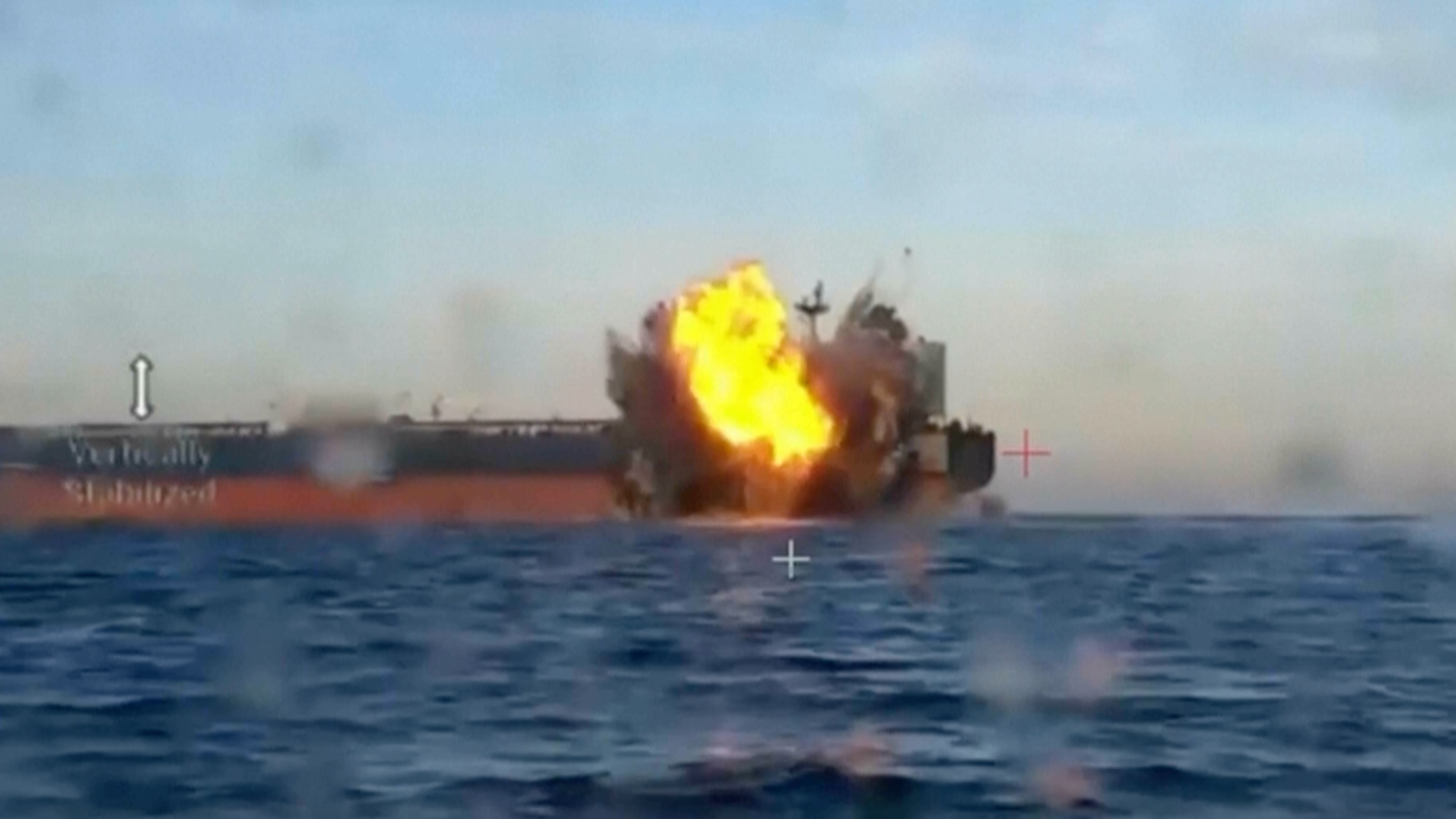
Iran’s Islamic Revolutionary Guard Corps (IRGC) revealed on Saturday that it struck an oil tanker called “Prima,” which was sailing under Malta’s flag, in the Strait of Hormuz, claiming that the vessel ignored “repeated warnings” from the IRGC Navy. “It is worth noting that the strategic Strait of Hormuz has been under control for the eighth day due to the malicious aggression of American terrorists, the martyrdom of the Leader of the Islamic Ummah, and the aggression against the Persian Gulf region and the Strait of Hormuz, and oil tankers and commercial vessels allied with the warring countries are not allowed to pass through this strait,” IRGC stated. Meanwhile, the United States announced a $20 billion reinsurance program yesterday for oil tankers and other vessels to promote maritime traffic through the Strait of Hormuz amid the ongoing conflict in the region and Iran’s threats to vessels attempting to go through the sea passage connecting the Persian Gulf to the open ocean.
NN: Its started… You can not effectively escort tankers in the age of drone warfare. Just like the US learned when it tried to supply tanks to Ukraine. Concentrate on defeating Iran and then the straights can be reopened. Until then we PARTY
Oil prices could soar to as much as $150 per barrel within two to three weeks if the critical Strait of Hormuz remains off limits for tankers, Qatar’s Energy Minister Saad al-Kaabi told the Financial Times in an interview published on Friday. That proclamation came just a few short hours before reports that Kuwait—one of the founding members of OPEC—had begun shutting in oil production at some oilfields as there just simply isn’t anywhere to store any more oil with the Strait of Hormuz still at a standstill. According to sources familiar with the matter, Kuwait is also discussing cutting production even further, and refining operations as well, to levels that would match what would be needed domestically. All major oil and gas exporters in the Middle East are set to declare force majeure on exports within days if the vital shipping lane remains de facto closed to tanker traffic, said al-Kaabi, who is also president and CEO of QatarEnergy. Qatar’s state energy firm earlier this week halted LNG production at its Ras Laffan hub, the world’s largest LNG complex, and later issued force majeure notices to buyers, following a drone attack at the facility and the all but halted tanker traffic through the Strait of Hormuz.
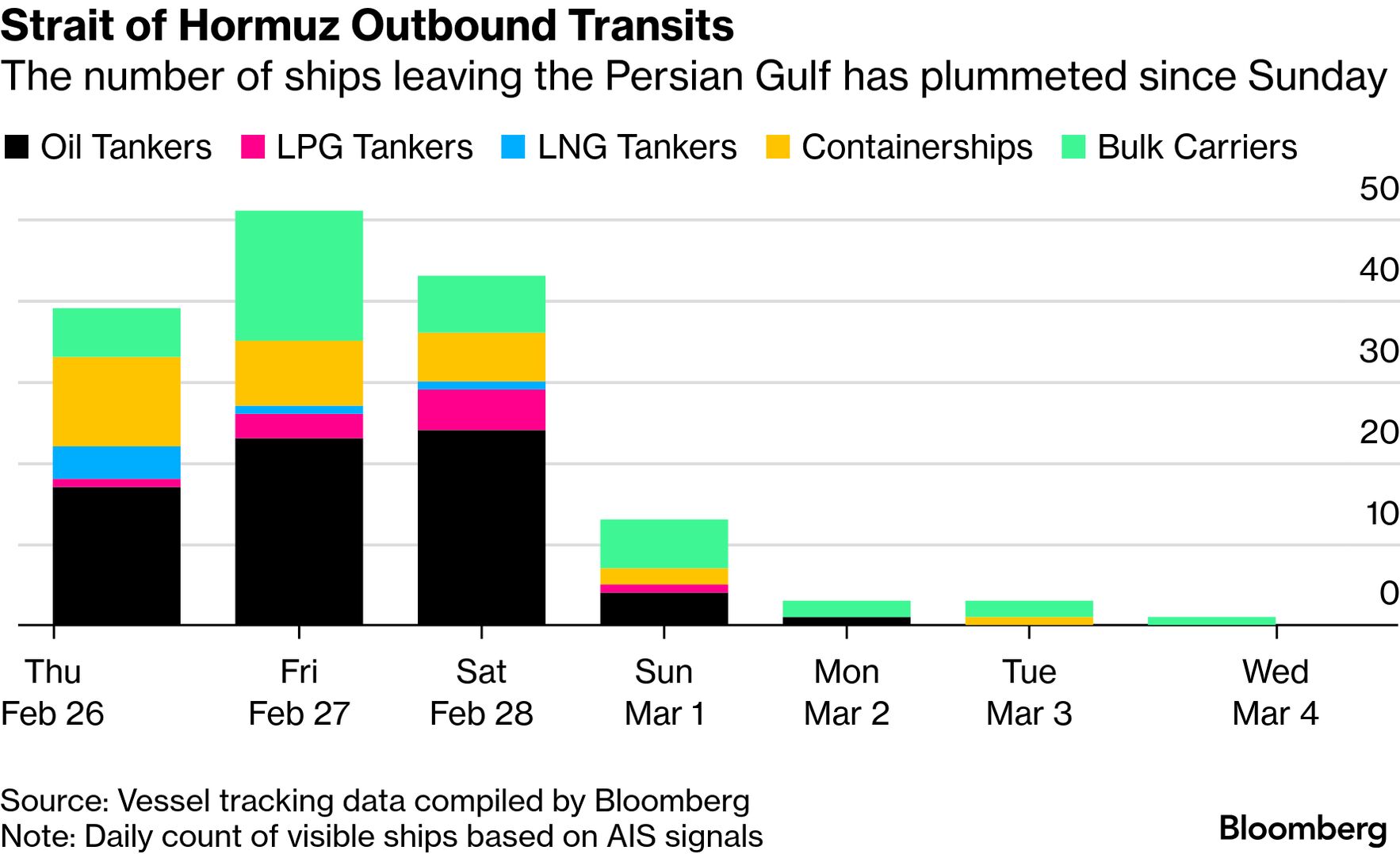
Vessel traffic through the Strait of Hormuz has crashed from an average of 138 ships a day to just two in the 24 hours to Thursday, the Joint Maritime Information Center has reported. The center noted that neither of the two vessels that passed the Strait were tankers.
There are several dozen tankers stranded near Hormuz, some have become the target of attacks, and insurers have pulled war insurance, contributing to the paralysis of energy trade in the world’s biggest oil-producing region. Announcements by the U.S. president that the federal government would step in to provide insurance coverage have yet to have an effect. “Everybody that has not called for force majeure we expect will do so in the next few days that this continues. All exporters in the Gulf region will have to call force majeure,” Qatar’s al-Kaabi told FT. The official also predicted that if the war continues for a few weeks, global economic growth would suffer.
But even if the war were to end today, Qatar would likely need “weeks to months” to return to a normal schedule and cycle of energy deliveries, al-Kaabi said.
Qatari Energy Minister Saad Al-Kaabi cautioned that war in Iran and affecting the region could devastate global economies, forecasting that all Gulf exporters would halt output within weeks and oil would hit $150 a barrel, the Financial Times said on Friday after interviewing him. Al-Kaabi, who is also President and CEO of QatarEnergy, warned that ongoing developments could “bring down the economies of the world.” “If this war continues for a few weeks, GDP growth around the world will be impacted. Everybody’s energy price is going to go higher. There will be shortages of some products and there will be a chain reaction of factories that cannot supply.” He warned LNG recovery would take “weeks to months” even if war ended. Also, he predicted gas prices would reach $40 per MMBTU as Asian buyers outcompete Europe for limited supplies and other Gulf exporters struggle to meet obligations.
NN: This is a BIG shit. I do not belie they can get the straights opened that fast. And that means we have a great potential for a great oil shock.
United States President Donald Trump said on Friday that there will be no deal with Iran “except UNCONDITIONAL SURRENDER.” He added that, after the current regime surrenders, and “GREAT & ACCEPTABLE” leaders are selected, the US and its allies will work to “bring Iran back from the brink of destruction, making it economically bigger, better, and stronger than ever before.” He concluded by saying that Iran “WILL HAVE A GREAT FUTURE.” Yesterday, Trump said that Iranian Supreme Leader Ali Khamenei should not be succeeded by his son Mojtaba Khamenei, calling him a “lightweight” and stating that the US wants “someone that will bring harmony and peace to Iran.”
NN: Iran is toast. They will surrender unconditionally just like Japan and Germany
The prices of oil skyrocketed on Friday, continuing their upside spiral after investors received two news pieces impacting the energy market. First, Qatar’s energy minister warned that war involving Iran could send oil to $150 and devastate global economies. Additionally, the Wall Street Journal said Kuwait began cutting production after running out of storage capacity, with further cutbacks expected within days. West Texas Intermediate (WTI) for April’s settlements soared by 8.33% at 8:54 am ET to sell for $87.76 per barrel. Meanwhile, Brent for May’s deliveries jumped by 5.67% to go for $90.25 per barrel.
NN: You need to keep buying as your aerage points are elected
A.P. Moller-Maersk announced on Friday that it will temporarily suspend shipping routes connecting the Far East to the Middle East and the Middle East to Europe, due to escalated tensions in the Gulf region. “This decision has been taken as a precautionary measure to ensure the safety of our personnel and vessels while minimizing operational disruption across our wider network,” the Danish shipping company said. Previously, Maersk suspended all transits through the Strait of Hormuz, as well as cargo bookings to and from the United Arab Emirates, Oman, Iraq, Kuwait, Qatar, Bahrain, and Saudi Arabia, as all these countries were targeted by Iranian projectiles and involved in the conflict.
Iran vows to retaliate anywhere for US attack on warship
Postponement of Khamenei mourning interrupts apparent plan to swiftly anoint his son
Israel to target underground missile sites in second phase of strikes
DUBAI/JERUSALEM, March 5 (Reuters) – The U.S.-Israeli campaign against Iran entered its sixth day on Thursday with what residents described as even more intensive bombing, while Iran vowed to retaliate anywhere for a U.S. attack on a ship thousands of miles from the battle zone. Inside Iran, the abrupt postponement of a planned three days of mourning for slain Supreme Leader Ali Khamenei interrupted apparent plans to swiftly anoint Khamenei’s hardliner son as his successor. “Today is worse than yesterday. They are striking northern Tehran. We have nowhere to go. It is like a war zone. Help us,” said Mohammadreza, 36, by phone from Tehran, with a shaky voice as explosions rang out from what Israel described as its latest wave of strikes on Iranian government targets. Although some international financial markets recovered from falls earlier in the week, the economic impact, opens new tab of the campaign intensified, with countries around the world cut off from a fifth of global supplies of oil and liquefied natural gas. Iran vowed to take revenge for a U.S. torpedo attack on an Iranian warship off the coast of Sri Lanka on Wednesday, which killed more than 80 sailors.
Iran’s foreign minister said Washington would “bitterly regret” the precedent it had set by sinking a ship in international waters without warning. A commander of the Revolutionary Guards, General Kioumars Heydari, told state TV: “We have decided to fight Americans wherever they are.”
The body of Supreme Leader Ayatollah Ali Khamenei, killed in the first hours of the U.S.-Israeli air campaign in the first assassination of a country’s top ruler by an airstrike, had been due to lie in state in a Tehran prayer hall from Wednesday evening to launch three days of mourning. But the memorial, expected to draw many thousands of mourners to the streets, was abruptly and indefinitely postponed shortly before it was due to begin. In the hours before announcing the delay, Iranian officials had said they were close to naming Khamenei’s successor, and that the leading candidate was his son Mojtaba, a powerful hardliner whose selection would be a strong gesture of defiance. Iranian officials gave no reason for the postponement of the memorial, but a source told Reuters it was motivated in part by fear of assassination of those attending while Israeli and U.S. warplanes remain in the skies. Memorial ceremonies of Shi’ite political and religious leaders, especially those seen as martyrs, are known for mass public displays of passion. Announcing the younger Khamenei as successor during a mourning period would allow him to take power while his father’s followers were on the streets, rallying support and making it more difficult for any opponents to mount a challenge. Israel has said it would consider any replacement for Khamenei who continued hostile policies an immediate target to be killed. Two sources familiar with Israel’s battle plans said that having killed many Iranian leaders during nearly a week of strikes, Israel was now planning to enter a second phase when it would target underground bunkers where Iran stores its missiles.
Israel has said its aim is to overthrow Iran’s clerical rulers. Washington says its goal is to prevent Tehran from being able to project force beyond its borders, but it has also called on Iranians to rise up and seize power. Many Iranians openly celebrated the death of the supreme leader, whose security forces had killed thousands of anti-government protesters just weeks ago in the worst domestic unrest since the era of Iran’s 1979 Islamic Revolution. State television was hacked on Thursday, airing a video of Reza Pahlavi, the exiled son of Iran’s last shah who has emerged as a significant opposition figure. “A heavy burden of destiny rests upon the shoulders of us all. And we, together, will walk this path until final victory. Long live Iran,” he said. A 25-year-old woman in Tehran who asked that her name not be used for security reasons said those opposed to the government were not yet able to take to the streets while the country was under attack, but had made their feelings clear by posting online videos of their celebrations at Khamenei’s death. “If Mojtaba takes over, he will be killed as well, so we are not concerned about it,” she said. Air raid sirens in Israel sent Israelis to shelters. Military spokesman Effie Defrin said there had been a decrease in the number of daily missile launches from Iran, although “the threat still exists”. “The more we intensify the damage and eliminate the launchers, the more the threat will diminish over time,” he said. The war has had global economic impact, above all from the interruption to tanker traffic through the Strait of Hormuz, where a fifth of global oil and liquefied natural gas flows along Iran’s coast. Iran’s Revolutionary Guards said they had hit a U.S. tanker in the northern part of the Gulf and the vessel was on fire, the latest of numerous reports of such attacks. Passage through the strait would be under Iranian control, the Guards said. Azerbaijan said four Iranian drones had crossed its border and wounded four people, and it was preparing a response. Iran, which has launched drones and missiles against U.S. allies in the region, denied blame for the incident.
A massive blaze erupted in Bahrain Petroleum Company (BAPCO) facilities on Thursday following a new wave of Iranian strikes against the Gulf country. The Iranian leadership announced it would target sites to inflict “maximum economic pain” on countries hosting US forces or supporting the coalition with Israel. Following the threat made on March 2, drones and missiles struck energy infrastructure across the Middle East, including the United Arab Emirates, Saudi Arabia, Qatar, and Kuwait.
NN: This is now a oil war. And its going to get bigger!
Six people were injured in a drone attack in the United Arab Emirates, the Abu Dhabi Media Office said on Thursday. The office said they are Pakistani and Nepali citizens and that their injuries, sustained from falling debris, are “minor and moderate.” Earlier today, air defense systems intercepted drones in two locations in Abu Dhabi. The local authorities did not release any information on the damage caused by the attacks.
NN: Further signs of Irans escalation making this a oil war.
The Iranian military likely only has several days’ worth of ballistic missiles left, the Wall Street Journal reported on Wednesday, citing anonymous Western officials. The claims resemble statements made by United States Defense Secretary Pete Hegseth, who said that Iran’s capabilities are “evaporating by the hour.” The report was based on Iran’s decreasing frequency of ballistic missile strikes, indicating that attacks by the US and Israel on Iranian manufacturing and storage facilities have been successful. However, a source said that Iran could be “holding back missiles so its operations can last longer.”
NN: Soon the only weapons they will have left will be sticks and stones. Until then the straights will stay closed.