Structural changes to the COVID-19 virus highlight the need to expand the research efforts.
Five specific mutations are more prevalent in the Delta Plus variant of COVID-19 compared to the Delta variant, according to the results of a new study published in the Journal of Autoimmunity. “Whether it is natural antibodies produced from previously having COVID-19 or the antibodies produced from the vaccine, we are showing structurally how dangerous and clever the virus is by being able to mutate in a way that the antibodies don’t seem to recognize and defend against these new variants,” Austin Spratt, an undergraduate student at University of Missouri (MU), said in a press release. Investigators found that in addition to 5 mutations, K417N is present in the Delta Plus infection, but not nearly in any other Delta infections. This shows structural changes to the COVID-19 virus and highlight the need to expand research efforts into combatting the virus, according to the study. “These findings help explain why there have been so many people testing positive for the Delta variants despite being vaccinated or having previously been infected with COVID-19,” Spratt said in the release. Investigators also said that developing antiviral drugs to target specific areas of the virus that remain unchanged by mutations would be beneficial in the fight against viruses that mutate, not just COVID-19. “There has not yet been a vaccine for HIV due to the unpredictable variability that often comes with viruses that mutate frequently,” Kamlendra Singh, a professor at the MU college of Veterinary Medicine and Bond Life Sciences Center, said in the release. “If we can develop small molecule drugs that target the part of the virus that does not mutate, that will be the ultimate solution for combatting the virus.” MU researchers identify mutations of Delta, Delta Plus variants.
“China has warned families to store food and other essentials in case of emergencies, as officials drastically tighten restrictions to control a small Covid-19 outbreak,” the Financial Times reports. “Beijing’s already harsh ‘zero Covid’ policies have grown even stricter as coronavirus cases climb in the country despite targeted lockdowns.”
China food supply: How a warning sparked panic buying
sues are more important to Beijing than food security. For centuries, China’s rulers have grappled with the challenges of feeding a large, expanding population. Droughts, floods and famines feature prominently throughout Chinese history — and rebellions launched by starving peasants toppled numerous imperial dynasties. A directive about stockpiling food from China’s Ministry of Commerce sparked panic buying among the public and frenzied online speculation this week. China directive orders local authorities to ensure that their citizens have an “adequate supply” of essentials this winter. It also instructs those governments to keep food costs stable — a point of concern in recent weeks, as extreme weather, energy shortages and Covid-19 restrictions threaten supply.
This directive has attracted the attention of everyday Chinese in a way that few other government notices have. In part, that appears to be because it includes rare language about the need for local authorities to encourage families to stockpile “daily necessities.” Even if the notice wasn’t intended for the average household to read, many online have seized on it as a personal warning. The government “didn’t even tell us to stock goods when the Covid outbreak erupted in early 2020,” wrote one user on the Twitter-like Weibo service earlier this week. The reaction has since escalated. One video posted on Weibo by the state owned news magazine China News Weekly shows long lines of shoppers at grocery stores in Changzhou, a city in Jiangsu province. Their carts are stacked full of produce and other supplies, while shelves throughout the stores are empty. Food is a very sensitive issue in China. The Great Chinese Famine during the 1950s and 60s led to the deaths of an estimated tens of millions of people. The tragedy remains within living memory for many in the country. And while China’s economy has since undergone a dramatic transformation, concerns about food security linger. The unease caused by the commerce ministry notice has been unusually intense. The Chinese government and some state media outlets have tried to allay fears about food shortages. Zhu Xiaoliang, a commerce ministry official, told state broadcaster CCTV this week that there’s plenty of supplies to go around. Zhu stressed that the directive was intended for local authorities. The Jiangsu Department of Emergency Management, meanwhile, acknowledged concerns about “emergency supplies” on its WeChat account Tuesday. But the agency said any recommendations for stockpiling are “normal” and intended to “improve the public’s awareness of disaster prevention.” The government’s commitment to a zero-Covid policy — even as countries around the world reopen and learn to live with the coronavirus — is also likely a factor. Just a single case can spur Chinese authorities into action, locking down entire areas and carrying out mass tests or quarantine requirements. Such measures “will likely impact residents going to shops, and also impact the operating hours of markets,” said Chenjun Pan, a senior analyst at Rabobank who researches agriculture in China. Wang Hongcun, an official with the Beijing Municipal Commerce Bureau, acknowledged last week that strict containment measures may be contributing to the rising cost of food, adding that the cost of transiting across regions could increase. He pointed out that the prices of some vegetables in the nation’s capital had soared 50% or more in October.
Lam said Beijing is not likely to change course, either, meaning that cities have to prepare to endure potentially long lockdowns as the government tries to keep its coronavirus case count low.
“This is a preparation for the fact that these lockdown conditions will continue, even though by and large, the total numbers for China are actually very low compared to other countries,” he added. “It’s unlikely that Beijing will stop this zero tolerance policy.” NN: Wake up and smell the coffee! The Chinese are a lot of things but stupid is not on the list. That title is reserved for US elected officials. So enqueuing minds want to know….. What the FUCK is China up to. This is not about food inflation, energy shortages or ha ha ha war with Taiwan. This is all about the Covid19 mutation. That may have been spliced by crisper scissors. China does not play fuck around. With a billion people most of whom most are packed like sardines. They have to take qick action as in proactive… Obviousiy the reactive model does not work.. I believe they have watched the disease spread globally and have rightly concluded lock downs are coming. Mean while America idiots in controll are opening things up, God forbid they should miss out on their Christmas dinner…. Instead they will have January funerals
Infections in Europe are returning to high levels as winter takes hold – prompting debate on whether curbs will need to be introduced in the lead-up to Christmas. Dr Edward Kelly. a former Director of Integrated Health Services at the WHO, says the success of vaccination programs means many people believe the threat of COVID is gone, and are no longer practicing the basic public health measures needed to keep the virus under control. NN: Warning prepare yourself for the triple wammie jammiee.
wammie number one is run away embedded inflation
wammie number two is the self inflected wound of a TEMPORARY energy crises
wammie number three is the new covid19 mutation starting a new death assault on mankind….. and China did it again.
Yes i know 2 things. Dark clouds are forming and i know what they are and where they are from. .And yes i know what to do to keep you health, wealthy and wise,,,, its my job as your in house librarian. And i love my job and thank you for the work…
Nov 8 (Reuters) – Global COVID-19 cases surpassed 250 million on Monday as some countries in eastern Europe experience record outbreaks, even as the Delta variant surge eases and many countries resume trade and tourism. The daily average number of cases has fallen by 36% over the past three months, according to a Reuters analysis, but the virus is still infecting 50 million people every 90 days due to the highly transmissible Delta variant. By contrast, it took nearly a year to record the first 50 million COVID-19 cases. Health experts are optimistic that many nations have put the worst of the pandemic behind them thanks to vaccines and natural exposure, although they caution that colder weather and upcoming holiday gatherings could increase cases. “We think between now and the end of 2022, this is the point where we get control over this virus … where we can significantly reduce severe disease and death,” Maria Van Kerkhove, an epidemiologist leading the World Health Organisation, told Reuters on Nov. 3.
Infections are still rising in 55 out of 240 countries, with Russia, Ukraine and Greece at or near record levels of reported cases since the pandemic started two years ago, according to a Reuters analysis.
Eastern Europe has among the lowest vaccination rates https://tmsnrt.rs/34pvUyi in the region. More than half of all new infections reported worldwide were from countries in Europe, with a million new infections about every four days, according to the analysis. Several Russian regions said this week they could impose additional restrictions or extend a workplace shutdown as the country witnesses record deaths due to the disease. More than half the world’s population has yet to receive a single dose of a COVID-19 vaccine, according to Our World in Data, a figure that drops to less than 5% in low-income countries. Improving vaccine access will be on the agenda of meetings of the powerful Asia-Pacific trade group APEC, hosted virtually by New Zealand this week. APEC members, which include Russia, China and the United States, pledged at a special meeting in June to expand sharing and manufacturing of COVID-19 vaccines and lift trade barriers for medicines. “Together we are continuing to keep supply chains functioning and are supporting trade in critical medical supplies – including testing kits, PPE and now vaccines,” New Zealand Prime Minister Jacinda Ardern said on Monday. The World Health Organization (WHO) and other aid groups last month appealed to leaders of the world’s 20 biggest economies to fund a $23.4 billion plan to bring COVID-19 vaccines, tests, and drugs to poorer countries in the next 12 months. NN: its not the lack of vaccinations. Its the fact they broke out the champaign to soon. Add to that horror the fact that antbody tesing proves that if you vaccine is 4 to 6 months old your protection level is under 40%. So what is a long haul survivor to do: you know the drill… Add to the easy list antibody testing and make your 3rd vaccine happen. I as you certified libarian urge you to get your antibodies tested every every 3 months. No i do mot like this…… I would prefer to not have to be raising hell about this shit. Is it not ironic, i am banned from all social media because i recommend people get their kiddies vacianted, that you should take your 3rd booster shot. And my most recent crime is urging you to get your antibodies tested….. Even thou the CDC says no need. See i answer to a higher authority…. As far as our next trade the Balck Mask Boss Trade this plays right into our hands…….
U.S. Energy Secretary Jennifer Granholm warned Sunday that Americans should expect to pay more to heat their homes this winter due to soaring gas prices amid the coronavirus pandemic. “This is going to happen. It will be more expensive this year than last year,” Granholm said on CNN’s State of the Union. “We are in a slightly beneficial position, we’ll certainly relative to Europe, because their chokehold of natural gas is very significant. But we have the same problem in fuels that the supply chains have, which is that the oil and gas companies are not flipping the switch as quickly as the demand requires,” she added. Granholm explained that the Biden administration has been focused on both “immediate-term and the long-term” solutions, such as investing in clean energy, in order to help alleviate high costs. Energy
Secretary Jennifer Granholm says Americans should expect to pay higher costs for heating this winter as a result of supply chain issues caused by the Covid-19 pandemic. pic.twitter.com/O28NtR3Ve7
— State of the Union (@CNNSotu) November 7, 2021
Last month, the Energy Information Administration (EIA) released a report stating U.S. households that rely on natural gas for heating could spend an average of $746 to heat their homes this winter—up 30 percent from the previous one. Retail natural gas prices are expected to hit the highest levels since the winter of 2005-2006. In total, the EIA found that households are expected to spend 54 percent more on propane, 43 percent more on home heating oil, 30 percent more on natural gas, and 6 percent more on electric heating compared to last winter. “Forecast expenditures are based on our expectations of high retail energy prices—many are already at multiyear highs—and of slightly more energy consumption per household than in the previous winter. Notably, many energy prices reached multiyear lows last year as a result of the COVID-19 pandemic,” the report stated. A new forecast on rising gas prices will be released by the EIA on Tuesday, according to Granholm. The energy secretary also said Sunday that the Biden administration “hopes” that gasoline prices in some parts of the country will not reach $4 per gallon soon, while adding that the Organization of the Petroleum Exporting Countries (OPEC) is “controlling the agenda.” “Every president is frustrated because they can’t control the price of gasoline because it’s a global market. You can call upon increased supply, which he has done, and OPEC is unfortunately controlling the agenda with respect to oil prices. OPEC is a cartel, and it controls over 50 percent of the supply of gasoline,” she added. The Biden official came under fire from Republicans earlier this week after a video showed her laughing during a Bloomberg TV interview when she was asked what the ‘Granholm plan’ to increase oil production in the U.S would be. “Oh my, that is hilarious,” she replied, before again blaming OPEC on the rising prices. “Oil is a global market, it is controlled by a cartel – that cartel is called OPEC.” According to AAA, the average price of gas is now $3.42 a gallon, and some experts have predicted that number could surge by another 50 percent next June. A spokesperson for the association told Newsweek last month that the “key driver” for the rise in the price of gas is crude oil. A recent decision by OPEC to not increase global oil production “only exacerbated the upward momentum for crude oil prices,” the spokesperson added. Granholm said Sunday that Biden has been weighing all options to address the rising prices, including the possibility of tapping into the nation’s emergency oil reserves, known as the Strategic Petroleum Reserve (SPR). “He is certainly looking at that, and I think we’ll be looking at that in the forecast that is coming out on Tuesday,” she added.
NN: I decided to play for you this second video of the shriek…. What a fucking nut case. Biden with glee cut the balls off of the US oil industry that had made the US energy independent.. And now OPEC’s bitch… do you really believe that happened in the name of ecology. I think not…… If the oil industry pipelines and fracking would not have been gutted oil would be at $30 a barrel…… Its painful watching a great empire collapse…You can take some solace in the fact that their is a killing to be made…..
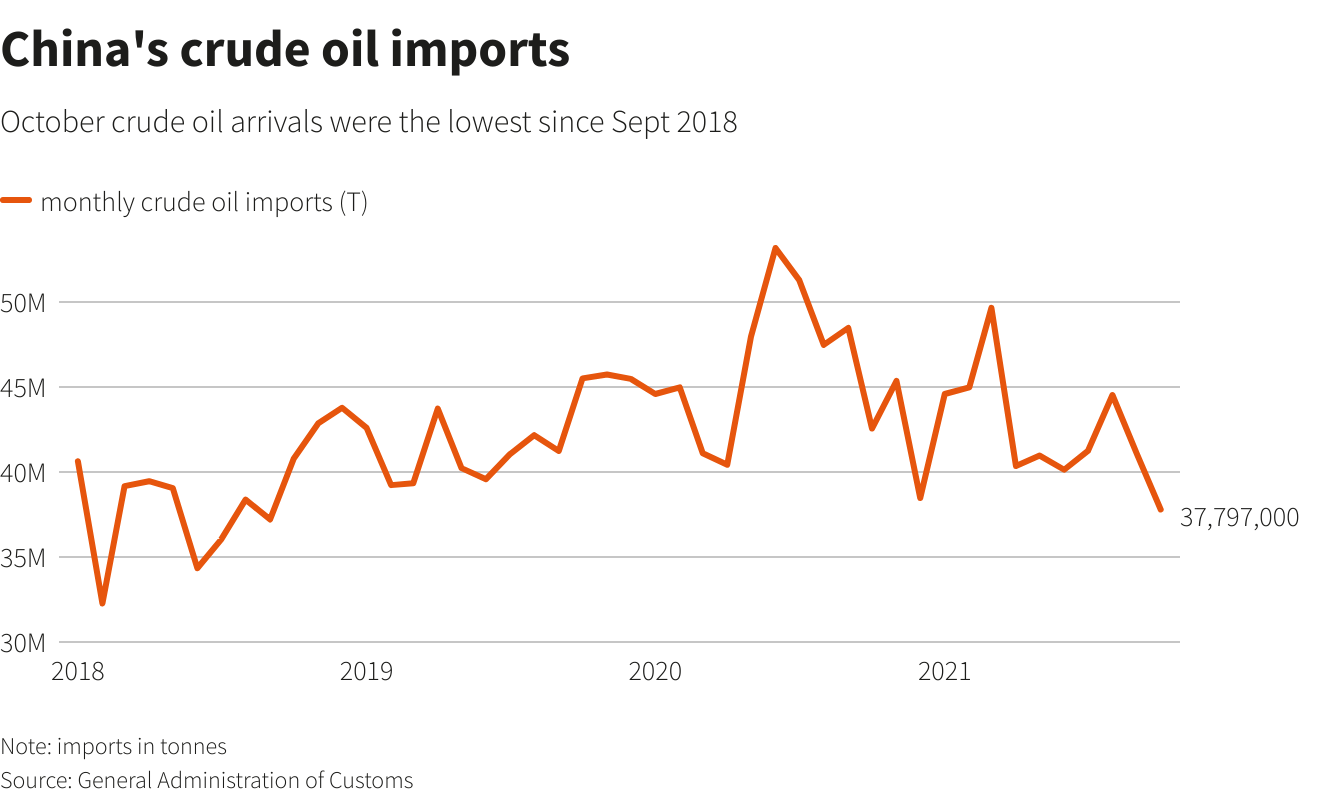
BEIJING, Nov 7 (Reuters) – China’s crude oil imports plunged in October to the lowest since September 2018, as large state-owned refiners withheld purchases because of rising prices while independent refiners were restrained by limited quotas to import. The world’s biggest crude oil importer brought in 37.8 million tonnes last month, data from the General Administration of Customs showed on Sunday, equivalent to 8.9 million barrels per day (bpd). That is down from 9.99 million bpd in September and 10.02 million bpd in the same period last year. Over the January-October period, crude arrivals totalled 425.06 million tonnes, or 10.21 million bpd, down 7.2% year-on-year, the customs data showed. Crude imports were down on a monthly basis for a second month and the decline has occurred amid a 62% jump in crude oil prices this year as economies open globally from COVID-19 pandemic restrictions, spurring fuel demand.
LONDON, Nov 7 (Reuters) – Britain reported 62 deaths on Sunday of people who had tested positive for COVID-19 within the past 28 days, and a further 30,305 new infections. The government figures show a fall from the 155 deaths and 30,693 new cases reported on Saturday.
Merck’s COVID drug to be rolled out this month in UK
LONDON (Reuters) – Britain will start to roll out Merck’s molnupiravir COVID-19 antiviral pill through a drug trial later this month, Susan Hopkins, Chief Medical Adviser at the UK Health Security Agency said on Sunday. Last week Britain became the first country in the world to approve the potentially game-changing COVID-19 antiviral pill, jointly developed by U.S.-based Merck & Co Inc and Ridgeback Biotherapeutics. The government said in October it had secured 480,000 courses of the Merck drug, as well as 250,000 courses of an antiviral pill developed by Pfizer Inc. Asked about the molnupiravir approval, Hopkins told BBC television: “That is great news and it will start to be rolled out through a drug trial in the end of this month/the beginning of December.” Hopkins said all the trials so far had been done with the unvaccinated, so this would help understand how it will work in the wider vaccinated population. “The new Pfizer drug is probably not going to be licensed until the new year some time,” she added. “It is still likely to be a couple of months away.” NN: Looks to me like they are getting desperate. Still they refuse to shut her down…… Stupid!
he AY.4.2 COVID variant has now been detected in over 30 U.S. states, with 130 cases reported in the country overall. The variant has caught scientists’ attention over the past couple of weeks due to its sharp rise in the U.K. in recent months. It is thought that AY.4.2 might have some sort of growth advantage over other Delta variants. AY.4.2, an offshoot of the Delta AY.4 variant, currently accounts for between 11 and 12 percent of recent U.K. COVID samples and 21,848 cases had been reported there overall on Monday morning EDT. The spread is not as rapid in the U.S, though the majority of states have reported at least one case. The state with the most AY.4.2 cases, as of Monday morning EDT, appeared to be Colorado, with 18. Florida followed with 17, and then Washington with nine, according to the variant tracking tool Outbreak.Info. At least one case has been reported in 32 states altogether, the database showed. It comes after AY.4.2 was recently declared to be a Variant Under Investigation on October 21 by the U.K. Health Security Agency, which had been assessing the variant’s spread. The agency noted AY.4.2 “appears to have a modestly increased growth rate compared to Delta” and “accounts for a slowly increasing proportion of cases in the U.K.” The agency is currently monitoring whether the variant has any effect on deaths, hospitalization and vaccine effectiveness and will report its findings when they are available.
Meanwhile AY.4.2 has been detected in a total of 39 countries around the world, according to Outbreak.Info, including Canada, Australia, Japan, and much of Europe. Romania has the highest proportion of AY.4.2 cases behind the U.K.
Despite the spread in the rest of the world, the World Health Organization (WHO) does not appear to have listed AY.4.2 as a separate variant under monitoring, a variant of interest or a variant of concern as of yet. Instead, it lists Delta as a variant of concern, which includes AY.4.2 and all other Delta sub-variants. In the U.S., Centers for Disease Control and Prevention (CDC) director Rochelle Walensky acknowledged AY.4.2’s presence in the country in a press briefing last week. She added: “At this time, there is no evidence that the sub-lineage AY 4.2 impacts the effectiveness of our current vaccines or therapeutics, and we will continue to follow up.” AY.4.2 is characterized by two mutations known as Y145H and A222V. Scientists are still trying to work out exactly what these mutations do and what sort of advantages, if any, they might provide to the Delta variant. It has already been noted that AY.4.2 appears to be slightly more transmissible than other Delta variants.
Europe has again become an epicenter for the coronavirus, calling into question the region’s efforts to recover from the pandemic.
Despite an abundance of Covid-19 shots, countries from Germany to Greece have reported record infections in recent days, while Romania and Bulgaria are experiencing horrific levels of fatalities and overwhelmed hospitals.
That’s putting fresh urgency into efforts to vaccinate the masses, whether that means getting first doses into the arms of tens of millions of vaccine holdouts or preparing to offer booster shots to hundreds of millions of others.
While governments are reluctant to reintroduce lockdowns, countries like Latvia have already concluded there is currently little alternative.
Here’s an overview of the pandemic from across Europe after a sobering week:
Germany
Germany’s fourth Covid wave is hitting hard, with infections reaching record levels this week and hospitals in some hot spots becoming overwhelmed. The country is now calling on all adults to get booster shots six months after their second doses, with Health Minister Jens Spahn saying that should be “the rule, not the exception.”
With 16 million Germans who are eligible for Covid shots having thus far refused them, authorities have little recourse but to push for greater protection for those willing to roll up their sleeves. The country’s efforts to respond are further complicated by a change in power. Chancellor Angela Merkel’s authority is fading as Social Democrat Olaf Scholz proceeds with efforts to form a new government.
Coronavirus infections in England reached a new high in October, according to large study by Imperial College London. U.K. Health Secretary Sajid Javid said that the study sends an “important message” about remaining vigilant heading into winter.
Last month, the country kicked off its largest-ever flu shot drive to address concerns over a spike in Covid cases coinciding with a resurgent flu. National Health Service walk-in centers in England have started offering coronavirus boosters for at-risk people without an appointment. Britain’s regulator also became the first in the world to approve Merck & Co.’s Covid-19 antiviral pill.
Italy
In Italy, some northern regions, including Veneto and Friuli Venezia Giulia, have seen a fast increase in cases, linked in part to protests by anti-vaccine activists against the introduction of a mandatory pass. The rise has prompted authorities to make a renewed push for people to get shots.
“We are working to extend the booster dose to new age groups starting next week,” Health Minister Roberto Speranza said Friday at a press conference in Rome. “We still need to catch up on first doses and accelerate on the third ones.”
France
In France, where government curbs helped keep infections at relatively low levels, cases are again beginning to rise. Officials across the country will reinstitute mask-wearing mandates in schools, while President Emmanuel Macron will take stock of the situation in an address to the nation on Tuesday.
Macron’s policy of requiring proof of vaccination for restaurants, cinemas and other venues helped bolster the immunization campaign and has been widely credited with keeping case counts, hospitalizations and deaths at lower levels than some neighboring countries. The French legislature passed a bill Friday that would keep the vaccine passport system in place as long as the end of July 2022, and officials are now encouraging older people to get booster shots.
Spain
Spain is a rare bright spot in Europe. Infections have remained low since September, with hospitalizations continuing to fall markedly.
Over 88% of people 12 and older are completely vaccinated and more than 1 million people have received a booster shot since the government approved the measure in early October.
Portugal
While Portugal on Thursday reported the highest number of daily cases since Sept. 9, the latest figures are still just a fraction of the January peak, when the country faced one of the world’s worst outbreaks.
About 86% of the country’s population is now completely vaccinated, among the highest rates in the world.
Ireland
Ireland’s daily case numbers are at their highest since January. The country held off plans to drop most remaining restrictions last month.
Deputy Prime Minister Leo Varadkar on Friday refused to rule out new limits on activity before the end of the year if the health system comes under renewed pressure.
Greece
In Greece, five record highs over the past six days has prompted a fresh round of restrictions, with unvaccinated individuals now needing to show a negative Covid test in order to visit some shops, beauty salons and restaurants.
The measures exempted supermarkets and drug stores, but also churches, which sparked more criticism over the government’s handling of the pandemic.
Denmark
In Denmark, where more than 75% of the population is fully vaccinated, the number of daily cases has doubled in the last 10 days and hospitalizations have spiked.
Soren Brostrom, head of the country’s health authority, on Thursday urged the government to re-introduce some restrictions, including the use of Covid-19 passports at public events.
Hungary
Hungary’s slow vaccine campaign and lack of Covid measures has helped fuel one of the world’s fastest growth rates in infections.
Prime Minister Viktor Orban is now trying to tighten some restrictions, including re-introducing a mask mandate on public transportation. Employers are also allowed to demand vaccine certificates from workers, who can be sent on unpaid leave if they refuse. In a state radio interview on Friday, Orban said further curbs may be introduced later, without providing specifics.
Czech Republic
The Czech Republic recorded its worst week of infections since March, when it endured one of the deadliest outbreaks in the world. Hospitalizations are at a six-month high, and fatalities are also rising.
The country is tightening rules to make it harder for unvaccinated people to visit restaurants as well as sporting and cultural events. But the outgoing government is refusing to impose harsher social distancing measures or shut down parts of the economy again.
Baltics
The Baltic region is reporting some of the world’s highest rates of infections per capita. Estonia is considering more restrictions if the situation deteriorates.
Last month, Latvia became the EU’sfirst member state to reimpose a four-week lockdown after a surge in cases threatened to overwhelm hospitals. The nation’s parliament passed legislation on Thursday, giving employers a green light to fire unvaccinated workers.
Lithuania is extending a school break to slow the spread of the virus among children.
Balkans
Romania recorded the world’s highest fatality rate in the past week. A lack of available beds has left people stranded in ambulances or to be treated in hospital hallways. Some patients received oxygen in their cars.
Bulgaria, the EU’s least-vaccinated member, had its deadliest week of the pandemic, with more than 1,000 fatalities. Authorities are tightening measures, while looking to avoid a lockdown ahead of a general election on Nov. 14.
The western Balkans have experienced close to record levels of infections in recent days. Serbia had its deadliest month of the pandemic in October. Montenegro, Bosnia-Herzegovina and Kosovo are close behind.
Croatia on Friday tightened measures after reporting record infections. Public gatherings will be limited to 50 people, except in cases where every attendee has a vaccine pass. The government also mandated inoculations for all public-sector employees from Nov. 15.
I am your baking dog at the gate. And i am barking my ass off. The Next wave is coming.. and it is a mutant strain for the most part they are not even testing for. I am warning you do not let your guard down. Even though the CDC poo poohs it GET YOUR ANTIBODIES TESTED. Its the only way to know if your protected……. If your antibodies are low GET THE FREEGING BOOSTER SHOT! Prepare yourself (you know the drill) we have a small window before the next wave of shutdowns come. I received my third Pfizer booster shot the first week of August. 3 months out beginning of November i got my latest antibody test. I got the LIAISON SARS-CoV-2 TrimericSIgG test. Why i selected this test is because studies show its the most sensitive. My results were >799 AU/mL. That is as high as the test goes….. I have maximum antibodies…….Thank GOD! ( please note their are different scales used depending upon the test. As a foot note because of CDC pressure the manufactures of the antibody tests do not readily publish the scale of effectiveness) But i know my job as a librarian and know the scale used for the 4 most common tests. I do not give a shit what the FDA/CDC says about how they do not recommend antibodies tests for the general public… REALITY is extensive testing is being done by drug companies that produce Covid vaccines. AND FOR A FACT they rely upon these test to ascertain vaccine effectiveness and to track antibody depletion over time to gauge when a booster shot is necessary. I urge you to do the same…..
Below is a link to study published July 27th.
Conclusions: The LIAISON® SARS-CoV-2 TrimericS IgG assay is highly sensitive and specific. The balance of these parameters, without emphasis on high specificity alone, is particularly important when applied to high prevalence populations, where a highly sensitive assay will result in reporting a lower number of false negative subjects.
Here is a link to the Evaluation of the antibody test: