BERLIN, Nov 5 (Reuters) – Germany is starting a very difficult period with regard to its COVID-19 pandemic situation with rising numbers of patients in intensive care, the country’s health minister Jens Spahn said on Friday.
He said that he had agreed with regional health ministers that in future everyone should be offered a booster shot of a COVID-19 vaccine six months after receiving their previous injection.
The country has already had to relocate first patients from regions with overburdened hospitals, Spahn said, urging German citizens to get vaccinated and observe safety regulations. “Anyone who thinks they are young and invulnerable should talk to intensive care staff,” he said.
BARK BARK BARK BARK BARK
I am your baking dog at the gate. And i am barking my ass off. The Next wave is comming.. and it is a mutant strain for the most part they are not even testing for. I am warning you do not let your guard down. Even though the CDC poo poohs it GET YOUR ANTIBODIES TESTED. Its the only way to know if your protected……. If your antibodies are low GET THE FREEGING BOOSTER SHOT! Prepare yourself (you know the drill) we have a small window before the next wave of shutdowns come. I received my third Pfizer booster shot the first week of August. 3 months out beginning of November i got my latest antibody test. I got the LIAISON SARS-CoV-2 TrimericSIgG test. Why i selected this test is because studies show its the most sensitive. My results were >700 AU/mL. That is as high as the test goes….. I have maximum antibodies…….Thank GOD! ( please note their are different scales used depending upon the test. As a foot note because of CDC pressure the manufactures of the antibody tests do not readily publish the scale of effectiveness) But i know my job as a librarian and know the scale used for the 4 most common tests. I do not give a shit what the FDA/CDC says about how they do not recommend antibodies tests for the general public… REALITY is extensive testing is being done by drug companies that produce Covid vaccines. AND FOR A FACT they rely upon these test to ascertain vaccine effectiveness and to track antibody depletion over time to gauge when a booster shot is necessary. I urge you to do the same…..
Infection rates have accelerated strongly in the past month, with the number of new COVID-19 cases rising by double-digit percentages from last week for several days in a row. “The epidemic is picking up speed again in Europe, Europe has again become the epicentre of the epidemic,” government spokesman Gabriel Attal told reporters. The seven-day average of daily new infections now stands at more than 6,200, up from less than 4,200 in early October. Attal said Macron would review the COVID-19 situation and would also talk about the country’s economic recovery, the government’s reform programme and other issues. Macron’s office said the speech would be on Tuesday. Macron’s last major televised speech was on July 12 at the start of a fourth wave of infections. He announced then that vaccinations would be mandatory for all health workers. French epidemiologists have recently suggested widening the scope of the vaccine booster campaign to include new categories. On Wednesday, the government said face masks would again be compulsory from next week for school children in 39 regional departments where infection rates are high. NN: You are damn straight i am concerned. World leader do not want to be the grench who stole Christmas. Instead they have chosen to become the grim reaper……
PARIS, Nov 3 (Reuters) – French health authorities reported 10,050 daily new COVID-19 infections on Wednesday, the first time the tally has topped 10,000 since Sept 14. In another sign the virus is ramping up again, hospitalisations for the disease are up by 84, at 6,764, a rise unseen since Sept 6.The cumulative total of new cases now stands at 7.18 million. The number of COVID-19 patients in intensive care rose by 5 in 24 hours to 1,096 and by 58 over a week. France also registered 35 new deaths from the epidemic, taking the total to 117,783
New Zealand’s daily coronavirus cases cross 200 for first time in pandemic
(Reuters) – New Zealand’s 206 new daily community infections on Saturday carried it past the double-hundred mark for the first time during the coronavirus pandemic, as the nation scrambles to vaccinate its population of 5 million. The most populous city of Auckland, which reported 200 of the new cases, has lived under COVID-19 curbs for nearly three months as it battles an outbreak of the infectious Delta variant, although restrictions are expected to ease on Monday. 78% of New Zealanders aged 12 and above had been fully vaccinated, while 89% had a first dose by Friday. Once praised globally for stamping out COVID-19, New Zealand has been unable to vanquish the Delta outbreak in Auckland, forcing Ardern to abandon a strategy of eliminating the virus in favour of efforts to live with it.
Austria tightens measures for unvaccinated citizens
The Austrian government announced on Friday new coronavirus-related restrictions for unvaccinated citizens as the number of newly registered cases continued to surge. From November 8, people who aren’t fully inoculated against COVID-19 will be restricted from accessing restaurants, coffee bars and hairdressing saloons as part of the government’s efforts to stop the coronavirus from spreading. The measures, which also include restrictions on events larger than 25 people, will last for at least a month.
.NN: This is the start of the next wave. More contageous and deadlier then ever, I am deeply concerned. In fact i am appalled that they are not controlling air traffic in those flying kevlar/aluminum incubator tubes,,,, It is an outrage that ALL safety protocols have been abandoned and the greatest travesty of all is they are not rolling out the third booster shot….. Testing everyone who comes into your air space, masking, fortifying your immune system, getting the third vaccine…. If you have caught the monkey see monkey do syndrome and have let your guard down all i can say is enjoy the calm before the storm….. At leat get your antibodies tested..
(Bloomberg) — OPEC+ ignored demands for a bigger oil-production increase, instead blaming their customers’ economic woes on soaring prices of natural gas and coal. “Oil is not the problem,” Saudi Energy Minister Prince Abdulaziz bin Salman told reporters after a meeting on Thursday, when the cartel emphatically rejected President Joe Biden’s request to quicken the pace of its supply hikes. “The problem is the energy complex is going through havoc and hell.” After a brief meeting on Thursday, the Organization of Petroleum Exporting Countries and its allies approved another 400,000 barrel-a-day production hike for December. That’s a pace that major consumers say is too slow to sustain the post-Covid economic recovery, with the U.S. asking for as much as double that amount to help alleviate inflation. If people are serious about attending to the real cause of the energy crisis they should focus on supplies of natural gas to Europe and Asia, and the related infrastructure, the prince said. He displayed, at length, a chart comparing the double-digit percentage increase in crude prices since the summer against triple-digit jumps in the cost of gas and coal. “Look at what Brent is doing compared to the rest,” Prince Abdulaziz said. “The 28% that happened to oil is nothing.” NN: They wish it was not their problem, Realty is OPEC always over plays its hand. Biden is in trouble in the polls. Oil doing a moon shot is the last thing he and the democrats want.. He needs to show he is in charge. How about a release of oil from the strategic stock pile. That will make the global energy crises OPEC’s problem real quick
NEW YORK (Reuters) – U.S. employment increased more than expected in October as the headwind from the surge in COVID-19 infections over the summer subsided, offering more evidence that economic activity was regaining momentum early in the fourth quarter.Nonfarm payrolls increased by 531,000 jobs last month, the Labor Department said on Friday. Data for September was revised higher to show 312,000 created instead of the previously reported 194,000. Economists polled by Reuters had forecast payrolls rising by 450,000 jobs. Worker shortages persisted, even as federal government-funded unemployment benefits wound down in early September and schools reopened.NN: The Fed had this data at this weeks FOMC meeting. Kind of hard to see why the economy needs stimlas… And easy to see why the sold out FED is behind the 8 ball on inflation…… This will bite them in the ass
Below up put the comments of the Wall Street Minions…..
WASHINGTON (Reuters) – The Federal Reserve threw its weight back behind the drive for a full U.S. jobs recovery on Wednesday, restating its belief that current high inflation is “expected to be transitory” and, despite risks to that view, arguing that price pressures will ease and pave the way for stronger employment and economic growth in the months to come. Even as the U.S. central bank announced it was tucking away one of its main pandemic-fighting tools, by trimming https://www.reuters.com/business/federal-reserves-taper-how-does-it-work-2021-11-03 its massive bond-buying program beginning this month, its latest policy statement and Fed Chair Jerome Powell’s remarks in a news conference signaled it would stay patient – and wait for more job growth – before raising interest rates. “Supply and demand imbalances related to the pandemic and the reopening of the economy have contributed to sizeable price increases in some sectors,” the Fed said in its latest policy statement, adding that “an easing of supply constraints (is) expected to support continued gains in economic activity and employment as well as a reduction in inflation.” Powell emphasized what he said is the Fed’s intent to push labor markets further with low interest rates, and to withhold judgment about the limits of job creation until further outbreaks of the coronavirus have been contained. “Ideally, we would see further development of the labor market in a context where there isn’t another COVID spike. And then we would be able to see a lot. To see how does (labor) participation react in the post-COVID world,” he told reporters. “We are going to have to see some time post-COVID, or post-Delta anyway, to see what is possible,” Powell said in reference to the coronavirus variant that was largely responsible for a COVID-19 surge and economic slowdown over the last three months.
Yet inflation was uncomfortably high, Powell acknowledged, blaming it on “turmoil” in global supply chains that is likely to last until perhaps the second half of next year, posing a challenge in the meantime to families on fixed incomes or those earning lower wages.
Inflation for the last five months has been running at twice the Fed’s 2% target, and moving in a way Powell said could well satisfy the central bank’s benchmark for a rate increase – once maximum employment is reached. But for now, he said, the Fed would be “patient” in deciding when to raise its benchmark overnight interest rate from the near-zero level, a counter to rising bets in financial markets that inflation would prompt the central bank to end its pandemic-era support for the economy sooner than later. The Fed last year said it would allow higher inflation in hopes of encouraging more job growth, but as prices rose this year so did skepticism about the depth of the central bank’s commitment to that new approach. “We don’t think it is time yet to raise interest rates. There is still ground to cover to reach maximum employment,” Powell said, adding that he thought that goal could perhaps be met late next year.The Fed, as widely expected, announced on Wednesday that it would begin reducing its $120 billion in monthly purchases of Treasuries and mortgage-backed securities at a pace of $15 billion per month, with a plan to end the purchases altogether in mid-2022. That bond-buying “taper,” the source of market turbulence when the Fed plotted its exit from a similar asset-purchase program that was rolled out to fight the 2007-2009 recession, this time came off without a hitch Indeed, investors in recent weeks had focused less on the bond-buying taper and more on the Fed’s reaction to a surge in prices that promises to last much longer than anticipated when it first took root in the spring. Powell’s response was to acknowledge the uncertainty, but argue that was part of the reason the Fed should not rush into a rate hike when it was still possible inflation would ease on its own and allow workers more time to navigate into jobs. “As the pandemic subsides, supply-chain bottlenecks will abate and job growth will move back up,” he said. “And as that happens, inflation will decline from today’s elevated levels. Of course, the timing of that is highly uncertain.”
The Fed instructed its market agents at the New York Fed to begin executing the reduced bond purchases in the middle of this month, but only laid out that plan for November and December. Starting in mid-November, it will buy $70 billion of Treasuries and $35 billion of MBS per month, a pace that will drop to $60 billion of Treasuries and $30 billion of MBS per month in mid-December.
Policymakers, the Fed said, judge that “similar reductions in the pace of net asset purchases will likely be appropriate each month, but (are) prepared to adjust the pace of purchases if warranted by changes in the economic outlook.” If the economy continues to progress as expected, the Fed could finish tapering those purchases by the middle of next year, Powell said. He stressed that officials have the flexibility to speed up, or slow down, the taper based on what happens in the economy. “They’re hedging their bets, but that’s not anything new, because we’ve heard publicly they’re a little less confident that things are going to come down as quickly on the inflation side as they thought,” said Joseph LaVorgna, Americas chief economist at Natixis in New York. “Along with supply disruptions, things just drag on a bit longer and the statement reflects those realities,” LaVorgna said. NN: Whats it all for? Why exactly is the FED tapering? Its because obviously the market has to much stimulus and it needs to slowly STOP all stimulus operations. That begs the question is why are they not raising interest rates slowly? If you want to cool off a overstimulated economy… Why would you not want to cool off the same overheating economy inflation wise. The argument is inflation is transitory… But the bubbles in the stock market are not and require Fed action… This is beyond stupid… They can’t have it both ways… and they know it…
BERLIN (Reuters) – Germany reported 33,949 new COVID-19 infections, the highest daily increase since the start of the pandemic last year, ahead of a two-day meeting of state health ministers. Countries across Europe have been reporting rises in coronavirus infections, prompting debate over whether to reintroduce restrictions and how to persuade more people to get vaccinated. The daily number of cases was likely inflated by a public holiday in parts of Germany on Monday that led to a delay in data-gathering. The previous record was on Dec. 18, with 33,777 cases. Helge Braun, chief of staff to acting Chancellor Angela Merkel, said that German states needed to make faster progress in giving older people booster shots.
As of Wednesday, only 6.7% of people over 60 in Germany had received a booster shot, according to data from the Robert Koch Institute for infectious diseases.
Older people were also more likely to be hospitalised with COVID-19. The number of infected people in hospital stood at 3.62 per 100,000 on Wednesday – up from 1.65 in early October – but at 8.27 per 100,000 for those over 60. NN: Incoming….. The next wave is on the way… Make sure you have gotten your third booster shot……….
MOSCOW, Nov 4 (Reuters) – The westbound flows via the portion of the Yamal-Europe pipeline, which brings gas from Russia via Poland to Germany, have been on hold since Saturday, data from Germany’s Gascade operator showed on Thursday. Flows into Germany at the Mallnow metering point, which lies on the Polish border, stopped early on Saturday and have not resumed, according to the data. The flows had been switched in reverse mode.
Russian exports hold sway over European and British gas prices
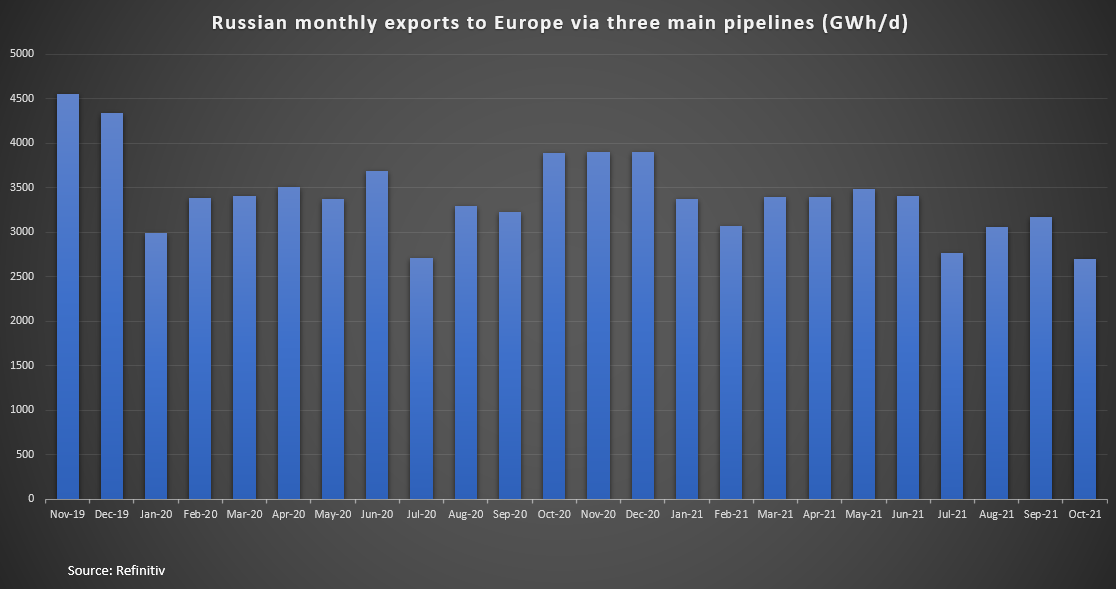
LONDON, (Reuters) – Benchmark European gas prices jumped 15% this week after a major pipeline bringing gas from Russia began sending flows eastwards. Europe relies on Russia for around 35% of its natural gas. The bulk comes through pipelines including Yamal, which goes through Belarus and Poland to Germany, Nord Stream, which goes directly to Germany, and pipelines going through Ukraine. Europe’s internal gas markets are linked through a network of interconnecting pipelines. Not all countries get supply directly from Russia, but if countries such as Germany, the biggest consumer of Russian gas, see lower flows from Russia they must replace this from elsewhere such as Norway. That has a knock-on effect on how much gas is available from other sources for other countries, and for transit. Gas prices in Britain have been just as volatile as those in continental Europe on any news out of Russia, even though it only typically gets around 5% of its gas from Russia. Lower overall Russian supply to Europe means less could be available from its largest suppliers, like Norway. Europe’s energy chief says European countries have enough gas to meet their needs over the winter. The issue, however, is the price they will need to pay. Last year gas exports from Russia fell because lower economic output, due to lockdowns designed to limit the spread of the coronavirus, led to a slump in demand. This year supplies to Europe failed to increase to match the rise in demand as economies recover. In the first 10 months of 2021 Russia supplied a total of 31,806 gigawatt hours a day of gas though its three main pipelines to Europe, Refinitiv Eikon data showed, down from 33,466 GWh/d during January-October 2020.
The Yamal pipeline has been working in reverse mode for the last five days, taking gas from the west to the east, data from Germany’s operator Gascade shows.
Russian monthly exports to Europe via three main pipelines (GWh/d
Globally there has been a scramble for gas supplies, sending prices soaring particularly in Asia, which means Europe is finding it harder to attract international LNG cargos which are often directed to whichever region is willing to pay the most. Typically gas storage sites are replenished in the summer when demand and prices are lower, but this year high prices meant less was sent to storage sites and owners with gas in storage have been keen to hang on to it in case demand and prices rise even more, leaving Europe facing winter with lower stocks than usual. Despite lower flows state-owned gas pipeline monopoly Gazprom (GAZP.MM) has said it is fulfilling all its long-term contracts, and European companies contacted by Reuters confirmed contractual obligations had been met. Russia prefers long-term gas contracts which can last for several years, over the short-term spot market which is based on one-off purchases. This is a way of ensuring it can retain market share and secure a consistent price, especially when Europe has said it is seeking new sources of gas. Russian President Vladimir Putin said Europe’s gas crisis is partly of its own making because of the shift to short-term spot deals. Less Russian gas has been available on the spot, day-to-day market, exacerbating the overall supply crunch in Europe.
Gazprom-controlled gas storage sites in Europe also have less gas than usual for this time of year, with Russia saying it is concentrating on replenishing domestic stocks before releasing any more gas to Europe. It expects the replenishment process to finish by Nov. 8.
Any significant changes in expectations of flows through the main Russian-EU pipelines or political declarations made by Russia can have a huge impact on daily EU gas prices. European benchmark gas prices hit a record 155 euros per megawatt hour (MWh) on Oct. 6 but plummeted the same day after Putin said Russia would send more gas to Europe, closing 26% down from the high at 114 euros/MWh. Flows through the Yamal Mallnow metering point in Germany at the Polish border have been flowing eastwards since Oct. 30, pushing benchmark European prices up around 15% since last week. Analysts have said the eastward flows could continue until Nov. 8, when Russia has said it expects its domestic storage sites to be filled. Putin said last month Russia was ready to provide more gas to Europe if requested, and rejected any suggestion that Moscow was squeezing supplies for political motives. EU energy commissioner Kadri Simson said the bloc had not asked more supplies from Russia, instead preferring to reach out to other trading partners. Norway, Europe’s second-largest supplier of gas, pledged in October to increase exports.
Russia has said Nord Stream 2, which is set to double Moscow’s annual gas export capacity in the Baltic, could provide relief to the European gas market.
The route, jointly with the existing Nord Stream pipeline, will double annual export capacity to 110 billion cubic metres, around half of Russia’s total gas exports to Europe a year.
The pipeline has been controversial and some European lawmakers have suggested Russia has deliberately reduced flows to Europe to stoke demand for the new project and smooth its progress.
Although the construction on the new pipeline has been completed, flows cannot start until it receives regulatory approval from German authorities, which could take until Spring 2022, by which time peak European winter demand will be over. NN: Obviousley Russia wants the Nord Stream II pipeline that it has invested $10 billion in including gas well investment turned on. Look at that as Europe getting gang raped. Of course they are going to wiggle as Russia holds them down…… Look at a contract dispute. Europe is becoming Russians bitch, so they are trying to get the best price they can as they sell their children into slavery……
PARIS, Nov 4 (Reuters) – World food prices rose for a third straight month in October to reach a fresh 10-year peak, led again by increases in cereals and vegetable oils, the UN food agency said on Thursday. The Food and Agriculture Organization’s (FAO) food price index, which tracks international prices of the most globally traded food commodities, averaged 133.2 points last month compared with a revised 129.2 for September. The September figure was previously given as 130.0. The October reading was the highest for the index since July 2011. On a year-on-year basis, the index was up 31.3% in October. Agricultural commodity prices have risen steeply in the past year, driven by harvest setbacks and strong demand. The FAO’s cereal price index rose by 3.2% in October from the previous month. That was led by a 5% jump in wheat prices, which climbed for a fifth consecutive month to reach their highest since November 2012, FAO said. “Tighter availability in global markets due to reduced harvests in major exporters, especially Canada, the Russian Federation and the United States of America, continued to put upward pressure on prices,” FAO said of wheat. Wheat futures started November at new peaks, with U.S. prices at fresh highs since 2012 and Paris front-month futures at a record high as import demand remained brisk. World vegetable oil prices jumped 9.6% on the month to set a record high, supported by further strength in palm oil prices as labour shortages in Malaysia continued to hamper production, FAO said. In contrast, global sugar prices eased 1.8% in October, ending a run of six straight monthly rises, according to FAO. Rome-based FAO cut its projection of global cereal production in 2021, to 2.793 billion tonnes from 2.800 billion estimated a month ago, according to its cereal supply and demand outlook. That mainly reflected reduced wheat output estimates for Iran, Turkey and the United States, offsetting an increased forecast for coarse grain production. Expected world cereal output would still represent a record, but would trail projected demand, leading to a fall in forecast cereal stocks, FAO said. Demand was supported by a raised projection of global cereal trade to a new record, bolstered by increased wheat trade. NN: This is more of that embedded inflation i have been warning about that the sold out FED refuses to acknowledge never mind raise interest rates. You cannot solve a problem you refuse to acknowledge you have…..
Major backers of coal, oil and gas projects will stop supporting them from 2023, instead backing clean energy in other countries
Four major economies have agreed to end their support for fossil fuel projects internationally in an announcement campaigners hailed as a “historic breakthrough”. At an overflowing event on the sidelines of Cop26 climate negotiations in Glasgow, Canada, the US and Italy joined the UK in promising not to commit any new finance for unabated coal, oil and gas projects in other countries by the end of 2022. Oil Change International campaigner Laurie van der Burg said: “The signatories of today’s statement are doing what’s most logical in a climate emergency: stop adding fuel to the fire and shift dirty finance to climate action.” E3G sustainable finance expert, Iskander Erzini Vernoit called it a “historic breakthrough that would not have been possible just a few years ago.” In total, 20 countries and five development banks signed the pledge. Big fossil fuel backers missing from the list include Japan, South Korea, China, France, Germany, Australia, the African Development Bank and World Bank.
As a last-minute addition, Italy was left off this map of signatories distributed by the UK government (Photo: Screenshot/Youtube/UK government)
Many developed country governments financially support projects abroad that they expect to benefit their own economies. They do this through offering export credit guarantees, so that their taxpayers bear a project’s risk rather than the private companies, or by offering loans on better terms than private banks. Research by Oil Change International shows that, in 2018-2020, Canada was the biggest financer of foreign fossil fuels in the G20, contributing $11bn a year. Speaking at the pledge’s launch event in Glasgow, Canadian minister of natural resources Jonathan Wilkinson cited the International Energy Agency’s recent report on what net zero by 2050 means for the global energy sector. He said: “The report called for immediate and massive deployment of all available clean and efficient energy technologies combined with a major global push to accelerate innovation… we need to deploy public resources in a way that is consistent with our climate goals”. The same analysis shows that the US provided $3.1bn a year while Italy contributed $2.7bn and the UK contributed $1.4bn. John Morton, climate counsellor to the US treasury, told the launch panel: “We don’t want to be using scarce public resources to lock in assets that will become stranded in a relatively short period of time as the world continues to transition.” Last year, the US, UK and Italy announced $7bn of public financing to a gas project in Mozambique. Maputo-based E3G analyst Jonathan Gaventa told Climate Home News: “Future projects of this type will be much more difficult to finance”. He added that the announcement puts in doubt whether US oil firm Exxon will be able to get US public finance for its Rovuma gas project in Mozambique. Shell and Equinor’s gas project in Tanzania will be difficult to finance too, he said.
South Africa $8.5bn finance package offers a model for ending reliance on coal
The signatories to this commitment pledged to “encourage further governments, their official export credit agencies and public finance institutions to implement similar commitments into COP27 and beyond”. While major European countries like France, Germany and Spain did not sign the agreement, E3G’s sustainable finance expert Iskander Erzini Vernoit told Climate Home News he was hopeful that they soon would. He pointed out that French development bank Agence Française de Développement (AFD) had signed the statement. But analysts said that the big Asian fossil fuel financers – Japan, South Korea and China – are less likely to sign up soon. All three have only agreed to phase out finance for the most polluting fossil fuel, coal, this year. The World Bank also did not sign up. In 2018-2020, it was the biggest multilateral back backer of fossil fuels, committing an average of nearly $2bn a year. Van Der Burg told Climate Home News that the US’ changing position could influence the bank. The US is the biggest shareholder in the World Bank and all of its presidents have been US citizens. NN: Talk about doubling down on a losing hand. Oil works, Nuclear works, natural gas works even nasty coal works… And the proof s the majority of the worlds energy comes from these c=sources,,,, Solar is marginal and wind is very problematic. So they are going to finance losers and shit on the systems that do work……. If you want to see how this thinking works out look no further then to England and Germany…… Forcing the greeneewenneieee technology prematurely will result in blackouts. And the support the carbon imitative has among the stupid money will melt away in the hot summer as the air conditioning shuts down for lack of power….