(Bloomberg) — Oil declined after Laura barreled into Louisiana, largely sparing the Texas Gulf Coast from widespread disruption to key energy infrastructure. Laura made landfall early Thursday near Cameron, Louisiana, as a Category 4 hurricane and has now weakened to a tropical storm. While the storm knocked out power to hundreds of thousands of people and impacted plants that produce chemicals and liquefied natural gas, southeast Texas ports and refineries — including the largest U.S. refinery — likely avoided the worst of it. Crude futures in New York fell less than 1% on Thursday, while gasoline futures dropped more than 5%. A stronger dollar also reduced the appeal for commodities priced in the greenback. “The damage is not as bad as anticipated, which is creating more sell pressure along the energy complex,” said Phil Flynn, senior market analyst at Price Futures Group. “The lower price of gasoline means worse refining margins potentially, meaning that there’s not going to be a lot of incentive to use a lot of crude quickly.” As the storm passes, traders are assessing the potential impact on both fuel production and consumption. Exxon Mobil Corp.’s Beaumont refinery in Texas will begin restarting Friday if an assessment shows no damage from Hurricane Laura, while its Baytown refinery on the Houston Ship Channel has already begun the restart process. Meanwhile, Magellan Midstream Partners LP’s East Houston terminal restored full operations at its refined products truck loading rack and the U.S. Coast Guard reopened the Port of Houston on Thursday. More than 80% of oil output in the Gulf of Mexico and almost 3 million barrels a day of refining capacity had been shut ahead of the storm, causing a spike in gasoline futures prices earlier this week. Since then, prices have retreated. Aside from the storm impact, a persistent inventory overhang as the coronavirus depresses demand continues to cloud the outlook for a sustained rebound in prices. “There’s still these competing inputs on the demand outlook,” said John Kilduff, a partner at Again Capital LLC. Due to the hurricane, there is a “big region where there’s going to be a lack of demand as people shelter in place and business patterns get disrupted.” In physical markets, Gulf Coast crudes are showing mixed signals after Laura’s landfall. Mars Blend, a high-sulfur crude, dropped on Thursday to its narrowest premium against Nymex WTI futures since July, while Heavy and Light Louisiana Sweet crudes strengthened. Meanwhile, bookings for tankers to ship gasoline from Europe to the U.S. surged this week. So far, 13 tankers were booked to load gasoline in Europe with the U.S. listed as a destination, according to shipping fixtures compiled by Bloomberg. Nick Note: Biggest hurricane ever hits the gulf of Mexico and oil prices collapse. Oil is so over supplied. Remember this 80% of crude oil is turned into jet fuel. And if you have not noticed their are no Jets flying. And their will not be a reprieve. Oil prices must collapse and will. I do not give a shit how many stewardesses they show with masks and how many ads of workman spreading disinfectant they show in their promos. Reality is no matter how they want to deny it… A virus that spreads as an aerosol turns every fight into a roll of the coronavirus roll of the dice. That will come up snake eyes.
College towns growing alarmed over outbreaks among students
RALEIGH, N.C. (AP) — As waves of schools and businesses around the country are cleared to reopen, college towns are moving toward renewed shutdowns because of too many parties and too many COVID-19 infections among students. With more than 300 students at the University of Missouri testing positive for the coronavirus and an alarming 44% positivity rate for the surrounding county, the local health director Friday ordered bars to stop serving alcohol at 9 p.m. and close by 10 p.m. Nick Note: Missouri is a major tourist state in the Midwest. And the billion dollar operators have corrupted the health services in Taney and Stone county. With a positivity rate over 40% they should be shutting down the tourist attractions. And to think closing a bar at 10 PM will stop infections is a sick joke!
Iowa’s governor has ordered all bars shut down around The University of Iowa and Iowa State, while the mayor of Tuscaloosa, Alabama, did the same in the hometown of the state’s flagship university. “What we’re seeing in our violations is they’re coming late at night,” said Stephanie Browning, head of the health department for Columbia, Missouri. “Big groups gathering. They’re not wearing their masks, they’re not social distancing.” In Utah, the city council in Provo overrode a mayoral veto to pass a mask mandate, which includes a $500 fine for organizing large mask-less gatherings, days before students return to Brigham Young University from around the country. But the council was nevertheless worried that college students sharing dorms, bathrooms and showers could become “super-spreaders” and bring the virus off campus, council chair George Handley said. “We’re already seeing what’s happened across the country at other universities,” he said. But a recent warehouse party organized by a BYU student’s promotional company called Young/Dumb also raised concern when pictures of hundreds of revelers without masks surfaced online. BYU, owned by The Church of Jesus Christ of Latter-day Saints, has its own rules requiring masks on campus. Requirements for indoor public spaces in town will help people stay healthy and businesses stay open, Handley said.
“This is actually about preserving our way of life, it’s not about destroying it — contrary to what some people say,” Handley said.
The outbreaks since students began returning to campus in the past few weeks have heightened tensions between colleges and their towns and led to recriminations between local politicians and university officials. Meanwhile, California announced a four-tiered, color-coded plan Friday for gradually reopening businesses after abandoning a reopening attempt earlier this summer. It requires counties to meet certain benchmarks showing progress in controlling the virus. In Arizona, another deadly hot spot this summer, a drop in transmission numbers allowed the Phoenix and Tucson areas to reopen gyms and some bars. The U.S. has recorded over 180,000 deaths from the coronavirus and 5.9 million confirmed infections. Worldwide, the death toll is put at more than 830,000, with at least 24.5 million cases. Surging infection numbers around the U.S. have been blamed in part on young people ignoring mask and social distancing requirements. In Iowa’s Story County, home to Iowa State, 74% of new cases over the past seven days were among people ages 19 to 24, Gov. Kim Reynolds said Thursday. In the same time period, 69% of new cases in Johnson County, the home of the University of Iowa, were in that age group. “It is increasing the virus activity in the community, and it’s spilling over to other segments of the population,” Reynolds said. Fueled in part by clusters where college students are returning to classes, Kansas has had its highest seven-day increase in coronavirus cases. Gov. Laura Kelly said outbreaks on college campuses and fraternities and sororities are at least a factor in the surge.“We cannot continue to go down this path,” she told reporters Friday.
The University of Alabama has recorded over 1,000 cases on campus since the fall semester began last week. In closing the town’s bars Monday for the next two weeks, Tuscaloosa Mayor Walt Maddox said that an unchecked spread of the virus threatens both the health care system and the local economy if students have to be sent home for the semester for remote learning.
Three of North Carolina’s largest public universities have abruptly halted in-person undergraduate instruction and directed students to move out of the dorms after hundreds tested positive following their return to campus. More than 800 have been infected at the University of North Carolina at Chapel Hill and over 670 at North Carolina State.
Leaders at UNC-Chapel Hill, which has shifted to online classes, wrote an open letter Thursday to the mayor outlining steps the university is taking to curb off-campus parties. “We recognize the very real problems with the behaviors of some of our fraternities and sororities,” the letter said. The problems did not change the thinking of other schools around the country. The University of Virginia announced Friday that it is moving ahead with plans to offer in-person instruction for the fall semester, after delaying the start of classes for two weeks to assess the spread of COVID-19.
“We know some will be delighted to hear this news and others will be disappointed,” a university statement said. “To be frank, it was a very difficult decision, made in the face of much uncertainty, and with full awareness that future events may force us to change course.” Nick Note: It is incredible to me that higher institutes of learning are so stupid.
As Trump travels, Secret Service copes with infections
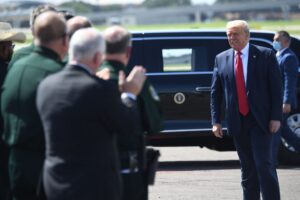
WASHINGTON – When President Donald Trump gave a speech to a group of sheriffs in Tampa late last month, his decision to travel forced a large contingent of Secret Service agents to head to a state that was then battling one of the worst coronavirus surges in the nation. Even before Air Force One touched down on July 31, the fallout was apparent: Five Secret Service agents already on the ground had to be replaced after one tested positive for the coronavirus and the others working in proximity were presumed to be infected, according to people familiar with the situation. The previously unreported episode is one of a series of examples of how Trump’s insistence on traveling and holding campaign-style events amid the pandemic has heightened the risks for the people who safeguard his life, intensifying the strain on the Secret Service. In the past two months, dozens of Secret Service agents who worked to ensure the security of the president and Vice President Mike Pence at public events have been sickened or sidelined because they were in direct contact with infected people, according to multiple people familiar with the episodes, who spoke on the condition of anonymity to describe the incidents.
Despite that, Trump has continued to hold large gatherings – most dramatically at the White House on Thursday night, when he delivered his acceptance speech at the Republican National Convention before a crowd of 1,500 people seated closely together on the South Lawn, with few masks in sight. The vast majority were not tested for the coronavirus ahead of time.
Trump’s actions rebuff the scientific consensus that the best way tamp down the spread of the virus is to avoid large gatherings and close quarters. Critics say his refusal to abide by those guidelines is imposing unnecessary risk on the Secret Service staff, who have no choice in whether to accompany the president.
“Never before has the Secret Service run up against a president so intent on putting himself first regardless of the costs, including to those around him,” said Ned Price, a national security expert and former CIA analyst. “And by maintaining a rigorous travel schedule and otherwise flouting public health guidance, he is demanding that agents add to their already considerable professional risk in ways that are qualitatively different than what they signed up for.”
White House spokesman Judd Deere said in a statement that the president “takes the health and safety of everyone traveling in support of himself and all White House operations very seriously, as well as those dedicated to covering him and this Administration.” “When preparing for and carrying out any travel, White House Operations collaborates with the Physician to the President and the White House Military Office, to ensure plans incorporate current CDC guidance and best practices for limiting covid-19 exposure to the greatest extent possible,” Deere added.
The Secret Service declined to provide information about the number of its employees who have tested positive. Secret Service Director James Murray told personnel last month in staff messages that the numbers of positive cases had been rising, a trend he attributed to the agency’s increased testing in previous weeks, according to two people familiar with the communication. Nick Note: Trump is a very dangerous wanna be Dictator. The safe guards are not built into the systems to safeguard American freedoms from such a man.
Continue reading “As Trump travels, Secret Service copes with infections”
Trump turns South Lawn into a Campaign Rally
On the final night of the Republican National Convention, about 1,500 people gathered on the South Lawn of the White House to hear President Donald Trump speak. The crowd didn’t appear to observe social distancing and few people in attendance wore masks. The Trump campaign issued a vague statement ahead of the speech that didn’t specify any testing protocols. Chairs being assembled on the lawn in the late afternoon drew initial concern for their lack of spacing, with most of the spots sitting only inches apart.
—Mark Knoller (@markknoller) August 27, 2020
Then, once the crowd began forming around sunset, a lack of mask wearing became apparent to reporters and photographers on the scene.
—Mark Knoller (@markknoller) August 28, 2020
White House Chief of Staff Mark Meadows said “a number of people” at the event will be tested, according to Bloomberg News.
The Trump campaign’s statement on coronavirus protocols for the final night of the convention was vague, and did not specify what the testing situation would be or whether masks would be mandatory.
“Patronus Medical, a leading medical, safety, and health company, has worked in partnership with the Republican National Committee to make certain proper protocols are in place to ensure the safety and well-being of individuals at convention venues.”
“These strict protocols are in full compliance with multiple guidelines set forth by the United States Centers for Disease Control, the District of Columbia Department of Public Health, and other leading authorities on health safety.”
Even though coronavirus research has found far fewer outdoor transmissions, packed areas like stadiums have been traced to “superspreader events.”A prominent Harvard Medical School professor tweeted his concerns.
—Ashish K. Jha (@ashishkjha) August 28, 2020
Mask wearing at Trump rallies has been a lingering issue of the 2020 campaign since the debacle in Tulsa back in June. While it is unknown precisely where he contracted the virus, former Republican presidential candidate Herman Cain died from COVID-19 a little more than a month after the Trump Tulsa Rally, where he was in attendance. He was hospitalized with the virus two weeks later.
—Renato Mariotti (@renato_mariotti) July 30, 2020
Two days after Cain announced positive test result, he expressed support for the Trump campaign’s decision not to require masks at the Mount Rushmore Fourth of July rally.
AstraZeneca says it has not had any discussions with any U.S. government “officials” about an emergency use authorization
Pharmaceutical firm AstraZeneca says it has not had any discussions with any U.S. government officials about an emergency use authorization for its coronavirus vaccine, Politico reports. The company’s statement comes a day after the Financial Times reported the White House would consider how to grant an emergency use of the AstraZeneca vaccine if a late-stage clinical trial currently taking place in the U.K. and other countries has positive results. “It would be premature to speculate on that possibility,” the pharmaceutical company said in a statement. The vaccine was developed by the University of Oxford. Currently, 11,000 people in the U.K., South Africa, and Brazil are enrolled in a clinical trial scheduled to end later this year. AstraZeneca is planning a similar trial in the U.S. it hopes will enroll 30,000 people, Politico reports. In May, the company signed a $1.2 billion deal to provide the U.S. with 300 million initial doses of the shot.
News of a possible fast-tracked virus vaccine comes as President Donald Trump has accused the FDA of not acting quickly enough on approving possible treatments. At the same time, FDA Commissioner Stephen Hahn is working to assure Americans it will not sacrifice safety or efficacy for speed, Politico reports.
“Data is driving the development of all COVID-19 countermeasures,” HHS spokesperson Michael Caputo said in a statement Monday. “Careless talk about career FDA experts somehow approving an unsafe and ineffective vaccine just for politics only undermines confidence in the public health system.” Nick Note: Let Me see if understand this. they get billions for a vaccine they don”t have. And sell 30 million doses for said not approved vaccine. its not a stretch for me to see them giving Trump a unproven vaccine for a October surprise. If they are paid enough.
Brutal campaign shaping up over pandemic, race and the economy
With just over 10 weeks until Election Day, the campaign for president turns from a pair of scripted conventions to the trench warfare of mobilizing voters and the unpredictability of September and October, with the campaign playing out against a backdrop unlike anything seen in modern times. In a month, the first of three presidential debates will be held, scheduled for Sept. 29 in Cleveland. Some strategists see that evening as a pivotal and potentially decisive confrontation, particularly if President Donald Trump has a bad night and Joe Biden looks strong. Still, the 2016 campaign moved late and, ultimately, decisively in Trump’s direction. Democrats worry about a repeat of that playbook and warn now against complacency. By the time of the first debate, early voting will have begun in a few states, and the pace will accelerate in October. Controversy over voting by mail is yet another backdrop of the argument between Trump, who claims without evidence that mail ballots are vulnerable to fraud, and Biden, who has charged that Republicans are trying to frustrate voters and suppress Democratic turnout. A deadly pandemic, an economy struggling to rebound, with millions out of work, and continued racial unrest and calls for racial justice sparked by shootings of unarmed Black men continue to shape Campaign 2020. The trio of crises will be the overriding issues as voters decide whether to give Trump a second term or turn the country over to Biden. For Trump, the challenge in the weeks ahead will be to undo impressions of nearly four years of chaotic leadership, to demonstrate the kind of discipline and focus that has too often been missing. For Biden, the challenge will be to hold steady while not appearing too passive, to persuade people he has the vision, the policies and the energy to move the country to a more positive place. Coming into this week, Biden held a stronger hand, at least as the polls tell the story. He was ahead nationally and in the battleground states, with an image more favorable than that of the president and with the country and the economy turned upside down by a coronavirus pandemic that the public has judged the president badly mishandled. But that was before he was subjected to four nights of battering, with the most comprehensive attack leveled by Vice President Mike Pence on Wednesday night. Trump’s political future depends on whether his convention begins to move the electorate back in his direction. The well-packaged program aimed some of the speeches at the president’s most fervent supporters, those who voted for him in 2016 and like-minded Americans who did not but whose votes this year could be vital. But just as important for Trump’s reelection hopes are those Americans who do not already know how they will vote in the November election and might be looking for a reason to support Trump, even with misgivings. Nick Note: Trump is a reality TV star. And he IS creating
Continue reading “Brutal campaign shaping up over pandemic, race and the economy”
Putin: 2nd COVID-19 vaccine ready in September
Russia is preparing to approve a second vaccine against COVID-19 in late September or early October, Russian Deputy Prime Minister Tatiana Golikova said Wednesday during a televised government meeting. Golikova told President Vladimir Putin that early-stage clinical trials of the vaccine, developed by the Vector Virology Institute in Siberia, will be completed by the end of September. “As of today there have been no complications among those vaccinated in the first and second stages of testing,” she said. Nick Note: This vaccine was developed at a Russian bio-weapons lab. The facility is biological warfare research Level V LAB with security up the ass… including a regiment of the Soviet Arm protecting the lab… Can you imagine the horrors going on their? The race is on between Putin and Trump to see who will be the first to rush a vaccine to market… October surprise anyone?
Laura makes landfall in Louisiana as Category 4 hurricane
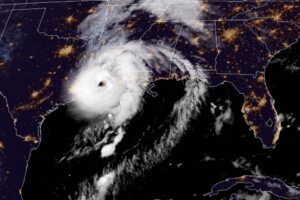
DELCAMBRE, La. — Hurricane Laura made landfall in southwestern Louisiana as a ferocious Category 4 monster with 150 mph winds early Thursday, swamping a low-lying coast with ocean water that forecasters said could be 20 feet deep and unsurvivable. The National Hurricane Center said the storm, which intensified rapidly Wednesday before plowing into land, came ashore at 1 a.m. CDT near Cameron, a 400-person community about 30 miles (48 kilometers) east of the Texas border. “Potentially catastrophic impacts will continue,” forecasters said. Video and photos on social media showed torrents of rain flying sideways past street lights in Lake Charles, and streets covered with water closer to the coast. A sudden storm surge knocked over cameras meant to capture the hurricane’s effects. With hours of violent weather ahead, officials said the extent of destruction likely wouldn’t be clear until daybreak, when search and rescue missions will begin. Drawing energy from the warm Gulf of Mexico, the system arrived early Thursday during high tide as the most powerful hurricane to strike the U.S. so far this year. “It looks like it’s in full beast mode, which is not what you want to see if you’re in its way,” University of Miami hurricane researcher Brian McNoldy said. Hurricane-force winds extending 60 miles (95 kilometers) from the storm’s center neared the coast, forecasters said, and bands of heavy rain fell 30 miles (48 kilometers) from the beach in Lake Charles. Maximum sustained winds increased to 150 mph (241 kph) before nightfall, and forecasters said up to 15 inches (38 centimeters) of rain could fall. Forecasters issued a string of tornado warnings as the storm pushed on to land, but there were no immediate reports of damage. More than 100,000 homes and businesses were without power in Texas and Louisianan. One major Louisiana highway already had standing water as Laura’s outer bands moved ashore with tropical storm-force winds. Earlier Wednesday, winds picked up as shoppers rushed into a grocery store in low-lying Delcambre. Trent Savoie, 31, said he was staying put. “With four kids and 100 farm animals, it’s just hard to move out,” he said. Texas Gov. Greg Abbott and Louisiana Gov. John Bel Edwards fretted that the dire predictions were not resonating despite authorities putting more than 500,000 coastal residents under mandatory evacuation orders. Officials said at least 150 people refused pleas to leave and planned to weather the storm in everything from elevated homes to recreational vehicles in coastal Cameron Parish, which could be completely covered by ocean water. “It’s a very sad situation,” said Ashley Buller, assistant director of emergency preparedness. “We did everything we could to encourage them to leave.” Edwards activated the state’s entire National Guard. In Lake Charles, Guard members drove school buses around neighborhoods, offering to pick up families. Across the state line in Port Arthur, Texas, few stragglers boarded evacuation buses, and city officials announced that two C-130 transport planes offered the last chance to leave. A Category 4 hurricane can render wide areas uninhabitable for weeks or months and knock out power for just as long. The threat of such devastation posed a new disaster-relief challenge for a government already straining under the coronavirus pandemic. The parts of Louisiana that were under evacuation orders included areas turning up high rates of positive COVID-19 tests. The National Hurricane Center kept raising its estimate of Laura’s storm surge, from 10 feet (3 meters) just days ago to twice that size – a height that forecasters said would be especially deadly. On Twitter, President Donald Trump urged coastal residents to heed officials. Hurricane warnings were issued from San Luis Pass, Texas, to Intracoastal City, Louisiana, and reached inland for 200 miles (322 kilometers). Storm surge warnings extended from Freeport, Texas, to the mouth of the Mississippi River. Nick Note: we will not know the extend of damages until daylight And survey crews return to the offshore oil rigs. We have overlayed satellite images:
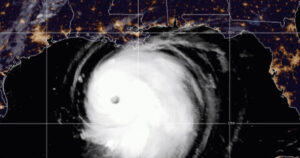 The storm missed the sweet spot of rigs in the Eastern Gulf. Most of the rigs have been spared and the refinery belt in Huston and Galveston bay were spared since the storm went east. As you can see here Houston and most of Texas were not hit. This was not a oil event but a Coonass disaster:
Fauci Was Having Surgery When Task Force Watered Down CDC Testing Guidelines
Dr. Anthony Fauci said that he wasn’t present in the room when other members of the White House Coronavirus Task Force decided to change its covid-19 testing guidelines. In fact, he was zonked out to high heaven on general anesthesia in an operating room. On Monday, the Centers for Disease Control and Prevention abruptly (and quietly) modified its testing guidelines to say that individuals who may have been exposed to someone with the novel coronavirus “do not necessarily” need to get tested, especially if they are not exhibiting symptoms or haven’t been directed to by a doctor. Before, the CDC recommended anyone potentially exposed to seek testing. This modification struck many in the medical community as confusing and suspicious, given that scientists currently believe those who have contracted the virus but who are asymptomatic or have not yet exhibited symptoms are a major driver of new infections. Meanwhile, Donald Trump has made little secret of the fact he thinks widespread testing is part of a scheme to inflate case numbers and hurt him politically, rather than an effort to track and control the spread of a disease now estimated to have killed at least 179,000 people across the country. The CDC ultimately is in charge of the guidelines. But Health and Human Services assistant secretary for health Admiral Brett P. Giroir told reporters the White House task force reached “absolute consensus” on the new guidelines at a meeting on August 20, specifically noting that Fauci was involved in the process. Fauci, the director of the National Institute of Allergy and Infectious Diseases and the most visible official on the task force, told CNN on Wednesday he wasn’t at that meeting. According to CNN, the idea was proposed in July by Redfield, who previously faced accusations he was rolled by the Trump administration on school reopening guidelines and has been largely sidelined during the crisis. The idea was “met with immediate resistance from several task force members,” but when it was brought back up on Aug. 20, Fauci wasn’t there to dissent. Anonymous federal health officials told CNN and the New York Times the directive to change the guidelines didn’t originate with the CDC at all but instead came from higher in the food chain. If fewer tests turned up fewer cases, that could help create the impression the situation is more under control than it really is. Infectious disease experts told Gizmodo they had similar concerns about the Food and Drug Administration’s emergency use authorization this week for convalescent plasma to treat covid-19, saying it lacked rigorous scientific data to support it. The CDC also removed guidance instructing those returning from overseas or out of state to self-isolate for two weeks on Monday. “I mean, the evidence that I’m aware of as of today is that close to 40% of the cases of the infections are asymptomatic and asymptomatic people transmit the infection,” Emory University School of Medicine associate dean and infectious disease specialist Dr. Carlos del Rio told CNN. “So, not testing—I mean, if you have been in contact with somebody for a few minutes, that’s okay. But if you have been in contact for 15 minutes and that people doesn’t have a mask, I think you need to be tested regardless if you have symptoms or not.”
“… We want to decrease cases by decreasing transmission, not by decreasing testing,” del Rio told the network.
“This is a collective experience that grows more concerning each day. It is substituting potential partisan policy for good regulatory and public health science,” University of Minnesota Center for Infectious Diseases Research and Policy director Michael Osterholm told Stat. “The two foundational organizations in this country for public health really have been the CDC and the FDA and the credibility of both has just really been undercut.” That’s “the worst thing that we can have happen to us in terms of public health credibility,” Osterholm added. Nick Note: Trump is not worth a shit as a leader. But ill tell you what he is great at. That is getting people to betray their principals and sell their sole to the Trump devil for 15 minutes of glory.
Impact on Oil From Hurricane Laura Marginal
NEW YORK — The energy industry braced Wednesday for catastrophic storm surges and winds as Hurricane Laura cuts a dangerous path toward the coastlines of Texas and Louisiana. Oil and gas producers have evacuated platforms and rigs in the Gulf of Mexico and companies are shutting down refineries in the storm’s path. Many had already done so while they were preparing for Tropical Storm Marco. Utilities are bracing for downed power lines and blackouts.
Experts say it’s unlikely that the U.S. will suffer from major oil or gasoline shortages due to the hurricane, as other regions fill in the gaps or turn to stored oil. And demand this summer has been at historic lows. And inventories are at record highs.
OFF-SHORE PLATFORMS
Nearly half of the oil and gas platforms in the Gulf of Mexico — almost 300 — were evacuated by Wednesday, along with most of the offshore rigs. Producers shut in 84% of the oil produced in the region, taking about 1.6 million barrels per day off the market. The Gulf region usually produces about 15% of the oil in the U.S. Producers also shut in about 61% of the natural gas produced in the Gulf. While some oil production is temporarily suspended, experts say it’s unlikely to cause problems for supply in the U.S. There has been a surplus of oil production this year, and demand for fuel is still well below pre-pandemic levels. Producers outside the region can pick up the slack.
———
REFINERIES
More than half of U.S. refining capacity is built along the Gulf Coast, where the storm is heading. Six refineries, which together have a refining capacity of about 2.2 million barrels per day, were shut down, including refineries operated by Valero, Total and Citgo.
Refineries built in hurricane regions have reinforced their facilities after prior hurricanes to withstand the storm, but it’s likely that there will be disruptions to some major refineries, Burkhard said.
———