Big Bankruptcies Sweep the U.S. in Fastest Pace Since May 2009

In the first few weeks of the pandemic, it was just a trickle: companies like Alaskan airline Ravn Air pushed into bankruptcy as travel came to a halt and markets collapsed. But the financial distress wrought by the shutdowns only deepened, producing what is now a wave of insolvencies washing through America’s corporations. In May alone, some 27 companies reporting at least $50 billion in liabilities sought court protection from creditors — the highest number since the Great Recession. They range from well-known U.S. mainstays such as J.C. Penney Co. and J. Crew Group Inc. to air carriers Latam Airlines Group SA and Avianca Holdings, their business decimated as travelers stayed put. In May 2009, 29 major companies filed for bankruptcy, according to data compiled by Bloomberg. And year-to-date, there have been 98 bankruptcies filed by companies with at least $50 million in liabilities — also the highest since 2009, when 142 companies filed in the first four months. Few people believe bankruptcies have by any means hit a peak. “I think we’re going to continue to see filings of at least the level we’re seeing for a while,”said Melanie Cyganowski, a former bankruptcy judge now with the Otterbourg law firm. The wave of insolvencies is seemingly at odds with U.S. credit markets, which are busier than ever: investment-grade corporations were able to cushion their balance sheets by borrowing nearly $1 trillion in the first five months of the year, the fastest pace on record. No such luck for weaker companies. Their revenues have evaporated, straining their ability to keep up with debt payments and all but forcing them to seek refuge in bankruptcy court. “If you know someone at the bankruptcy courts, be sure to thank them,” Duston McFaul, a partner at law firm Sidley Austin, said in an email. “They’re already over-stretched and we’re only in the first inning.” Nick Note: Prepare yourself for some great bargains. NOW is the time to buy. I can tell you we are gearing up. A friend of mine just bought a 1000 electric bikes from a ride share service that is getting out of the busies.

Russia Ready To Boost Production As Soon As OPEC+ Deal Ends

As OPEC+ prepares to meet in two weeks’ time, members are weighing whether to extend the output cuts or ease them.

Russia is determined to start easing oil output cuts from July, sticking to the terms of the OPEC+ deal struck earlier this year, according to people familiar with the key producer’s position. OPEC and its allies reached a historic accord in April to slash production as the pandemic savaged demand. As part of that deal, the cuts would slowly taper from July. But since the agreement was sealed, Saudi Arabia tried to prop up the market with additional cuts and Gulf allies followed suit. As OPEC+ prepares to meet in two weeks’ time, members are weighing up whether to extend the cuts or ease them. Three Russian officials and two people in the industry, speaking on condition of anonymity, said the nation’s position is to stick to the plan. Kremlin spokesman Dmitry Peskov told reporters on Tuesday the deal is “undoubtedly successful,” and said countries will look how the situation develops before taking a decision at the June 9-10 meeting. The historic April agreement, which marked the end of a price war between Moscow and Riyadh, helped to reduce global glut and has prompted a recovery in crude prices. Brent traded at $36 a barrel on Tuesday — almost 70% higher than a month ago — as the easing of coronavirus lockdowns around the world slowly lifts demand. At these levels, it’s still a blow for Russia’s budget. On Tuesday Russian oil producers discussed the future of the OPEC+ deal with Energy Minister Alexander Novak, including the possibility of extending the deepest cuts for another two months, according to Kommersant, a Russian business newspaper.  The discussion came up as Saudi Arabia, the de-facto OPEC leader, has pressed for extending the cuts, Kommersant said, citing an unidentified person. The meeting didn’t reach a consensus, according to the newspaper. Russia has traditionally preferred a cautious, wait-and-see approach before OPEC+ meetings, often agreeing to proposals of its partners at the last moment. While the crude surplus remains at about 7 million to 12 million barrels a day, Russia expects that global supply and demand could balance in June or July, Novak said in a statement Monday. Russian industry players are also cautiously optimistic about the recovery. The St. Petersburg Oil Terminal, where fuel from key refineries is loaded onto ships bound for Europe, has recorded a sharp rebound in European demand for some types of oil products, such as diesel, as lockdowns are relaxed. “We see that the demand is approaching normal levels,” with the exception of jet fuel consumption, which may take as much as three years to return to the 2019 volumes, Mikhail Skigin, the terminal’s Chief Executive Officer told Bloomberg in an email. Skigin expects Russia’s domestic refineries to return to normal operations in summer after massive idling earlier this month. The cuts have been painful in Russia, where producers have faced their greatest challenge in decades: shutting in a large number of wells without permanently damaging the fields. Russia is making about a quarter of the total OPEC+ cuts. Rosneft PJSC, which accounts for about 40% of nation’s output, has so far just limited oil flows to comply with its quota. But within the next three months it will look into “full shut-ins and long-term conservation of some of the highest-cost projects,” Chief Financial Officer Pavel Fedorov said this month. According to the deal, Russian oil companies have to reduce their crude production on pro-rata basis by 2.5 million a barrels in May and June, down from about 11 million barrels a day. Then the cuts will average 2 million barrels a day until the end of this year and will flatten further to 1.5 million through April 2022.   Nick Note: Their is a lot of room for error here. OPEC is betting on a BIG rebound in demand in another month  and it may not materialize.

EIA: US crude stockpiles rise by 7.9M barrels

U.S. commercial crude oil inventories (excluding those in the Strategic Petroleum Reserve) increased by 7.9 million barrels from the previous week. At 534.4 million barrels, U.S. crude oil inventories are about 13% above the five year average for this time of year.
Total motor gasoline  U.S. crude oil refinery inputs averaged 13.0 million barrels per day during the week ending May 22, 2020 which was 87,000 barrels per day more than the previous week’s average. Refineries
operated at 71.3% of their operable capacity last week. Gasoline production increased last week,
averaging 7.2 million barrels per day. Distillate fuel production decreased last week, averaging
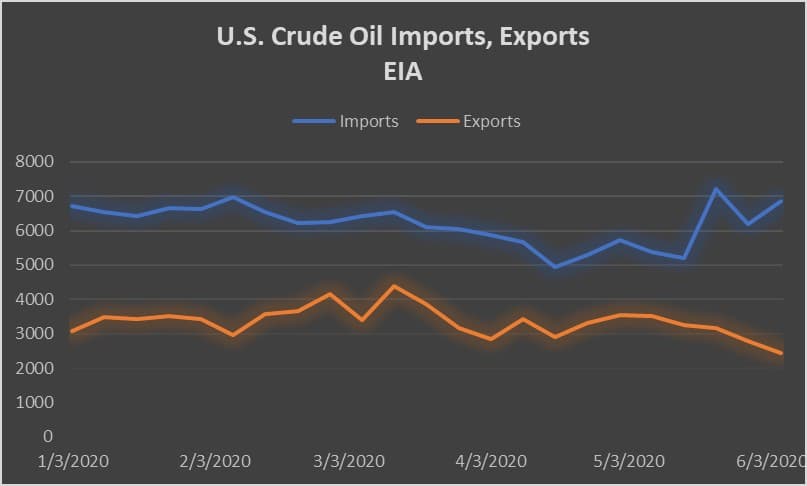
4.8 million barrels per day. U.S. crude oil imports averaged 7.2 million barrels per day last week, increased by 2.0 million barrels per day from the previous week. Over the past four weeks, crude oil imports averaged about 5.9 million barrels per day, 16.4% less than the same four -week period last year. Total motor gasoline imports (including both finished gasoline and gasoline blending components) last
week averaged 292,000 barrels per day, and distillate fuel imports averaged 155,000 barrels per
day. inventories decreased by 0.7 million barrels last week and are about 10% above the five year average for this time of year. Finished gasoline inventories decreased while blending components inventories increased last week. Distillate fuel inventories increased by 5.5 million barrels last week and are about 24% above the five year average for this time of year. Propane/propylene inventories increased by 1.5 million barrels last week and are about 13% above the five year average for this time of year. Total commercial petroleum inventories increased last week by 14.9 million barrels last week. Total products supplied over the last four-week period averaged 16.2 million barrels a day, down by 20.1% from the same period last year. Over the past four weeks, motor gasoline product supplied averaged 7.0 million barrels a day, down by 25.7% from the same period last year.
Distillate fuel product supplied averaged 3.5 million barrels a day more than the past four weeks,
down by 13.6% from the same period last year. Jet fuel product supplied was down 66.6% compared with the same four -week period last year. Nick Note: Inventories better start dropping and dropping fast. If they do not. We will soon be back to the Twenties!

Oil Plunges After API Reports Large Unexpected Crude Inventory Build

The American Petroleum Institute (API) reported a large crude oil inventory build, of 8.731 million barrels for the week ending May 22. Analysts had predicted an inventory draw of 2.50 million barrels. In the previous week, the API reported a draw in crude oil inventories of 4.8 million barrels. Meanwhile, the EIA’s estimates were wildly different, with the industry body reporting last week that the inventories had fallen by 5 million barrels. WTI was trading down on Wednesday afternoon prior to the API’s data release, although the outlook for a rebalanced oil market is more positive than it was even just two weeks ago, with many U.S. states easing lockdown restrictions and the world’s largest oil producers, including Saudi Arabia, Russia, and the United States, cutting production by more than many market analysts had predicted would be the case. Oil production in the United States has now fallen from 13.1 million bpd on March 13 to 11.5 million bpd for May 15, according to the Energy Information Administration—a drop of 1.6 million bpd—more than OPEC’s production cut agreement from last year. The API reported a build of 1.120 million barrels of gasoline for week ending May 22—compared to last week’s 651,000-barrel draw. This week’s draw compares to analyst expectations for a 33,000-barrel draw for the week. Distillate inventories were up by 6.907 million barrels for the week, compared to last week’s 5.1-million-barrel build, while Cushing inventories saw a draw of 3.370 million barrels. Nick Note: As you know we racked up a bingo trading oil long off the bottom and oil instruments. We took profits damn near at the exact top….. Another lucky guess. the reason i gave you my two most favorite words in the English language *take profits” was because i felt the oil market got way way ahead of itself. Its all about inventories and weather the pent up demand materializes in People Start Your Engines…. So for now we stand neutral and we wait and we watch. Wait is the word i hate most in the English language!

Oil slides on U.S.-China tensions

Mike Pompeo declares that Hong Kong is ‘no longer autonomous’ from China as Beijing prepares to pass security crackdown – opening way for ending trade privileges
  • ‘No reasonable person can assert today that Hong Kong maintains a high degree of autonomy from China,’ said Pompeo
  • The president warned in a statement Tuesday Hong Kong would risk its role as a ‘financial hub’ if China imposed its new national law 
  • Pompeo said he certified to Congress that it doesn’t deserve special trade treatment
  • However his statement did not revoke any specific trade privileges 

Secretary of State Mike Pompeo said Wednesday that Hong Kong no longer deserves special treatment under trade laws as it is no longer maintains a ‘high degree’ of autonomy from China. Pompeo issued the statement a day after President Trump issued a threat that if China imposes its new national law on Hong Kong the island would lose its role as a ‘financial hub.’ ‘No reasonable person can assert today that Hong Kong maintains a high degree of autonomy from China, given facts on the ground,’ Pompeo said in a statement.  ‘No reasonable person can assert today that Hong Kong maintains a high degree of autonomy from China, given facts on the ground,’ Secrtary of State Mike Pompeo said in a statement. The territory enjoyed special protections carried over from when it was under British rule before 1997. Pompeo said he certified in a statement to Congress that the territory ‘does not continue to warrant treatment under United States laws in the same manner as U.S. laws were applied to Hong Kong before July 1997.’ ‘Beijing’s disastrous decision is only the latest in a series of actions that fundamentally undermine Hong Kong’s autonomy and freedoms and China’s own promises to the Hong Kong people under the Sino-British Joint Declaration, a U.N.-filed international treaty,’ Pompeo added. He wrote in a tweet that the gesture shows the U.S. ‘stands with’ Hong Kong. ‘Today, I reported to Congress that Hong Kong is no longer autonomous from China, given facts on the ground. The United States stands with the people of Hong Kong,’ he wrote.  The statement comes a day after President Trump commented on the subject through his press secretary. President Trump had warned Hong Kong’s status as a ‘financial hub’ was at risk National Security Advisor Robert O’Brien warned Sunday on CBS ‘Face the Nation’ that it ‘looks like’ Beijing was violating a 1984 agreement providing Hong Kong certain autonomy through 2047.  ‘I can’t see how Hong Kong remains an Asian financial center if the Chinese Communist Party goes through and implements its national security law and takes over Hong Kong,’ he told the network. ‘That’d be a tragedy for the people of Hong Kong and it would also be very bad for China.’

Coronavirus update: Global case tally crosses 5.5 million as WHO warns of risk of ‘second peak’ in current infection wave

The global case tally from the coronavirus that causes COVID-19 climbed above 5.5 million on Tuesday, as the World Health Organization warned of the possibility of an immediate “second peak” in infections during the current wave, if countries and local governments ease measures to contain the spread too soon. Dr. Mike Ryan, WHO emergencies chief, offered the warning in an online briefing, as the Associated Press reported.  “We cannot make assumptions that just because the disease is on the way down now it is going to keep going down and we are get a number of months to get ready for a second wave,” said Ryan. “We may get a second peak in this wave.” His warning comes after the U.S. Memorial Day holiday celebrations saw crowds gathering on beaches and in parks in many states (with notable images emerging from the Lake of the Ozarks resort area in Missouri), failing to observe social-distancing measures and other guidelines that public-health experts say are still essential to control the spread of the virus. Media reported widely on the culture wars brewing across the U.S. between those who refuse to comply with safety measures, such as wearing face masks, and even claim the pandemic is not real, and those who are respecting guidelines. Social media reflected the divide in videos of individuals in some states brawling with store workers when asked to wear a mask, while in other states store associates were refusing to allow entrance to people wearing masks. The 1918 Spanish flu’s second wave was even more devastating’: WHO advises caution to avoid ‘immediate second peak’ President Donald Trump visited Arlington National Cemetery in Virginia and Fort McHenry in Baltimore to commemorate the sacrifice of soldiers but did not wear a mask to either event. Former Vice President Joe Biden, the presumptive Democratic presidential nominee, did wear a mask on a visit to a veterans memorial in Delaware and was careful to socially distance from a group of attending veterans. Biden has pledged to observe all measures recommended by health experts, who have repeatedly cautioned Americans that reopening too soon would cause unnecessary suffering and death. Dr. Deborah Birx, coordinator of the White House coronavirus task force, said she was “very concerned” about scenes of people crowding together over the weekend. “We really want to be clear all the time that social distancing is absolutely critical,” she told ABC’s “This Week.” “And if you can’t social distance and you’re outside, you must wear a mask.” Nick Note: it ain’t over till theirs  no more coronavirus in about…..  100 yeas.

WHO temporarily pauses studying hydroxychloroquine due to safety concerns

The World Health Organization has temporarily halted studying hydroxychloroquine as a potential Covid-19 treatment in its Solidarity Trial due to safety concerns, WHO Director-General Tedros Adhanom Ghebreyesus said during a briefing in Geneva on Monday. The decision was made after an observational study was published in the medical journal The Lancet on Friday, which described how seriously ill Covid-19 patients who were treated with hydroxychloroquine and chloroquine were more likely to die. Tedros said that an independent executive group is now reviewing the use of hydroxychloroquine in WHO’s Solidarity Trial. The trial, which involves actively recruiting patients from more than 400 hospitals in 35 countries, is a global research effort to find safe and effective therapeutics for Covid-19. “The Executive Group of the Solidarity Trial, representing 10 of the participating countries, met on Saturday and has agreed to review a comprehensive analysis and critical appraisal of all evidence available globally,” Tedros said on Monday.

“The review will consider data collected so far in the Solidarity Trial and, in particular robust randomized available data, to adequately evaluate the potential benefits and harms from this drug,” Tedros said. “The Executive Group has implemented a temporary pause of the hydroxychloroquine arm within the Solidarity Trial while the data is reviewed by the Data Safety Monitoring Board.”

Tedros added that the other arms of the trial are continuing.

“This concern relates to the use of hydroxychloroquine and chloroquine in Covid-19,” Tedros said. “I wish to reiterate that these drugs are accepted as generally safe for use in patients with autoimmune diseases or malaria.”  Nick Note: I have taken hydroxychloroquine for 10 years. I never got the Dingy or Malaria. And Everyone around me did. Under my Doctors supervision the Professor I to a load dose of 400 Mg for 4 days and then 200 Mg for 15 days will NO side effects. i know of over 100 cases treated with hydroxychloroquine and ONLY 4 deaths of patience over 80 years old who has one foot in the grave when treatment started. MANY Doctors swear by the stuff. But lets face facts does big Pharma really going to allow a treatment cheaper then dirt get in the way of their thousands of dollars a dose billions dollars in profits “cures”….. Think Again!

Trump doesn’t see how HK can remain financial hub – WH

United States President Donald Trump said he doesn’t see how Hong Kong can remain a financial hub with China’s new security law, White House revealed on Tuesday. Trump insisted he is “displeased” with China’s actions over Hong Kong, as cited by White House Press Secretary Kayleigh McEnany. Earlier in the day, the European Union urged China to respect “one country, two systems” principle that governs Hong Kong’s autonomy. On the other hand, Hong Kong’s Chief Executive Carrie Lam insists the national security law China is planning to adopt is not against the city’s Basic Law. Nick Note: Since King Solomon split the baby smart people have understood  1 state to solutions never ever works. Its not going to work in Jerusalem and is sure as hell is not going to work in Hong Kong. They are headed for a great big Ash Shit. And china is shooting itself in the dick…..

WHO’s Mike Ryan warns on 2nd peak of infection

The World Health Organization is warning of a second peak – not necessarily a second wave – of coronavirus cases.  During a media briefing on Monday, Dr. Mike Ryan, executive director of WHO’s Health Emergencies Programme, said right now, we are “right in the middle of the first wave, globally.” “We’re still very much in a phase where the disease is actually on the way up,” he added.

“We need to be also cognizant of the fact that the disease can jump up at any time. We cannot make assumptions that just because the disease is on the way down now that it’s going to keep going down, and the way to get a number of months to get ready for a second wave – we may get a second peak in this way,” Ryan said.

Ryan warned that a second peak or wave could come during the normal influenza season, “which will greatly complicate things for disease control.” Maria Van Kerkhove, a WHO infectious disease epidemiologist, said “all countries need to remain on high alert here. All countries need to be ready to rapidly detect cases, even countries that have had success in suppression. … Even countries that have seen a decline in cases must remain ready.”   Van Kerkhove said if given the opportunity, the virus will start an outbreak. “A hallmark of coronaviruses is its ability to amplify in certain settings, its ability to cause transmission – or super spreading events. And we are seeing in a number of situations in these closed settings. When the virus has an opportunity, it can transmit readily,” she said. Nick Note: Do not underestimate this monster. It ain’t over till the ventilators  are shelved. Clueless politicians have thrown the world economy into disarray with not well thought out blanket  lock downs.  A billion or two in tests on time… Saves trillions lost on unnecessary mass quarantines…