(CNSNews.com) – The debt of the federal government topped $26 trillion for the first time on Tuesday, when it climbed from $25,960,547,920,986.11 to $26,003,751,512,344.91, according to data released today by the Treasury Department.
The federal debt had topped $24 trillion for the first time on April 7, 2020. It then climbed another trillion dollars in just 28 days, topping $25 trillion for the first time on May 5. Only 35 days had elapsed from when the debt topped that $25-trillion threshold on May 5 to yesterday, when it topped $26 trillion for the first time.
The chart below shows the date on which the federal debt surpassed each trillion-dollar threshold from $5 trillion to $26 trillion:
The 28-day climb from $24 trillion in debt to $25 trillion and the 35-day climb from $25 trillion to $26 trillion are the two fastest periods in which the federal debt has risen from one trillion-dollar threshold to another. Nick Note: This will end in massive deflation and double digit NEGATIVE interest rates
(Bloomberg) — U.S. equity futures rebounded with European stocks on Friday after a dramatic selloff spurred by concerns over a second wave of coronavirus infections and a slower-than-expected economic recovery. Treasuries slipped alongside the dollar. Contracts on the three main American equity benchmarks pointed to solid gains at the open after Wall Street suffered its biggest drop in 12 weeks on Thursday. The Stoxx Europe 600 Index jumped, with car makers, banks and travel companies leading gains after driving yesterday’s losses. WTI crude steadied at around $36 a barrel in New York, erasing an earlier decline. A frantic stock rally that carried equity benchmarks well off their March lows stumbled this week on pessimism about the pace of recovery following months of lockdown. The International Monetary Fund said on Friday the global economy is bouncing back more slowly than expected and will bear lingering scars from the pandemic. Still, investors appear bullish overall, even as fears over a second wave of infections that could derail the recovery loom large.
“We see some positive points — the worst is over, the economy is gradually re-opening — but we also see downside risks,” Janet Mui, investment director at Brewin Dolphin, told Bloomberg TV. “Overall we are adding a bit of equities now, primarily to the U.S. and emerging markets ex-Asia.”
Futures on the S&P 500 Index advanced 1.9% as of 7:19 a.m. New York time.The Stoxx Europe 600 Index gained 1.2%.The MSCI Asia Pacific Index dipped 1.2%.The MSCI Emerging Market Index decreased 0.6%.
Currencies
The Bloomberg Dollar Spot Index dipped 0.1%.The euro was little changed at $1.1304.The British pound gained 0.2% to $1.2625.The onshore yuan weakened 0.2% to 7.078 per dollar.The Japanese yen weakened 0.5% to 107.42 per dollar.
Bonds
The yield on 10-year Treasuries advanced four basis points to 0.71%.The yield on two-year Treasuries dipped less than one basis point to 0.20%.Germany’s 10-year yield climbed less than one basis point to -0.41%.Britain’s 10-year yield advanced three basis points to 0.226%.Japan’s 10-year yield gained less than one basis point to 0.013%.
Commodities
West Texas Intermediate crude climbed 0.4% to $36.47 a barrel.Brent crude gained 0.6% to $38.79 a barrel.Gold strengthened 0.5% to $1,736.39 an ounce.Nick Note: Well we guessed lucky again. You know i make all this bullshit up.! You need to go to the section called CERTIFIED financial planners and they can help find a real trader… not a bullshit artist like me. Since they love you most brokers will let you trade for free. And if you realy want to become a Craimer millionaire you have endless you tubes and Agora publications to shot you how!! I do not even talk about trading profits anymore! but they do… WHat a sick fucking world! Its freat this way more money for me and you!
Another 1.54 million Americans file for unemployment benefits
Stocks are opening sharply lower on Wall Street as investors turn jittery once again in the face of rising numbers of coronavirus infections in many U.S. states and countries. Stocks have been rallying over the past two months at a rate that many skeptics said was unsustainable and that didn’t reflect the dire condition of the economy. The Federal Reserve warned a day earlier that the road to recovery would be long. European and Asian markets also fell
An additional 1.542 million Americans filed for unemployment benefits in the week ending June 6. The prior week’s figure was revised higher to 1.897 million from the previously reported 1.88 million. Over the past 3 months, more than 44 million Americans have filed for unemployment insurance.
In the U.S., Texas and Florida were among the states reporting jumps in the number of coronavirus cases after precautions were relaxed last month. The total number of U.S. cases has surpassed 2 million. “After all, a secondary outbreak is nothing to sneeze at as traders remain in a state of risk limbo watching risk assets for signs of continuation or stall,” Innes said in a commentary. Nick Note: The fed is radially running out of bullets. MAYBE they can do another 5 trillion. If the economy does not pick up and soon it will take 100 trillion to keep this ship afloat… A impossible number! Cuidado Amigo!
The head of America’s central bank has pledged to continue support for the US economy for “as long as it takes”. Warning that the US faces a “long road” to recovery, Federal Reserve Chair Jerome Powell said the bank would keep interest rates near zero for the foreseeable future. A policymaker forecast released by the Fed showed rates remaining low until the end of 2022. “This is going to take some time,” Mr Powell said.
In December, Fed policymakers said they expected the US economy to grow about 2% this year and the unemployment rate to remain around 3.5%.
But the pandemic has dramatically rewritten that outlook, prompting the loss of more than 20 million jobs in March and April in the US alone.
The OECD on Wednesday said the pandemic had triggered the most severe recession in a century and warned that the global economy could contract 7.6% this year, should a second outbreak hit. Predictions released by the Fed on Wednesday show policymakers expect the US economy to shrink 6.5% this year and the unemployment rate to be 9.3%, before falling to 6.5% in 2021. The Federal Reserve slashed interest rates toward zero at the onset of the pandemic and has pledged to maintain low rates until the economy is back on track. It has pumped trillions of dollars into the financial system, buying up US Treasuries and other assets to encourage banks to keep lending and prevent a market collapse. It has also stepped in with new programmes to lend to small and medium-sized firms and buy corporate and municipal debt. The swift action has won widespread praise in Washington. In a hearing about the pandemic response on Wednesday, Republican Senator John Kennedy called Mr Powell a “rock star”. Mr Powell on Wednesday said financial conditions had improved, thanks to the Fed’s efforts to keep markets from freezing up. He defended the bank’s plan to continue asset purchases at the current levels, despite criticisms that such moves primarily help wealthy investors. “We don’t take those gains for granted,” Mr Powell said. No change in interest rates at this meeting, and it seems most of the Fed’s policy makers expect no change before 2023. One of the documents released alongside the policy statements is a summary of the expectations of the Fed’s policy makers. It doesn’t identify individuals, but it does give us some indication of what they’re thinking, if not exactly who is thinking it. None expect rates to rise this year or next. There is at least one who thinks there will be a rise of a full percentage point in 2022. But the majority think that won’t happen.
On growth the most optimistic thinks this year will see a contraction of 4.2%. One expects a pretty hideous figure of 10%.
Most expect a return to growth next year. But if you take the median – the one in the middle if you rank them – it will be 2022 before this year’s losses are fully recovered. That suggests, for that period, more than two years of lost growth, at the rate they think is likely over the long term. Nick Note: They shire as hell launched the rocket like we told you they would and we trades]and we cashed in. The problem is the space ship did not enter orbit. Some bad luck with the riots and stupidness letting the captives free to soon. As you know we are shorting this next wave down. One other factor was the trade for free (commission free) millennial’s got an erection on the you tube get rich trading videos and went all in…….. That free trade account will be the most expensive thing they have ever done!
(Bloomberg) — As many as 25,000 U.S. stores could close permanently this year after the coronavirus pandemic devastated an industry where many mall-based retailers were already struggling.
The number would shatter the record set in 2019, when more than 9,800 stores closed their doors for good, according to a report from retail and tech data firm Coresight Research. Most of the closures are expected to occur in malls, with department stores and clothing shops predicted to be among the hardest hit. “If the anchor tenants close stores in the mall, other tenants are likely to follow suit,” Coresight Chief Executive Officer Deborah Weinswig said in the report, which put the expected range at 20,000 to 25,000. “Department and large apparel-chain store closures in malls will therefore create a ripple effect that spells bad news for malls.”
The U.S. has the most retail selling space per capita of any country and the lowest sales per square feet, according to commercial real estate company Cushman & Wakefield.
Most retailers have been reluctant to shrink their store networks, but the pandemic has forced many to rewrite their playbooks. American retailers went dark in mid-March in response to the Covid-19 outbreak, and — even though states are now beginning to ease restrictions — many shops are still shuttered or only providing limited service. As of June 5, retailers have planned about 4,000 permanent store closures, including hundreds by J.C. Penney, Victoria’s Secret and Pier 1 Imports. In March, before the extent and duration of the virus lockdown was clear, Coresight estimated that about 15,000 stores would shutter in 2020. Alongside the closures, the firm expects to see another spate of bankruptcies as debt-laden retailers are pushed over the edge. Fifteen major retailers have already filed this year. Nick Note: The last time I was in a mall I “Drove” around the fountain when i got in as they were changing the shit box Prias on display. The last time i Tried to get into a mall they blocked the entrance with a garbage truck. We came to a truce that i was barred from the mall forever. It was for the best. Because that mall is now closed and entering receivership. I would love to buy it, fire that blue shirted security ashole ,,,,,,,, If i can steal it and turn it into a retirement village. The municipal has approached me (as they often do) about just such a project. I am a bit of a legend since I predicted this and put in a clinic. Let me define Legend: The crazy guy on Rancho Perro who never leaves the compound (except to raise hell), has solar panels all over the place, Satellite dishes over the buildings that are either wooden shacks with zinc roofs or converted shipping containers. As you know we are not so crazy as the assholes laughed at us. Now watch as their lives turn to shit. The FUCKING millennial’s never wanted for anything…. Now they will want for everything. As i have been warning you for years brick and mortar retailers and office cubicals were destined to go the way of the wooden wagon wheel. The pandemic just accelerated their demise. Hear me well this ain’t over yet. Beware of the second wave the third, fourth and fifth. GOD is pissed!
The city of Chicago notched a grim milestone last weekend, as 18 people were murdered on Sunday, May 31 alone, marking the deadliest day in the city since at least 1961. The University of Chicago Crime Lab’s numbers do not go back further than 1961, so it’s impossible to say how long it’s been — if ever — since so many people were murdered in the city one 24-hour stretch. The Chicago Sun-Times describes some of the victims:
A hardworking father killed just before 1 a.m.
A West Side high school student murdered two hours later.
A man killed amid South Side looting at a cellphone store at 12:30 p.m.
A college freshman who hoped to become a correctional officer, gunned down at 4:25 p.m. after getting into an argument in Englewood.
In the entire weekend stretching from 7 p.m. Friday, May 29, through 11 p.m. Sunday, May 31, 24 people were killed in Chcago and another 85 were wounded by gunfire. The next-highest murder total for a single day in Chicago was on Aug. 4, 1991, when 13 people were killed. “We’ve never seen anything like it, at all,” said Max Kapustin, the senior research director at the crime lab. ” … I don’t even know how to put it into context. It’s beyond anything that we’ve ever seen before.” Nick Note: I guess black lives do not matter among your fellow black Bros. Where are the black leaders on black on black crime. The murder rate among blacks is far far greater then death by police. When you are faced with a unseasonable problem stop trying to solve it.Just walk away! Black leaders do ot want these problems solved.Its worth to much to them this way!
U.S. commercial crude oil inventories (excluding those in the Strategic Petroleum Reserve) increased by 5.7 million barrels from the previous week. At 538.1 million barrels, U.S. crude oil inventories are about 14% above the five year average for this time of year.
U.S. crude oil refinery inputs averaged 13.5 million barrels per day during the week ending June 5, 2020 which was 178,000 barrels per day more than the previous week’s average. Refineries operated at 73.1% of their operable capacity last week. Gasoline production increased last week, averaging 8.1 million barrels per day. Distillate fuel production increased last week, averaging 4.8 million barrels per day. U.S. crude oil imports averaged 6.9 million barrels per day last week, increased by 0.7 million barrels per day from the previous week. Over the past four weeks, crude oil imports average about 6.4 million barrels per day, 13.3% less than the same four -week period last year. Total motor gasoline imports (including both finished gasoline and gasoline blending components) last week averaged 629,000 barrels per day, and distillate fuel imports averaged 177,000 barrels per day. Total motor gasoline inventories increased by 0.9 million barrels last week and are about 11% above the five year
average for this time of year. Finished gasoline and blending components inventories both increased last week. Distillate fuel inventories increased by 1.6 million barrels last week and are about 29% above the five year average for this time of year. Propane/propylene inventories decreased by 1.0 million barrels last week and are about 6% above the five year average for this time of year. Total commercial petroleum inventories increased last week by 9.7 million barrels last week. Total products supplied over the last four-week period averaged 16.3 million barrels a day, down by 20.1% from the same period last year. Over the past four weeks, motor gasoline product supplied averaged 7.4 million barrels
a day, down by 22.7% from the same period last year.
Distillate fuel product supplied averaged 3.2 million barrels a day more than the past four weeks,
down by 18.1% from the same period last year. Jet fuel product supplied was down 63.8% compared with the same four-week period last year.
(CNN)Health experts have long warned about a second peak in Covid-19, and now a rise in cases has pushed Arizona to tell its hospitals to activate emergency plans. Arizona is one of the 19 states with the trend of new coronavirus cases still increasing. While 24 are trending downward, seven states’ trends are holding steady. Nationally more than 1.9 million people have been infected by the virus and more than 112,000 have died, according to data from Johns Hopkins University. At its peak, Arizona’s intensive care unit beds were 78% in use. As of Monday, 76% were occupied. Arizona’s Director of Health Services Dr. Cara Christ asked that hospitals “be judicious” in elective surgeries to ensure bed capacity. “We know Covid-19 is still in our community, and we expect to see increased cases,” the Arizona Department of Health Services tweeted Tuesday night. Bed capacity and medical resources were among the top concerns in treating the coronavirus pandemic when the nation first reached a peak. Health experts say it is a matter of when — not if — the country sees another surge in cases that could overwhelm healthcare systems once more. Many states have loosened restrictions that were put in place starting in March to curb the spread of the virus. But with no vaccine and more people congregating in public places and national protests, health experts warn that the high rates of cases seen in the spring may come back. Fears of another spike in cases extend all over the US. North Carolina recently broke the record of the number of people hospitalized with coronavirus, according to the North Carolina Healthcare Association. The reported hospitalizations are at 774. Though there is plenty of capacity left in hospitals, the state is concerned about the trends in hospitalizations that increased when restrictions were first relaxed and then again after Memorial Day weekend, the agency said. And states that were hit hard by the pandemic earlier on remain cautious. With 375 new positive cases and 91 coronavirus-related deaths reported Tuesday, New Jersey’s numbers are improving. But the state does not yet believe it is out of the woods, Gov. Phil Murphy said in a press conference. And Los Angeles is encouraging residents who have attended protests over the death of George Floyd to monitor for symptoms, fearing that the large gatherings could provide the potential for the virus to spread. “You could have an exposure and it will not come through a contact tracing system. Nobody knows that you were there nobody has your name,” Los Angeles County Public Health Director Barbara Ferrer said during a press conference on Monday. As states implement measures to manage the pandemic, Director of the National Institute of Allergy and Infectious Diseases Dr. Anthony Fauci said the road to medical intervention is long. Providing the billions of doses of potential vaccines to everyone around the world who needs them will take the work of researchers around the world, he said in a taped interview with President and CEO of the Biotechnology Innovation Organization Dr. Michelle McMurry-Heath. Nick Note: Its obvious the second wave has started. Its a deal killer as in shutting down the recovery. Its fixing to die rag as they say.
Infections near 2 million in the US with more than 110,000 dead
President Trump’s infectious disease expert Dr. Anthony Fauci issued a grim assessment of the coronavirus Tuesday
He called the ongoing pandemic his ‘worst nightmare’ and insisted the fight against its spread is far from over
The White House advisor said although he knew it was possible for an outbreak like this could occur, he was surprised by how ‘rapidly he took over the planet’
He said the coronavirus is far more complicated than HIV – a disease he has dedicated his career studying – because of its varying degrees of severity
Fauci added that vaccines will be the only way to completely curb the coronavirus’ spread, however he did voice confidence one would be found soon
Here’s how to help people impacted by Covid-19
President Trump’s infectious disease expert Dr. Anthony Fauci issued a grim assessment of the coronavirus Tuesday, calling the ongoing pandemic his ‘worst nightmare’ and insisting the fight against its spread is far from over. The bleak admission from Fauci, the director of the National Institute of Allergy and Infectious Diseases, comes as states across the US continue with their gradual reopening efforts amid widespread protests over the police killing of George Floyd. ‘In a period of four months, it has devastated the whole world,’ Fauci said of COVID-19 during a virtual appearance at a Biotechnology Innovation Organization conference. ‘And it isn’t over yet.’
As of Tuesday, confirmed coronavirus cases in the US are heading towards two million and more than 111,000 have died.
President Trump’s infectious disease expert Dr. Anthony Fauci issued a grim assessment of the coronavirus Tuesday, calling the ongoing pandemic his ‘worst nightmare’ and insisting the fight against its spread is far from over
You would have to have a death wish to get in this line
The bleak admission from Fauci, the director of the National Institute of Allergy and Infectious Diseases, comes as states across the US continue with their gradual reopening efforts
How much will all this matter if your dead?
Reopenings have come amid widespread protests across the US over the police killing of George Floyd The White House advisor said although he knew it was possible for a devastating outbreak like this could occur, he was surprised by how ‘rapidly he took over the planet’. ‘An efficiently transmitted disease can spread worldwide in six months or a year, but this took about a month,’ Fauci said. Fauci continued that still so little is known about the virus, how it can be contracted or spread and the specific impact it may have on the human body. He said the coronavirus is far more complicated than HIV – a disease he has dedicated his career studying – because of its varying degrees of severity, ranging from asymptomatic carriers to patients who develop fatal conditions. ‘Oh my goodness,’ Fauci responded. ‘Where is it going to end? We’re still at the beginning of really understanding.’
The doctor said COVID-19 shines a ‘bright light’ on the health disparities in the US, warning that as the country begins to rear its head from the public health crisis, resources must be readily available for the most vulnerable communities. Fauci identified African Americans as a particularly vulnerable group, who, because of a number of different factors – including socioeconomic and employment – have been ‘getting hit with a double whammy’ of the virus.
Nick Note: This iis far from over. What a colossal cluster fuck. Set the captives free to rioat and bunch up in big crowds. What Floyd really accomplished was to hasten the return of the plague and insure million DIE. Evil does what evil does. The man spent his life in violienc dealing drugs and assulting people. He came to a violent end. They always do. being hidden from you is the fact that Death and destruction followed him where ever he went. And he is still doing this from his grave.
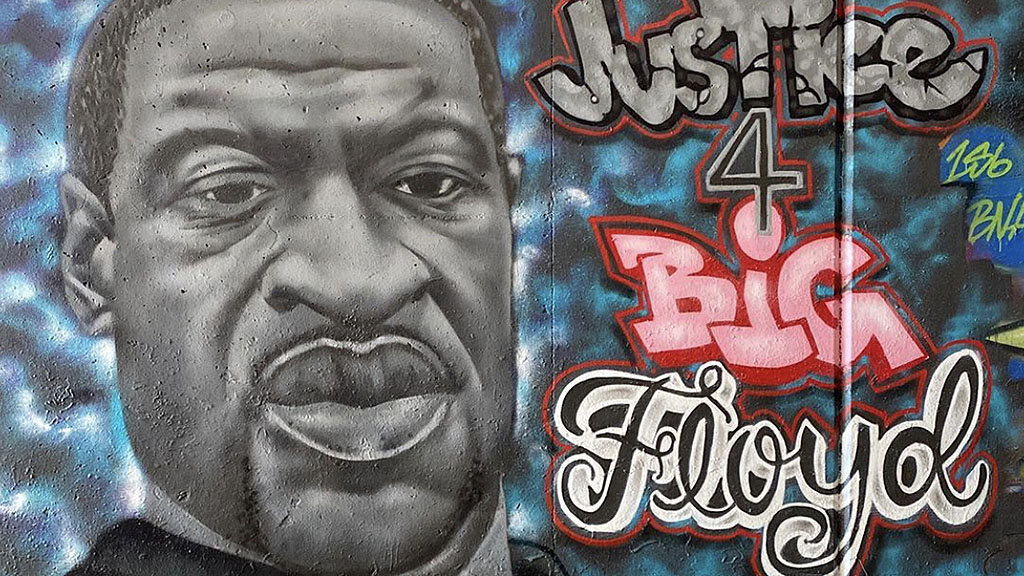
STONEHAM (CBS) – A heartfelt mural calling for justice for George Floyd was defaced by spray paint in Stoneham. The artist behind the original image, Esben Rey, told WBZ-TV he was inspired by the country coming together to honor Floyd’s life. “Essentially I painted it because the times – it just broke my heart to see him murdered that way and it just hurt my heart a lot,” said Rey. “So I thought the best way to positively interpret that was to commemorate him and paint a picture of his face.” It appears the vandals covered the image in white paint, even tried to scribble out Floyd’s name before taking off. Passersby walking through the I-93 tunnel in Stoneham say the damage is disheartening.
George Floyd mural in Stoneham before it was defaced (Image credit artist Esben Rey)
“It was definitely a tribute to a man who deserved a tribute and someone defaced it. It’s disappointing,” said Patti Cameron of Reading. In a time of unrest across the nation, one Peabody woman believes this act of hate was uncalled for. “This doesn’t help at all. Nope. It’s dividing everybody,” said Marie Cannatella.
Mural for George Floyd defaced in Stoneham (Image credit artist Esben Rey)
Rey said he won’t let someone erase the good message he was trying to spread. “I’m bummed that somebody did that,” he said. “I’ll be back and I’ll fix it and hopefully the new one will ride.” Nick Note: Look if Americans want to make a convicted felon, a man guilty of numerous assaults and drug dealing a hers go ahead and do it. I find it incredible that his past and lengthy criminal record is not being publicized. This will end in a race war.