The World’s Largest Oil Fund Is Sitting On $725 Million In Unrealized Losses

BOSTON (Reuters) – The United States Oil Fund was sitting on more than $700 million in unrealized losses at the end of March, several weeks before the market fully grasped the outsize role it would play in this month’s unprecedented collapse in the price of front-month oil contracts. U.S. crude oil futures plunged to -$37.63 a barrel on April 20, the first time in history the contract traded in negative territory. Exchange-traded products like USO, along with other investors, were caught holding positions that would have required them to take delivery of crude barrels with few places to put it, leading to a panicked sell-off.

The $3 billion exchange-traded product, known as USO, revealed on Tuesday that it had an unrealized loss of $726 million at the end of March. USO also booked actual realized losses of $466.4 million during March, according to a filing with the U.S. Securities and Exchange Commission.

Investors, nonetheless, have piled into the fund. Net deposits have totaled more than $3 billion this month amid heavy losses, Refinitiv data shows. Individual investors are in a battle with hedge funds, which are using short positions to bet on further declines in the fund. Nearly 50 U.S. money managers and wealth advisers reported holding small amounts of USO shares for clients at the end of March, SEC disclosures show. The trust division at Chicago-based First Midwest Bank, for example, reported holding about 64,000 shares for investors at the end of the first quarter. Meanwhile, short interest in USO is about $94 million, up about 1% in the past week, according to analyst Ihor Dusaniwsky at S3 Partners LLC. Analysts have questioned whether USO is an appropriate investment for retail investors, given that it makes concentrated bets on complex futures contracts. Individual investors, however, are filling a void left by pension funds, Colorado-based energy analyst Phil Verleger of PK Verleger LLC said in a research note this week. USO is now recasting its investment strategy. It is selling its position in front-month June crude futures contracts, and has been diversifying into later-dated contracts to avoid a repeat of last week’s panic. On Wednesday, a previously announced reverse stock split went into effect, reducing outstanding shares to 185 million from about 1.5 billion. The move was designed to add liquidity while protecting shares from delisting. Bloomberg sources suggest that as of two weeks ago, the USO held 25 percent of the outstanding shares of May 2020 WTI oil futures. Shares had been trading around $2 and risked being delisted if they fell below $1. Post-split shares were up about 6% at $18 on Wednesday, but they are still down about 80% this year. Nick Note:  if you or I had 24% of the volume (and open interest) they would double or triple our margins sighting concentration. But the fix was in with Mr McFuck of the CME. So not only where they allowed to concentrate positions they did so with a cute arrangement on margins and allowed to not have to mark to market or realize losses. A little birdie told me that their is a billion dollars in loses to allocate to someone some where… Including i am told 100 million for the pricks at eTrade….. it could not happen to a nicer group of ASHOLES!  I think we are going to get to fuck the monkey again!

U.S. Oil Companies Begin Sending Crude To Strategic Petroleum Reserve

SPR

U.S. oil companies have started sending oil to the Strategic Petroleum Reserve, Bloomberg reports, citing a Department of Energy official. 

According to the official, since the start of April, some 1.1 million barrels of crude have been sent into the SPR after the federal government finalized negotiations with nine companies for leasing SPR space for them to store their crude in. The talks for the lease of 23 million barrels worth of space began earlier this month, amid fast-falling prices that tanked deep below zero on April 20. Since then, West Texas Intermediate has recovered above zero but has been unable to sustain a level of above $20 a barrel. After yesterday the United States Oil Fund said it would sell all its WTI futures contracts for June delivery within four days, WTI again slid lower, trading at $11.11 a barrel at the time of writing. Brent traded at $19.20 a barrel, down by close to 4 percent while WTI was down by almost 13 percent. It was a massive selloff to avoid physical delivery that brought about negative WTI prices this month. The selloff could repeat as storage space runs out, both onshore and offshore. Vessel demand data from Signal Group shows a marked increase in demand for Very Large Crude Carriers—the ones that can hold up to 2 million barrels of crude. But space is running out both in terms of tankers and in terms of tanks onshore. Besides, SPR, the central storage hub in Cushing, Oklahoma, is reportedly soon to reach its limit, according to a Reuters report. The report cited traders as saying despite official data putting the Cushing occupancy rate at 70 percent, the rest has already been booked by oil companies looking for storage space. The hub has a capacity for 76 million barrels. As of April 17, it held 53 million barrels. Nick Note: YAWN! we fucked them one and we will fuck them again. If they want to sell oil at negative 40$ a barrel ill take all they care to pay me to take. FUCKING IDIOTS. like I have been warning you they give these shit heads  a trillions of dollars of other peoples money to lose. Thank GOD otherwise i would have to work for a living at the only job i am qualified for…….  dishwasher.

Trump’s ‘Operation Warp Speed’ Aims to Rush Coronavirus Vaccine

The Trump administration is quietly organizing a Manhattan Project-style effort to drastically cut the time needed to develop a coronavirus vaccine, with a goal to have 100 million doses ready by year’s end, according to two people familiar with the matter. Called “Operation Warp Speed,” the program will pull together private pharmaceutical companies, government agencies and the military to try to cut the development time for a vaccine by as much as eight months, one of the people said. As part of the arrangement, taxpayers will shoulder much of the financial risk that vaccine candidates may fail, instead of drug companies. President Donald Trump’s top medical advisers, led by the infectious disease expert Anthony Fauci, have repeatedly said that a coronavirus vaccine won’t be ready for 12 to 18 months at best. Until then, White House guidelines envision some economically damaging social-distancing practices maintained even as the U.S. begins to resume a more normal social and business life. Last month, Trump directed Health and Human Services Secretary Alex Azar to speed development of a vaccine, and administration officials have been meeting on the effort for three to four weeks, one of the people said. A meeting on the project was scheduled at the White House on Wednesday. The people asked not to be identified because the project hasn’t yet been publicly announced. A spokesman for the Department of Health and Human Services, Michael Caputo, said the president refused to accept the timeline for standard vaccine development and encouraged a breakthrough process. Vaccine development is typically slow and high risk. The project’s goal is to cut out the slow part, the people said. Operation Warp Speed will use government resources to quickly test the world’s most promising experimental vaccines in animals, then launch coordinated human clinical trials to winnow down the candidates. The best prospective vaccines would go into wider trials at the same time mass production ramps up. The project will cost billions of dollars, one of the people said. And it will almost certainly result in significant waste by making inoculations at scale before knowing if they’ll be safe and effective — meaning that vaccines that fail will be useless. But it could mean having doses of vaccine available for the American public by the end of this year, instead of by next summer. There are at least 70 different coronavirus vaccines in development by drugmakers and research groups, according to the World Health Organization. But drugmakers have not coordinated their efforts to the extent they could through the Warp Speed project, one of the people said. The group is also discussing the use of what’s known as a master protocol to test the vaccines. Instead of multiple clinical trials run by each drugmaker, competing for patients and resources, the government would organize one large trial to test several vaccines at once and advance the most promising ones. It’s not clear how much of Operation Warp Speed is new and how much will involve ongoing projects, such as investments made by BARDA, the Biomedical Advanced Research and Development Authority. Nick Note: this will become a mass experiment on the sleeping masses. All i can say its OK Donald you go first!

Fed keeps rates close to zero during pandemic fallout


The Federal Reserve kept its main interest rate close to zero on Wednesday, as officials weighed the impact of the heavy dose of liquidity and stimulus already delivered to the US economy in the last two months. At the end of a two-day meeting on Wednesday, the Federal Open Market Committee stopped short of any big new monetary policy action or guidance, but pledged to take additional steps if needed. “The Federal Reserve is committed to using its full range of tools to support the US economy in this challenging time, thereby promoting its maximum employment and price stability goals,” it said. “The coronavirus outbreak is causing tremendous human and economic hardship across the United States and around the world.” The target range of the federal funds rate was maintained between 0 and 0.25 per cent, its level since March 15, when Fed policymakers were forced to slash rates and boost asset purchases to shield the economy from the coronavirus pandemic. In its statement, the FOMC said that it would keep rates close to zero “until it is confident that the economy has weathered recent events and is on track to achieve its maximum employment and price stability goals” — using the same language as in March. It also reiterated that the Fed would “use its tools and act as appropriate to support the economy”, highlighting that the US central bank was still poised for additional action if necessary. The FOMC offered an even more downbeat assessment of the economic outlook than it did in March. “The ongoing public health crisis will weigh heavily on economic activity, employment, and inflation in the near term, and poses considerable risks to the economic outlook over the medium term,” it said. The statement came after new data exposed the economic damage already inflicted by the Covid-19 outbreak on the US economy. Output contracted at an annualised rate of 4.8 per cent in the first quarter of the year, its worst performance since the Great Recession, and the slump is expected to be deeper in the second quarter after at least 26m people were left newly unemployed. The Fed has already stepped in with lower interest rates, a sharp expansion of its balance sheet, the establishment of dollar swap lines with foreign central banks, and the creation of lending facilities with the US Treasury to offer credit to struggling businesses across the country. Trading conditions in critical debt markets have stabilised as a result, buoyed by the Fed’s commitment to expand its efforts as needed. “The committee will closely monitor market conditions and is prepared to adjust its plans as appropriate,” the Fed added in its statement. Jay Powell, the Fed chair, has previously said the US central bank is not considering a move towards negative interest rates, as some of its counterparts around the world have done. However, the Fed still has scope to firm up its commitment to ultra-low rates for a long time, by setting specific targets based on unemployment and inflation levels for any increase. It also has room to expand its asset purchases and credit facilities. Nick Note: they will not stop at zero. How about negative rates….. And are you ready for double digit negative rates. A few yeas back when i was warning about a stock market wipeout and negative rates  i heard  laughter. Well they are not laughing anymore. Especially since they sold oil at a negative 40$ a barrel.

Dow jumps over 600 pts on COVID-19 drug trial success

United States markets opened sharply higher on Wednesday after Gilead Sciences announced its drug remdesivir showed positive results in treating COVID-19 patients during clinical trials. The result from Gilead’s (NASDAQ:GILD) trial of remdesivir is “quite good news,” says “President” Anthony Fauci, with the data showing “clear cut significant positive effect in diminishing the time to recovery.” The FDA, he says, is working with Gilead on the availability of the drug. Nick Note: Obviously we know who bought the biggest bag of money to the table… Sorry i mean lobbyist.  Wither their is a cure or not their will be a cure.  and weather their is a vaccine or not their will be a vaccine..

WTI surges 15% to rebound from losses

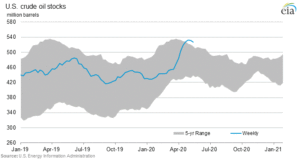
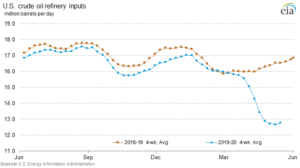
Prices of oil soared on Wednesday to recover some losses recorded earlier this month with West Texas Intermediate (WTI) jumping over 15% on OPEC+ output cuts optimism. Russian Energy Minister Alexander Novak stressed that the country’s oil companies are expected to trim its oil production by as much as 19% to comply with the OPEC+ deal. Meanwhile, the American Petroleum Institute’s data showed lower-than-expected growth in the United States oil inventories in the week ending April 24. WTI for June delivery climbed 15.07% to sell for $14.20 per barrel at 3:57 am ET, while Brent for the same month’s settlement went up by 3.91%, trading for $21.26 per barrel a minute later.. Nick Note: these assholes do not know shit. Oil production has been slashed. either by voluntary cuts or by the simple fact 90% of the worlds producers canot Not NOT produce oil at these price levels. Oil demand is weeks away from soaring as they LET MY PEOPLE GO TO PARTY AND SHOP!

FOR THE RECORD THE BOTTOM IN OIL IS IN! BY THE SHIT OUT OF IT……

Coronavirus Relief Often Pays Workers More Than Work

Roughly half of all U.S. workers stand to earn more in unemployment benefits than they did at their jobs before the coronavirus pandemic shut down swaths of the U.S. economy, a result of government relief that employers say is complicating plans to reopen businesses. The package of coronavirus stimulus laws Congress passed and President Trump signed in March included a $600 boost to weekly unemployment benefits through July 31. As that support is added to state benefits over the coming weeks, the average weekly payment to a laid-off worker should rise to about $978 from the nearly $378 the Labor Department said was paid on average late last year. Qualified workers will receive the government payout every week through July, and in most cases, the combined $978 weekly payout amounts to better pay than what many workers received before the crisis hit. Labor Department statistics show half of full-time workers earned $957 or less each week in the first quarter of 2020. The stimulus measure means that in coming months many low-wage workers will avoid both significant harm to their finances and the potential health risks—and further virus spread—of returning to crowded workplaces. That money in consumers’ pockets in turn puts the U.S. economy on firmer footing to rebound once authorities allow businesses to reopen. Figures on prior earnings of the more than 26 million Americans who sought unemployment benefits from March 15 through April 18 aren’t yet available, but the initial wave of job losses were concentrated among restaurant, hospitality and retail workers, whose median hourly pay is less than the minimum now paid under enhanced unemployment benefits. The $600 bonus payment was intended to make sure the average worker had full wage replacement in the months following mass layoffs caused by the pandemic. Last year, states’ unemployment benefits replaced about 45% of laid-off workers’ wages, according to the National Employment Law Project, which advocates for low-wage workers. Congress opted for a flat amount because decades-old technology underpinning state unemployment systems didn’t allow for payments to be calibrated to each worker’s lost wages. “If we waited for the systems to be set for 100% wage replacement, the payments wouldn’t go out until June,” said Michele Evermore, a NELP senior policy analyst. She added that under the existing system, many laid-off workers waited weeks to have their unemployment claims processed and some still are waiting for the enhanced payments. The $600 payment aligns with working full time at $15 an hour—the minimum-wage level many Democrats in Congress support. The federal minimum wage—followed by 21 states—is $7.25 an hour and has been unchanged for a decade. Restaurant and front-end retail workers in those states, including Texas and Georgia, are likely to receive more in benefits than from their jobs. Nick Note: For the record the masses are sitting fat and sassy. they are chomping at the bit to   spend their happy checks. They have no rent to pay, their mortgage payments are suspended. The charge card companies are letting them delay payments same thing with car payments even the damn internet company  is letting them off the hook. And the limit on their credit card has been lifted. Banks and lenders are chockablock full of cash to loan out in vast amounts on any fool thing. GENTLEMAN START YOUR SPENDING SPREE!