Source says Putin demanding control of entire Donetsk region
Trump says Zelenskiy ‘gotta make a deal’
Zelenskiy reported to have rejected demand
Zelenskiy to visit Trump on Monday with European back-up
Europeans say they will maintain or increase pressure on Russia
WASHINGTON/MOSCOW/KYIV, Aug 16 (Reuters) – U.S. President Donald Trump said on Saturday Ukraine should make a deal to end the war with Russia because “Russia is a very big power, and they’re not”, after hosting a summit where Vladimir Putin was reported to have demanded more Ukrainian land.
In a subsequent briefing with Ukrainian President Volodymyr Zelenskiy, a source familiar with the discussion cited Trump as saying
the Russian leader had offered to freeze most front lines if Kyiv’s forces ceded all of Donetsk, the industrial region that is one of Moscow’s main targets.
Zelenskiy rejected the demand, the source said. Russia already controls a fifth of Ukraine, including about three-quarters of Donetsk province, which it first entered in 2014.
Trump also said he had agreed with Putin that a peace deal should be sought without the prior ceasefire that Ukraine and its European allies, until now with U.S. support, have demanded.
Trump’s meeting with Putin in Alaska on Friday, the first U.S.-Russia summit since Moscow launched a full-scale invasion of Ukraine in February 2022, lasted just three hours.
“It was determined by all that the best way to end the horrific war between Russia and Ukraine is to go directly to a Peace Agreement, which would end the war, and not a mere Ceasefire Agreement, which often times do not hold up,” Trump posted on Truth Social.Russia has been gradually advancing for months. The war – the deadliest in Europe for 80 years – has killed or wounded well over a million people from both sides, including thousands of mostly Ukrainian civilians, according to analysts. In an interview with Fox News’ Sean Hannity, Trump signalled that he and Putin had discussed land transfers and security guarantees for Ukraine, and had “largely agreed”.
“I think we’re pretty close to a deal,” he said, adding: “Ukraine has to agree to it. Maybe they’ll say ‘no’.”Asked what he would advise Zelenskiy to do, Trump said: “Gotta make a deal.”
“Look, Russia is a very big power, and they’re not,” he added.
Graphic: Map of Ukraine shows the eastern oblasts and the areas under Russian control
NN: Its pretty obvious they are arranging terms of Ukraine’s surrender. My bet is at the end of the day all this is a lot of Trump realty TV blow and go for his high explosives peace prize
United States President Donald Trump said on Monday that he does not believe there will be a temporary ceasefire between Russia and Ukraine until the end of the war. “I don’t think you need a ceasefire … We can work on a peace deal while they’re fighting. They have to fight. I wish they could stop. I’d like them to stop, but strategically that would be a disadvantage for one side or the other,” Trump told journalists during his meeting with Ukrainian President Volodymyr Zelensky at the White House. Additionally, the US president reiterated that he “likes the concept of a ceasefire for one reason – because you’d stop killing people immediately, as opposed to two weeks or one week or whatever it takes.”
Senior Hamas leader and the group’s chief negotiator, Khalil al-Hayya, submitted the militant group’s updated response to the latest ceasefire proposal to Qatari Prime Minister Mohammed bin Abdulrahman bin Jassim Al-Thani during their meeting in Egypt, Axios’ Global Affairs Correspondent Barak Ravid reported on Monday, citing a diplomatic source.
Meanwhile, United States President Donald Trump claimed earlier today that the only way for the Israeli hostages to be released is for Hamas to be “confronted and destroyed.”
Ukrainian President Volodymyr Zelensky said on X that he had arrived in Washington ahead of his visit to the White House on Monday and voiced the “strong desire” shared by himself and Kiev’s allies to end the war with Russia “quickly and reliably.” “And peace must be lasting. Not like it was years ago, when Ukraine was forced to give up Crimea and part of our East—part of Donbas—and Putin simply used it as a springboard for a new attack,” the Ukrainian leader wrote. Just earlier, United States President Donald Trump appeared to shift the responsibility for ending the war entirely onto Zelensky, saying the Ukrainian president has the option of doing so “almost immediately.” “I am confident that we will defend Ukraine, effectively guarantee security, and that our people will always be grateful to President Trump, everyone in America, and every partner and ally,” Zelensky noted in his post.
NN: ‘Et Tu Donald’ Zelensky is on time for his back stabbing. Today they cave in on Ukraine. Tomorrow its Poland….. Next the EU.
United States Secretary of State Marco Rubio remarked on Sunday that Russia and Ukraine will both have to make certain concessions to reach peace, noting that “you can’t have a deal between two warring factions unless both sides agree to give up something.” Speaking to Fox News, Rubio confirmed that “99%” of the meeting between Donald Trump and Vladimir Putin, the respective presidents of the US and Russia, was dedicated to the conflict in Ukraine
. Rubio added that, if it does not agree to a ceasefire soon, Russia will face consequences, including sanctions.
However, he also noted that the prospect of new sanctions forcing Russia into a truce is limited, pointing out that the Eurasian country is already under a lot of them.
NN: Trump will soon realize he has to cripple Russian with severe sanctions
Ukrainian President Volodymyr Zelensky noted on Sunday that Russia has given “no sign” on whether it wants a trilateral meeting with his country and the United States. “And if Russia refuses, then new sanctions must follow,” Zelensky said after he met with European Commission President Ursula von der Leyen in Brussels. Commenting on what could lead to a potential ceasefire, Zelensky said Russian President Vladimir Putin “has many demands, but we do not know all of them.”In the meantime, writing on X, Zelensky noted that “it is important that Europe’s unity remains at the level of 2022. This unity helps bring about a just peace, and it must remain strong.”
NN: Putin has over played his hand… Sanctions are still coming
Donald Trump will host President Volodymyr Zelenskiy in Washington on Monday after the US president abandoned his push for an immediate ceasefire in Ukraine and Vladimir Putin again insisted that Kyiv give up land in peace talks.
Trump told the Ukrainian president and European leaders in a call that Putin wants Kyiv to cede control of the entire Donbas region in Ukraine’s east, renewing his longstanding demand, according to people familiar with the matter who spoke on condition on anonymity.
They spoke as Trump flew back from Friday’s high-profile summit with Putin in Alaska, which failed to deliver a path to end the war, currently in its fourth year. Trump called his meeting productive, then signaled he would tell Zelenskiy to make a deal, piling more pressure on the Ukrainian leader.
After the Alaska summit, several senior European diplomats expressed angst over the outcome, noting Putin appeared to have gained the most from the meeting. They pointed to Putin’s symbolic win for securing an invitation to the US and the Russian leader apparently prevailing on Trump to shift focus to an overarching peace settlement without seeking an immediate ceasefire.
European allies from the so-called coalition of the willing countries that pledged support to Kyiv will hold a video call on Sunday, France said on Saturday. Some European leaders may also join Zelenskiy in person for his meeting with Trump on Monday, said one of the people.
Zelenskiy has repeatedly ruled out giving up all of Donetsk and Luhansk, which Moscow’s forces only partially control and have so far failed to take militarily. Russia would halt advancing its claims over the parts of Zaporizhzhia and Kherson region it doesn’t now control, effectively freezing the battle-lines there, the people said.
German Chancellor Friedrich Merz on Saturday voiced his doubts about the Russian leader’s intentions about ending the war in Ukraine. “Putin has promised a lot so far, signed many agreements. I don’t believe it so easily. But at least, it’s the beginning of a conversation,” Merz said in an interview with RTL/ntv.
Trump told European leaders that he was prepared to contribute to guaranteeing Ukraine’s security as long as it didn’t involve NATO, they added. The president suggested Putin would be OK with that, the people said.
“Ukraine reaffirms its readiness to work with maximum effort to achieve peace,” Zelenskiy said in a social media post after a call with Trump on Saturday. Trump confirmed the Ukrainian president’s visit to Washington in a Truth Social post, and said a meeting with Putin and Zelenskiy could be scheduled “if all works out.”
The US president said in the post that his meeting with Putin and the call with Zelenskiy both went “very well.” “It was determined by all” that the best way to end the war was to achieve a peace agreement and “not a mere Ceasefire Agreement,” he wrote.
The statement comes after Trump said previously that a ceasefire would be his key demand of Putin at the summit. He also threatened to walk out of the meeting and to impose new tough punitive measures if it wasn’t met. Trump signaled on Friday he wasn’t in a rush to implement fresh penalties on Russia’s trading partners.
Monday’s visit to the White House will be a pivotal moment for Zelenskiy, who’s had an uneasy relationship with Trump. His last visit in the Oval Office in February descended in a shouting match between the two leaders and briefly led to the US pausing military aid to Ukraine, which undercut the country’s fighting capabilities.
Trump and Zelenskiy have since met repeatedly, including at the NATO leaders summit in Hague and at the Vatican, and patched up their ties.
European officials welcomed Trump’s efforts during their call with the US president. They also reiterated the need for a trilateral meeting between Trump, Putin, and Zelenskiy in a statement released on Saturday. That statement made no mention of earlier demands for an immediate ceasefire as a first step toward negotiations.
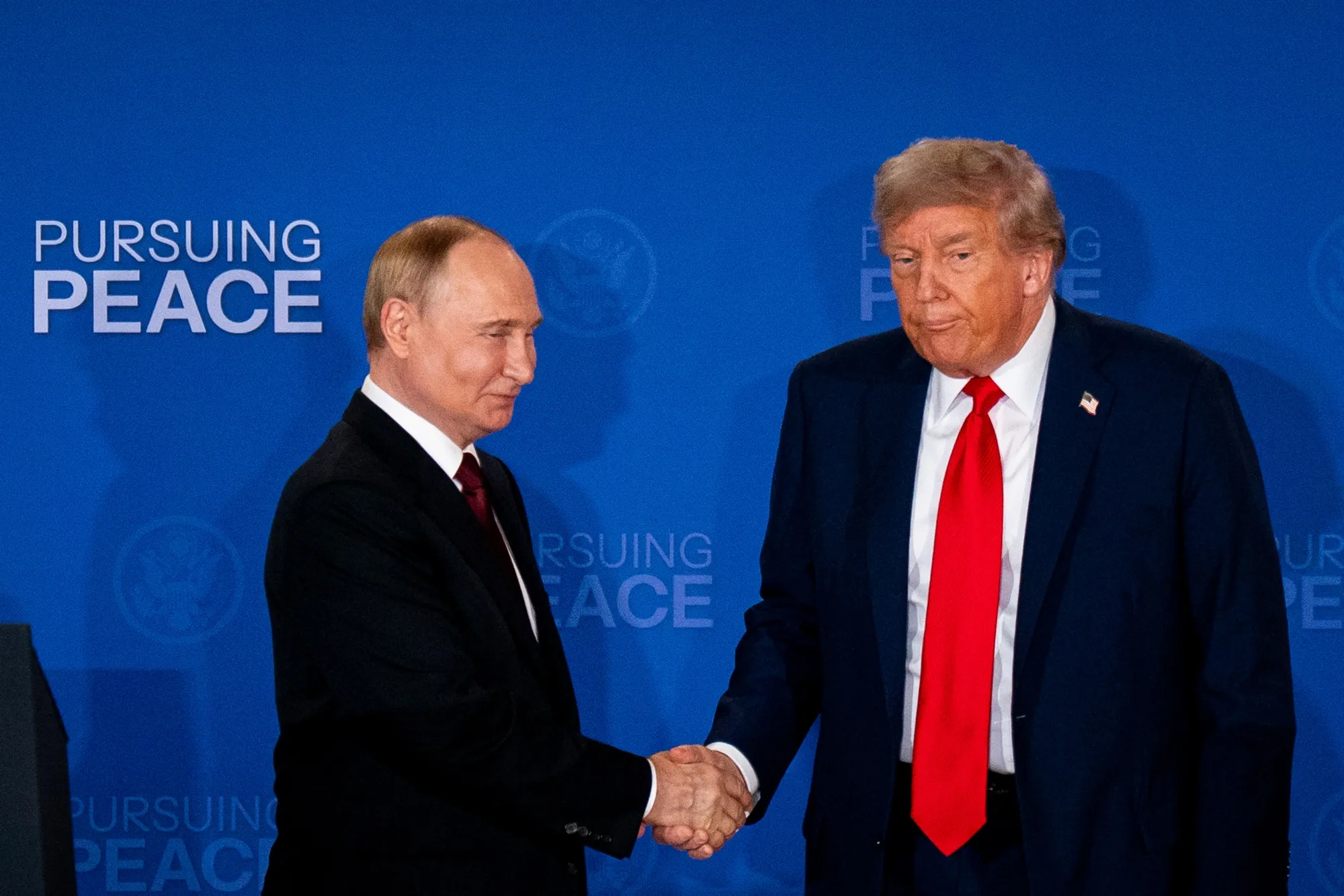
Vladimir Putin, Russia’s president, left, and US President Donald Trump shake hands during a joint news conference at Joint Base Elmendorf-Richardson in Anchorage, Alaska, US, on Friday, Aug. 15, 2025.Photographer: Al Drago/Bloomberg
The topic of a trilateral summit wasn’t raised in Alaska, Russia’s state TV channel Vesti reported on Saturday, citing Russian presidential aide Yuri Ushakov.
European leaders also said that it will be up to Ukraine to make decisions on its territory. “International borders must not be changed by force,” according to the statement, signed by the leaders of France, Italy, Germany, Finland, Poland the UK and the president of the European Commission.
Some European officials are concerned that Trump will now pressure Zelenskiy to make territorial concessions to reach a deal, according to people familiar with the matter, who spoke on condition of anonymity to discuss private deliberations.
“President Trump’s resolve to get a peace deal is vital,” said European Union foreign policy chief Kaja Kallas. “But the harsh reality is that Russia has no intention of ending this war anytime soon.”
Putin continues to drag out negotiations and “left Anchorage without making any commitments to end the killing,” Kallas said.
Putin told his government on Saturday that the conversation with Trump in Alaska was “very frank and meaningful,” the Kremlin said on its website. “We, of course, respect the position of the American administration, which sees the need for a speedy end to military action,” he said. “We would also like this and would like to move to resolving all issues by peaceful means.”
In an interview with Fox News’ Sean Hannity after the Alaskan summit, Trump said that there were a few sticking points remaining after his discussion with Putin, even as he cautioned that the two hadn’t reached a deal, and shifted his focus to Zelenskiy, saying it was up to him to resolve the war.
“We are clear that Ukraine must have ironclad security guarantees to effectively defend its sovereignty and territorial integrity” and “no limitations should be placed on Ukraine’s armed forces or on its cooperation with third countries,” the statement from European leaders said. “Russia cannot have a veto against Ukraine‘s pathway to EU and NATO.” “We anticipate that in the coming days the Russian army may try to increase pressure and strikes against Ukrainian positions in order to create more favorable political circumstances for talks with global actors,” Zelenskiy said on X.
Meanwhile, Ukraine’s Air Force said on Telegram Saturday morning that Russia launched 85 drones and a ballistic missile at Ukrainian territory overnight, underscoring Moscow’s intention to press on with the war.
NN: Ukraine is screwed. And Trumps reality TV show was a sick JOKE
If Russia loses its streams of revenue from selling its gas and oil to third countries, then it will have a severe impact on the Russian economy. The threat of secondary sanctions has been particularly successful, so Putin would like to avoid that at any cost, There are a lot of questions about … any kind of credibility of agreements with Russia, like how reliable are … Russian promises to stick to agreements of a ceasefire or anything else that might be discussed and put on paper at the meeting in Alaska. Putin and the Russian regime will try to create an impression that they are participating in the negotiations, that they are sticking to some kind of agreements and deals that are being discussed. Reality is they do not have any intention of actually stopping the war
Analysts at Standard Chartered Bank highlighted that U.S. President Donald Trump and Russian President Vladimir Putin are due to meet in Alaska today, “with the U.S. appearing determined to broker a Russia-Ukraine ceasefire agreement”. “Although a comprehensive and mutually acceptable peace deal looks distant, if the talks are positive, and issues such as territorial concessions and political/military alignments can be resolved, we see three key questions emerging for the oil market,” the analysts noted in that report.
One of those questions is “can Russia markedly increase its production rapidly,” the report highlighted.
Responding to that question in the report, the Standard Chartered Bank analysts said, in their view, Russia has been producing unsustainably at its maximum capacity with long-term consequences for its reservoirs. “Crude oil production averaged 9.01 million barrels per day (mb/d) in H1-2025, 0.61mb/d lower than the 2021 annual average (before the invasion of Ukraine),” the analysts said in the report. “If sanctions are lifted, western service companies return and quality replacement parts can be sourced, there is some scope for stabilization, but a rapid increase is unlikely,” they added.
“In addition, the country is beholden to its production cap as part of the OPEC+ production adjustments, with a required level for September loadings of 9.449mb/d, which we see as an ambitious target,” they continued.
Another question is “could more Russian product reach the international markets”, the report pointed out.
Responding to this question, the analysts said it is yet to be determined what an agreement could mean for the additional tariffs and penalties that the U.S. has applied to countries taking Russian crude.
“At present, both the EU and U.S. have imposed sanctions, import bans and shipping/insurance restrictions, with a price-cap mechanism in place. The removal of these restrictions is not likely to be an immediate condition of a ceasefire and would require wholesale political realignment,” they said.
“A removal of the price-cap would eliminate the price advantage for China and India to take Russian crude, and higher freight costs would become more important in sourcing decisions. India has been an opportunistic purchaser of this cheaper crude, and could revert to its previous import volumes, or continue purchases of crude that its refiners prefer, albeit at a higher cost,” they added.
“Given the additional efforts Russia has undertaken to evade export sanctions, we do not expect a large increase in Russian supply to the global markets in the near term,” the analysts continued.
The final question posted in the report is “does the market want Russian crude”.
Responding to this question, the Standard Chartered Bank analysts said, “removing price from consideration, Europe has successfully reduced its dependency on Russian oil and gas over the last three years, and we see limited desire to return to the potential weaponization of energy flows, with concerns over reliability and security”.“Buyer appetite outside of Russia’s current partners is likely to remain minimal in the near term and the re-establishment of trade pathways should take time,” they added.
“Although the market might react to positive ceasefire news by selling-off in the near term, this would be sentiment, rather than fundamentally, driven, and we expect any price-dip on headlines to be short-lived, given the roadblocks to Russian supply,” the Standard Chartered Bank analysts went on to state.
Both Trump and Putin are seeking wins from their first face-to-face talks since Trump returned to the White House.
Trump, who casts the war as a “bloodbath” fraught with escalatory risk, is pressing for a truce in the 3-1/2-year-old war that would bolster his credentials as a global peacemaker worthy of the Nobel Peace Prize. For Putin, the summit is already a big win as he can use it to say that years of Western attempts to isolate Russia have unravelled and that Moscow has retaken its rightful place at the top table of international diplomacy.
The summit, the first between a U.S. and Russian leader since 2021, will begin at 11 a.m. Alaska time (1900 GMT). Trump conceded on Thursday it had proven a tougher nut to crack than he had thought.. Putin might be willing to freeze the conflict along the current front lines and seize that territory. A deal that Ukraine has repeatedly said it would never accept.
After surging to record highs earlier, the crypto market dropped over 4% on Thursday following a report from the Sentora platform warning that corporate adoption of Bitcoin as a treasury asset is like playing “balance sheet roulette”.
“Bitcoin’s scarcity and programmability make it an unprecedented corporate asset — but without scalable yield and durable financing, most current adopters are playing a dangerous game of balance sheet roulette,” Sentora’s Head of Lending Patrick Heusser mentioned in the report. The report analyzed 213 organizations holding 1.79 million BTC ($214 billion), noting that 71% (~1.27 million BTC) is on public companies’ balance sheets, and highlighted the risk that buying Bitcoin with borrowed money is a “negative carry trade,” since BTC generates no yield. Bitcoin (BTC) plunged 4.11% to $118,298.546 at 9:25 am ET, while Ethereum (ETH) tumbled 4.68% to sell for $4,528 at the same time.
NN: Is this the blowoff top for this canned fish speculative orgy? MAYBE
United States President Donald Trump said that the potential second meeting with Russian President Vladimir Putin will be “very very important,” although he stressed it might not happen. In an interview with Fox News, he estimated that the upcoming first meeting, taking place in Alaska on Friday, has about a 25% chance of being unsuccessful. Trump predicted there will be some “give and take on boundaries and lands,” although Ukraine has so far rejected the possibility of surrendering territory to Russia. Trump also said he will impose further sanctions on Russia if it refuses to reach a peace deal, although he did not provide details.
Russia: No plans to sign documents after Alaska summit
Kremlin spokesperson Dmitry Peskov said on Thursday that Russia does not plan to sign documents following the upcoming Alaska summit between Russian President Vladimir Putin and United States President Donald Trump. “Nothing has been prepared. Moreover, it is unlikely that there could be any document here. But, given that there will be a joint press conference, the president will, of course, outline the scope of agreements and understandings that he will manage to reach,” Peskov told reporters. Furthermore, the Kremlin spokesperson shared that the timing for the preparations of the meeting between the two leaders was short, yet “nevertheless, it was fulfilled as necessary, and all parameters were met.”