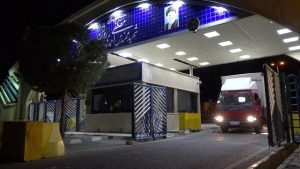
IAEA pulls last team of inspectors out of Iran under threat of arrest.

The United Nations atomic watchdog is said to have pulled its last remaining inspectors out of Iran following the implementation of a new law that criminalizes international monitoring, deepening the blackout over Tehran’s nuclear program. The last International Atomic Energy Agency  specialists were safely withdrawn from Tehran on Friday to the Vienna-based agency, according to a western diplomat, who asked not to be identified discussing sensitive information.

It’s the first time since Iran began enriching uranium two decades ago that IAEA monitors — who conducted almost 500 inspections in the Islamic Republic last year — have been expelled from the country.

The withdrawal is likely to draw swift rebukes from Western governments, which have been urging Tehran to allow a resumption of IAEA visits since a ceasefire in the Israel-Iran war last month. Instead, the Israeli decision to bomb nuclear sites and military targets on June 13 has effectively put up a barrier, ending oversight of whether Iran is capable of developing a weapons program.

The 274 IAEA monitors accredited to conduct inspections had been verifying the location of Iran’s 409 kilograms (902 pounds) of near-bomb-grade uranium, which is now unknown. Iran has accused the watchdog of being complicit in Israel’s attack against its nuclear installations, a charge IAEA Director General Rafael Mariano Grossi has denied. Tehran’s envoy in Vienna said the strikes, which US forces joined on June 22, have caused irreparable harm to the nuclear Non-Proliferation Treaty, the international agreement that allows non-weapons states access to nuclear technologies in return for IAEA inspections. While Iran has yet to leave the NPT, it can argue it’s legally entitled to suspend monitoring under provisions of the Vienna Convention on the Law of Treaties, which allows signatories to withdraw cooperation if their rights have been breached. It’s widely established internationally that attacks against nuclear facilities break legal norms. Whether Iran’s legal arguments gain purchase at the IAEA or beyond may influence whether or not the ceasefire between the Persian Gulf nation and Israel holds.

Fighting stopped on June 24 after 12 days, but neither side has ruled out resuming hostilities. To help deter against a renewed assault, Iran could use uncertainty over the whereabouts of its highly enriched uranium to try to dictate events.

For the US and Israel to gain knowledge of the state and location of the stockpile, physical inspections and verification will need to be carried out, most likely via negotiated access for the IAEA.
Oil Slips as US Plans Iran Talks……Again!


Oil declined after Axios reported the US plans to restart nuclear talks with Iran, reducing the risk of another flare-up in the Middle East conflict .HaHaHa

 The news service said US Middle East envoy Steven Witkoff plans to meet with Iranian Foreign Minister Abbas Araghchi in Oslo next week. That followed a statement from Iran’s top diplomat that the country would continue to engage with the UN’s nuclear watchdog. Crude prices have been buffeted by geopolitical events in recent weeks, first surging after the escalation that included direct US strikes in Iran then declining after Tehran’s retaliation was dismissed as largely symbolic. Renewed negotiations over Iran’s nuclear program would further reduce oil’s already-diminished risk premium. Oil’s slump on Thursday also may have been amplified by low liquidity ahead of Friday’s July Fourth holiday in the US.

The Middle East developments squelched some earlier strength in prices that was driven by US jobs data showing stronger-than-expected additions in June. Equity markets rose and the dollar gained, making commodities priced in the currency less appealing.

The US also took fresh steps to restrict the trade of Iranian oil, including sanctions on companies and a “shadow fleet” of vessels that help Iran export its crude.

Oil had rallied on Wednesday against the backdrop of a market flashing pockets of strength. Diesel’s premium to crude in the US earlier hit the biggest in 15 months after stockpiles of the fuel continued to decline. Spreads on the nearest crude contracts are also pointing to tight supplies, with stockpiles at the key storage hub of Cushing, Oklahoma, sliding.

The continued outlook for supply dynamics, however, depends on a meeting between the Organization of the Petroleum Exporting Countries and its allies on Sunday. The group has begun discussing another 411,000 barrel-a-day production increase and is largely expected to agree to the significant supply increase, but may move back from the accelerated production increases if prices dip into the $50-a-barrel range, according to Citigroup Inc.

“We believe we are on the brink of rolling into more structural softness over the next few months,” said Helge Andre Martinsen, senior energy analyst at DNB Bank ASA, led by a seasonal and structural decline in oil demand growth and OPEC+ continuing with its large output hikes.

Trump says Iran wants to talk, hints at meeting if needed

United States President Donald Trump told reporters before leaving for Iowa that Iran wants to start talks and he believes it is the right time. “Iran does wanna speak and I think they’d like to speak to me and it’s time that they do,” Trump said. He stressed that the US does not want to harm Iran but wants to see it “be a country again” after facing serious challenges. Trump added that Iran had been “beat up really bad” and suggested he is open to a meeting if needed. His comments come as tensions between Washington and Tehran remain high, with the US recently launching strikes on Iranian nuclear sites.

NN: See yesterdays BlackMask Pod Cast titled: 

Savages At The Gate With Nukes

Oil slips 1% with OPEC+ meeting in focus

The prices of crude oil dipped by more than 1% on Friday, continuing their downward trajectory from yesterday, as investors digested the reports of a potential output increase at the next meeting of the Organization of the Petroleum Exporting Countries (OPEC) and its allies, which was moved to Saturday. The markets also reacted to easing tensions regarding Iran, after the country’s Foreign Minister Abbas Araghchi reaffirmed Tehran’s commitment to the Non-Proliferation Treaty (NPT) and United States President Donald Trump’s claims that Iran wants to speak to him, hinting at a potential future meeting.

West Texas Intermediate (WTI) for August’s settlements declined by 1.13% at 5:31 am ET, going for $66.24 per barrel. Meanwhile, Brent for September’s deliveries slipped by 1.21% and sold for $67.98 per barrel at 5:32 am ET.

NN: As you know today is the 4th of July with US markets closed. I pay little attention to range bond trading in very low volume markets…,

Iran: No retaliation against US, enrichment continues

Iran has no plans to strike back at the United States but will push ahead with its nuclear program, Deputy Foreign Minister Majid Takht-Ravanchi said in an interview published Thursday by NBC. “As long as there is no act of aggression being perpetrated by the United States against us, we will not respond again,” While Tehran supports diplomacy and is open to dialogue, Takht-Ravanchi stressed that Washington must first guarantee it will not resort to military threats during talks. the minister explained. According to him, Iran is “ready to engage with others to talk about the scope, the level, the capacity” of its enrichment program.

AEI Weekly Petroleum Data

 Weekly Petroleum Data for the week ending June 27, 2025

U.S. commercial crude oil inventories (excluding those in the Strategic Petroleum Reserve) increased by 3.8 million barrels from the previous week. At 419 million barrels, U.S. crude oil
inventories are about 9% below the five year average for this time of year. U.S. crude oil refinery inputs averaged 17.1 million barrels per day during the week ending June 27, 2025, which was 118 thousand barrels per day more than the previous week’s average. Refineries operated at 94.9% of their operable  capacity last week. Gasoline production decreased last week, averaging 9.6 million barrels per day. Distillate fuel production increased by 244 thousand barrels per day last week, averaging 5 million barrels per day. U.S. crude oil imports averaged 6.9 million barrels per day last week, increased by 976 thousand barrels per day from the previous week. Over the past four weeks, crude oil imports averaged about 6.1 million barrels per day, 13.9% less than the same four-week period last year. Total motor gasoline imports (including both finished gasoline and gasoline blending components) last
week averaged 906 thousand barrels per day, and distillate fuel imports averaged 118 thousand barrels per day. Total motor gasoline inventories increased by 4.2 million barrels from last week and are about 1% below the five year average for this time of year. Both Finished gasoline inventories and blending components inventories increased last week. Distillate fuel inventories decreased by 1.7 million barrels last
week and are about 21% below the five year average for this time of year. Propane/propylene inventories increased by 3 million barrels from last week and are 11% above the five year
average for this time of year. Total commercial petroleum inventories increased by 9.4 million
barrels last week.
Total products supplied over the last four-week period averaged 20.3 million barrels a day, down by 1.1% from the same period last year. Over the past four weeks, motor gasoline product supplied averaged 9.2 million barrels a day, down by 0.1% from the same period last year. Distillate fuel product supplied averaged 3.7 million barrels a day over the past four weeks, up by 0.6% from the same period last year. Jet fuel product supplied was up 2.4% compared with the same four-week period last year

Iran: Strikes won’t halt our nuclear progress….

Iran’s Atomic Energy Organization head, Mohammad Eslami (pictured), stated on Wednesday that the country’s nuclear industry “cannot be destroyed by bombing.” Speaking to reporters in Tehran, Eslami stressed that the recent military operation, which targeted Iran’s nuclear sites and scientists, carried out by Israel and the United States, breached international law. “It shows that the law of the jungle governs the world – and if you don’t have power, you can’t survive. The Iranian people understand this well and are standing firm,” he said. Eslami further said that the path for Iran’s further advancement in the nuclear sector “is open,” adding that nuclear technology is “part of the soil and spirit of this land.”

Iran officially suspends cooperation with IAEA

Iranian President Masoud Pezeshkian announced on Wednesday that his government is suspending cooperation with the International Atomic Energy Agency (IAEA) “until certain conditions are met, including ensuring the security of the facilities and scientists.” Iran has condemned the agency’s “double standards,” accusing it of releasing inaccurate reports on the country’s nuclear program. In June, the IAEA found that Tehran was in breach of its nuclear safeguards obligations, leading to Israel launching air strikes on Iran the next day. Iran has blamed the IAEA for giving Israel a “final pretext” for the attacks.

NN: sounds to me they are racing ahead to build a nuclear arsenal…. And use it!

IAEA Chief Warns That Iran Could Enrich Uranium ‘in A Matter Of Months’

Rafael Grossi, who heads the International Atomic Energy Agency (IAEA), said that US strikes on three sites a week ago had caused “severe damage” but it was not “total”. Mr Grossi told CBS News: “The capacities they have are there. They can have, you know, in a matter of months, I would say, a few cascades of centrifuges spinning and producing enriched uranium, or less than that. “But as I said, frankly speaking, one cannot claim that everything has disappeared and there is nothing there.” Iran still has “industrial and technological capabilities… so if they so wish, they will be able to start doing this again”, he added.

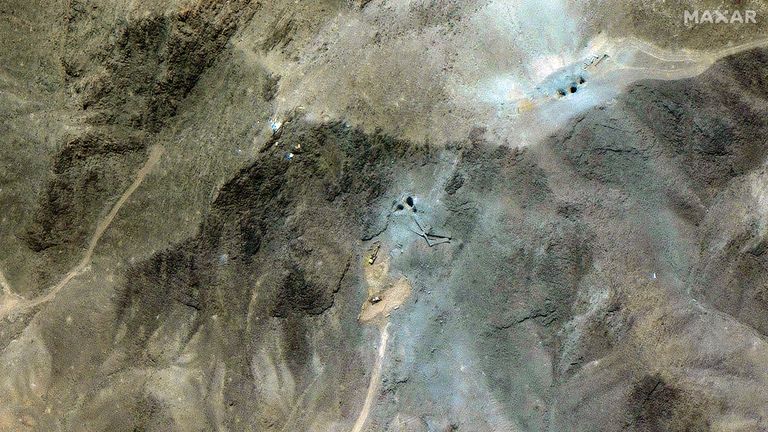
A satellite overview shows excavators at tunnel entrances at the Fordow site in Iran. Pic: Maxar/Reuters
Image:A satellite overview shows excavators at tunnel entrances at the Fordow site in Iran. Pic: Maxar Technologies/Reuters

Iranian nuclear and military sites  were attacked by Israel on 13 June, with the Israelis claiming Tehran was close to developing a nuclear weapon. The US then carried out its own strikes on 22 June, hitting Iranian nuclear installations at Fordow, Natanz and Isfahan, under Operation Midnight Hammer. Iran has insisted its nuclear research is for civilian energy production purposes.

US President Donald Trump said last weekend that the American deployment of 30,000lb “bunker-busting” bombs had “obliterated” Iran’s nuclear programme. But that claim appeared to be contradicted by an initial assessment from the US Defence Intelligence Agency. A source said Iran’s enriched uranium stocks had not been eliminated, and the country’s nuclear programme, much of which is buried deep underground, may have been put back only a month or two. Mr Trump has rejected any suggestion that the damage to the sites was not as profound as he has said. And he stated he would consider bombing Iran again if Tehran was enriching uranium to worrying levels. At a news conference on Thursday alongside US defence secretary Pete Hegseth, the chairman of the joint chiefs of staff General Dan Caine, told reporters the GBU-57 bunker buster bombs had been designed in some secrecy with exactly this sort of target in mind.

US: Iran nuclear sites ‘obliterated’

The head of the CIA has also said a “body of credible intelligence” indicates Iran’s nuclear programme was “severely damaged”. Director John Ratcliffe revealed that information from a “historically reliable and accurate source” suggests several key sites were destroyed – and will take years to rebuild. Meanwhile, Iran’s supreme leader Ayatollah Ali Khamenei said his country “slapped America in the face” by launching an attack on 23 June against a major US base in Qatar, adding the nation would never surrender. The 12-day air conflict between Israel and Iran ended with a US-brokered ceasefire. But the Iranian armed forces chief of staff, General Abdolrahim Mousavi, has said his country doubts Israel will maintain the truce. A spokesman for Iran’s foreign ministry said the US strikes had caused significant damage to Tehran’s nuclear facilities.

Iran: IAEA cannot expect Tehran to cooperate as usual…..UK, France, Germany condemn threats against IAEA head after Iran newspaper calls for his arrest

Iranian Foreign Ministry spokesperson Esmail Baghaei (pictured) stated on Monday that cooperation between Tehran and the International Atomic Energy Agency (IAEA) “cannot go as usual,” following Israeli attacks on Iran. Speaking at a press conference, Baghaei asked General Director of IAEA Rafael Grossi how he can expect “when peaceful Iranian facilities are targeted, that we can ensure the security of the inspectors, and on the other hand, you cannot expect the [International Atomic Energy] Agency and the Director General [Rafael Grossi] to remain silent when an Agency member is attacked.” He also stressed that “the agency must reconsider its approach.” Additionally, Baghaei stated that the IAEA must act unbiased and “act away from political approaches,” while urging Grossi to adhere to the “framework of his technical duties and not be influenced by some members of the agency.”

UK, France, Germany condemn threats against IAEA head after Iran newspaper calls for his arrest

  • Iranian hardline newspaper accused Grossi of ties to Israel’s Mossad
  • European countries call on Iran to halt steps to cease cooperation with IAEA
  • Iran blames watchdog for providing justification for Israeli bombing
  • IAEA chief says focus is on returning inspectors to sites
DUBAI, June 30 (Reuters) – Britain, France and Germany denounced threats against the head of the U.N. nuclear watchdog on Monday, after a hardline Iranian newspaper said IAEA boss Rafael Grossi should be tried and executed as an Israeli agent. “France, Germany and the United Kingdom condemn threats against the Director General of the IAEA Rafael Grossi and reiterate our full support to the Agency and the DG in carrying out their mandate,” said a statement from the three countries’ foreign ministries.
“We call on Iranian authorities to refrain from any steps to cease cooperation with the IAEA. We urge Iran to immediately resume full cooperation in line with its legally binding obligations, and to take all necessary steps to ensure the safety and security of IAEA personnel,” they added.
The statement did not specify what threats had been made against Grossi, but it follows an article in Iran’s hardline Kayhan newspaper, closely associated with Supreme Leader Ayatollah Ali Khamenei, which accused Grossi of ties to Israel’s Mossad intelligence agency. Should Grossi enter Iran, he should be tried and sentenced to death, it said. Grossi has not directly responded to the newspaper’s allegations. He has said his top priority is ensuring IAEA inspectors can return to nuclear sites in Iran as soon as possible Iranian officials have not publicly endorsed the newspaper article. Iran’s ambassador to the United Nations, Amir Saeid Iravani, denied that there was any threat against Grossi But Iran has increasingly criticised Grossi and threatened to halt cooperation with the IAEA, which Tehran blames for providing a justification for Israel’s bombing, which began the day after the IAEA board voted to declare Iran in violation of obligations under the Nuclear Non-Proliferation Treaty.
Iran’s President Masoud Pezeshkian told French President Emmanuel Macron in a phone call on Monday that the IAEA’s “double standards” had created problems for regional and global security, Iranian state media reported. “The view of the Iranian government, parliament, and people is that the IAEA director has not acted impartially in relation to our country’s nuclear file, despite all the cooperation and interactions that have taken place, and this behaviour is in no way acceptable to us,” the reports quote Pezeshkian as saying.
Foreign Minister Abbas Araqchi has said Grossi is not welcome in Iran, having carried out “malign action” and played a “regrettable role”. Iran also said on Monday it could not yet be expected to guarantee the safety of IAEA inspectors.
“How can they expect us to ensure the safety and security of the agency’s inspectors when Iran’s peaceful nuclear facilities were attacked a few days ago?” Foreign Ministry spokesperson Esmaeil Baghaei told a news conference.
Baghaei said an Iranian  parliamentary bill calling for the government to withdraw cooperation with the IAEA had been approved by the Guardian Council, a security body controlled by appointees of the supreme leader, and was now mandatory.
“Iran shouldn’t be expected to accept its obligations under the nuclear Non-Proliferation Treaty when the U.N. nuclear watchdog has stopped short of condemning the attacks on Iran’s nuclear sites,” Baghaei said.

Trump: Iran didn’t move uranium before strikes

United States President Donald Trump said on Sunday that Iran did not move enriched uranium before the strikes on its nuclear facilities last week, as they did not have the chance to do so.

The US president told Fox News in an interview that his administration did not give Iran enough of a notice before the attacks to allow it to move the enriched uranium from the nuclear sites before they got hit. but enough time to poor vast amounts of concrete

Trump said that the material is too heavy and too dangerous to move quickly enough. weighs 5 kilos a hockey puck and od fit on 3 pickup trycks

He emphasized that Iran was too focused on evacuating the masons who were using concrete to shelter the entrance I am sure they are capable of multitasking

where the bombs could be dropped in, but claimed that they were unsuccessful, as the bombs did not have trouble going in. T they bombed the shit ot of a empty bunker

“the last thing Iran wants to do” is to work on its nuclear program, as he said “they are exhausted.” they are more motivated then ever to get nukes now that they have no defenses

NN: Audio File
don’t be so sure