BAGHDAD (Reuters) – Tens of thousands of people marched in Baghdad on Saturday to mourn Iran’s military chief Qassem Soleimani and Iraqi militia leader Abu Mahdi al-Muhandis, killed in a U.S. air strike that has raised the spectre of wider conflict in the Middle East.By ordering Friday’s strike on the commander of the Iranian Revolutionary Guard’s foreign legions, President Donald Trump has taken Washington and its allies, mainly Saudi Arabia and Israel, into uncharted territory in its confrontation with Iran and its proxy militias across the region. Gholamali Abuhamzeh, a senior commander of Iran’s elite Revolutionary Guards, said Tehran would punish Americans “wherever they are in reach”, and raised the prospect of possible attacks on ships in the Gulf.
Nick Note: We always told you Trump is a colossal Fuck UP. And he would do anything to keep the impeachment out of the news. Within 12 hours of the media finding over 20 emails where Trump Froze aid cut to the Ukraine he ordered the attack. You may not be worried about Trumps impeachment and he probable will not be impeached. BUT he sure as shit is worried about it.
The flaring and venting of natural gas in the U.S. continues to soar, reaching new record highs in recent months.
The volume of gas that was burned or simply released into the atmosphere by oil and gas drillers reached 1.28 billion cubic feet per day (Bcf/d) in 2018, according to the EIA, up from 0.772 Bcf/d in 2017. The practice is a disaster on many levels. It is wasteful, it worsens air quality and it exacerbates climate change. Venting gas is much worse than burning it since it releases methane into the atmosphere, a potent greenhouse gas.
The New York Times documented several “super emitters” in the Permian, using infrared cameras to visually capture the epidemic. The NYT even recorded an oil worker walking into an invisible plume of leaking methane. But shale drillers continue the practice and regulators have shown little interest in regulating them. Even though venting is off limits in North Dakota and restricted in Texas, flaring has largely gone unchecked while methane leaks at virtually every stage of the extraction process. In the third quarter of 2019, the Permian basin alone vented and flared 752 million cubic feet of natural gas per day, up sharply from 661 mcf/d in the first quarter, according to Rystad Energy. “This represents a new all-time high. Oil production in the Permian Basin is growing at an accelerated pace again, and we observe high, sustained levels of flaring and venting of associated gas in the basin,” Artem Abramov, head of shale research at Rystad, said in November. Some oil companies trumpet their reduced rate of flaring, but others have flared at higher rates. “A significant number of operators have exhibited a clear downwards shift in flaring intensity in 2019. Yet there are other examples of a recent increase in flaring intensity, which are primarily represented by some operators active in the Eastern Midland Basin,” Abramov said. Nick Note: Unless your are still under the fantasy that the US has a HA HA HA free economy where the FREE market decides things bullish. The reality is the refinery industry has stopped Natural gas from becoming a transportation fuel.. WHY because they don’t get to refine NG since its plug and play. And the big profits in the oil industry are the down stream refinery business. Get this many companies flare natural gas under the excuse their are no pipelines to take the gas to market. BULLSHIT again! the reality is its cheaper to flare NG rather then pay the pipeline transportation costs since NG prices are below the cost of production and transportation for many producers in the bonnies. Reality is Natural GAS (NG) is the equivalent of .25 cents a gallon gasoline. And your engine will run forever polluting less than an electric car whose batteries in most cases is charged by a coal fired generator down the road and out of sight….
U.S. commercial crude oil inventories (excluding those in the Strategic Petroleum Reserve) decreased by 11.5 million barrels from the previous week. At 429.9 million barrels, U.S. crude oil inventories are at the five year average for this time of year. U.S. crude oil refinery inputs averaged 17.3 million barrels per day during the week ending December 27, 2019, which was 303,000 barrels per day more than the previous week’s average. Refineries operated at 94.5% of their operable capacity last week. Gasoline production decreased last week, averaging 10.2 million barrels per day. Distillate fuel production decreased last week, averaging 5.3 million barrels per day. U.S. crude oil imports averaged 6.4 million barrels per day last week, down by 457,000 barrels per day from the previous week. Over the past four weeks, crude oil imports averaged about 6.7 million barrels per day, 10.8% less than the same four-week period last year. Total motor gasoline imports (including both finished gasoline and gasoline blending components) last week averaged 473,000 barrels per day, and distillate fuel imports averaged 183,000 barrels per day. Total motor gasoline inventories increased by 3.2 million barrels last week and are about 5% above the five year average for this time of year. Finished gasoline and blending components inventories both increased last week. Distillate fuel inventories increased by 8.8 million barrels last week and are about 6% below the five year average for this time of year. Propane/propylene inventories decreased by 0.2 million barrels last week and are about 11% above the five year average for this time of year. Total commercial petroleum inventories decreased last week by 2.9 million barrels last week. Total products supplied over the last four-week period averaged 20.3 million barrels per day, down by 2.7% from the same period last year. Over the past four weeks, motor gasoline product supplied averaged 9.1 million barrels per day, up by 0.9% from the
same period last year. Distillate fuel product supplied averaged 3.8 million barrels per day more than the past four weeks, down by 10.0% from the same period last year. Jet fuel product supplied was up 10.2% compared with the same four-week period last year. Meanwhile, the EIA said earlier this week that U.S. oil production had hit a record 12.66 million barrels daily in October, with weekly estimates suggesting this could have risen further in the months since October to over 13 million bpd.
SYDNEY (Bloomberg) – U.S. stock-index futures fell after a U.S. airstrike near Baghdad international airport killed a top Iranian commander. S&P 500 Index futures contracts expiring in March retreated as much as 0.7% after the attack that killed Qassem Soleimani, the Iranian general who led the Revolutionary Guards’ Quds force. Dow Jones Industrial Average contracts were down as much as 0.7%, while those on the Nasdaq 100 also shed as much as 0.7%. Oil spiked on news of the strike, with futures in New York and London surging more than 4%. Gold also surged, while the dollar weakened against the yen. “This is more than just bloodying Iran’s nose. This is an aggressive show of force and an outright provocation that could trigger another Middle East war,” Stephen Innes, chief Asia market strategist at Axitrader, wrote in a note. “Get the defensive strategy tool kit ready as you will likely need it through the day.” The S&P 500 Index closed 0.8% higher in New York on Thursday, with Apple, Alphabet and Nike all reaching fresh records. Nick Note: The perfect excuse for a badly needed 10% correction… And your boss will not be pissed because how could a algorithm predict a US strike on Iran. And since its the new year traders bonuses calculated on the December 31st close are still guaranteed. Tiffany stores in New York are stocking up!
Pentagon says strike carried out to protect troops in Iraq; IRGC also confirms powerful Quds force leader killed; Trump tweets picture of American flag with no explanation
The US Department of Defense confirmed late Thursday that it had carried out an airstrike in Baghdad to kill powerful Iranian general Qassem Soleimani and the head of a robust pro-Iran militia in Iraq. At least seven people were killed in the strike at the Baghdad International Airport late Thursday night, according to Iraqi officials, including Soleimani, the head of Iran’s elite Quds Force, and Abu Mahdi al-Muhandis, deputy commander of Iran-backed militias in Iraq known as the Popular Mobilization Forces, or PMF. The Pentagon said it carried out the strike at the direction of US President Donald Trump.
“At the direction of the President, the US military has taken decisive defensive action to protect US personnel abroad by killing Qasem Soleimani,” a statement said.
Qassem Soleimani, commander of the IRGC Quds Force, attends an annual rally commemorating the anniversary of the 1979 Islamic Revolution, in Tehran, Iran, February 11, 2016. (AP Photo/Ebrahim Noroozi)
“General Soleimani was actively developing plans to attack American diplomats and service members in Iraq and throughout the region. General Soleimani and his Quds Force were responsible for the deaths of hundreds of American and coalition service members and the wounding of thousands more,” the Department of Defense added. Following Soleimani’s death, Trump tweeted an image of the US flag without any further explanation. Iranian state television also confirmed Soleimani’s death, citing a Revolutionary Guard statement that said he was “martyred” in an attack by US helicopters near the airport, without elaborating. The attack came amid tensions with the United States after a New Year’s Eve attack by Iran-backed militias on the US embassy in Baghdad. The two-day embassy attack which ended Wednesday prompted Trump to order about 750 US soldiers deployed to the Middle East. It also prompted Secretary of State Mike Pompeo to postpone his trip to Ukraine and four other countries “to continue monitoring the ongoing situation in Iraq and ensure the safety and security of Americans in the Middle East,” State Department spokeswoman Morgan Ortagus said Wednesday.
Protesters burn property in front of the US embassy compound, in Baghdad, Iraq, Tuesday, Dec. 31, 2019. D (AP Photo/Khalid Mohammed)
The breach at the embassy followed US airstrikes on Sunday that killed 25 fighters of the Iran-backed militia in Iraq, the Kataeb Hezbollah. The U.S. military said the strikes were in retaliation for last week’s killing of an American contractor in a rocket attack on an Iraqi military base that the US blamed on the militia. US officials have suggested they were prepared to engage in further retaliatory attacks in Iraq. “The game has changed,” Defense Secretary Mark Esper said Thursday, telling reporters that violent acts by Iran-backed Shiite militias in Iraq — including the rocket attack on Dec. 27 that killed one American — will be met with US military force. He said the Iraqi government has fallen short of its obligation to defend its American partner in the attack on the US embassy.
President Donald Trump’s killing of one of Iran’s top military commanders means the elimination of a dangerous U.S. foe – but it also represents a risky escalation in a volatile feud that could backfire on U.S. personnel and allies in the Middle East and beyond. The Pentagon confirmed Thursday that Qassem Soleimani, who leads Iran’s elite Quds force, was killed in what it termed a “defensive action.” Iraqi and other media said Soleimani died in an airstrike at Baghdad’s international airport. Some media accounts described the airstrike as coming from a U.S. drone, but the Pentagon did not specify. “At the direction of the president, the U.S. military has taken decisive defensive action to protect U.S. personnel abroad by killing Qasem Soleimani, the head of the Iranian Revolutionary Guard Corps-Quds Force, a U.S.-designated Foreign Terrorist Organization,” the Pentagon said. “General Soleimani was actively developing plans to attack American diplomats and service members in Iraq and throughout the region,” it added, blaming him for recent attacks on U.S. troops and the U.S. Embassy in Baghdad. “This strike was aimed at deterring future Iranian attack plans.” Even the possibility that the U.S. had directly targeted Soleimani – especially on Iraqi soil – sent shockwaves around the globe, spiking oil prices and leading to instant assessments of the potential fallout. U.S. officials have long depicted Soleimani as a paramilitary and terrorist mastermind, deemed responsible for attacks on American troops in Iraq and against U.S. interests all over the world.
“It is hard to overstate the significance,” said retired Gen. David Petraeus, who oversaw the “surge” of American troops in Iraq in the violent years after the 2003 U.S. invasion. “But there will be responses in Iraq and likely Syria and the region.”
Some current and former U.S. officials, as well as veteran Iran observers, said the killing was an escalatory move far beyond what they had ever expected. “There’s no chance in hell Iran won’t respond,” said Afshon Ostovar, an expert on Soleimani and author of “Vanguard of the Imam” a book about Iran’s Islamic Revolutionary Guard Corps. The strike also reportedly killed Iraqi militia commander Abu Mahdi al-Muhandis, who was traveling in the same convoy as Soleimani. It astonished even some members of the Trump administration who said killing the Iranian general had not been seriously considered — at least not recently. “I can’t believe it,” one U.S. official said. “The immediate concern for me is: What’s the next step from Iran? Is this the beginning of a regional conflagration?” A former U.S. official who dealt with the Middle East said the strike was especially notable because it targeted the leader of a state apparatus, as opposed to a non-state actor. “We need to be prepared that we’re now at war,” he said. A second Middle Eastern official said that a retaliation by Iran – known for its own assassinations abroad – could occur anywhere. “It could be targets in Africa, it could be in Latin America, it could be in the Gulf, it could be anything,” the official said. “I don’t think they’re going to take the assassination of one of their key guys and just turn the other cheek.” Trump’s “maximum pressure” campaign has intensified in recent months, as the U.S. has clashed with Iran and its proxies. Just days ago, an American contractor died in Iraq after an attack by an Iraqi militia allied with Iran. The U.S. responded by bombing sites held by the group, killing some two dozen militiamen. Within days, protesters believed to be linked to the Iran-backed militia breached parts of the U.S. Embassy compound in Baghdad. The Iraqi government, meanwhile, condemned the U.S. airstrikes, noting that the militia had ties to its own security forces. In comments Thursday that may have foreshadowed the strike, Esper warned that the U.S. reserved the right to strike preemptively in Iraq or the region. “If we get word of attacks, we will take preemptive action as well to protect American forces, protect American lives,” the defense secretary told reporters at the Pentagon. “The game has changed.” But the killing of Soleimani was a shocking development, even considering how tense U.S.-Iran relations have grown under Trump. The president has heaped economic sanctions on Iran’s Islamist regime and at times threatened Tehran with military action. Nick Note: This is a BIG shit! In my opinion not well thought out. What is Trumps plan B? Iran will retaliate and Trump does not have the resources to guarantee US forces security in the Middle East. My BIG bet is this is not a oil story….. we shall see if i am guessing lucky.
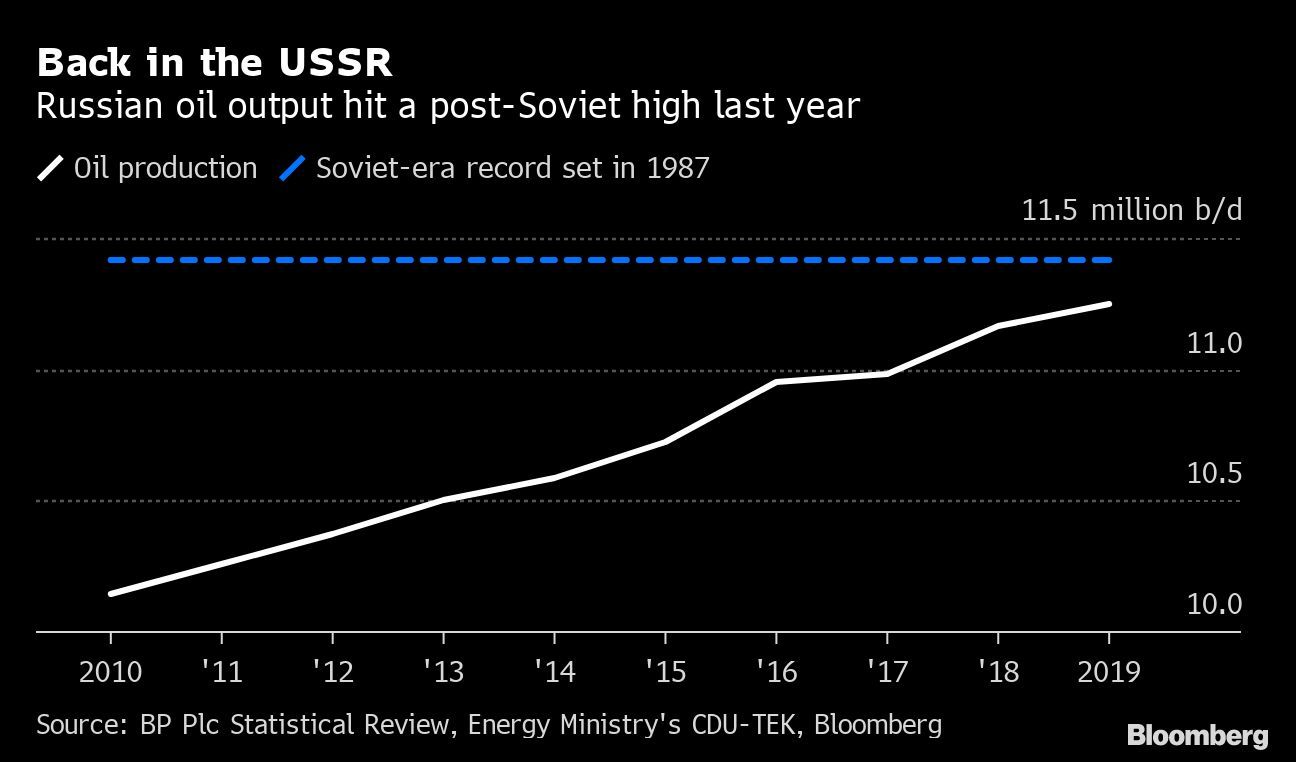
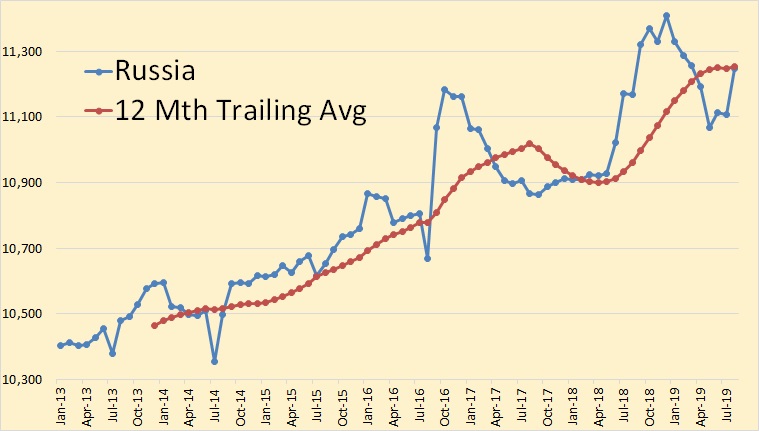
MOSCOW (Bloomberg) – Russia’s crude oil and condensate output hit a post-Soviet high last year even as it curbed production under an agreement with OPEC. The 11th consecutive year of output growth underscores the reality of Russia’s cooperation with the Organization of Petroleum Exporting Countries. Despite being one of the architects of the original 2016 deal, Moscow has a poor record of fulfilling its pledged production cuts and has come under pressure from its allies to do better.The country consistently failed to meet its quota last year, overshooting its target in nine of the 12 months, Bloomberg calculations show. The Energy Ministry has come up with various explanations for producing above the target — from the limitations of a harsh climate to technical issues after the Druzhba oil-contamination crisis. Russia produced 560.2 million tons of oil in 2019, up 0.8% from the previous year, preliminary data from the Energy Ministry’s CDU-TEK unit show. That’s equivalent to 11.25 million barrels a day, according to Bloomberg calculations. Russia produced a record 11.416 million barrels a day in 1987, BP Plc data show. Under the OPEC+ deal, Russia pledged to cut output by 228,000 barrels a day from the October 2018 baseline of 11.418 million barrels a day. That allocation will change this month after OPEC and its allies agreed in December to deepen their cuts. Saudi Arabian Energy Minister Prince Abdulaziz bin Salman has urged the laggards in the deal to carry their share of the burden. The kingdom is making the deepest cuts in the group. Russia has agreed to deepen its reductions by 70,000 barrels a day to about 300,000 a day in the first quarter. But its baseline and monthly production calculations will exclude a type of light oil called condensate, potentially making it easier to hit its cuts target. Energy Minister Alexander Novak has denied that the change is a loophole allowing Russia to pump more oil and still claim compliance. While Russia’s official statistics don’t yet provide a breakdown for crude and condensate, the ministry will regularly inform analysts, the media and OPEC about the composition of its output, according to Novak. Russia has also started making noises about the future of the OPEC+ alliance. When ministers meet next in March, the group will have been restricting output for more than three years, compared with an initial plan for six months. During the meeting, Russia may bring up the issue of exiting the agreement, Novak said in an interview to state TV network Rossiya24 last month. “Oil production cuts can’t be eternal,” Novak said, adding that Russia needs to defend its global market share and let its oil companies develop new projects. “We will gradually need to make a decision on exiting” the accord, he said.
Ending the deal would allow Russia to deploy about 500,000 barrels a day of spare production capacity, which could pave the way for a new output record in 2020.
Russian oil exports rose by 3.3% in 2019 comapred to 2018, Moscow’s Central Dispatching Department of Fuel Energy Complex said in a statement on Thursday. Exports to the Commonwealth of Independent States (CIS) declined 2.4% to 17.6 million tonnes while exports to non-CIS countries increased by 3.7% in 2019 compared to the previous year. Russia exported 206.1 million tonnes of oil last year despite being a part of the OPEC+ output cut deal. In December, OPEC+ agreed to extend and widen its output cuts by an additional 500,000 barrels per day, bringing the total cuts to 1.7 million barrels per day. Russia remained the second largest gas, and the third largest oil producer, accounting for 17% and 12% of the global output, respectively. Russian oil exports grew by 2% (to 9.2 Mb/d) and accounted for 13% of the global total; gas exports grew by 5.4% (to 248 bcm) accounting for 26% of the global total. Nick Note: OPEC+ production cuts my ass. Its the height of winter oil production… Of course inventories will drop……. for now. Wait and see their is oil up the ass out their……
He was once a titan of the car industry who held hero status in Japan. He then became one of the country’s most well-known criminal suspects. Now he’s an international fugitive. Carlos Ghosn, the multi-millionaire former boss of Nissan, spent months preparing to stand trial on financial misconduct charges. At least, that was what the Japanese authorities were led to believe. He posted 1bn yen (£6.8m; $8.9m) in bail in April. He was monitored by a 24-hour camera installed outside his house. His use of technology was heavily restricted and he was banned from travelling abroad. Then, in a move that left Japan red-faced and his own legal team baffled, he appeared in Lebanon on New Year’s Eve. “I have escaped injustice and political persecution,” he declared in a statement. “We were completely caught by surprise. I am dumbfounded,” his lawyer, Junichiro Hironaka, told a crowd of reporters in Tokyo shortly after learning of Mr Ghosn’s flight. “I want to ask him, ‘How could you do this to us?'” Another pressing question is: how did he do it at all? One Lebanese TV channel – MTV – reported that Mr Ghosn had fled his court-approved residence in Tokyo with the assistance of a paramilitary group who were disguised amongst a band of musicians. It said the band had performed at his house and, shortly after they had finished, the 65-year-old hid himself in a large musical instrument case which was then hurried to a local airport. If this really happened, it may have been a tight squeeze even for Mr Ghosn, whose height is reported at 5ft 6in (167cm). According to the MTV story, he then flew to Turkey, before arriving in Lebanon on a private jet. The broadcaster provided no proof for this theory which, unsurprisingly, spread rapidly across social media. The former CEO’s getaway from Tokyo to Beirut was meticulously planned over a period of several weeks, according to the Wall Street Journal. The newspaper, which cited a number of unidentified sources, said a team was carefully assembled to carry out the plot. The group reportedly included accomplices in Japan who transported Mr Ghosn from his house and onto a private jet bound for Istanbul. From there, he continued his journey to Beirut where he arrived in the early hours of 30 December. The plane tracking site FlightRadar24 showed a a Bombardier Challenger private jet arriving at Beirut-Rafic Hariri international airport shortly after 04:00 local time. Mr Ghosn then met his wife Carole, who was born in the city and was heavily involved in the operation, the Wall Street Journal says. The embarrassment caused by Mr Ghosn’s flight soon sparked a reaction from Japan. One Japanese politician asked whether he “had the support of some country”. A former governor of Tokyo was more forthright, accusing Lebanon of direct involvement. “The government has nothing to do with [Mr Ghosn’s] decision to come,” Lebanese minister Salim Jreissati was quoted as saying by the New York Times. “We don’t know the circumstances of his arrival.” France and Turkey have also said they were unaware of Mr Ghosn’s plan. There is no extradition deal between Japan and Lebanon, which means the future of Mr Ghosn’s trial is now fraught with uncertainty. Nick Note: I salute Ghosen…. No way in hell can you get a fair trial in America or japan. Just for the record the US has the highest incarceration and conviction rate for white collar crime in the world. Even more then in Japan. Tens of millions and hundreds of millions is not enough. The only people i have seen avoid federal prosecution for crimes they obviously committed are people who did runners like Mark Rich (later pardoned by Clinton for a payoff) and billionaire bankers. Federal Prosecutes have more dirty tricks then a Los Vegas casino. Its a rigged game. I had a federal prosecutor tell me (“The guilty are easy to convict but he especially enjoyed prosecuting the innocent” They will drag out the case out to run you out of money. They will prejudice the jury pool. One trick is they have a business publication that is sent to the jury pool that just happens to do a disinformation story on you. They will get their cronies in the media to out and out lie about you. They will look for your enemies like your xWife and get dirt on you real or not they do not care., And everyone is against you Freinds neighbors and especially your lawyer who will milk you dry. (my clients are innocent until proven broke). They will shut down your business, bank accounts and cash flow. Scare off your banks and business associates and freeze your money and assets without any proof of a crime. The will get your associates to testify against you and lie their asses off on fear that they will face charges. Its worse then the inquisition. What Ghosen did was the smartest move imaginable……..