
Baker Hughes (BKR) reports Q2 earnings July 22nd. Analysts expect revenue of $4.8 billion and EPS of $0. The revenue estimate implies a double-digit percentage decline sequentially. Investors should focus on the following key items.
North America Could Fall Hard
The North America land drilling market had previously buoyed Baker Hughes, Halliburton (HAL) and Schlumberger (SLB). However, E&P in the region has been facing headwinds for the past 18 months, and pricing power has waned. Schlumberger and Halliburton have engaged in cost containment efforts to offset headwinds to their top lines. In Q1 2020, Baker Hughes generated revenue of $5.4 billion, down 15% Q/Q.
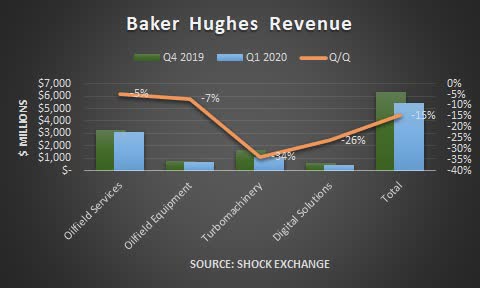
Oilfield Services and Digital Solutions are short cycle businesses that could be a proxy for North America land drilling. They reported a combined $3.6 billion in revenue, down 8% sequentially. They represented about 67% of total revenue, making Baker Hughes highly-dependent on the region. Oilfield Services revenue was hampered by a decline in international pressure pumping, artificial lift and completions. Digital Solutions revenue declined due to headwinds from the coronavirus. It could fall further as the knock on effects of the coronavirus continue to linger. That said, oil prices fell to as low as $10 after the pandemic, but rebounded to over $40 after supply cuts from OPEC and Russia. Halliburton’s Q2 revenue from North America fell over 60% Y/Y. Baker Hughes’s revenue from short cycle businesses could free fall as well. Turbomachinery and Oilfield Equipment generated combined revenue of $1.8 billion, down 25% Q/Q. Turbomachinery was negatively affected by the disposition of certain business lines. Oilfield Equipment was hampered by lower volume for Subsea Production Systems and Flexible Pipe products. Oilfield Equipment orders fell over 55% sequentially, implying falling revenue in the future. With oil in the $40 range, deep water projects may not be economical. Oilfield Equipment could be the company’s weakest segment going forward. Sentiment for BKR could hinge on cost takeouts. Halliburton and Schlumberger have been more aggressive in cutting costs. In Q1 Baker Hughes incurred restructuring and impairment charges, including inventory impairments and separation charges of $1.5 billion. I anticipate more efforts to rightsize the business with sizable cuts to headcount and its facilities footprint in Oilfield Services and Oilfield equipment. Q1 gross profit was $755 million, down over 40% Q/Q. Gross margin was 14%, down over 600 basis points versus Q4. SG&A costs of $675 million were down 10% Q/Q, yet the decline was not enough to offset the loss of revenue. EBITDA of $435 million fell over 50% sequentially. EBITDA margin of 8% was down 600 basis points versus Q4. Cost cuts could help this quarter, but likely will be unable to offset the expected loss of scale. EBITDA margin for Baker Hughes trails that of Halliburton and Schlumberger who reported margins in the 17-18% range. There could be room for margin improvement over time. Oil services firms will need ample liquidity to survive current recessionary pressures. Baker Hughes has $3.0 billion in cash and over $4.0 billion in working capital. Free cash flow (“FCF”) was $160 million, up from an outflow of $440 million in the year-earlier period. This came despite $365 million in capital expenditures, up from $294 million in Q1 2019. I expect management to cut capital expenditures this quarter. The company must squirrel away as much capital as possible going forward. The last downturn in the oil patch caused some of the lesser-capitalized firms to go belly up. BKR has an enterprise value of $19 billion. It trades at 7x last 12 months (“LTM”) EBITDA, which I deem appropriate given headwinds in the oil patch. Its valuation could fluctuate with broader markets, yet investors should remain focused on earnings fundamentals. Baker Hughes’s financial results could remain dismal until the pandemic subsides. I rate BKR a hold for now. Nick Note: For the record they will not make it out of this……..