Israel and the Lebanon-based Hezbollah militant group have been exchanging near-daily fire along the Israel-Lebanon border since Oct. 8. The US and France are attempting to broker a diplomatic solution that would end the fighting. Should those negotiations fail, Israeli officials anticipate a full-blown war with the Iran-backed militia. In the last such conflagration, in 2006, an intensive air campaign by Israel resulted in hundreds of civilian deaths, massive displacement and severe damage to homes and infrastructure in Lebanon. Lebanon’s military has no air defense capabilities, apart from a rudimentary air force vastly inferior to Israel’s. Hezbollah possesses surface-to-air missiles, and has used them to knock down Israeli drones over Lebanon. Israeli civilians and civilian infrastructure suffered in 2006 too, to a lesser extent. Now, Israel has considerable air defenses, but a new war could mean thousands of missiles fired daily at Israel that would strain — and possibly overrun — them. Today, Hezbollah is believed to have an arsenal of more than 150,000 missiles, including long-range and precision-guided ones that could reach deep into Israel and target major cities and strategic assets such as military bases, airports, electricity grids and hospitals, according to Israeli assessments.
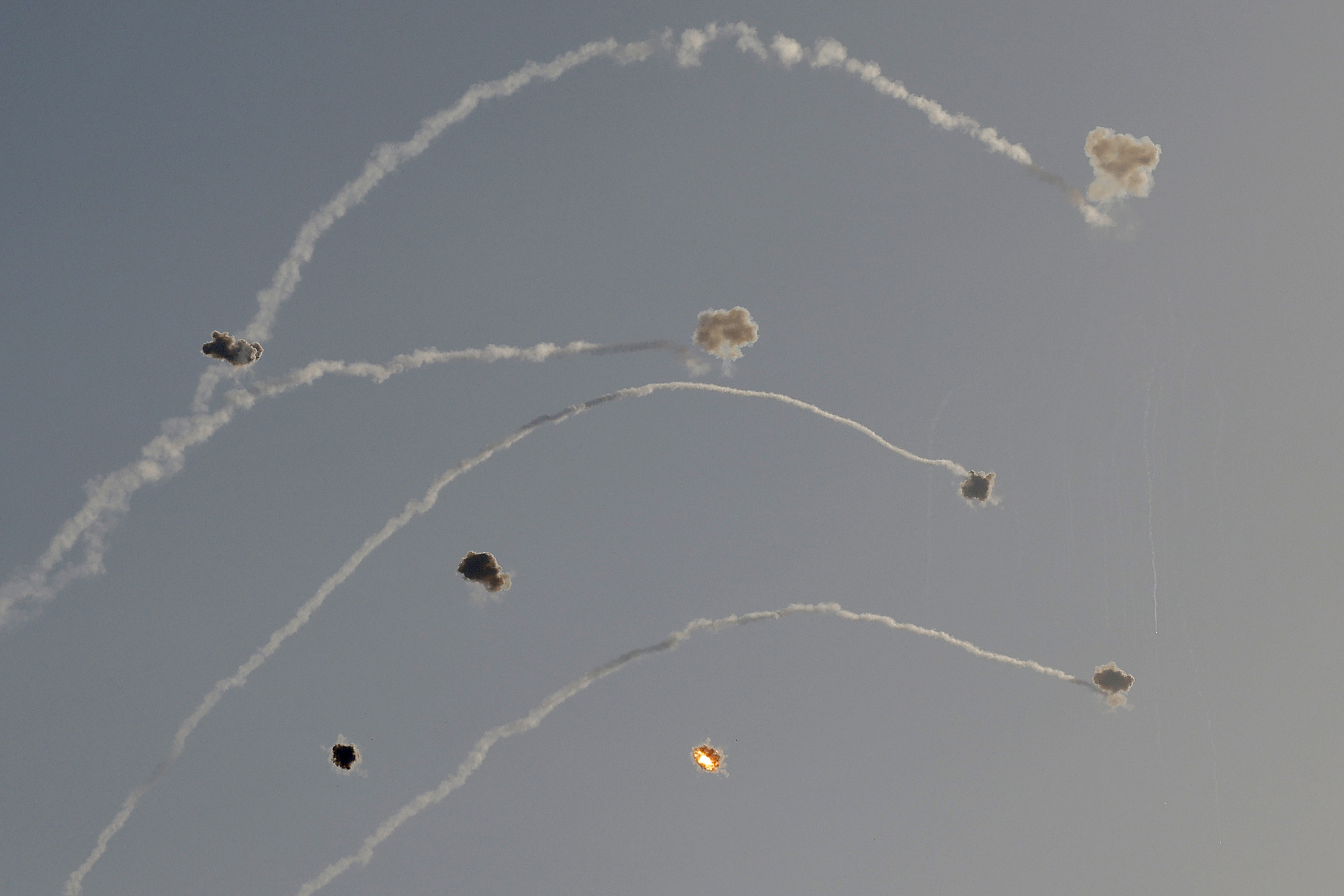
What air defenses does Israel have?
Iron Dome. The most active and well-known of Israel’s air defenses is Iron Dome, which since 2011 has intercepted thousands of rockets fired by Hezbollah and by militant Palestinian groups in the Gaza Strip. The system, developed by Israel’s Rafael Advanced Defense Systems and co-produced since 2014 with the US-based Raytheon Technologies, is designed to counter projectiles and drones with a short range, from 4 kilometers to 70 kilometers (2.5 to 43 miles). Israel’s army says Iron Dome intercepts 90% of such projectiles heading toward populated areas. The Israeli military announced in April that a mobile, maritime version of Iron Dome — known as C-Dome — was operational. It could be used to fend off Hezbollah attacks targeting Israel’s offshore gas fields or ships.
David’s Sling. In 2017, Israel installed a medium-to-long-range interceptor known as David’s Sling, which was co-developed by Rafael and Raytheon. David’s Sling is designed to detect and destroy ballistic and cruise missiles, as well as drones, at a reported range of up to 200 kilometers. That range covers southern Lebanon as well as Gaza.
Arrow. Israel also possesses the advanced Arrow missile defense system, made up of Arrow 2 and Arrow 3. Developers have said the Arrow system can intercept missiles fired from up to 2,400 kilometers away and can do it above Earth’s atmosphere, where long-range ballistic missiles spend part of their flight time. Arrow could be activated if Iran-backed groups in Yemen, Syria and Iraq were to attack Israel to help Hezbollah.
Iron Beam. Israel’s military is testing another system called Iron Beam, which uses lasers to intercept projectiles fired at close range at less expense than the Iron Dome. Iron Beam is not expected to be operational before mid-2025.
Can these systems be overcome?
Already, Hezbollah has inflicted damage and caused dozens of casualties in northern Israel since October using kamikaze explosive drones, many of which are able to slip through Israel’s defenses. The group is thought to be increasing its stockpile of these drones. What’s more, Israel’s army has acknowledged that its air defenses, including Iron Dome, can be overwhelmed if a large number of projectiles are fired simultaneously. Israel expects Hezbollah could fire some 3,000 rockets and missiles every day during a war, far exceeding the capacity of the systems designed to intercept them.
Some of Israel’s newer air defense systems were only recently battle-tested. Arrow 3, which was jointly developed by Israel Aerospace Industries and Boeing Co., notched its first battlefield success in November 2023 when it shot down a missile fired toward southern Israel by Yemen’s Houthi rebels. David’s Sling knocked down rockets from Gaza in fighting that erupted last May. Both were successfully used in Iran’s unprecedented bombardment of Israel on April 13. During that attack, Israel and its allies intercepted 99% of the 300 drones and missiles fired at the country, mostly before they entered Israeli airspace. However, in that case, Israel had advance warning of the assault and received significant help from US and British fighter pilots, conditions that might not be repeated during a weeks- or months-long war with Hezbollah.