Chief White House Medical Advisor Anthony Fauci warned state leaders on Sunday (March 14) against easing their COVID-19 restrictions, as reported by CNBC. Appearing on two morning news programs, Fauci pointed to a spike in coronavirus cases in Europe as evidence that ending public health precautions too soon could extend the pandemic. “Don’t spike the ball on the five-yard line. Wait until you get into the end zone. We are not in the end zone yet,” Fauci said on “Meet the Press.” Easing restrictions too quickly led some European countries seeing a third wave of COVID-19 cases, Fauci said on FOX News Sunday. “They thought they were home free and they weren’t and now they are seeing an increase,” he added. “If you wait just a bit longer to give the vaccine program a chance to increase the protection in the community, then it makes pulling back much less risky.” According to CNBC, several countries in Europe, including Germany, Italy and Poland, have seen significant spikes in COVID cases, while Slovakia and the Czech Republic are reporting some of the world’s greatest number of fatalities from the virus. Last week, German public health officials reported a 20 percent increase in new COVID cases over the space of seven days. The wave in new cases comes at a time when Germany is also facing high unemployment and flagging retail sales. Germany, like some U.S. states, recently began lifting quarantine restrictions. “We have very clear indications for the fact that the third wave has already begun in Germany,” RKI head Lothar Wieler told reporters in Geneva. “I am very worried.” Wieler stressed that people need to continue to wear masks and practice social distancing. Last week, the Organization for Economic Cooperation and Development called for governments to increase the pace of their inoculation efforts to ensure economic recovery. “Speed is of the essence,” OECD Secretary-General Angel Gurría said in a news release. “There is no room for complacency. Vaccines must be deployed faster and globally. This will require better international cooperation and coordination than we have seen up to now.” Nick Note: Do not let your guard down.
Iran enriching uranium with new advanced machine type at underground plant: IAEA
Iran has started enriching uranium at its underground Natanz plant with a second type of advanced centrifuge, the IR-4, the UN nuclear watchdog said in a report obtained by Reuters on Tuesday, in a further breach of Tehran’s deal with major powers.
Last year Iran started moving three cascades, or clusters, of different advanced models from an above-ground plant at Natanz to the below-ground Fuel Enrichment Plant (FEP). It is already enriching underground with IR-2m centrifuges. The deal only lets it enrich there with first-generation IR-1 machines.
“On 15 March 2021, the Agency verified that Iran began feeding the cascade of 174 IR-4 centrifuges already installed at FEP with natural UF6,” the International Atomic Energy Agency said in a report to member states dated Monday, referring to uranium hexafluoride, the form in which uranium is fed into centrifuges for enrichment. Nick Note: The world sat back and watched Hitler amass mighty weapons and did not stop him when it was easy. History is repeating itself while N.Korea, China and Iran are arming themselves to the teeth. a MIGHTY WAR IS COMMING.
Fed officials may talk technical rate move but delay acting for now
(Reuters) – A spate of volatility in money markets has stoked speculation the Federal Reserve may be forced into a technical adjustment to the levers controlling its benchmark interest rate to ensure that it does not fall too low, but few expect the central bank to act on the matter at this week’s meeting.
Interest rates in some short-term funding markets have dropped into negative territory on a handful of occasions recently, driven down by factors such as the Fed’s $120 billion a month of bond purchases, a surge in bank reserves and a big drop in the federal government’s cash stockpile as it doles out pandemic relief payments and tax refunds.
Fed officials are likely to discuss these sinking borrowing costs when they meet on Tuesday and Wednesday. Most economists and strategists, however, expect them to hold off for now in taking corrective action that would mean lifting the rate the Fed pays on bank reserves – known broadly by the acronym IOER. Currently set at 0.1%, IOER helps the Fed keep its key policy rate, the federal funds rate, within the central bank’s target range, which was slashed to between zero and 0.25% a year ago when the coronavirus pandemic forced a broad economic shutdown. The fed funds rate has held steady at 0.07% since mid-February, although it has drifted lower since the start of the year along with other short-term rates. Fed officials historically have taken corrective action when the fed funds rate is within 0.05 percentage point of the top or the bottom of the target range, said Mark Cabana, head of U.S. rates strategy at Bank of America. So while officials are keeping an eye out, Cabana and most other Fed watchers see them waiting until the funds rate hits that trigger point.
That may happen in the weeks ahead, however, as last week’s enactment of the Biden administration’s $1.9 trillion COVID-19 relief package will send more cash into bank accounts and likely push short-term rates down further, Cabana said. It’s not entirely out of the question that the Fed could move on the matter this week.
Given the Fed also faces a looming deadline on whether to extend an exemption granted a year ago on how bank capital requirements are calculated, which can have a big influence on the level of bank reserves held at the Fed, TS Lombard’s Chief U.S. Economist Steven Blitz sees a need to deal with it now. “What the Fed is likely to do is tweak management of the balance sheet by raising IOER around 5 basis points, and adjust the SLR (supplementary leverage ratio) exemption that is ending,” Blitz wrote in a note. Should it need to take action on IOER, the Fed would likely also raise the rate paid on overnight reverse repurchase operations, which acts as a floor on short-term interest rates. That rate is currently set at zero. The Fed last made such an adjustment – which is seen as technical and not a change in its easy-money policy – in January 2020, when it nudged up IOER and the reverse repo rate but left its policy rate unchanged. The move worked: the funds rate had been trading at 1.55% – just 0.05 percentage point from the bottom of what was then the Fed’s target range of 1.50% to 1.75% – and it promptly rose closer to the middle of that range. Nick Note: The Fed is at the point of no return. They will put up their hands and surrender to double digit negative interest rates. The Fed is absorbing 1 trillion a year in treasury debt. This has a end point. In their death throws they are stepping on the yield curve as i have predicted and documented. Reality is the short end will go lower and the back end will climb by at least 100 bases points…. Buy the back end and sell the front end!
BULLSHIT: Days with large Nasdaq alphas a sign of imminent market weakness.
video to be posted later
On March 9, the Nasdaq Composite index did something it hadn’t done in nearly 20 years: It outperformed the Dow Jones Industrial Average by more than 3.5 percentage points—3.59, to be exact. Some believe it to be bullish for the market as a whole for the tech-heavy Nasdaq to outperform the blue chips by this much. But a careful reading of history suggests otherwise: Large divergences in the two indexes aren’t healthy. If you were to focus on just one trading session to make this point, consider the day when the Nasdaq outperformed the Dow by the greatest amount: Jan. 3, 2001. On that day the Nasdaq’s outperformance (or alpha) over the Dow was an incredible 11.4 percentage points. No other day since the Nasdaq was created in February 1971 has come close to that large an alpha. Yet it was hardly a bullish omen. In fact, it came in the middle of the bear market that was caused by the bursting of the dot-com bubble. That’s just one data point, of course, but it’s consistent with the historical record. More often than not, an increased frequency of days with large Nasdaq alphas has been a sign of imminent market weakness. Newsletter Sign-up We certainly saw that at the top of the dot-com bubble. Over the three months prior to that top, there were no fewer than 14 trading sessions in which the Nasdaq’s alpha over the Dow was at least two percentage points. No other three-month period over the past 50 years has seen as many large positive alphas between the two indexes. In fact, during the nearly 11-year secular bull market between the March 2009 low and the February 2020 high, there was just one trading session with that big of a Nasdaq alpha. Ominously, there have been two such days over the past month alone. It’s not just positive Nasdaq alphas that are concerning. Large negative alphas are too. That’s noteworthy, since there has been a pickup recently in the number of such days as well. Over the past three months, for example, there have been four trading sessions with a Nasdaq alpha of greater than minus two percentage points. That brings the total number of large negative or positive alphas to six over the trailing six months. That’s the most since 2002. This is illustrated by the accompanying chart, which shows the number of large positive or negative alphas by year since the early 1970s. Aside from the months immediately before the top of the dot-com bubble, and then the ensuing bear market, this year is shaping up to be a record.
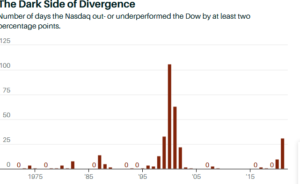
How worried should you be by all this? At least somewhat, according to an analysis conducted for Barron’s by performance-tracking firm Hulbert Ratings. That analysis examined all trading sessions since the Nasdaq Composite was created in 1971, focusing on those days in which there were large alphas (more than two percentage points, positive or negative). A higher frequency of such days was associated with below-average market performance over the subsequent three months. Though the correlation was modest, it nevertheless reached the 95% confidence level that statisticians typically use when determining that a pattern is significant. You shouldn’t be surprised by this result, since a healthy market is one that is firing on all cylinders. While tiny divergences probably don’t mean anything, and a big divergence unaccompanied by any others is probably not a big deal, it becomes a source of concern when large divergences become more frequent—as they have been recently. Even if you aren’t persuaded by this statistical significance, these results show that the market is risky right now. At a minimum, you should not be celebrating days like March 9 in which there was a large positive Nasdaq alpha over the Dow. Nick Note: Hubert is widely followed by Hedge Funds and usually wrnog. That is why Hedge funds are on average break even. In a good year they might make 7%. After this analysis was givn to hege funds the Nasdaq was down by 11%. on March 5th. and a low of around 1200. That is when the bottom was put in. I called the bottom realizing that the hedge funds went all in short beliving it was the START of a great bear market in stocks with many asshole advisers predicting a 30% FURTHER sell off. I correctly saw it as a usual 10% correction and NOT the start just yet of a great bear market. Being a simple man and a lucky guesser i achieved a Nick indicator. Their was blood in the streets and everyone was a seller. Its like a disease with me I had no choice but to declare a bottom and have everyone buy the shit out of the market. When everyone else is selling i am a buyer… pretty simple don’t you think. I declared a bottom and issued a urgent buy ON THE BOTTOM on March 5th.
COVID SCIENCE-mRNA vaccines spur lymph nodes for longer-term protection
March 15 (Reuters) – The following is a roundup of some of the latest scientific studies on the novel coronavirus and efforts to find treatments and vaccines for COVID-19, the illness caused by the virus. mRNA vaccines spur lymph nodes for longer-term protection. Along with inducing antibodies for immediate defense, mRNA vaccines against COVID-19 also stimulate the lymph nodes to generate immune cells that provide protection over the long term, a new study confirms. The early wave of antibodies are generated by B cells called plasmablasts.
In healthy volunteers, blood tests showed that two doses of the Pfizer/BioNTech vaccine induced “a strong plasmablast response,” said coauthor Ali Ellebedy of Washington University School of Medicine in St. Louis.
The immune cells that will produce antibodies upon exposure to the virus in years to come – called memory B cells – are generated by germinal center B cells found only in lymph nodes near vaccine injection sites, his team explained in a paper currently undergoing peer review for possible publication in a Nature journal. In repeated biopsies of volunteers’ lymph nodes, “we saw a robust germinal center response,” Ellebedy said. The responses lasted at least seven weeks, “with no sign of cooling down anytime soon,” he added. “While we do not have long-term samples yet, it is safe to assume given the magnitude and persistence of the germinal center reaction that those individuals will develop a durable immune response” to mRNA vaccines. Moderna Inc’s vaccine also uses mRNA technology. (https://bit.ly/3tnAiYw)
Throat swab test accuracy may vary by time of day
The accuracy of gold-standard PCR tests of nasopharyngeal swab samples may vary by time of day, new data suggest. Researchers analyzed 31,094 tests performed in symptomatic and asymptomatic individuals at 127 testing sites, including 2,438 tests that showed COVID-19. In a paper posted on Saturday on medRxiv ahead of peer review, they report tests were most likely to be positive around 2 p.m. – and the proportion of positive tests in the early afternoon was two-fold higher than the lowest proportion seen at other times of the day. The study “suggests people may be more contagious at certain times of the day and it raises questions about whether tests for SARS-CoV-2 may be less accurate when they are collected between late evening and early morning,” said coauthor Dr. Candace McNaughton of Vanderbilt University. “If our findings are confirmed, clinicians and public health teams could focus their efforts on lowering the risk of viral spread during times of peak viral shedding,” she said. That could entail emphasizing mid-day to early-afternoon masking at home while isolating, or encouraging early morning shopping for vulnerable populations. “There may be greater benefit in repeat testing if a negative test was collected when viral shedding is generally less,” McNaughton said. (https://bit.ly/2NjcZiY)
Surgery delay advised after COVID-19
When possible, surgery should be delayed for at least seven weeks after infection with the new coronavirus, and patients who still have symptoms at that point may benefit from further delay, researchers advise in Anaesthesia. They reviewed data on 140,231 surgery patients from 116 countries, including 3,127 with a history of COVID-19. The mortality rate at 30 days after surgery was 1.4% in patients who never had COVID-19. It was 9.1% among patients diagnosed within two weeks before surgery, 6.9% among those diagnosed within 3 to 4 weeks, and 5.5% when the diagnosis was made 5 to 6 weeks preoperatively. The mortality rate came down to 2% when at least 7 weeks had elapsed between diagnosis and surgery. For patients with ongoing symptoms, the 30-day mortality rate was 6% even after a 7-week delay, researchers found. After adjusting for other risk factors, the odds of death were increased 3.6-to-4.1-fold in patients having surgery within six weeks after a COVID-19 diagnosis. “Patients with ongoing symptoms at least seven weeks from diagnosis may benefit from further delay” of their surgery, the researchers said. Nick Note: The only vaccines to get are the mRNA. We do not know the long term affects of these vaccines. I based my decision to get the Pfizer vaccine by the fact that we have data going back over 5 years by these vaccines given for the Zika virus and a rabies vaccine. So we do have some history. Look we are getting to be the old geysers we use to laugh at when we were twenty somethings. And the risk of the coronal virus in baby boomers is extreme. So we have no choice as i see it but to take the path that represents the least risk. I mush rather risk the vaccine then the coronavirus……Below is a link to one of the best studies going back to 2016 on the mRNA technology used to fight Zika
Biden: 100M relief checks to be distributed over next 10 days
- Biden pledged to get 100 million shots in arms and 100 million checks in pockets in the next 10 days.
- As of Friday, the US had already administered 100 million COVID-19 vaccine doses.
- Stimulus checks from the American Rescue Plan are starting to hit Americans’ bank accounts.
President Joe Biden said on Monday that the US was on track to meet two big goals in the coming 10 days: administering over 100 million COVID-19 vaccine doses, and sending 100 million stimulus checks. “Over the next 10 days, we’ll reach two giant goals. The first is 100 million shots in people’s arms will have been completed in the next 10 days, and 100 million checks in people’s pockets,” Biden said during a speech at the White House.
“Shots in arms and money in pockets – that’s important,” he added.
The US hit the first goal on Friday, surpassing the benchmark of 100 million shots administered. The figure covers doses in Pfizer-BioNTech’s and Moderna’s two-shot regimens and Johnson & Johnson’s one-shot vaccine. As of Monday, 71 million Americans had received at least one vaccine dose, including 38.3 million who have been fully vaccinated, according to the Centers for Disease Control and Prevention. That means one in five US adults has gotten at least one vaccine dose. The Biden administration has recently made significant investments in the US’s vaccine supply. It plans to procure enough vaccines for all American adults by the end of May. On Thursday, in his first prime-time address to the American people, the president announced that the administration would direct states and localities to make every adult eligible to get vaccinated by May 1. Biden also confirmed that he would appoint the former national economic advisor Gene Sperling to oversee the implementation of the American Rescue Plan, the sweeping $US1.9 ($2) trillion COVID-19 relief package that Biden signed into law on Thursday. The bill includes $US1,400 ($1,811) stimulus checks for people below certain income thresholds and other direct aid for families. It followed the bill signed into law by President Donald Trump in December that delivered $US600 ($776) checks to eligible individuals. “We’re just getting started,” Biden said on Monday. “By the time all the money is distributed, 85% of American households will have gotten $US1,400 ($1,811) rescue checks.” Some people have already received their payments, and millions more Americans are set to get theirs in their bank accounts on Wednesday. People can check on the status of their check with the IRS’s “Get My Payment” tool. Nick Note: Their are so many calls by people checking on their checks that the IRS system crashed as reported by our Downdetector service. Also the Redditt web sight a favorite of the new blood millennial traders was overwhelmed. All this means is that people are going crazy looking for their happy checks. And they cannot wait to get into the free money the stock marker has to give.
US closes higher, Dow, S&P reach new records
(Reuters) – Wall Street climbed on Monday, with the S&P 500 closing at a record high, as investors awaited cues from the Federal Reserve this week amid caution over rising borrowing costs spurred by massive fiscal stimulus. In a concrete sign that the worst of the damage from the coronavirus pandemic may be over for the airline industry, Delta Air Lines, Southwest Airlines and JetBlue Airways said leisure bookings were rising. The S&P 1500 airlines index jumped to a one-year high, while other travel-related stocks, including Carnival Corp, Wynn Resorts and MGM Resorts also gained. Most of the 11 major S&P sector indexes rose, led by utilities and real estate. Major stock indexes on Friday logged their best week in six after mass vaccinations and congressional approval of a $1.9 trillion aid bill accelerated demand for stocks expected to outperform as the economy reopens, such as banks, energy, materials companies. The Russell growth index outperformed the Russell value index in a modest reversal of investors’ recent trend away from technology and other high-growth stocks. The DJIA was up 0.53% at the closing bell. McDonald’s Corp. was the best performer on the index, rising 3.82%. The S&P 500 gained 0.65% with United Airlines Holdings Inc. climbing 8.26%. The Nasdaq 100 jumped 1.12%, as NXP Semiconductors N.V. surged 8.84%. Nick Note: The Black Jack trade its a killer. THe rocket is ready to launch…….
EU Starts Legal Action Vs UK As Brexit Deal Delays Make Split Nastier by the Day
The divorce between the U.K. and the EU is turning nastier by the day. The European Union said Monday it is starting legal action against the United Kingdom, arguing the former member does not respect the conditions of the Brexit withdrawal agreement and is violating international law. The 27-nation EU is objecting to Britain unilaterally extending a grace period beyond Apr. 1 that applies to trade on the island of Ireland, where the EU and the United Kingdom share a land border and where a special trade system was set up as part of the Brexit divorce deal. “The recent measures once again set the U.K. on the path of a deliberate breach of its international law obligations and the duty of good faith that should prevail,” EU Vice President Maros Sefcovic wrote to his U.K. counterpart David Frost. It marks a further worsening of relations between the two sides since a divorce transition period ended on Jan. 1. Disputes have ranged from fights over vaccines, to the full diplomatic recognition of the EU in Britain and now again the terms of the divorce agreement. On March 3 the U.K. decided to unilaterally extend a grace period until October on checks for goods moving between Britain and Northern Ireland. Northern Ireland is part of the United Kingdom but remained part of the EU’s single market for goods after Brexit to avoid a hard border that could revive sectarian violence. That means that products arriving from Britain face EU import regulations. A U.K. government spokesperson said it will respond to the EU Commission “in due course,” insisting the measures are temporary and aimed at reducing disruptions in Northern Ireland. Nick Note: The kid gloves have come off and the brass knuckles are on. This divorce has just gotten very nasty. You should see the mess the UK’EU finacial system is in….. Fortunately we saw this comming and picked the winner ENGLAND.
See how they RUN
Canaccord Genuity Chief Market Strategist Tony Dwyer breaks down his outlook for the economic recovery and stock market with Yahoo Finance’s Myles Udland and Brian Sozzi.
Margaret Patel, senior portfolio manager at Wells Fargo Asset Management, and Ernesto Ramos, U.S. CIO at BMO Global Asset Management, join “Squawk on the Street” to discuss moves in the markets.
https://youtu.be/SC-g5t2IQ8U
RBC Capital Markets Equity Derivatives Strategist Amy Wu Silverman speaks with Bloomberg’s Alix Steel and Guy Johnson about effect of rising yields on the equity market and how U.S. stimulus checks may boost options on “Bloomberg Markets:”.
Dow hits record high at open as Nasdaq moves between gains and losses
Mohamed El-Erian, economic advisor at Allianz and Gramercy and president at Queens College, Cambridge, joined “Squawk Box” on Monday to discuss the markets ahead of a new trading week as Americans receive their latest stimulus checks.
Investor Ann Winblad on where she sees Big Tech stocks heading
Nick Note: See how they are scratching their collective asses and starting to figure it out
Repeating: Masters of Equities Universe Are Unfazed by Spike in Bond Yields
(Bloomberg) — The recent rise in interest rates triggered a bout of volatility, but it’s not making the pros in the stock market run for the hills just yet.
Some of the world’s biggest fund managers say equities can persevere and continue rallying through the rise in government bond yields. They are focusing instead on prospects for a powerful economic and profit recovery.
In an informal Bloomberg News survey of more than 50 market players, most respondents including State Street Global Advisors and JPMorgan Asset Management said they’re monitoring the pace of the ascent in yields — and the reasons for it — rather than awaiting a particular level that will mark a breaking point for stocks. As long as central banks stick to accommodative policies, the equity bull run can power ahead, these investors say. “Absent a shift in central banks’ thinking, we don’t think yields will rise to a level where it broadly hurts equities,” said Hugh Gimber, a London-based global market strategist at JPMorgan Asset Management. “Provided the Fed sticks to guidance, and remains comfortable, willing to look through any temporary spike in inflation, I don’t see an environment where yields are rising in a way that’s problematic for equities broadly.” The surge in government bond yields over the past month helped fuel an exit from the frothier parts of the market such as technology and defensive shares, leading to a dip of as much 11% in the Nasdaq 100. But the vaccination push in major economies and bets on a recovery in economic growth as well as consumer spending are filling equity bulls with confidence that they can keep reaping returns despite higher interest rates. At the same time, the pick-up in yields and the more than 70% rally in stocks from pandemic lows are pushing fund managers to become more selective. The likes of Manulife Investment Management and HSBC Asset Management say that, while this isn’t the time to exit equities, the selloff in bonds will accelerate the rotation out of the more expensive growth parts of the market and into cheaper and laggard equities that can benefit from the economic recovery. “If rates were rising from a normal range, tech stocks would’ve been fine, but not true when the valuations are what they have been,” said Dave King, a Boston-based portfolio manager at Columbia Threadneedle Investments. “Potential reopening, coinciding with the rise in yields as well as other factors, were positive for the stocks that people didn’t like too much last year, whether it’s banks or energy.” The energy sector is the best performer in the MSCI World this year, rising about 30%, while financials are next with a 14% gain. More defensive and rates-dependent sectors, such as consumer staples and utilities, are both in the red. Cult stocks that have been investors’ favorites throughout the pandemic have also had a harsh few weeks. Tesla Inc. was down as much as 36% from its January peak before recouping some of its losses last week. Even market stalwart Apple Inc., the biggest U.S. stock, crashed as much as 19% from its record high. This environment could also mark a shift from U.S. stocks to other international equities, such as Europe and emerging markets, that have higher exposure to value sectors. Having lagged the S&P 500 during last year’s rally from the March lows, the Stoxx Europe 600 is outpacing the American benchmark so far in 2021. “The risk of an equity market correction driven by higher yields is highest in the U.S.,” said Joost van Leenders, an Amsterdam-based senior investment strategist at Kempen Capital Management. “The U.S. economy has recovered faster than the European economy, and another major fiscal stimulus bill has just been approved. Inflationary pressure in Europe looks minimal. From a style perspective, growth is more at risk than value. This also means Europe may benefit relative to the U.S.” Investors who are watching out for a particular Treasury yield level that can significantly hurt global equities pointed to a range between 2% and 3% for 10-year bonds.
“It’s important to remember that historically, rising yields have been consistent with rising markets, because both are driven by growth, and we think that will remain the case this time,” said Mark Haefele,
chief investment officer at UBS Global Wealth Management. At the same time, he added that “yields above 2.25-2.5%, if not accompanied by an improvement in the long-term earnings growth outlook and lower risk premia, would start to make current equity valuations look more challenged.” The pause in the bond market selloff in the middle of the week last week showed how quickly stocks and growth sectors can come rushing back. The Nasdaq 100 on Tuesday surged 4% for its biggest jump since November, signaling that appetite for tech names remains strong. “If the rise in bond yields is too quick or too high, it’s a negative for equity valuations. However, if controlled and modest over time, equities can absorb the adjustment reasonably well,” said Nathan Thooft, Boston-based global head of asset allocation at Manulife Investment Management. “Especially if the reason for higher rates is better growth rather than just higher inflation.” Nick Note: How many times can i tell you. The Hedge Gunds shorted the shit out of this market and it is gained back a lot of its former glory. So much so that indicators tell us they are under water. Now the horror show begins for them…. A billion little piss ants are about to go into this marekt and eat the elephants…… Bon Apitite,