Oil edges further above $65 on trade hopes, supply cuts

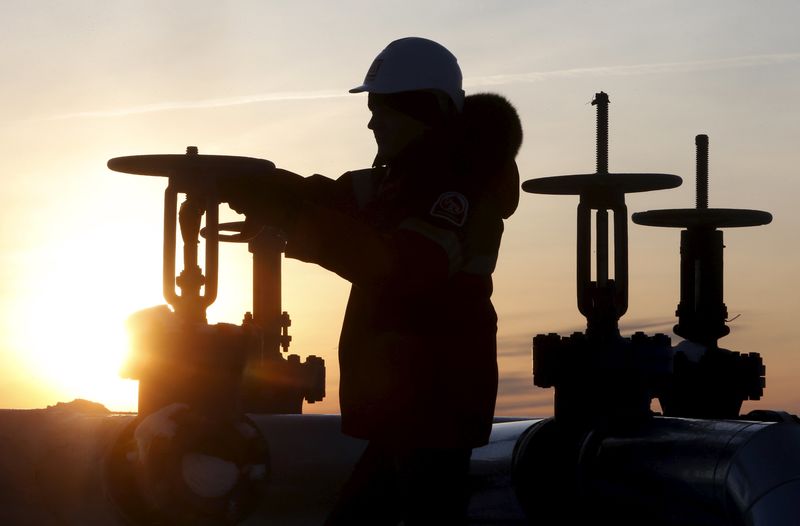
Рабочий проверяет вентиль нефтепровода на месторождении Имилорское рядом с Когалымом. Цены на нефть снижаются за счет опасений за рост мировой экономики и рекордных запасов нефти на терминале в американском Кушинге. REUTERS/Sergei Karpukhin

LONDON (Reuters) – Oil edged further above $65 a barrel on Tuesday, supported by hopes that the U.S.-China trade deal will bolster oil demand in 2020 and the prospect of lower U.S. crude supplies. The ‘Phase One’ agreement between the world’s two largest economies has been “absolutely completed,” Larry Kudlow, a top White House adviser, said on Monday, adding that U.S. exports to China will double under the deal. Brent crude LCOc1, the global benchmark, rose 17 cents to $65.51 a barrel by 1104 GMT, while U.S. West Texas Intermediate crude CLc1 added 1 cent to $60.22. “Christmas has definitely arrived early for oil producers,” said Craig Erlam, analyst at brokerage OANDA. “Brent could get closer to $70 before the rally starts to run on fumes.” The prolonged trade dispute has been a dampener for oil demand and weighed on prices. Banks including JP Morgan and Goldman Sachs have revised up their 2020 price forecasts in the wake of the improving trade outlook and a new OPEC-led agreement to curb output. “The risk-on tone is still noticeable,” said Tamas Varga of oil broker PVM. “The next event to look out for is the weekly U.S. oil inventory statistics.” Supply reports from oil industry group the American Petroleum Institute and the government’s Energy Information Administration are expected to show U.S. crude inventories probably fell last week. The first of the two, from the API, is scheduled for release at 4:30 p.m. EST (2130 GMT) on Tuesday. The government report follows on Wednesday. Also supporting prices, the Organization of the Petroleum of Exporting Countries and allies such as Russia – a group known as OPEC+ – are making a further oil supply cut of 500,000 barrels per day from Jan. 1 to support the market. This comes on top of the existing deal to trim supply by 1.2 million bpd that came into effect on Jan. 1 this year. Nick Note: Their is no trade deal, there is no global economic recover, their is NO orderly Brext and their are not going to be any real supply cuts…. In fact just the opposite. So get ready for the Christmas culling and the New year pay day as oil rises and falls again!

Italy approves 900 million euro rescue for ailing bank Pop Bari

ROME (Reuters) – Italy’s government approved late on Sunday an emergency decree granting a lifeline of up to 900 million euros ($992 million) to cooperative bank Popolare di Bari, in the latest state bailout of an ailing lender. The bank, which said last week it needed an urgent injection of up to 1 billion euros, has struggled to cope with mounting loan losses during a slump that has devastated Italy’s economy, notably in Popolare di Bari’s home region in the south. It was placed under special administration by the Bank of Italy on Friday but the government led by Prime Minister Giuseppe Conte failed to approve a rescue package on the same day as several ministers boycotted a hastily convened cabinet meeting. “The government is on the side of the savers and employees of Popolare di Bari and is committed to re-launching it for the good of the economy of the south,” Economy Minister Roberto Gualtieri said. The government plan calls for an injection of up to 900 million euros into state-owned Banca del Mezzogiorno-Mediocredito Centrale so that it can finance a capital increase at Popolare di Bari. Of these funds, 500 million would be used to quickly bolster the financial strength of Popolare di Bari and the rest would be set aside in case of future requirements, a source close to the matter said. The government wants a deposit guarantee fund financed by Italian banks to take part in the rescue by providing as much as 500 million euros. The Interbank Deposit Protection Fund (FITD), whose executives are due to meet this week, said this month it had been asked for help by Popolare di Bari but wanted to examine the bank’s business plan before making a decision. The crisis at Popolare di Bari has heaped pressure on Conte’s fractious coalition, which brings together the anti-establishment 5-Star Movement and the center-left Democratic Party.

Only hours before the cabinet meeting on Friday night, Conte said the banking system was in good health and there would be no need for state bailouts, prompting the right wing opposition League party to call on him to resign.

5-Star leader Luigi Di Maio said on Saturday he wanted to know why the bank’s health had been allowed by the Bank of Italy, the sector supervisor, to deteriorate so badly and which bank managers were responsible for its pile of bad loans. Since 2016, Italy has had to rescue several of its banks, including Monte dei Paschi di Siena and two Veneto lenders, rescues slammed by 5-Star – which at the time was in opposition – as a waste of taxpayer money to help fat-cat bankers. With 5 Star and the PD at odds over a growing list of economic issues, from the fate of airline Alitalia to the troubled Ilva steel plant in the south, Popolare di Bari’s woes could have potentially serious implications for the government.

Like thousands of Italians who invested savings in the shares and bonds of local banks, Popolare di Bari’s 69,000 shareholders stand to lose their money in a rescue.

Nick Note: Here we go again it has started… You have been warned…

The NSA had not Broken Silent Circle Security

https://youtu.be/Rs27d3QZhz8

From The SAGE Encyclopedia of Business Ethics and Society

Operation Bull Run

NSA Operation Bull Run commenced sometime around 2000 and ended in 2010. This NSA program has stimulated criticism of the Internet encryption operation. NSA capabilities now include the power to break numerous commonly used encryption systems. The NSA codebreakers have been able to decipher encryption from some virtual private networks, and this service was so popular that NSA was receiving 1,000 requests per hour from government clients. The NSA has also cracked the Secure Shell protocol, the Secure Socket Layer encryption method, and the Internet Protocol Security system.

Yet some encryption methods remain invulnerable to NSA decryption efforts. The e-mail service provider Zoho and the Tor network, also known as the Onion Router, have remained unbroken. The encryption programs Truecrypt and Off-the-Record have also continued to elude the decryption efforts of the NSA. The instant messaging system CSpace has thus far foiled solution, and ZRPT (a voice-over Internet protocol technology) has kept its secrets, too. ZRPT evolved from the Pretty Good Privacy program and evolved into GNU Privacy Guard.

Nick Note: We are as sure as we can be that Silent Circle encryption has not been  compromised. Silent circle messages and phone call records have never been introduced in any criminal prosecutions. I was involved in the ZRPT (heart of silent circle) PGPFone and ZFhone development protocols.

ZRTP (composed of Z and Real-time Transport Protocol) is a cryptographic key-agreement protocol to negotiate the keys for encryption between two end points in a Voice over Internet Protocol (VoIP) phone telephony call based on the Real-time Transport Protocol. It uses Diffie–Hellman key exchange and the Secure Real-time Transport Protocol (SRTP) for encryption. ZRTP was developed by Phil Zimmermann, with help from Bryce Wilcox-O’Hearn, Colin Plumb, Jon Callas and Alan Johnston and was submitted to the Internet Engineering Task Force (IETF) by Zimmermann, Callas and Johnston on March 5, 2006 and published on April 11, 2011 as RFC 6189.[1]

I had access to the development software RFC 6189 . I had a few “friends” look over the source code. And we were certain their were no back doors. Link here: https://tools.ietf.org/html/rfc6189

OPEC Deal Could Send Oil To $70


The OPEC+ deal could push oil prices back to $70 per barrel next year, assuming all goes according to plan. The combination of raising the production cuts to 1.7 million barrels per day (mb/d), plus the unilateral over-compliance by Saudi Arabia, adding another 400,000 bpd of additional cuts, surprised the market last week. In addition, Saudi Arabia hopes to apply pressure to all member countries to comply with their allotted reductions. Oil prices jumped immediately after the deal was announced.One of the questions was how the group would allocate the additional cuts. Here is a quick rundown of a few key figures:

  • Saudi Arabia agreed to cut by another 167,000 bpd (while also including 400,000 in voluntary cuts)
  • The UAE: 60,000 bpd
  • Kuwait: 55,000 bpd
  • Iraq: 50,000 bpd
  • Russia: 70,000 bpd

There are smaller contributions from the rest of the group. While the initial reaction was positive from a pricing perspective, the reactions have since become more mixed. According to Bank of America Merrill Lynch, the first quarter could still see a surplus of 700,000 bpd. High compliance with the cuts would only slash that surplus by 200,000 bpd. The bank was skeptical that all producers would comply, with Iraq a particular focus. Julian Lee over at Bloomberg Opinion pointed out that Saudi Arabia has really staked its credibility on this deal, and it will either succeed in getting all producers to comply with the deal, or else Riyadh may decide to flood the market when the deal expires in March. Bank of America also had an eye on this risk factor. “If other members are producing egregiously above their targets, Saudi may opt to boost output to its agreed quota levels,” Bank of America Merrill Lynch wrote in a note. But if everyone works out, OPEC+ might be able to claim some degree of success. “Strong compliance, coupled with other positive economic developments, such as a pick-up in global inventory restocking and a small US-China trade deal, could push Brent to our $70 price target ahead of schedule.”  Goldman Sachs revised up its Brent price for 2020 to only $63 per barrel, up from $60 previously, with supply-demand numbers largely in balance. The bank said that the deal would likely increase the backwardation in the futures curve. Others largely shrugged at the deal, pointing out that actual production levels from OPEC+ aren’t all that different from the announced numbers. “We expect most participants to abide by their new commitments and will adjust the countries’ economic forecasts accordingly. However, the overall impact on price is likely to be limited – with the agreement doing more to redistribute the existing cutting burden than to alter actual absolute production by the 24 adherents,” Pat Thaker, Editorial and Regional Director, MEA at The Economist Intelligence Unit, said in a statement. Nick Note: OPEC Compliance my ass… Global economic recovery… Don’t make me laugh. Trump is not ending trade wars but starting new ones. Fed is pumping money like their is no tomorrow..And they may be right! Oil prices are doomed…. doomed i tell you. The Saudies are not that kid… this is alabout gettng te worlds biggest IPO launched… Once that is down and dusted.. Katti bar the door. Frackers should be stashing money and arranging their Brazilian passports!

US Credit Card Industry Failed To Innovate For A More Secure System

creditcard-dec09-lt.jpg

A study has revealed how vulnerable the U.S. credit card industry is, and stressed the need to establish adequate security standards. Noted industry research firm Retail Payments Global Consulting Group says the leadership of EMVCo, an organization owned by the world’s six largest payment card companies that sets technical specifications for credit, debit and other payment cards, has put profits ahead of security, driven up costs for businesses and consumers, and left the United States with a fraud-prone payment card system. The research paper, titled “Payment Insecurity: How Visa and Mastercard Use Standard-Setting to Restrict Competition and Thwart Payment Innovation[CS1]”, highlighted a systemic pattern of decision-making by EMVCo that put in place standards with less security and lead to more fraud risk just to help those card companies dominate the market. The report says the U.S. payments system is less secure when compared to other international markets.The study, conducted for the Secure Payments Partnership coalition, observed that the U.S. payments industry is being harmed by the card companies and EMVCo.” Because EMVCo is run entirely by the major card companies, it is not an appropriate organization to develop standards that have such high impact on the U.S. payments industry, according to the report’s author and RPGC President and Managing Director Rene Pelegero. Responding to the report, the National Retail Federation said that as millions of Americans experience credit card fraud, the responsibility to ensure safe credit card payment system in the country should be entrusted with a neutral third party standard-setting body. The report shows that Visa and MasterCard own and control EMVCo and ensure it sets standards that the major U.S. financial services corporations can use to beat competitors “before the game even starts”. EMVCo bolstered VIAS’s more than 20 years-old battle against unaffiliated debit networks, resulting in the implementation of less-secure chip-and-signature EMV cards in the United States, the report said. EMVCo reportedly adopted expensive, complex and difficult-to-implement technology such as NFC because it prevents other competitors from entering the mobile payments market. Nick Note: We are working on a solution. Bottom line is the ENTIRE financial system is at grave risk form sever overleveragng by US financial institutions and antiquated technology


For comments and feedback contact: editorial@rttnews.com

Business News

Massive… Huge… Largest Ever”: Fed Will Flood Market With Gargantuan $500 Billion In Liquidity To Avoid Year-End Repo Crisis

In previewing today’s Fed statement regarding repurchase operations, on Tuesday Curvature Securities repo expert Scott Skyrm said that he expects the Fed to announce a $50 billion (at least) term operation for Monday December 23 (double the current term ops) and a $50 billion (at least) term operation for Monday, December 30. This prediction was in response to Zoltan Pozsar’s warning that reserve levels are too low and the result would be a market crash that could spark QE4. The NY Fed did publish it latest weekly “Statement Regarding Repurchase Operations” as expected laying out the Fed’s expected repo operations for the period December 13 – January 14… According to the statement, the NY Fed will continue to offer two-week term repo operations twice per week, four of which span year end. In addition, the Desk will also offer another longer-maturity term repo operation that spans year end. The amount offered in this operation will be at least $50 billion. In addition, to prevent a cascading year-end liquidity squeeze, Fed overnight repo operations will continue to be held each day, and just to be safe, the Fed will go to town by substantially expanding their size: On December 31, 2019 and January 2, 2020, the overnight repo offering will increase to at least $150 billion to cover the “turn” in a flood of overnight liquidity.  In addition, on December 30, 2019, the Desk will offer a $75 billion repo that settles on December 31, 2019 and matures on January 2, 2020. And just in case that’s not enough, the NY Fed’s markets desk also added that it “intends to adjust the timing and amounts of repo operations as needed to mitigate the risk of money market pressures that could adversely affect policy implementation, consistent with the directive from the FOMC.” What the Fed means is that in addition to expanding the sizes of its “turn” overnight repos to $150 billion, the Fed will conduct a total of nine term repos covering the year-end turn from Dec 16 to Jan 14, 8 of which will amount to $35BN and the first will be $50BN, for a total injection of a whopping $365 billion in the coming month. Nick Note: Its now a 4 alarm fire..somebody is broke in fact a lot of somebodies are broke. I urge you to get your excess  funds  into treasury direct. We are searching for alternatives….. The curse is the fractional banking system is out of control. The solution is Full Reserve Banking of a bygone era. I am working on it. I was known as the slayer of discount commodity brokers. Soon i will be the destroyer of investment banks.

And visually:

Sterling skyrockets to 18-month high as exit poll points to Tory majority

Pound jumps 3pc against dollar to 18-month high after exit poll

Analysts say exit poll points to ‘best outcome for markets’


The pound has skyrocketed to its highest level in 19 months as the City cheered a strong Conservative majority promising to finally end the Brexit deadlock. Investors piled into sterling after the exit poll suggested Boris Johnson would be given a majority strong enough to put to bed the uncertainty plaguing businesses and the economy. After sinking during nervy trading in the run-up to the exit poll, the pound erased early losses to soar 3pc against the dollar in just half an hour, breaking past the $1.35 milestone. Top banks drafted in traders for a frantic night of dealing on currency markets with analysts predicting that sterling could build on its initial gains if the Tories secured their predicted majority. Nick Note: We are getting kiiled in our pound trade…. But the January deadline will lead into years of negotiations…. talk about the worst trade deal in history. England will be the slave on Europe. It called the fine print that NO ONE has read never mind understand.

Trump: Getting very close to big China trade deal

United States President Donald Trump said on Thursday Washington is nearing a “big deal” on trade with China

“Getting VERY close to a BIG DEAL with China. They want it, and so do we!” Trump tweeted. The comments come after reports that Trump was meeting his trade and economic advisors today to discuss the trade dispute with China and whether to go ahead with imposing additional tariffs on Chinese products on December 15. Earlier media reports claimed China and the US are set to delay the tariffs set to take effect this weekend. Meanwhile, China has insisted that any potential trade agreement must include a tariff rollback.

Months before he died, Volcker ripped into Trump and ‘nihilistic forces’ undermining confidence in the US

Volcker died Sunday at age 92. An excerpt of the afterword was published Wednesday in the Financial Times. He guided the Fed from 1979-87 and led the …

Three months before he died, former Federal Reserve Chairman Paul Volcker issued a scathing critique against President Donald Trump and the “movement to undermine Americans’ faith in our government and its policies and institutions.” In an afterword to a paperback release of his autobiography, the legendary former central bank chief called out the president for his attacks on the Fed and said there is a general movement to undermine confidence in essential U.S. institutions. “Nihilistic forces are dismantling policies to protect our air, water, and climate,” Volcker wrote at the end of “Keeping At It: The Quest for Sound Money and Good Government.” “And they seek to discredit the pillars of our democracy: voting rights and fair elections, the rule of law, the free press, the separation of powers, the belief in science, and the concept of truth itself.” In the essay he wrote in September, Volcker addressed Trump’s repeated criticism of the Fed. The president has demanded the central bank lower rates and has called officials there “boneheads” and said Chairman Jerome Powell was “clueless.” “Not since just after the second world war have we seen a president so openly seek to dictate policy to the Fed,” Volcker wrote. “That is a matter of great concern, given that the central bank is one of our key governmental institutions, carefully designed to be free of purely partisan attacks.” Volcker added that confidence in the U.S. is “under siege.”

“Seventy-five years ago, Americans rose to the challenge of vanquishing tyranny overseas. We joined with our allies, keenly recognizing the need to defend and sustain our hard-won democratic freedoms,” he said. “Today’s generation faces a different, but equally existential, test. How we respond will determine the future of our own democracy and, ultimately, of the planet itself.”

The concerns are similar to those he expressed a year ago in an interview with Andrew Ross Sorkin of The New York Times and CNBC, during which he said the U.S. was in “a hell of a mess” because “nobody believes in the leadership of the country.” Nick Note: In my NY days as a kid not knowing SHIIT I  lived in the business libraries and the archives of the FED. Many times I attended lectures by Ann Rand and Paul Volker….. It changed my life and taught me the secrets of the temple. That is what has made all of us millions through the years.