NEW YORK, Nov 29– U.S. crude oil production in September rose to a new record of 12.46 million barrels per day (bpd) from 12.397 million bpd in August, the U.S. government said in a monthly report on Friday. The United States has become the world’s largest oil producer as technological advances have increased production from shale formations. Oil output in Texas rose 72,000 bpd in September, while production in North Dakota and the Gulf of Mexico fell during the month. Production also climbed in Oklahoma and Alaska. U.S. gasoline demand fell 652,000 bpd in the month to 9.2 million bpd. U.S. demand for distillate fuels, including diesel, fell 87,000 bpd to 3.9 million bpd, according to the report. Meanwhile, monthly gross natural gas production in the lower 48 U.S. states rose to an all-time high of 104.8 billion cubic feet per day (bcfd) in September from the prior record of 104.2 bcfd in August, according to the EIA’s 914 report. In Texas, the biggest gas producing state, output increased 1% to a fresh record high of 29 bcfd in September. In Pennsylvania, the second-biggest gas-producing state, output rose 0.1% to a record 19.24 bcfd in September from the prior all-time high of 19.22 bcfd in August.
Saudi Arabia signals it’s had enough of OPEC+ quota cheats
LONDON (Bloomberg) – For the last year, Saudi Arabia has largely turned a blind eye to cheaters within the OPEC+ alliance, cutting its own output more than agreed to offset over-production from the likes of Iraq and even Russia. Now, Riyadh’s had enough. Prince Abdulaziz bin Salman, who took over from Khalid Al-Falih in September, will likely use his first OPEC meeting as Saudi oil minister next week to signal OPEC’s dominant producer is no longer willing to compensate for other members’ non-compliance, according to people familiar with the kingdom’s thinking. OPEC meets in Vienna on Dec. 5, followed by the larger OPEC+ alliance, which includes Russia, the next day. “Saudi Arabia is taking a harder line than in the past,” said Amrita Sen, chief oil analyst at consultant Energy Aspects Ltd. in London. “Riyadh is making very clear that they don’t want to shoulder all the cuts alone.” The willingness to tolerate cheating was a key part of the “whatever it takes” policy to support oil prices that Al-Falih set out in late 2016, borrowing a line from central banker Mario Draghi. Al-Falih paid lip service to dealing with the cheating, trying to cajole OPEC+ nations to cut output as much as they had promised. But when his admonitions failed and oil prices faltered, endangering the initial public offering of state oil producer Saudi Aramco, he simply decided to bear the burden. Earlier this year, in an abrupt change to decades of Saudi oil policy, Riyadh cut production far below their agreed target. Whether the new policy simply represents a shift in tone, or a more meaningful change isn’t yet clear. Saudi officials privately say Prince Abdulaziz will simply reiterate the decades-long Saudi mantra that everyone needs to contribute to make the production cuts successful. During the tenure of Ali Al-Naimi, oil minister from 1995 to 2016, Riyadh resolutely refused to cut its production deeper than it had agreed at OPEC meetings. The prince already made the point when he attended an OPEC+ committee meeting in Abu Dhabi in September. “Every country counts regardless of its size,” he said at the opening session of the meeting. The cheating has been widespread. Iraq, for example, should be pumping no more than 4.51 million barrels a day; but in some months it produced nearly 4.8 million barrels a day. Kazakhstan accepted a limit of 1.86 million barrels a day, however, it has produced closer to 1.95 million barrels. Nigeria agreed a quota of 1.68 million barrels a day, but has regularly pumped more than 1.8 million barrels a day. Russia has pumped more oil than allowed by the OPEC+ deal in eight months this year. It has complied with the agreement in only three months of this year — May, June and July — when disruption to the key Druzhba oil pipeline pushed production below its OPEC+ target. Al-Falih was forced to act partly because the kingdom needed a higher oil price to push ahead with the Aramco IPO. But Prince Abdulaziz probably won’t be so constrained once Aramco prices its share sale on Dec. 5, the same day as OPEC’s meeting. The policy of accommodating cheating has been costly for the kingdom. Riyadh was forced to reduce its own production as much as 700,000 barrels a day below its own OPEC+ quota to prevent oil prices from falling. In December 2018, Saudi Arabia agreed a production limit of 10.31 million barrels a day through this year. But it reduced production unilaterally earlier this year, reaching a low of 9.58 million barrels a day in July. As Saudi Arabia had to cut production deeper than others, it’s reaped fewer rewards from the recovery in oil prices. Russia, for example, is earning about $170 million a day more than it did in the final quarter of 2016 when the OPEC+ cuts were first agreed, according to the International Energy Agency. Saudi Arabia is earning just $125 million more. For OPEC watchers, the test of how far Saudi Arabia is ready to get tough with cheaters is whether the kingdom brings production back to its official OPEC+ quota of 10.31 million barrels a day and sustains it for several months. The production picture is clouded by the impact of the September attack against two key Saudi production facilities called Abqaiq and Khurais. The kingdom depleted its inventories in the days after the attack to sustain exports and Riyadh has subsequently lifted production to re-fill them. In November, the kingdom has pumped 10.23 million barrels a day, a slight reduction from October but significantly above the year-to-date average of 9.8 million, according to Vienna-based consultant JBC Energy GmbH.
Russia Wants To Renegotiate The OPEC+ Deal
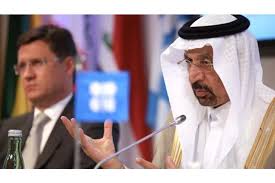
Russian oil companies prefer to keep their production restriction quotas until March, when the current OPEC+ cuts expire, and discuss an extension then, signaling that Russian producers don’t want deeper cuts or any major changes to the pact at next week’s meeting. “We all proposed that we stay in the deal with the same quotas, and at the end of the first quarter we will meet and discuss,” Ravil Maganov, Vice President at the second-biggest Russian oil producer, Lukoil, said after a meeting with Energy Minister Alexander Novak on Thursday to discuss the Russian firms’ view on the OPEC+ deal. Last week, Lukoil’s chief executive Vagit Alekperov said that he expects the OPEC+ group to decide next March whether to roll over the production cuts through the rest of 2020. “It is going to be decided in March,” Alekperov said last week, as carried by Reuters, referring to the ongoing production cuts which OPEC and its Russia-led non-OPEC partners are implementing in a bid to rebalance the market and prop up oil prices. After the meeting with the Russian oil companies, minister Novak, in one of his typical ‘I’m-not-giving-away-anything’ statements, told reporters that Russia’s position going to the Vienna meeting next week “is still a secret.” But the market expects the OPEC+ coalition to come up with some sort of concrete decision next week—otherwise analysts expect a sell-off in oil. The Saudis are said to be pushing non-compliant OPEC members to fall in line and start keeping their respective quotas. The Russians have a grievance about the pact that they are likely to take up with their OPEC allies. Russia is expected to discuss with its OPEC partners the exclusion of gas condensate from its cap, as condensate isn’t exported, while it is included in Russia’s oil production statistics, Novak said last week. Speaking on Thursday, Novak said that Russia hasn’t asked OPEC+ yet to exclude gas condensate from the calculations. Russia tries to fully comply with the cuts, but it is unable to do it because of increased gas condensate production, the minister noted.
Finland, Belgium, Denmark, Netherlands, Norway, Sweden Join INSTEX Mechanism for Trade With Iran
Iran considers the European Instrument in Support of Trade Exchanges (INSTEX), a tool set up to help trade with Tehran under the US sanctions, to be weak, Iranian Deputy Foreign Minister Seyed Abbas Araghchi stated earlier in November, adding that the system has not been fully implemented so far. Finland, Belgium, Denmark, Netherlands, Norway, Sweden will join the INSTEX mechanism for trade with Iran, the Finnish Foreign Ministry said in a statement.
“In light of the continuous European support for the agreement and the ongoing efforts to implement the economic part of it and to facilitate legitimate trade between Europe and Iran, we are now in the process of becoming shareholders of the Instrument in Support of Trade Exchanges (INSTEX) subject to completion of national procedures”, the joint statement reads.
The INSTEX is a special purpose vehicle created by Germany, France, and Britain in February to help EU companies do business with Iran, bypassing US sanctions against the country. Following a meeting of the Joint Commission of the JCPOA in June, the mechanism became operational and available to all EU member states. The trade instrument in its initial stage only covers the supply of medicines, medical equipment, and agricultural products, but Tehran also seeks to export oil. In 2018, the United States abandoned its conciliatory policy on Iran, withdrawing from the Joint Comprehensive Plan of Action (JCPOA) and hitting Iran with sanctions. The European Union has been trying to preserve the JCPOA by various diplomatic means. The JCPOA was signed in 2015 by Iran, China, France, Germany, Russia, the United Kingdom, the United States, Germany, and the European Union. It required Iran to scale back its nuclear programme and severely downgrade its uranium reserves in exchange for sanctions relief. After the United States’ unilateral withdrawal from the pact in May 2018 and reintroduction of large-scale sanctions on Iran, Tehran began gradually abandoning its JCPOA obligations. In May of this year, Iran warned it would gradually abandon its nuclear commitments every 60 days.
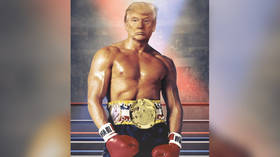
Trump tweets picture of his head on Rocky Balboa’s body
— Donald J. Trump (@realDonaldTrump) November 27, 2019
Nick Note: What a col president…. NOT! Try fucking idiot!!!
Morgan Stanley dismisses traders linked to concealment of 150 million-dollar loss: Bloomberg
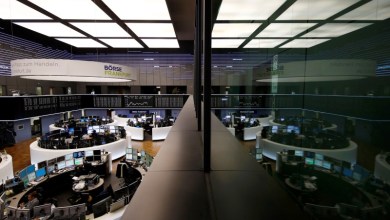
(Reuters) – Morgan Stanley has fired or placed on leave at least four traders over alleged mismarking of securities that concealed losses of between $100 million and $140 million, Bloomberg reported on Thursday citing people familiar with the matter. The company is investigating the suspected mismarking that was linked to emerging-market currencies and the traders were based in London and New York, according to the report. A Morgan Stanley spokesman declined to comment on the report. The probe at the sixth largest U.S. bank relates to complex trading products including so-called FX options that give buyers the right to trade currencies at a set price in the future, according to Bloomberg.
Former Deutsche Bank Exec Connected to Trump Loans Dies by Suicide in Malibu
Thomas Bowers, who worked above Trump’s personal banker, was 55
A former Deutsche Bank executive who reportedly signed off on some of the institution’s unorthodox loans to Donald Trump killed himself in his Malibu home on November 19. Thomas Bowers, the onetime head of Deutsche Bank’s American wealth-management division, where he oversaw Trump’s private banker, committed suicide by hanging, according to Los Angeles County Medical Examiner-Coroner’s office. Bowers was 55.
I’ve learned that Tom Bowers, a former senior @DeutscheBank executive, died last week at 55 in Malibu, Calif. I knew him. It’s very sad.
— David Enrich (@davidenrich) November 26, 2019
Trump’s relationship with Deutsche Bank—which lent him around $2 billion after most other institutions had forsaken him for his history of defaults and bankruptcies—has come under investigation by two Congressional committees and the New York Attorney General, who are hoping the bank can shed light on Trump’s elusive finances, according to the New York Times. At one point, Bowers had a close connection to those finances.
Rosemary T. Vrablic, a managing director at Deutsche Bank who became Trump’s private banker in 2010 after being introduced by her client, Jared Kushner, reported directly to Bowers. Vrablic reportedly helped Trump secure loans from her bank, which Bowers approved—including more than $100 million to buy his Doral resort in Miami—even after Trump and Deutsche had to settle messy litigation over a Chicago loan that went bad.
“Rosemary is widely recognized as one of the top private bankers to the U.S. ultra high-net-worth community,” Bowers said in a press release when Deutsche Bank hired her in 2006.
Bowers hasn’t been employed by Deutsche since at least 2015, when he joined Starwood Capitol Group as COO, and was then appointed to the Board of Directors of Opus Bank in 2016.
Bowers isn’t the first Trump-connected Deutsche exec to commit suicide. In 2014, Deutsche derivatives analyst William S. Broeksmit, who reportedly had links to Trump and Russia, hung himself from a dog leash at his home in London.
Iran Could Have A Nuclear Bomb Within Months
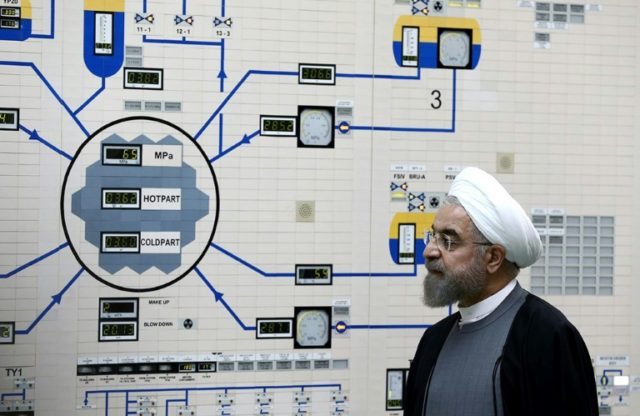
The Iranian government is shortening its nuclear breakout time — the amount of time required to produce enough weapons-grade uranium for a single nuclear weapon. Tehran has accomplished this through several steps in the last few months. Iran’s government first increased its enriched uranium stockpile beyond the 300 kilogram limit; it enriched uranium to levels beyond the cap of 3.67 percent, and then activated 20 IR-4 and 20 IR-6 advanced centrifuges. The Iranian leaders even boasted that their government is now exploring new uranium enrichment programs and producing centrifuges. Most recently, the head of the Atomic Energy Organization of Iran, Ali Akbar Salehi, declared that Iran has an adequate supply of 20% enriched uranium., “Right now we have enough 20% uranium,” he told the Iranian Students News Agency, ISNA, “but we can produce more as needed”. He added that the country is resuming uranium enrichment at a far higher level at the Fordow nuclear facility — an underground uranium enrichment facility which is reportedly located on one of bases of the Islamic Revolutionary Guard Corps (IRGC) — injecting uranium gas into centrifuges, and operating 60 IR-6 advanced centrifuges.
Continue reading “Iran Could Have A Nuclear Bomb Within Months”
U.S. oil drillers cut rigs for record 12th month in a row -Baker Hughes
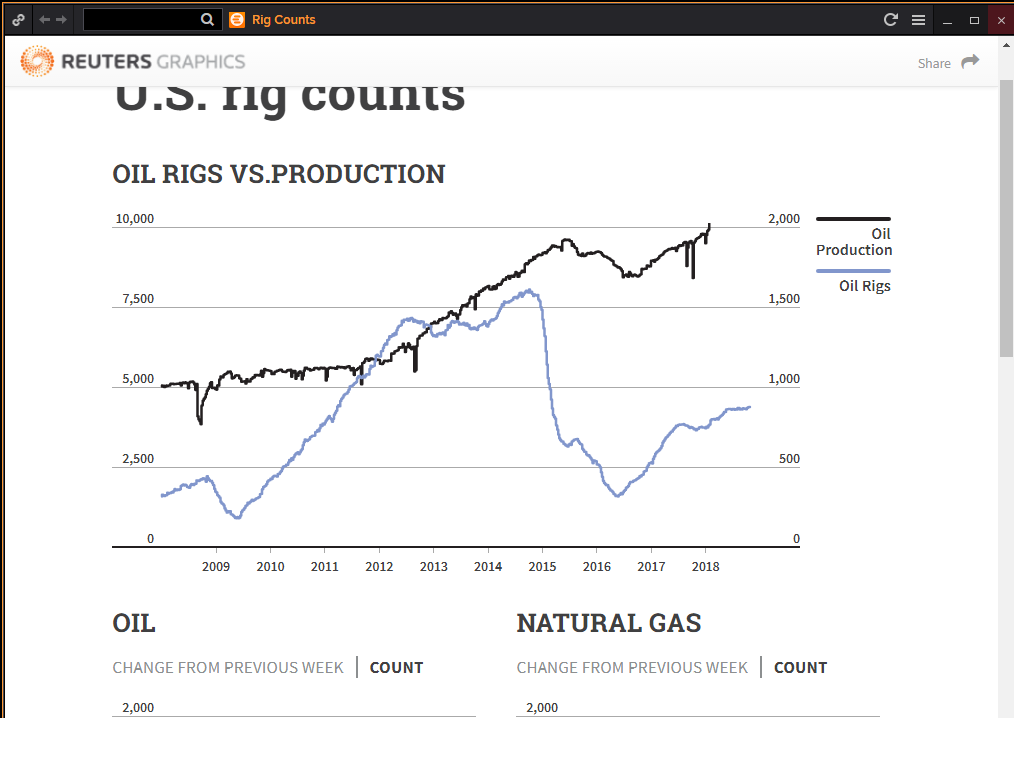
Nov 27 (Reuters) – U.S. energy firms reduced the number of oil rigs operating for a record 12th month in a row after this week cutting rigs for a sixth consecutive week as producers slash spending on new drilling. Drillers cut three oil rigs in the week to Nov. 27, bringing the total count down to 668, the lowest since April 2017, energy services firm Baker Hughes Co said on Wednesday in a report released two days early due to the U.S. Thanksgiving holiday. In the same week a year ago, there were 887 active rigs. In November, drillers cut 28 oil rigs. That puts the oil rig count on track to fall for the first time in three years. The 2019 decline, however, so far only totals 217, which is much smaller than 2015’s record 963 rig decline, according to Baker Hughes data going back to 1987. The oil rig count, an early indicator of future output, declined for a record 12 months in a row as independent exploration and production companies cut spending on new drilling as shareholders seek better returns in a low energy price environment. U.S. financial services firm Cowen & Co has said that 22 of the exploration and production (E&P) companies it watches reported spending estimates for 2020. Cowen said there were 16 decreases, one flat and five increases, implying a 13% year-over-year decline in 2020, which puts spending on track to decline for a second year in a row. Cowen has said the producers it watches expected to spend about $80.5 billion in 2019 versus $84.6 billion in 2018. Year-to-date, the total number of oil and gas rigs active in the United States has averaged 955. Most rigs produce both oil and gas. Analysts at Simmons & Co, energy specialists at U.S. investment bank Piper Jaffray, said it lowered its rig count forecast due to the significant contraction in land rigs over the past several weeks. Simmons now projects the annual average combined oil and gas rig count will slide from a four-year high of 1,032 in 2018 to 943 in 2019 and 816 in 2020 before rising to 849 in 2021. That compares with Simmons previous forecast of 950 in 2019, 905 in 2020 and 958 in 2021.
Saudi Aramco IPO’s retail tranche oversubscribed -lead manager –
The state oil giant plans to sell a 1.5% stake, or about 3 billion shares, and has said at least one-third of the sale is expected to be covered by retail investors, who have until Thursday to sign up. With an indicative price of 30-32 riyals, the IPO is valued at as much as 96 billion riyals ($25.6 billion) and gives the firm a market value of $1.6-$1.7 trillion.
It will be the world’s biggest IPO if it tops the $25 billion set by China’s Alibaba in 2014.
Around 4.17 million retail investors had subscribed to 1.19 billion shares by 12 p.m. on Thursday, injecting 6.13 billion riyals above the amount needed for full coverage, Samba said. Subscription will continue until midnight on Thursday and final results will be announced on Friday, it said in a statement. The IPO is the centrepiece of Crown Prince Mohammed bin Salman’s plans to diversify the Saudi economy away from its reliance on oil. Aramco is the crown jewel of the economy and the world’s most profitable company. It is relying on local and regional demand to pull off the deal, after cancelling marketing roadshows outside the Gulf region due to a lack of interest from foreign institutional investors. Sources told Reuters this week that the sovereign wealth funds of Abu Dhabi and Kuwait plan to invest. Saudis have been eager to buy shares, with many seeking to invest on behalf of their dependents to increase the number of shares they can buy. The government has encouraged rich Saudis to invest, with many viewing it as an opportunity to show their patriotism after a September attack on Aramco facilities that struck at the heart of the kingdom’s energy industry. Washington and Riyadh blamed regional rival Iran for the attacks, which temporarily cut more than 5% of global oil supply. Tehran denied any involvement.
($1 = 3.7500 riyals)