Trump says U.S. will impose metal tariffs on Brazil and Argentina

WASHINGTON — President Donald Trump said Monday that he would impose tariffs on steel and aluminum from Brazil and Argentina, a move that would shatter previous agreements struck with those countries and widen a global trade war. Trump, in a message on Twitter, accused Brazil and Argentina of manipulating their currencies and hurting American farmers. “Therefore, effective immediately, I will restore the Tariffs on all Steel & Aluminum that is shipped into the U.S. from those countries.” The Trump administration never imposed tariffs on Brazilian and Argentine metals, though it did force them to limit shipments to the United States under a quota system last year. The United States initially exempted Brazil, Argentina and other countries from the president’s sweeping metal tariffs in March 2018, with the United States saying it would continue negotiations with those countries to improve their trade terms. In May 2018, the United States announced that it had reached an agreement with the countries that would cap their metal shipments at a specific volume each year. It is unclear what prompted Trump to reverse those agreements. But last week the Brazilian currency, the real, fell to a record low against the dollar after the country’s economic minister signaled that he was not concerned about exchange-rate fluctuations.

Argentina’s peso has weakened with the country in the midst of an economic crisis.

Both economists and government officials have rejected the idea that Brazil and Argentina are manipulating their currencies. But those currency movements have made Brazilian and Argentine goods cheaper to purchase abroad, a dynamic that is particularly important for the agricultural sector and the U.S.-China trade war. As of Monday morning, neither the Office of the U.S. Trade Representative nor the Commerce Department had issued the formal notices that would put tariffs on Brazil and Argentina into effect. If they are imposed, the tariffs stand to do considerable damage to South America’s two biggest economies at a time when Argentina is in recession and Brazil confronts high unemployment and anemic growth. The announcement appeared to take the Brazilian and Argentine governments by surprise. “This was completely unexpected,” said Dante Sica, Argentina’s minister of production. “I was in Washington last week, and I talked to a lot of people, and there was no sign whatsoever that there would be any kind of change.” The Brazil Steel Institute, which represents the interest of steel exporters, said in a statement that it found the new tariffs “perplexing” and warned that it would harm companies in both countries.
Palladium reaches new all-time high

The price of palladium broke another record on Monday as persisting uncertainty surrounding the trade relations between the world’s two biggest economies made traders turn to safe-haven assets. Largely contributing to the spike were strong economic figures from China, whose manufacturing sector improved in November with the PMI standing at 50.2, rising 0.9 points from October. Meanwhile, the non-manufacturing PMI also recorded an increase, landing at 54.4 in the eleventh month. Palladium rose 0.95% at 4:45 pm CET, selling for 1,859.08 per ounce.

Russia’s $400 Billion Pipeline Project Launches

The presidents of Russia and China will officially inaugurate the Power of Siberia natural gas pipeline that will eventually deliver 38 billion cubic meters annually to China, with the full capacity to be reached some time in 2025. The deal for the pipeline was signed between Gazprom and CNPC back in 2014 for a period of 30 years, which makes it worth around $400 billion. Construction began later that same year. Costs were calculated at $12 billion for the construction works and another $6.7 billion for the development of the fields that the gas will come from.Russia has the largest natural gas reserves in the world while China will likely this year become the largest importer of the fuel. According to the International Energy Agency’s Gas 2019 report, the country will account for 40 percent of global natural gas demand growth between now and 2024 as it seeks to reduce its dependence on coal for energy. Russia is the obvious choice, although China is also betting big on LNG to diversify its sources of energy. The two neighbors have been forging closer relations in the past two decades amid a growing alienation for both Europe and the United States, and the Power of Siberia project is equally important for Russia and China. For Russia, it will open up a huge new market to supplement and eventually maybe even overtake its key European market. For China, it will ensure a steady supply of natural gas amid fast-growing demand, and help it to avoid the shortages some northern provinces suffered two years ago due to lack of supply and distribution infrastructure. Meanwhile, Gazprom is working on finalizing another two priority gas pipeline projects. Nord Stream 2 will double the amount of natural gas that Russia sells to Germany and that doesn’t go through Ukraine. TurkStream will supply gas to Turkey, beginning in January 2020.

Iraq says OPEC+ to consider further cuts, contradicting group consensus

BAGHDAD (Bloomberg) – Iraq said that OPEC and its allies will consider deeper production cuts, though the comments come after the coalition has widely signaled reluctance to take such action. The reduction could be about 400,000 barrels a day, Iraq’s oil minister Thamir Ghadhban told reporters in Baghdad on Sunday, adding that Iraq complied with its commitment to lowering output in November. “This figure has been discussed and reached between OPEC ministers as a result of careful studies.” “There are viewpoints for OPEC+ to do further cuts, but not as big as 1.2 million barrels a day,” Ghadhban said. “Such cuts will lead to market stability, maintain shipments to consumers.” Contrary to Ghadhban’s comments, the Organization of Petroleum Exporting Countries and its allies have sent signals that they’ll stick with existing output cuts at their meeting this week. Even if the group doesn’t need to go beyond its existing curbs, supply and demand data suggest it will at least need to prolong the agreement past its current end-March expiry. In recent weeks, OPEC’s Secretary-General Mohammad Barkindo has publicly expressed optimism on the oil market, talking of “brighter spots for the 2020 outlook” and arguing that any weakness early in the year will be fleeting.Crude prices have remained around $60 a barrel for most of this year, despite supply disruptions such as the crippling attacks on Saudi Arabia’s energy infrastructure in September and Russia’s contaminated crude crisis. Banks have warned that oil could slump below $50 a barrel without deeper production cutbacks. Ghadhban’s comments are likely to be treated with skepticism by analysts, as the country’s has largely flouted its own agreed cutbacks and increased production. Even though the minister publicly pledged at an OPEC gathering in September that Iraq would finally honor its commitments, its performance barely improved. Just one out of 35 analysts and traders in a global survey by Bloomberg expect OPEC+ will agree a further reduction when they meet. Most of them see the 24-nation coalition — which cut output by 1.2 million barrels a day this year to prevent a glut — deciding to prolong their existing supply limits until the middle of 2020. Russia, one of the main architects of the deal, has consistently failed to hold up its end of the bargain: November may be the eighth month this year of the country’s non-compliance. Russian Energy Minister Alexander Novak said on Friday that it makes sense to decide on whether to extend or deepen cuts within the OPEC+ deal closer to its expiry in end-March.

Trillion-dollar deficits as far as the eye can see, and hardly a voice of caution to be heard

In the old days, a decade or so ago, Democrats would have assailed Donald Trump‘s failure on federal deficits; instead of eliminating it, as promised, the deficit has doubled to a trillion dollars as far as the eye can see. Republicans would be in full fury over the spending schemes of Democratic presidential candidates; even the mainstream moderates propose huge increases for health care, education and the social safety net for the disadvantaged. Yet deficits, as a political issue, are dead. The political impact always was exaggerated, but out-of-control deficits were a staple of opposition rhetoric. There invariably was some budget-balancing blue-ribbon group, the most famous being the Simpson-Bowles Commission. For Democrats, the pressing urgency of unmet needs in health care, education, infrastructure and the social safety net far outweigh any rising debt. They favor tax hikes, mainly on the rich, to reverse the huge 2017 Republican tax cuts, but there’s less premium on the green eyeshade test of paying for all spending initiatives. Most Republicans strongly want to keep those tax cuts — the only significant achievement of three years of party rule — and have little interest in tackling politically popular entitlements. In the years the Republican Party controlled both houses of Congress and the White House, it focused only on gutting the Affordable Care Act. This has become the Trump Party, which overshadows the old Republican battle lines between budget balancers and tax cutters. This Republican executive is a tax cutter and budget buster.As well as the politics, Democrats have a strong policy basis for their position. Early this year, the two most prominent Democratic economists — former Treasury Secretary Larry Summers and Jason Furman, chairman of the Council of Economic Advisers, both under Barack Obama — wrote an influential article citing structural declines in interest rates. This means that “policymakers should reconsider the traditional fiscal approach that has often wrong-headedly limited worthwhile investments in such areas as education, health care and infrastructure,” they said. “Politicians and policymakers should focus on urgent social programs, not deficits,” they advised. They don’t go as far as the Modern Monetary Theorists who basically argue the sky is the limit on debt unless inflation takes off. Instead, Summers and Furman claim a key is that the federal debt — as a percentage of the economy — stays at a relatively stable 3 percent to 4 percent, where it has been for the past five years. The Republican deficits hawks, most recently former House Speaker Paul Ryan, have been rendered obsolete, as least as long it’s the party of Trump. Even back in the 1970s, however, some Republicans embraced what supply-side propagandist Jude Wanniski called the “Two-Santa Theory” — namely, to counter Democrats’ support for popular spending programs, Republicans should favor huge tax cuts without concern for the deficit. (Ronald Reagan once joked he didn’t worry about the deficit, as it was “big enough to take care of itself.”)

Continue reading “Trillion-dollar deficits as far as the eye can see, and hardly a voice of caution to be heard”

Hong Kong clashes continue, protesters thank US

Hong Kong protesters and the police clashed again on Sunday after anti-government demonstrators took to the streets of China’s special administrative region to thank the United States for the support. Protesters marched to the US consulate in “gratitude” after US President Donald Trump (Trump the enemy of freedom wold not have signed it if he could have avoided it) signed the bill backing them into law. The demonstrators also called on Trump to “liberate” Hong Kong and blocked roads in the city center by building barricades. Law enforcement officers responded by firing tear gas at the protesters. Nick Note: US congress passed the Honk Kong bill with a veto proof majority and forced the spineless prick Trump to sign it.One must have a lot of admiration and respect  for the freedom fighters of Hong Kong. Sleeping Americans could learn a lot from their desperate struggle against the dictators of China. This will end very badly if the free world does not come to their aid.

WTI plunges 5% ahead of this week’s OPEC+ meeting

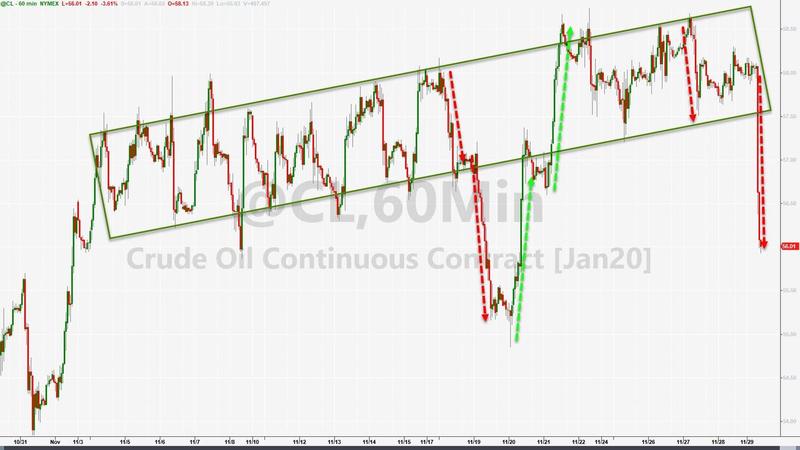
Oil extended losses on Friday with West Texas Intermediate (WTI) plummeting 5% ahead of OPEC+ meeting in Vienna. According to reports, the cartel and other major producers are expected to agree to prolong current output cuts. However, Russia’s Energy Minister Alexander Novak stressed that his country would prefer the decision on the potential extension of the cuts to be made closer to April as current cuts are set to expire in March 2020. Meanwhile, investors also digested Iraqi Prime Minister Adil Abdul Mahdi’s decision to step down, which some believe will lead to the end of protests in the Middle Eastern country. WTI for settlements in January plunged 5.09% to sell for $55.28 per barrel at 12:25 pm ET, while international benchmark Brent for January delivery dropped 2.18% to go for $62.48 per barrel at 12:31 pm ET.

Boris Johnson was personally warned about risks of freeing terrorists

Borris  said there was ‘no money’ to deradicalise them, ex-top prosecutor says

Damaging claim comes as solicitor for London Bridge attacker says he asked for help to turn away from terrorism – but was not given any

A former top prosecutor says he personally warned Boris Johnson about the risk posed by freeing terrorists who had not been deradicalised, but was told there was “no money”.

The hugely damaging claim came as the solicitor for the London Bridge attacker revealed he had asked for help to turn away from terrorism while in prison, but was not given any. As anger grew over the early release of Usman Khan, Jeremy Corbyn branded the attack he was able to carry out “a complete disaster”, saying: “There has got to be a very full investigation.” Visiting London Bridge, the prime minister attempted to deflect blame, saying: “I’ve argued that when people are sentenced to a certain number of years in prison they should serve every year of that sentence.” But the focus switched to efforts made to deradicalise prisoners when Nazir Afzal, the former chief prosecutor for North West England, intervened by revealing his private conversation with Mr Johnson. He said he had raised the problem of terrorists being released “whilst ostensibly rehabilitated but still radicalised” in many government meetings, before raising it with Mr Johnson in June 2016. “He asked me what keeps me awake at night and I told him it was this issue,” Mr Afzal said. “When he wanted to know what to do about it, I told him it was more resources for one-to-one deradicalisation.

“Back then, he hadn’t found the ‘money tree’ so he frustratingly said there was no money.” The atrocity committed by Khan – who killed two people, before being shot dead by police on Friday – has become a major general election controversy, with questions also asked about the apparent failure to monitor him.

Meanwhile, the Conservative campaign lead has been halved in just one week, putting the UK in “hung parliament territory”, an exclusive poll for The Independent showed. Further questions were raised when the Parole Board said it had no involvement when Khan left prison last December, saying he “appears to have been released automatically on licence”. Chris Phillips, a former head of the UK National Counter Terrorism Security Office, warned the criminal justice system was “playing Russian roulette” with the lives of the public.

Pointing out that the original trial judge “wanted this man in prison for a very very long time”, he described Khan’s release as “quite incredible”.

“What we have got to ask now is why is the criminal justice system allowing people like him to be back on the streets?” Nick Note: The civilized world has been sleeping since 911….. if the truth be known way before. The great world empires are crumbling because of the decadence, corruption and over leveraged financial system. Clinton, Bush I and Bush II, Mohammad Obama and now the biggest disaster of them all the colossal fuck up Trump refuses to see the threat never mind engage them. Allowing these fucks to acquire, territory,  rockets and nukes will bring  disaster and untold suffering  on America, England and Europe in that order…..

Corporate debt nears a record $10 trillion, and borrowing binge poses new risks

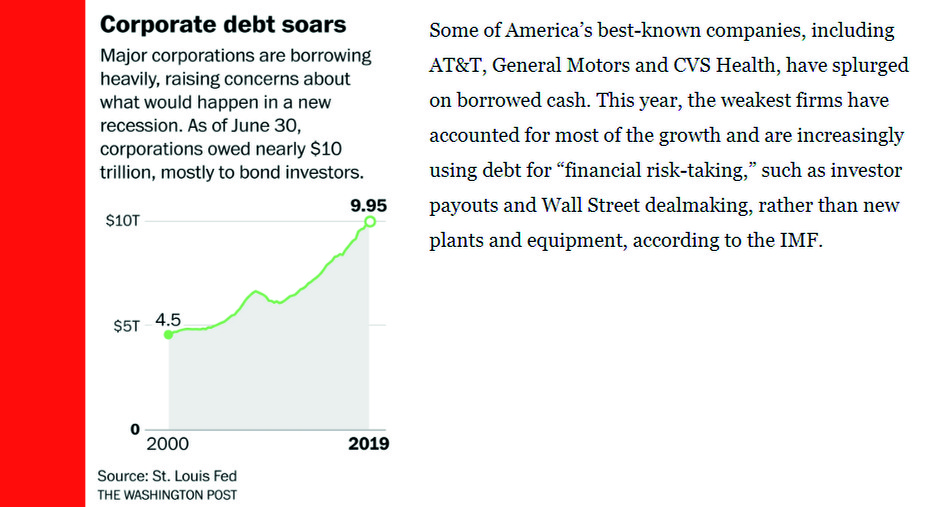
Little more than a decade after consumers binged on inexpensive mortgages that helped bring on a global financial crisis, a new debt surge – this time by major corporations – threatens to unleash fresh turmoil. A decade of historically low interest rates has allowed companies to sell record amounts of bonds to investors, sending total U.S. corporate debt to nearly $10 trillion, or a record 47% of the overall economy. In recent weeks, the Federal Reserve, the International Monetary Fund and major institutional investors such as BlackRock and American Funds all have sounded the alarm about the mounting corporate obligations. The danger isn’t immediate. But some regulators and investors say the borrowing has gone on too long and could send financial markets plunging when the next recession hits, dealing the real economy a blow at a time when it already would be wobbling. Some of America’s best-known companies, including AT&T, Ford Motor and CVS Health, have splurged on borrowed cash. This year, the weakest firms have accounted for most of the growth and are increasingly using debt for “financial risk-taking,” such as investor payouts and Wall Street dealmaking, rather than new plants and equipment, according to the IMF.

Amid the avalanche of debt, the sharp growth in lower-quality corporate bonds, just one notch above junk, represents a special concern. Investors hold nearly $4 trillion in these bonds, including $2.5 trillion from U.S. companies, according to the credit rating agency Standard & Poor’s.

Since Oct. 1, familiar names like Hasbro, Nordstrom, Marriott and Hyundai all have tapped investors for cash by selling near-junk bonds that S&P labels “BBB.” This low-quality corporate debt bulge, by itself, is unlikely to cause a recession, according to economists and investors. But it could make the next one much worse.

“We are sitting on the top of an unexploded bomb, and we really don’t know what will trigger the explosion,” said Emre Tiftik, a debt specialist at the Institute of International Finance, an industry association.

The United States is outperforming other advanced economies in Europe and Japan. But over the past four quarters, the economy grew at just a 2.1% annual rate, virtually unchanged from its 2.2% average since the recession ended in mid-2009. If downgrades occurred at the same rate as during the 2009 crisis, the volume of debt hitting the market could be well above the normal daily sales, the Bank of International Settlements in Basel, Switzerland, warned earlier this year. Last month, in its twice-yearly financial stability report, the Fed warned about the potential consequences of the market’s failure to police the rapid increase in risky corporate debt. During the 2009 crisis, “BBB-rated” companies – the lowest rung of investment-grade – faced borrowing costs almost 7 percentage points higher than higher-quality companies. Today, the difference or “spread” is just 1.4 percentage points. The risk of fire sales by institutional investors is real. Mutual funds have tripled their corporate bond holdings over the past decade. At $1.5 trillion, they now amount to about one-sixth of all corporate bonds on the market, according to the Fed. “It’s going to amplify everything,” said Krista Schwarz, a finance professor at the University of Pennsylvania’s Wharton School. “It’s going to make everything happen faster, larger, worse. The recession would just be that much deeper.”