Charles Schwab to buy TD Ameritrade for $26 billion

Charles Schwab Corp. is buying TD Ameritrade Holding Corp. for $26 billion, with a deal expected to be announced Thursday morning, Fox Business reports, citing unidentified people familiar with the situation. Shares in Charles Schwab reversed an earlier decline in premarket trading and are up 2.4%, while TD Ameritrade reduced some of the earlier gains and is up 17%. Neither company responded immediately to emails and phone calls seeking comment. A deal would create a firm with roughly $5 trillion in combined assets, consolidating an industry under pressure from a price war that escalated last month when Schwab announced plans to eliminate commissions for U.S. stocks, exchange traded funds and options.

The move forced other brokerages to follow suit and triggered a slump in the shares of such firms, with TD Ameritrade among the hardest hit.

TD Ameritrade has lost 11% since then, valuing the company at $22 billion. Schwab gained 7% in the same period, giving it a stock market value of $57 billion. Just weeks after Schwab stunned competitors by letting customers trade stocks for free, the talks to acquire TD Ameritrade shows the company is moving to tighten its grip on the industry, according to a person familiar with the matter. The deal would give Schwab, America’s original discount broker, even more sway over the industry it pioneered nearly a half-century ago — and an edge in the intensifying battle for ordinary investors’ dollars, and the investment adviser business. But analysts say the tie-up, and the $5 trillion titan that would result, could attract antitrust scrutiny. “An acquisition of TD Ameritrade would expand Schwab’s roster of active traders and solidify its leading position serving independent advisers,” said David Ritter, a financials analyst with Bloomberg Intelligence. Shares of ETrade Financial Corp., which analysts had speculated TD Ameritrade might want to buy, fell 9%. A deal between its two rivals could leave smaller brokerage ETrade contending with a more formidable competitor than ever. Schwab’s move to zero commissions forced other brokerages to follow suit and triggered a slump in the shares of firms, with TD Ameritrade among the hardest hit. Eliminating commissions swept away a revenue stream and rekindled speculation that online brokerages might have to cut deals to survive the increased industry pressure.TD Ameritrade has relied more on commissions than some competitors, drawing 36% of its net revenue from commissions in 2018, compared to 7% at Schwab and 17% at ETrade. For founder Charles Schwab, ending commissions has been a longtime goal. “I hated commissions,” he said at the Impact 2019 conference in San Diego. “I hated them then. I hate ’em now. I took ’em away.” A deal between the two companies could face antitrust scrutiny, Keefe, Bruyette & Woods analyst Kyle Voigt wrote in a client note Thursday. Schwab and TD Ameritrade are both top custody service providers to independent financial advisers, which could give authorities pause. Mr. Voigt estimates Schwab has about a 50% market share of registered investment adviser custody assets, while TD Ameritrade may have up to 20%. An acquisition would come at a time of transition for TD Ameritrade. The Omaha-based brokerage said in a surprise announcement in July that CEO Tim Hockey would leave no later than the end of February 2020, which rekindled questions of whether the company would pursue a deal. Mr. Hockey denied that his departure had anything to do with a potential deal at the time. Toronto-Dominion Bank, Canada’s second-largest lender by assets, owns a 43% stake in TD Ameritrade.
Bridgewater Associates bets over $1 billion on market drop

(Reuters) – Bridgewater Associates LP, a hedge fund founded by billionaire Ray Dalio, has bet more than $1 billion that stock markets around the world will fall by March, the Wall Street Journal reported on Friday, citing people familiar with the matter. The bet, assembled over a span of months and executed by a handful of Wall Street firms, including Goldman Sachs Group Inc (and Morgan Stanley , would pay off for the world’s biggest hedge fund if either the S&P 500 .SPX or the Euro Stoxx 50 .STOXX50E — or both — declines, the report said. The bet is made up of put options, contracts that give investors the right to sell stocks at a specific price by a certain date. The options expire in March and currently represent one of the largest bearish bets against the market, the report added. Bridgewater Associates was not immediately available for comment.

President Putin says five men died trying to create a weapon that ‘has no equal in the world’

  • President awarded widows during a decoration ceremony today at the Kremlin  
  • It has been reported the explosion happened while testing a Burevestnik missile 
  • Known as Skyfall by NATO, the missile is said to have a virtually unlimited range 
  • He expressed condolences but said Russia will continue to develop the weapon 

Russian President Vladimir Putin has told widows of the five scientists who died in a nuclear explosion earlier this year that their husbands were working on ‘the most advanced and unmatched technical’ weaponry.  Putin’s comments came during a ceremony of state decorations at the Kremlin today where he awarded the deceased employees of Russia’s state nuclear company with the Order of Courage, posthumously.  ‘They led a very difficult, responsible and critical direction, we are talking about the most advanced and unmatched technical ideas and solutions,’ he said.  On August 8, five employees of the Russia’s nuclear company, Rosatom, were blown up while testing a nuclear rocket propulsion system.  On August 8, five employees of the Russia’s nuclear company, Rosatom, were blown up while testing a nuclear rocket propulsion system at the Nyonoska testing site in the White Sea. The blast caused a brief radiation spike in the nearby city of Severodvinsk.  Putin said that they made ‘an indispensable contribution to the strengthening of the Russian state.’ He expressed his condolences to the widowed but maintained that Russia would go on developing this type of advanced weaponry.  ‘The fact of possessing such unique technologies is today the most important reliable guarantee of peace on the planet. And no matter what, we will certainly improve this weapon,’ he said.    The August explosion raised concerns that a prototype of a weapon, called Burevestnik by Russia and known as Skyfall by NATO, is being developed by the Kremlin.  Experts said they suspected an explosion and radiation release came from an accident during the testing of a nuclear-powered cruise missile at a facility outside the village of Nyonoksa It has not been confirmed a Burevestnik cruise missile was being tested during the explosion but US experts claim the deadly blast was from a ‘Skyfall’ rocket It has not been confirmed whether a Burevestnik cruise ‘Doomsday’ missile was being tested when the explosion occurred. But US nuclear experts at the James Martin Center for Nonproliferation Studies in California insist the blast did come from a Skyfall test. Anne Pellegrino, a research associate at the James Martin Center, told German broadcaster Deutsche Welle:  ‘Our operating theory is that there was a catastrophic failure of some kind during the testing of Russia’s nuclear powered cruise missile. They call it Burevestnik but NATO refers to it as Skyfall.’ The mysterious incident led to a ‘radiation spike’ in the nearby city Severodvinsk, according to reports in the aftermath of the explosion.  Three injured testers are reported to be recovering. They were named for the first time as engineers Dmitry Abanin and Aleksander Manyukhin along with another specialist Sergey Grishin. The five killed in the explosion were Vyasheslav Yanovsky, 71, one of Russia’s most senior nuclear scientists, Vyacheslav Lipshev, 40, director of a secret research institute, Evgeny Korotaev, 50, a leading electronics engineer, Alexey Vyushin, 43, who had developed a high-energy photon spectrometer, and Sergey Pichugin, 45, a testing engineer.

Pound struggles to break through $1.30 after Labour election manifesto

– The pound struggled to break through the $1.30-mark yet again on Thursday, as a rebound in the dollar and an election manifesto from the opposition Labour Party that fuelled some profit-taking on the British currency.

In its fourth attempt to break through $1.30 in nearly two months, the pound struggled to gain momentum as investors moved to the sidelines before the Dec. 12 election.

Labour leader Jeremy Corbyn unveiled his party’s election manifesto on Thursday, setting out radical plans to transform Britain with public sector pay rises, higher taxes on companies and a sweeping nationalisation of infrastructure.  “Sterling yet again found profit takers up at 1.2970, but gave up more ground than most would have expected as the USD rallied against all majors,” said John Marley, a senior currency consultant at FX risk management specialist, SmartCurrencyBusiness. “Support likely in the low 1.29’s, and very hard to see a break of this tight range ahead of the election.” Voters face a stark choice at the country’s Dec. 12 election: opposition leader Corbyn’s socialist vision, including widespread nationalisation and free public services, or Prime Minister Boris Johnson’s drive to deliver Brexit within months and build a “dynamic market economy”.Sterling has gained more than 8% from a Sept. 3 low as markets cut the risks of a no-deal Brexit. But gains have stalled in the past month as election uncertainty has risen, including the prospect of victory for the Labour Party that has pledged tax hikes for the wealthy and a swathe of nationalisations. Jasper Lawler, head of research at London Capital Group, said sterling and shares in UK-focused companies were pricing risks attached to Brexit and a Labour government. “The more extreme the Labour manifesto, the more volatility we’d expect to see in the pound and UK shares when the polls tighten closer to election day,” he said, speaking before the manifesto launch, though he did not expect an immediate reaction. “We still favour a break above 1.30 in sterling but stand ready to reverse that call if Labour’s manifesto can capture the public’s imagination.” The currency had slipped to a five-day low of $1.2888 after Tuesday’s televised debate in which Corbyn was seen to have performed better than expected. While bearish positions on sterling have been cut in recent weeks, they remain high, and on derivatives markets too there are signs of nervousness. One-month implied volatility, a contract capturing the election date, has risen 5 percentage points in the past two weeks to 11.7%.

GLOBAL LNG-Asian prices continue downward trend as supply floods

– Asian spot prices for liquefied natural gas (LNG) fell this week as a supply glut continued to weigh, while demand growth was muted by signs of a mild winter in Northeast Asia. Prices for January delivery to Northeast Asia LNG-AS are estimated to be about $5.70 per million British thermal units (mmBtu), down 20 cents from last week for the same period, said several sources who are market participants.With European gas storage nearly full, cargoes may struggle to find a home, traders said. Singapore’s Pavilion Energy has taken the unusual step of cancelling the loading of a cargo from the United States, but has agreed to pay for it, several industry sources said. A company spokeswoman said Pavilion evaluated scheduling and other commercial matters and took the decision not to lift the cargo in coordination with the supplier. Supply was ample with several LNG plants offering cargoes this week.Angola’s LNG project offered a cargo for delivery in January to as far as Indonesia, while Australia’s Ichthys and Papua New Guinea LNG plants offered a cargo each for December, sources said. Indonesia’s Tangguh LNG plant, which is operated by oil major BP BP.L, also offered five cargoes for delivery over the first quarter of next year, sources added. Some buy tenders from Thailand were finalised with PTT’s Singapore trading unit awarding a tender to buy more than 10 LNG cargoes for delivery over a year from March, 2020, a company official said.  Low spot prices also attracted some demand from India, with Indian Oil Corp seeking a cargo for delivery on Dec. 17, industry sources said. “The low prices may be creating some end-user demand in India which is attracting purchase interest in the international market,” a source familiar with the Indian market said.

Saudi Aramco order book reaches 73 billion riyals so far

RIYADH/DUBAI (Reuters) – Saudi Aramco’s initial public offering (IPO) has attracted approximately 73 billion riyals ($19.47 billion) in institutional and retail orders so far, Saudi Arabia’s Samba Financial Group said on Thursday. Some 1.8 million retail subscribers have injected more than 14 billion riyals into the IPO so far, Samba, one of the banks managing the deal, said in a statement sent to Reuters. Institutional subscriptions amounted to 58.4 billion riyals and 1.82 billion subscribed shares, it added. “Retail and Institutional subscription levels for the first five days of the offering have reached an unprecedented scale, demonstrating the confidence of investors in Saudi Aramco,” said Rania Nashar, vice chairman of Samba Capital, the investment arm of the bank, in the statement.“We anticipate further increases in subscription levels during the remainder of the offering period.” A banking source told Reuters earlier that the institutional tranche of the IPO was oversubscribed. However, the preliminary estimates do not show that it is oversubscribed. “Receiving banks send their statistics (by) the end of the day, some are late for technical or bureaucratic reasons, that is what makes the different figures,” the source said.“The order book shows very good signs the IPO will be oversubscribed.”Aramco, which did not immediately respond to a request for comment, plans to sell 1.5% of the company, or about 3 billion shares, at an indicative price range of 30 riyals to 32  riyals, valuing the IPO at as much as 96 billion riyals and giving the company a potential market value of between $1.6 trillion and $1.7 trillion. Representatives of the state-owned oil giant plan meetings with investors in Dubai next week, sources have said, for what is expected to be the world’s biggest share sale. Aramco has said at least one-third of the sale is expected to be covered by retail investors, who have until Nov. 28 to sign up for the IPO. Institutional investors can subscribe until Dec. 4. Aramco kicked off the sale process on Nov. 3 after a series of false starts. The deal is crucial for Crown Prince Mohammed bin Salman’s plans to raise billions of dollars to invest in non-oil industries, create employment and diversify the world’s top crude exporter away from oil.

Beijing monitoring Trump’s response to US HK bill

China is monitoring closely the situation in the United States regarding the Hong Kong Human Rights and Democracy Act, which was approved by the Senate and House of Representatives, and the potential signing of the bill into law by the American president Donald Trump. The bill presents another cause for pessimism in trade negotiations between Washington and Beijing, South China Morning Post reported on Thursday, citing unnamed sources.

One of the sources was quoted as saying that China would “have to respond” if the controversial bill gets the approval of the US president, while others suggested that Beijing would “fight and talk alternatively.”

Earlier today, the adoption of the Hong Kong bill by the US Congress was criticized by the Chinese Foreign Ministry.

Oil rises to two-month high on hopes of longer OPEC cuts, U.S.-China trade deal

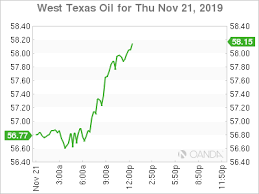
NEW YORK (Reuters) – Oil prices rose more than 2% on Thursday to the highest in nearly two months following a Reuters report that OPEC and its allies are likely to extend output cuts until mid-2020 and fresh signs that China had invited U.S. trade negotiators for a new round of talks. To support oil prices, the Organization of the Petroleum Exporting Countries and its allies are likely to extend output cuts to June when they meet next month, according to OPEC sources. OPEC meets on Dec. 5 at its headquarters in Vienna, followed by talks with a group of other oil producers, lead by Russia, known as OPEC+. The current supply cuts deal runs through to March 2020.

The sources told Reuters that formally announcing deeper cuts looked unlikely for now although a message about better compliance with existing curbs could be sent to the market.

Russian President Vladimir Putin said on Wednesday Russia and OPEC had “a common goal” of keeping the oil market balanced and predictable, and Moscow would continue cooperation under a global deal cutting oil supply. “I think the market is pretty much resigned to the fact that economic growth is slowing as is the rate of increases in oil demand where forecasts having been revised lower continually… a lot of that bearishness has been priced in, so that the upcoming OPEC meeting and unrest in Iran and Iraq is becoming the focus,” said Andrew Lipow, president of Lipow Oil Associates in Houston. Amid the long-drawn trade war between the United States and China, U.S. President Donald Trump is expected to sign two bills passed by Congress intended to support protesters in Hong Kong, a move likely to anger China. Hong Kong has seen increasingly violent protests against Chinese rule for several months and the passage of the bills could potentially undermine efforts to secure a trade deal. “Positive speak from China is not offsetting expectations that President Trump will sign a bill supporting Hong Kong protesters,” said Edward Moya, senior market analyst at OANDA in New York. “The timing of phase one deal is unclear, but markets are starting to get nervous we could see a repeat of the collapse in talks that took place in May.”

EIA increases U.S. crude oil production forecast

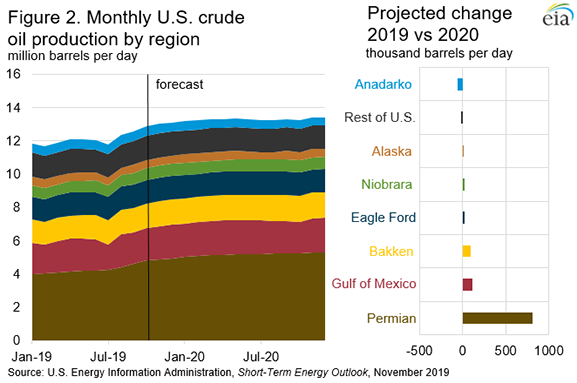
Figure 2. Monthly U.S. crude oil production by region

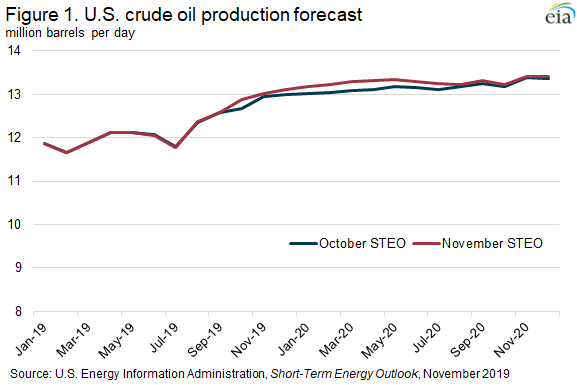
WASHINGTON – The U.S. Energy Information Administration revises the U.S. crude oil production forecast it publishes in each Short-Term Energy Outlook based mainly on two factors: updates to EIA’s published historical data and EIA’s crude oil price forecast. In the November 2019 STEO, EIA increased its forecast of U.S. crude oil production in 2019 by 30,000 bpd (0.2%) from the October STEO. EIA increased its 2020 crude oil production forecast by 119,000 bpd (0.9%) compared with the October STEO.

  • EIA’s upward revision to historical production in the Lower 48 states of about 90,000 bpd for August, based on EIA’s most recent–October 31, 2019–914 monthly crude oil and natural gas production survey
  • Higher initial production for future wells that will be drilled in the Texas Permian region
  • Slightly higher crude oil price forecast for the November 2019–January 2020 time period than in the October STEO
Figure 1. U.S. crude oil production forecast
Figure 1. U.S. crude oil production forecast In the November STEO

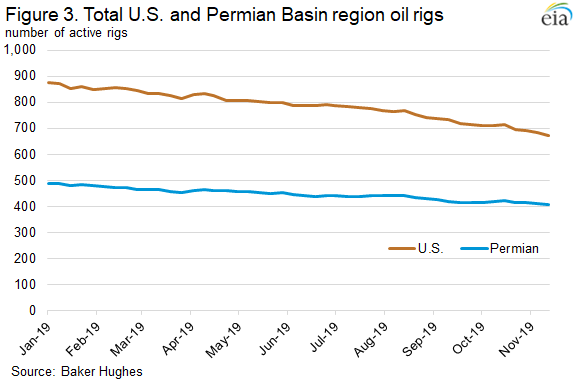
EIA increased its U.S. benchmark West Texas Intermediate (WTI) crude oil price forecast by $2/bbl in November to $56/b and by $1/bbl in both December and January to $55/bbl and $54/bbl, respectively. The slight increase in crude oil prices also contributed to EIA’s increased production forecast for the first half of 2020 because of EIA’s assumption of a six-month lag between a crude oil price change and a production response. In the November STEO, EIA now forecasts U.S. crude oil production will increase to 12.3 MMBPD in 2019 from 11.0 MMbpd in 2018. Production in the Permian region is the primary driver of EIA’s forecast crude oil production growth, and EIA forecasts Permian production will grow by 915,000 bpd in 2019 and by 809,000 bpd in 2020 (Figure 2). Increases in Permian production are supported by the crude oil pipeline infrastructure expansion seen earlier this year, which helped alleviate the transportation bottleneck and supported prices for WTI in Midland, Texas (the price producers may expect to receive in the Permian region), relative to prices for WTI-Cushing. The higher relative prices in the Permian should continue to encourage production in the region. EIA forecasts that the Bakken region will have the next largest crude oil production growth in 2019, and it is forecast to grow by 152,000 bpd in 2019 and 96,000 bpd in 2020. EIA forecasts that production in the Federal Offshore Gulf of Mexico will increase by 138,000 bpd in 2019 and 116,000 bpd in 2020.Although EIA forecasts that overall U.S. crude oil production will increase, EIA expects the growth rate to decline from 11.8% in 2019 to 8.1% in 2020. One of the primary indicators of a slowdown in production growth is the decline in oil-directed rigs. According to Baker Hughes, active rig counts fell from 877 oil-directed rigs in the beginning of January 2019 to 674 rigs in mid-November. Rig counts in the Permian region also declined during this period, falling from 487 to 408 (Figure 3). Because EIA expects WTI-Cushing crude oil prices to stay below $55/b until August 2020, EIA anticipates that drilling rigs will continue to decline as producers cut back on their capital spending, resulting in notable slowing in the growth of domestic crude oil production over the next 14 months.

Figure 3. Total U.S. and Permian Basin region oil rigs
 Total U.S. and Permian Basin region oil rigs

Although U.S. rig counts are declining, improvements in rig efficiency, which allows fewer rigs to drill the same number of wells, partially offset declining rig counts. In addition, higher initial production from wells (although not necessarily the total estimated ultimate recovery) is offsetting some of the slowdown in rigs.

U.S. Rig Count Crashes Again: Loses Nearly 100 Rigs In 3 Months

Rig roughneck

The US oil and gas rig count continued its downward slide this week, according to Baker Hughes, as the rig count piles on a string of losses with a drop of 11 rigs for the week. For oil rigs specifically, this week marks eleven decreases out of the last thirteen weeks, falling 96 rigs in that timeframe. The total oil and gas rig count now stands at 806, or 276 down from this time last year. The total number of active oil rigs in the United States decreased by 10 according to the report, reaching 674. The number of active gas rigs fell by 1 to reach 129. Oil rigs have seen a loss of 214 rigs year on year, with gas rigs down 65 since this time last year. By state, Texas has seen a drop of 127 year on year, while Oklahoma sunk by 94 to hit 52 rigs. Even though the number of oil rigs have declined by 203 this year alone, production has grown from 11.7 million bpd at the beginning of the year to an all-time high of 12.8 million bpd for week ending November 8, marking the first production increase after five weeks of holding fast at 12.6 million bpd. The production growth represents an increase of more than 1 million bpd from the beginning of the year. Canada’s overall rig count decreased this week, with oil and gas rigs falling by 6, after last week’s 2-rig decrease. Oil and gas rigs in Canada now stand at 134, down 63 year on year.