Dow is having its longest winning streak in more than 35 years
The Dow Jones Industrial Average managed to pull off a 13th day in the green on Wednesday — it’s longest winning streak since Jan. 20, 1987. There’s no question that the Dow’s latest milestone is one for the history books. One more day in the green and the blue-chip gauge will be able to claim its longest winning streak in more than 125 years. It’s a notable reversal of fortune for a U.S. equity index that has lagged its peers all year. But what does the Dow’s performance so far tell us about how stocks’ might perform over the next year? Generally speaking, the index was higher one year later after rising for 12 days or more, according to Dow Jones Market Data. Meanwhile, the index was higher three months after each 12-day streak of gains. Unfortunately the sample size here is pretty limited: there have only been five such streaks, including the current one, since the late 19th Century.
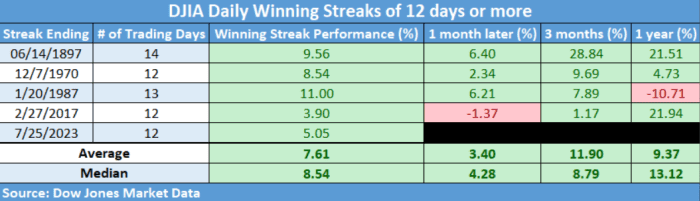
And although the blue-chip gauge has been on average 9.4% higher one year later after such a protracted winning streak, there has been at least one notable exception:
The Black Monday market crash, which saw the Dow drop more than 22% in a single day, occurred nine months after a 13-day Dow winning streak ended in January 1987. One year later, the index was down 10.7%.
What’s more, the Dow narrowly missed another 12-day streak during the month of July 1929, when it climb What’s more, the Dow narrowly missed another 12-day streak during the month of July 1929, when it climbed for 11 days through July 8, 1929 (this was back when the New York Stock Exchange still offered U.S. stock trading on Saturdays), according to DJMD. Three months afterward, the stock market collapsed, ushering in the start of the Great Depression. That the Dow recorded outsize winning streaks in 1929 and 1987 means there’s “something for everyone if you want to play the analogy game,” said Jonathan Krinsky, chief technical strategist at BTIG, in a Wednesday research note. It’s also notable that none of the 12- or 13-day streaks, when they ended, marked the end of the rally. Of course, 1929 and 1987 did see historic crashes later in the year, Krinsky added. Looking at the Dow performance compared with the start of recession leaves investors with a similar takeaway. While the blue-chip gauge’s gains have usually occurred during periods of economic strength, they haven’t always. “The Fed is still determined to get inflation back down to 2%, and that could mean that rates stay around these levels until something breaks,” Cox said in emailed commentary. NN: You are dam straight something is going to break,,,,, The StockMarket