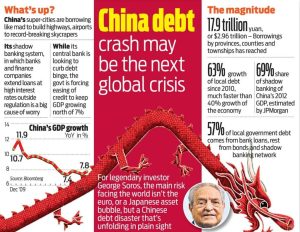
Fitch Ratings revised China’s outlook to negative from stable, saying the government is likely to pile on debt as it seeks to pull the economy out of a real estate-driven slowdown. Growing uncertainty about the outlook for the world’s second-biggest economy, amid Beijing’s drive to make growth less dependent on housing, “could keep debt on a steady upward trend,” Fitch said on Wednesday. China’s government, which has been talking up the prospect of a turnaround in the economy, rapidly pushed back — saying the rating company failed to reflect the role of fiscal policy in shoring up growth, which helps to stabilize debt burdens. Financial markets were unfazed, with China’s 10-year sovereign bond yield little changed at around 2.29%, and the yuan also steady. Fitch’s action matched a similar one by Moody’s Investors Service in December.
IMF measure of general government gross debt as share of GDP
“I don’t think this will have much market impact,” said Michelle Lam, an economist at Societe Generale SA, who said the risk for investors from rising Chinese debt is that it will slow growth, not raise sovereign default risks. “China’s debt problem and property crisis are well known and understood by market participants.” The Fitch announcement comes at a crucial time for China’s economy. In the coming week, the government is due to release some key indicators — including first-quarter growth — while the central bank will decide on a key loan rate. Financial markets are closely watching for clues about whether the economy has put the worst behind it, after some encouraging numbers for manufacturing and exports earlier this year. Those data releases are what markets are focusing on, but the Fitch decision “may still hurt near-term market sentiment on China while the confidence level is already low,” said Xiaojia Zhi, an economist at Credit Agricole. China’s public debt has risen rapidly over the past dozen years or so, as the government pumped funds into the economy in a bid to maintain the world-leading growth rates it posted over previous decades. Amid the property slump that’s now threatening to slow output, the government has outlined some new stimulus measures — like subsidies for households and businesses that want to upgrade appliances or machinery — and signaled that more may follow. Public debt was close to 80% of gross domestic product as of the middle of last year, roughly double the level of the mid-2010s, according to the Bank for International Settlements. That’s well below many advanced economies like Japan and the US, though relatively high for an emerging market. Beijing’s own measure for government debt shows it at 56% of GDP at the end of 2023, up sharply since the pandemic.
NN: AUDIO FILE
CHINA IS THE B IN THE DEMAND SIDE OF OUR BINRY OIL TRADE