Worldwide, stocks have been weak.[i] In US dollars, global stocks are in a bear market—a typically long decline exceeding -20% from a high.[ii] Historical research shows bull markets are born on pessimism. Recent surveys suggest bearishness is at an extreme.
Bank of America’s (BofA) global fund manager survey, showed broad bearishness in September.[iii] The latest reading indicated a record share of respondents have cut equity holdings.[iv] This survey started in 2002, and includes the 2007 – 2009’s bear market and early-2020’s brief downturn for comparison. 62% of managers have raised cash holdings—a reading that has never been above 60% in two decades.[v] Also notable: 72% expect the global economy to weaken in the next year, with 68% seeing recession—broadly weak economic conditions—likely.[vi] Both rates are near all-time highs, exceeded by only March 2009 and April 2020.[vii] The earnings outlook is even glummer with 92% expecting declining profits.[viii] BofA’s survey reflects professional investors’ attitudes—what large money managers are thinking and doing.
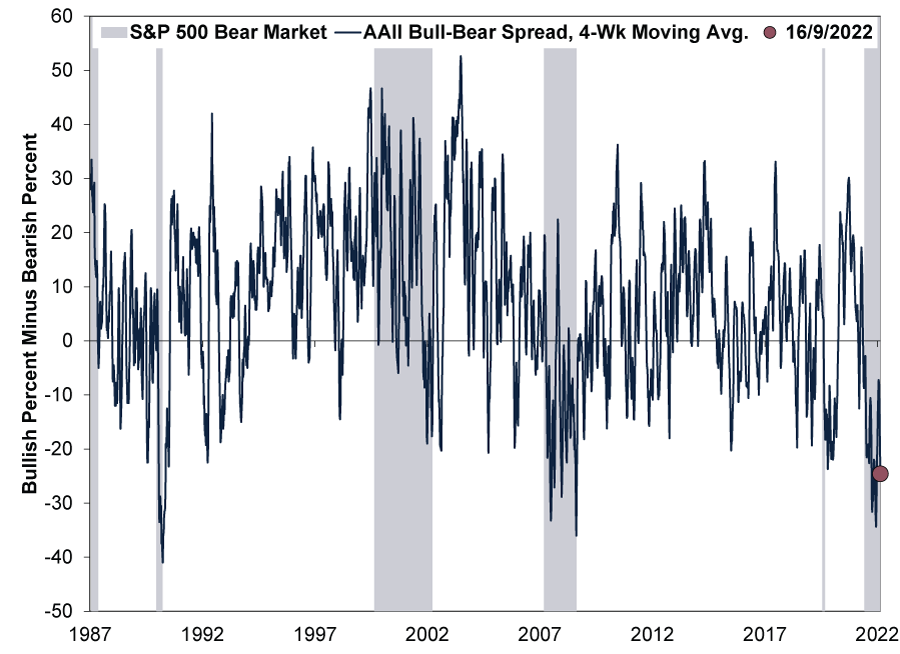
The American Association of Individual Investors’ (AAII) polling shows individual investor sentiment is similar .[ix] AAII surveys its members weekly about their outlook: positive (bullish), negative (bearish) or neutral. Combining them, AAII subtracts the bearish from the bullish, resulting in its net bull-bear percentage. This can be very noisy week to week, so we look the rolling four-week average. It remains below nearly all points in its 35-year history.[x]
American Individual Investors
AAII Bull-Bear Market Spread, 31/7/1987 – 16/9/2022. Bear market dating based on the S&P 500 price index in US dollars. Currency fluctuations between the dollar and pound will result in lower investment returns.
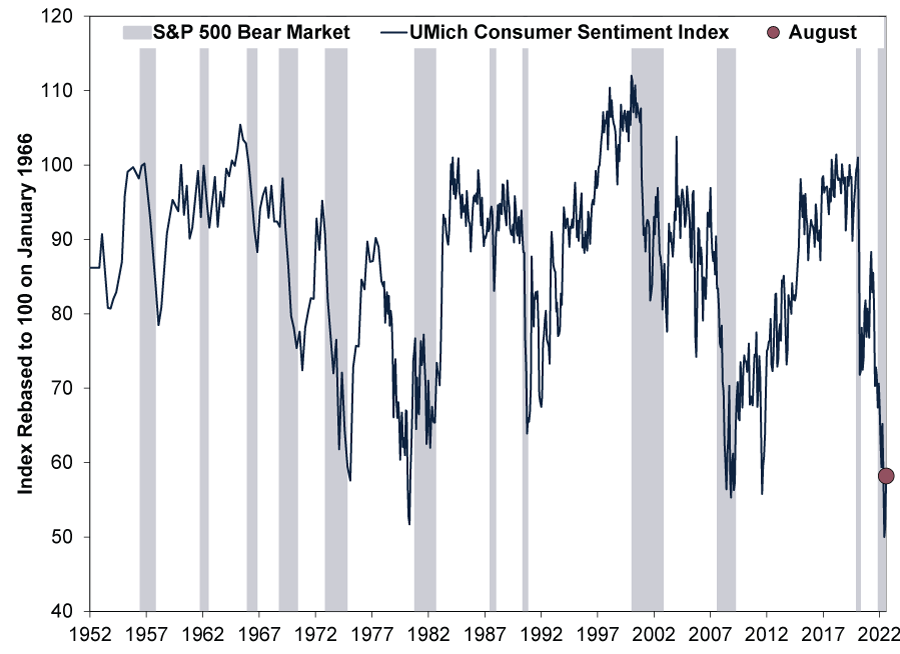
University of Michigan’s (UMich) Consumer Sentiment Index Has hit an all-time low in June.[xi] The American consumer sentiment under 60 is extremely low historically. From stocks to the economy, long-running survey suggest folks feel about the worst they have ever been, according to these data.
US Consumer Sentiment About as Pessimistic as It Gets
Source: FactSet, as of 19/9/2022. UMich Consumer Sentiment Index, January 1952 – August 2022. Bear market dating based on the S&P 500 price index in US dollars.
Germany’s ZEW Economic Expectations Index[xii] Over the past 30 years, the outlook for the German economy has never been this bad.
The UK consumer confidence index. YouGov’s UK consumer confidence index fell into negative territory for the first time since the COVID lockdowns in June 2020.[xiii]
When everyone expects the worst, its priced into the market. Their are no sellers left. In my time trading i have seen these indexies turn bearish 6 times and every time we had a big rally. Maybe this time will be the same. NO PROMISES!
[i] Source: FactSet, as of 20/9/2022. Statement based on MSCI World Index returns with net dividends, 31/12/2021 – 19/9/2022.
[ii] Ibid. Statement based on MSCI World Index returns with net dividends, 4/1/2022 – 19/9/2022. Presented in US dollars. Currency fluctuations between the dollar and pound may result in higher or lower investment returns.
[iii] “BofA Survey Shows Investors Fleeing Equities En Masse on Fear of Recession,” Sagarika Jaisinghani, Bloomberg, 13/9/2022. Accessed via Yahoo!
[iv] Ibid.
[v] Ibid.
[vi] “Portfolio Managers Are ‘Super Bearish’ With Cash Holdings Highest Since 9/11, Bank of America Says,” Barbara Kollmeyer, MarketWatch, 13/9/2022. Accessed via MSN.
[vii] Ibid.
[viii] Ibid.
[ix] “AAII Sentiment Survey: Pessimism Pulls Back While Optimism Rebounds,” Staff, AAII, 15/9/2022.
[x] Source: FactSet, as of 19/9/2022. Statement based on S&P 500 total returns in US dollars. Currency fluctuations between the dollar and pound may result in higher or lower investment returns.
[xi] Source: American Automobile Association, as of 19/9/2022.
[xii] ZEW stands for Zentrum für Europäische Wirtschaftsforschung, which if you are wondering means Centre for European Economic Research.
[xiii] “Overall Consumer Confidence Is Negative for the First Time Since May 2020,” Christien Pheby, YouGov, 16/9/2022.