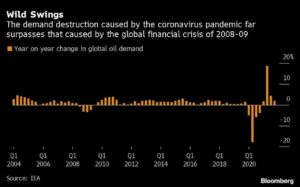
(Bloomberg) — Oil consumption is set to recover from the impact of coronavirus more slowly than previously thought, even though the worst of the demand destruction doesn’t look quite as awful as had been feared a month ago. Global demand will still be below pre-pandemic levels by the end of 2021, never mind this year, according to the two major forecasting agencies whose outlooks extend that far. The International Energy Agency, the Organization of Petroleum Exporting Countries and the U.S. Energy Information Administration have all updated their oil market forecasts in the past 10 days and the IEA has extended its view out to the end of 2021. It makes grim reading for producers that might have been hoping for a swift recovery in demand back the levels seen before the Covid-19 pandemic triggered the biggest-ever slump in oil consumption.
All three agree that worldwide consumption will fall by somewhere between 16.6% and 18% year-on-year in the second quarter of 2020 — although those numbers will be subject to revision for many months to come, as more data emerge. That is the biggest year-on-year drop in oil demand on record by a wide margin and compares with a decline of just 3.4% during the worst quarter of the 2008-09 financial crisis.
The outbreak in Beijing, together with one at a German meatpacking plant and resurgent infection rates in some U.S. states, all act as warnings that the return to normalcy, and with it the recovery in oil demand, will not be smooth. Those concerns are evident in the latest forecasts, particularly from the IEA. Although the Paris-based group has reduced the depth of the worst of the demand destruction, it has also trimmed the pace of recovery in the second half of the year. It now sees oil demand lagging last year’s level by almost 6 million barrels a day in the third quarter, compared with a gap of less than 5.5 million barrels in its previous forecast, and by nearly 4 million barrels a day in the final quarter of the year. The demand outlooks highlight the necessity of the output cuts introduced by the OPEC+ group of countries. Compliance with those reductions in May was assessed at 87% and it’s set to improve in the coming months after the group’s laggards were persuaded to compensate for their poor performance by making deeper cuts in the third quarter.
Global oil stockpiles are set to increase by about 1.54 billion barrels in the first half of 2020, according to the IEA.
If the OPEC+ output deal is honored in full by its participants and production outside the group doesn’t rebound alongside demand, then about 60% of the inventory built up over the first half of the year should be drawn down again in the second half, both the IEA and the EIA forecasts show. That would still leave somewhere between 530 million and 600 million barrels of excess inventories at the start of 2021. The latest forecasts show that producers won’t be able to relax their vigilance anytime soon and the OPEC+ countries will have to hope that their efforts to support oil prices aren’t so effective that they encourage producers outside the group to reopen the taps that they were forced to close when prices slumped. Nick Note: Its a conundrum. In order for the price rises to bite and not be reversed. In order to get s sustained price increase in oil you have got to have demand to return back to normal like in the good ole days last year. That is never going to happen again. It truly is a new normal with waves of the modern plague stifling demand till a real vaccine (if one ever comes) is developed. I want to be clear here. Crowd officeing is a thing of the past. The daily commute will be permanently cut in half. Which means transportation fuel demand will be halved. And as far as those contagious disease incubation tubes the modern Jetliner. Demand will NEVER recover!. Why fly when you can Skype or Zoom.