Oil crept higher as Saudi Arabia surprised customers in Asia by hiking prices for its main crude grade, signaling a vote of confidence that the market can absorb extra OPEC barrels. West Texas Intermediate crude traded above $67 a barrel, erasing earlier losses. Saudi state producer Aramco will raise the price for Arab Light crude, its flagship grade, by $1 a barrel to $2.20 a barrel more than the regional benchmark for Asian customers in August, according to a sheet from the company seen by Bloomberg. The pricing move staved off a rout in oil after a simultaneous decision by eight OPEC+ nations to increase supply more rapidly than expected with an addition of 548,000 barrels a day in August and more expected in September.
“The decision to raise prices during the peak summer demand season signals that physical markets remain tight, suggesting the additional barrels can be absorbed — for now,” said Ole Hansen, head of commodity strategy at Saxo Bank A/S. “In the short term, downside risks to crude appear contained.”
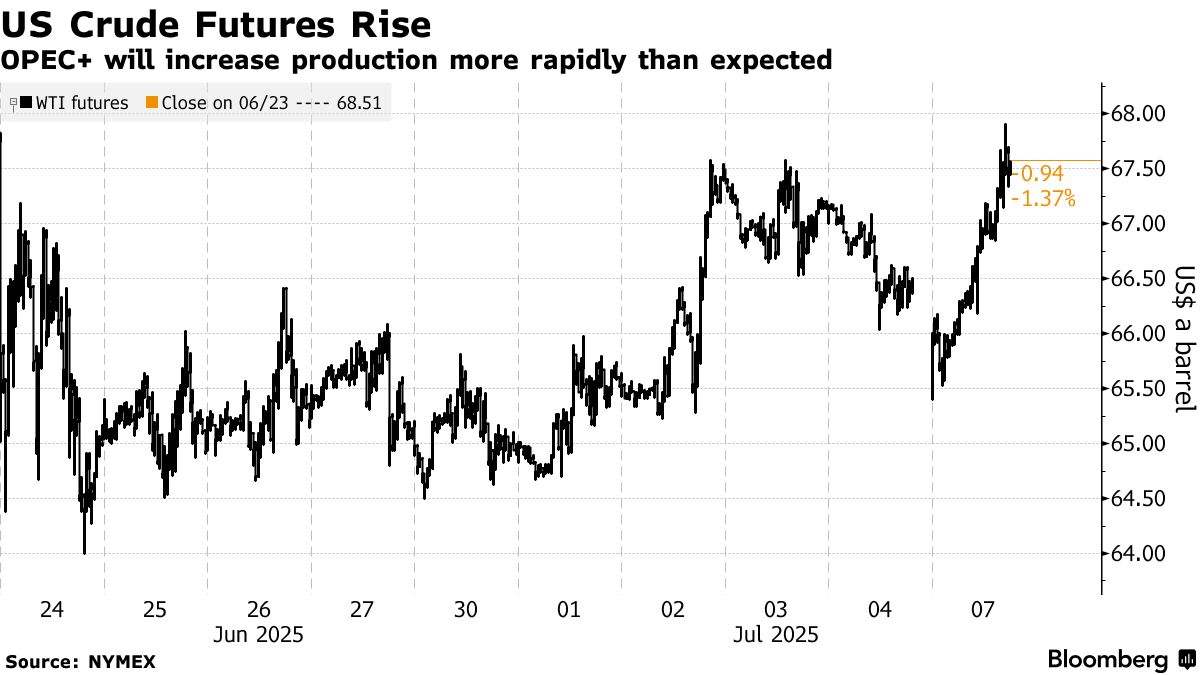
Meanwhile, President Donald Trump pushed back a July 9 deadline for country-by-country tariffs to go into effect to Aug. 1, allowing trade partners three more weeks to negotiate away economy-crushing levies on exports to the US. The delay has improved the near-term demand outlook for oil-consuming nations, including the European Union, facing especially punishing tax rates, but uncertainty surrounding the final outcome of talks continues to weigh on crude prices. Traders and analysts also noted that OPEC’s decision to hike production at an even faster-than-anticipated rate highlights bullish market fundamentals, including resilient demand in the US and China, as well as pockets of extreme tightness in the physical market amid summer driving season. The larger increase also amplifies a dramatic strategy pivot, from years of output restraint to reopening the taps to reclaim market share. The Organization of the Petroleum Exporting Countries and its allies had announced hikes of 411,000 barrels a day for May, June and July — already three times faster than initially planed — and traders had expected the same for August. The cartel will consider adding another 548,000 barrels a day in September at its next meeting on Aug. 3, according to delegates. The boost was based on “a steady global economic outlook and current healthy market fundamentals,” the group said in a statement on Saturday. OPEC+ will increase oil production even more rapidly than expected next month as eight key alliance members agreed to raise supply by 548,000 barrels a day at a video conference on Saturday. The countries had announced increases of 411,000 barrels for each of May, June and July. Bloomberg’s Anthony di Paola reports. Oil has been trading in a relatively narrow band since the pause in the Israel-Iran conflict, which saw Brent top $80 a barrel. OPEC+ is “clearly taking advantage of a period of tightness in global energy markets,” said Robert Rennie, the head of commodity and carbon research at Westpac Banking Corp. However, there are “downside risks” to oil prices as seasonal demand wanes after summer, he added. In the Middle East, Yemen’s Houthis have claimed responsibility for an attack on a ship sailing through the Red Sea, in their first strike on merchant shipping since December.