An Israel Defense Forces (IDF) officer was arrested amid the investigation into the leaking of intelligence documents from Prime Minister Benjamin Netanyahu’s Office, which may have affected a hostage deal, Israeli media reported on Monday. On Sunday, the Rishon Le-Zion Magistrates’ Court revealed that it had arrested Eliezer Feldstein, Netanyahu’s media adviser, as a central suspect in the case, accusing him of disclosing top-secret information with national security implications to European media. The court said that documents leaking raised “concerns of serious harm to national security and a danger to the sources of the information,” but also may have harmed “the goal of releasing the hostages” held by Hamas in the Gaza Strip.
Gaza intel scandal sends shockwaves across Israel
Arrests, a gag order and a leak that could’ve harmed hostage talks Prime Minister Benjamin Netanyahu has denied any wrongdoing as it emerged that one of his aides was under investigation after a judge loosened a gag order on Sunday.
An aide to Israeli Prime Minister Benjamin Netanyahu is among the suspects arrested for an alleged security breach involving “classified and sensitive” intelligence taken illegally from Israeli Defense Forces, an Israeli judge said on Sunday. The arrests of four suspects, including Netanyahu spokesperson Eli Feldstein, are at the center of what is likely to be the biggest scandal inside the Israeli government since the beginning of the war in Gaza.
- The alleged leak of top secret information could have caused “significant damage” to efforts to free hostages held by Hamas in Gaza, the judge said.
The big question: whether Netanyahu knew or was involved in the leaks, which appear to be intended to influence Israeli public opinion to support Netanyahu’s hardline position about a deal to release hostages being held by Hamas and establish a ceasefire in Gaza.
- The episode was under a gag order for several days until a judge release some details on Friday.
Israeli officials said that a few weeks ago the Israel Defense Forces (IDF) asked the Shin Bet, Israel’s domestic intelligence agency, to open an investigation after a top secret raw intelligence report was leaked to the German tabloid, Bild.
- The Bild published a story in early September that referred to a document that was allegedly drafted by Hamas leader Yahya Sinwar and contained Hamas’ strategy about the hostage and ceasefire deal negotiations.
- A joint investigation by the Shin Bet, the Israeli police and the IDF has led to the arrest of several suspects.
- The investigation focused on a “concern of a security breach due to the unlawful provision of classified information” that has put at risk “sensitive information and intelligence sources, as well as harmed the efforts of achieving the goals of the war in the Gaza Strip,” according to information the judge released for publication on Friday.
- Four suspects, including Feldstein and some members of the security establishment, have been arrested and interrogated so far, the judge said on Sunday.
Netanyahu denied his office was involved. “No one from the Prime Minister’s Office was questioned or arrested,” he said in a statement.
- He added that there was no leak from the Prime Minister’s Office and accused other government bodies, which he didn’t name, of leaking classified information.
- “Nobody else was questioned. I wonder why,” Netanyahu said.
Israeli officials say one of the suspects is Netanyahu’s closest aides.
- The Israeli public broadcaster Kan reported the aide, who worked closely with Netanyahu since the beginning of the war, participated in sensitive security meetings and was exposed to highly classified information even though he failed has security background check.
- As a result, he didn’t have the security clearance needed to work at the Prime Minister’s Office and wasn’t officially hired by the office.
- At the same time, he actively advised Netanyahu.
The scandal will likely deepen the mistrust and tension between Netanyahu and the IDF and intelligence services, which has been growing since the security failures around the Oct. 7 Hamas attacks on Israel.
- It also comes as Netanyahu battles Israel’s legal system and the attorney general. In just a few weeks the prime minister is expected to take the stand for the first time in his corruption trial..
NN: This is a major AHHHHH shit and changes everything
Iran condemns US for B-52 bombers deployment
Iranian Foreign Ministry spokesperson Esmaeil Baghaei condemned the United States on Monday for its deployment of B-52 Stratofortress strategic bombers in the Middle East, calling it a “destabilizing presence” in the region. “We have always believed that the presence of America in the region is a destabilizing presence,” Baghaei said during a news conference and claimed that the bombers’ deployment won’t affect Iran’s “resolve to defend itself.” Pentagon announced the B-52 bombers’ deployment last Friday, warning that the US will take “measures” to defend its people “should Iran, its partners, or its proxies use this moment to target American personnel or interests in the region.” A day later, the US also warned Iran that it will not be able to contain Israel if Iran decides to carry out another retaliatory attack.
Oil Rises as OPEC+ Delays Output Hike and Iran Steps Up Rhetoric….. OPEC chief remains optimistic on global oil demand
- OPEC+ postponed its planned production increase, prioritizing price support over regaining market share.
- This decision caused a surge in oil prices, although some analysts believe the increase may not be sustainable.
- The long-term impact of OPEC+’s strategy remains uncertain, with analysts predicting a potential market surplus in 2025 if production cuts aren’t maintained.
Oil advanced after OPEC+ agreed to push back its December production increase by one month and tensions escalated again in the Middle East. Brent rose as much as 2% to more than $74 a barrel, while West Texas Intermediate climbed toward $71. The producer group had intended to begin returning 180,000 barrels a day from next month, but they will now keep supply restrained for the rest of the year. The group led by Saudi Arabia and Russia had intended to begin a series of monthly production increases by adding 180,000 barrels a day from December, but they will now keep supply restrained through that month, according to a statement posted on OPEC’s website on Sunday.
“Market conditions won out,” said Harry Tchilinguirian, head of oil research at Onyx Commodities Ltd. “OPEC+ showed it couldn’t ignore the current macroeconomic economic realities centered on China and Europe, which point to weaker oil demand growth.”
“For me, the impact is more important on sentiment than the numbers,” said Amrita Sen, director of research at consultant Energy Aspects Ltd. “The market has been incorrectly viewing OPEC+ as wanting to flood the market to regain market share,” but instead, their “primary focus remains keeping oil inventories under control.”
Meanwhile, Iran escalated its rhetoric against Israel with supreme leader Ayatollah Ali Khamenei warning of a “crushing response” in a speech on Saturday. The Wall Street Journal reported that Tehran told allies an attack would come after Tuesday’s US presidential vote but before January’s inauguration and wouldn’t be limited to missiles and drones, as two previous strikes were.
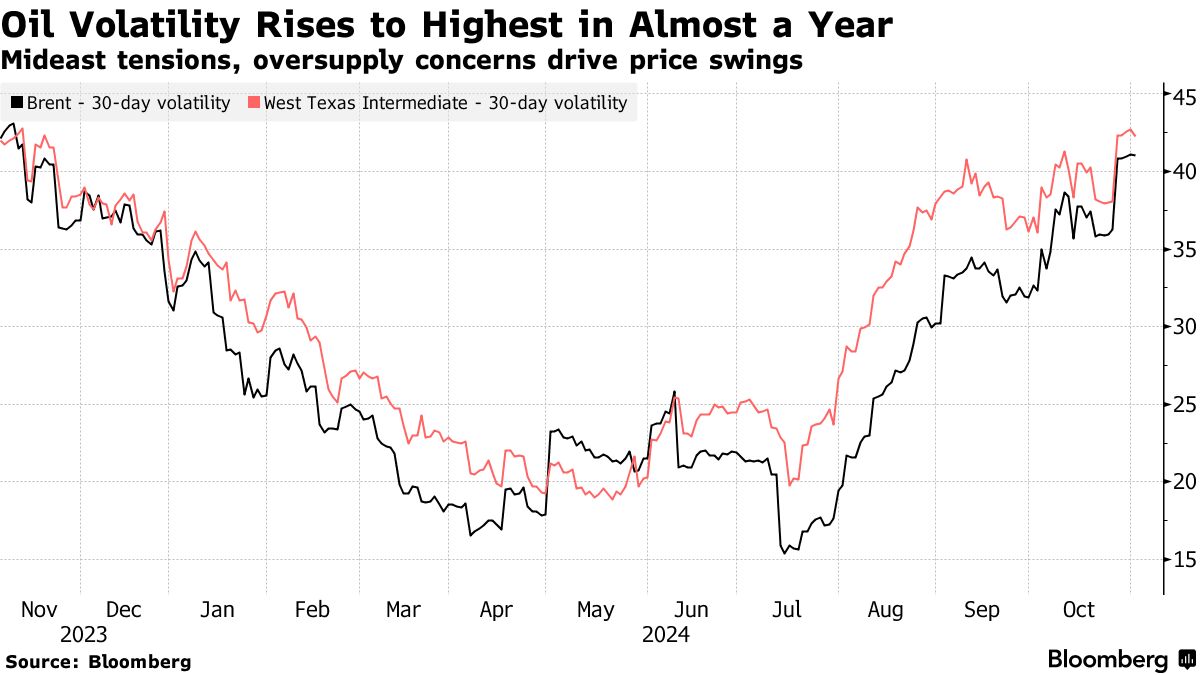
“Concerns that OPEC was poised to oversupply a fragile market have been weighing significantly on sentiment,” RBC Capital Markets LLC analysts including Helima Croft said in a Nov. 3 note. “A continuing cycle of retaliatory strikes between Israel and Iran raises the risk that oil facilities will be caught in the crosshairs.” Oil prices have become increasingly volatile, with concerns of an oversupply next year and lackluster demand in top importer China weighing against unrest in the Middle East, which supplies about a third of the world’s crude. While futures fell early last week after the strike by Israel on Iran avoided energy infrastructure, they later pared the decline on concerns the move lower was too strong. The oil market has a number of key events on the horizon this week, including the US election and a meeting of China’s top legislative body. Saudi Aramco is also scheduled to release its official prices for December, with the producer expected to lower its rates for Asia, according to a Bloomberg survey.
OPEC chief remains optimistic on global oil demand
Organization of the Petroleum Exporting Countries (OPEC) Secretary General Haitham al Ghais said Monday that the group’s demand is currently buoyant in both the short and long term. Speaking at ADIPEC in Abu Dabi, Al Ghais expressed optimism about the global situation and dismissed concerns about a rebound in demand. At the same time, Al Ghais highlighted the need for balanced, practical energy policies that address energy security and emissions goals. He stressed that collaboration between the Global North and South is essential, noting that “no one-size-fits-all solution” exists for global energy needs.
NN AUDIO FILE
US B-52 bombers arrive in Middle East……. US allegedly warned Iran it’ll be unable to stop Israel
United States B-52 Stratofortress strategic bombers arrived in the Middle East, US Central Command (CENTCOM) announced in a post on X. The deployment of the B-52 bombers was announced on November 1, amid rising tension in the region. “Should Iran, its partners, or its proxies use this moment to target American personnel or interests in the region, the United States will take every measure necessary to defend our people,” Pentagon spokesman Major General Pat Ryder underlined. Meanwhile, previous reports claimed that Washington warned Tehran that if it launches a new retaliatory attack against Israel, it won’t be able to hold the latter back.
The United States warned Iran that if it carries out another retaliatory attack against Israel, it won’t be able to contain the latter,
Axios reported on Saturday citing a US official and a former Israeli official. “We told the Iranians: We won’t be able to hold Israel back, and we won’t be able to make sure that the next attack will be calibrated and targeted as the previous one,” the US official told the news outlet. The former Israeli official detailed that Washington sent the message to Tehran through Switzerland. Previous reports claimed that Israel is currently anticipating Iran to attack its territory from Iraq.
YOU DON’T SEND B52 BOMBES UNLESS YOU WANT TO BOMB SOMETHING BIG… LIKE UNDERGROUND NUCLEAR WEAPONS PRODUCTION FACILITES
Austin orders additional forces sent to Middle East
United States Secretary of Defense Lloyd Austin ordered the deployment of additional military forces to the Middle East to protect US citizens in the region and support Israel, according to the statement from the Pentagon. Washington will boost its military presence in the region by sending additional ballistic missile defense destroyers, fighter jets, and refueling tanker aircraft, as well as B-52 strategic bombers. “These movements demonstrate the flexible nature of U.S. global defense posture and U.S. capability to deploy world-wide on short notice to meet evolving national security threats,” Pentagon Press Secretary Pat Ryder said. Austin warned Iran, its proxies, and allies that Washington will defend its personnel and interests in the region. Previously, Tehran indicated that it could retaliate against the Israeli attack on October 26.
I keep hearing rumors Iran will attack Israel before elections from Iraq…. with NEW jet powered drones
Israeli intelligence suggests Iran is preparing to attack Israel from Iraqi territory in the coming days, possibly before the US presidential election on November 5
Today Iran’s Supreme Leader Ayatollah Ali Khamenei warned that Israel as well as the United States could face “a crushing response” for their actions against Iran and its allies. Khamenei’s comments came after Israel conducted airstrikes in late October, targeting military bases in Iran and killing four Iranian soldiers. Khamenei emphasized the seriousness of the threats against Iran, stating that “the enemies, whether the Zionist regime or the United States of America, will definitely receive a crushing response.” Previously, Khamenei had advocated for a more measured approach. Four sources from Iraqi armed groups said the Kataeb Hezbollah and Nujaba groups, which are leading the attacks on Israel, have warned the prime minister against pressuring them to halt their actions and vowed to continue their attacks as long as Israel continues its operations against Hamas and Hezbollah. Those groups have rockets and the new jet powered drones, 25% of them lately have penetrated Israeli defense systems. Kataeb Hezbollah, the most powerful of the armed factions, said Israel and the US would have to pay a price for Israel’s strikes on Iran last week.
Hezbollah targets Israeli intelligence base near Tel Aviv….. Air alarms sound in central Israel after launch from Lebanon
Hezbollah launched rockets at an Israeli intelligence base near Tel Aviv early Saturday, targeting the Glilot base used by the 8200 military intelligence unit.The Israeli Defense Forces (IDF) previously reported that three rockets were fired from Lebanon toward central Israel overnight.
Air alarms sound in central Israel after launch from Lebanon
The Israel Defense Forces (IDF) said it was investigating a missile launch from Lebanon that targeted the central parts of the country after air raid alerts were declared in several areas, including a suburb of Tel Aviv. According to the IDF, an impact was “apparently” detected after air defense systems were activated in the Sharon and Dan regions, adding that the investigation was underway. NN: Its the just delivered to Hezbollah new Turbojet powered drone……that’s getting through Israeli defense systems…. See next story Drone From Hell.
Hamas unsatisfied with new ceasefire proposals……. Lebanon: Israel’s PM rejected ‘roadmap’ to ceasefire
Hamas believes the latest proposals regarding a potential ceasefire in the Gaza Strip brought up by Egyptian and Qatari mediators are not serving the interests of Palestinians, RIA Novosti reported on Friday citing a source from the militant group. According to the source, while the proposed temporary ceasefire, which would last for a few days, calls for an increase in humanitarian aid trucks and a partial exchange of prisoners, it does not mention a “complete end to aggression, the withdrawal of occupation forces, or the return of refugees.” Previously, Hamas underlined that Israel’s siege of the Gaza Strip must be brought to an end.
Lebanon: Israel’s PM rejected ‘roadmap’ to ceasefire
Speaker of the Parliament of Lebanon Nabih Berri (pictured) said on Friday that Israeli Prime Minister Benjamin Netanyahu “rejected the Lebanese roadmap” to ceasefire between the two countries, which was agreed upon with the United States envoy to Lebanon, Amos Hochstein, according to Lebanon’s National News Agency (NNA). Berri claimed that the initiative to resolve the crisis between Israel and Lebanon was postponed until after the US presidential election. He avoided making predictions about how the US election results will affect the situation in Lebanon, stating that “this leaves matters in Lebanon dependent on developments in the field.” Berri also expressed his concern about “turning Lebanon into a second Gaza.” The Lebanese politician confirmed that Hochstein “has not communicated with us since leaving Israel.” Previously, Lebanon’s Prime Minister Najib Mikati expressed optimism about Hochstein’s trip to Tel Aviv but said that Israel’s increasing attacks on Lebanon showed its reluctance
nn: i repeat peace my ass
10 and 30-year US Treasury yield highest since late July
The yields on United States Treasuries with a remaining maturity of 10 and 30 years soared on Friday as investors digested mixed results on the country’s labor market, as the last data on nonfarm employment before presidential elections showed weaker-than-expected job additions in October, but a steady unemployment rate. The activity in the US manufacturing sector expanded last month, seemingly raising uncertainty around the Federal Reserve’s monetary policy before the end of the year. Personal consumption expenditure increased in line with expectations, while an underwhelming reading of jobless claims appeared to point to the labor market’s resilience. The return on the 10-year Treasury note climbed 4.9 basis points to 4.331%, reaching its highest point since July. The yield on the 30-year bond rose 6.3 basis points to 4.538%.NN: ZEROES here we come