White House National Security Communications Advisor John Kirby said on Thursday that the Biden administration recognizes that Iran is providing financial support for certain demonstrations against Israel taking place in the United States. “We do know that Iran has been funding and encouraging some of the protest activity here in the US, some of it,” Kirby told the press. “We do not believe all the protest activity out there on a daily basis is being fully funded by Iran.” Kirby’s comments come after Israeli Prime Minister Benjamin Netanyahu told the US Congress during yesterday’s address that Iran was funding pro-Palestinian protests in the country.
Houthis to escalate joint ops with Iraq against Israel
The leader of Yemen’s Houthi movement, Abdul-Malik Badruldeen al-Houthi claimed on Thursday that the group will increase joint operations with the Iraqi militia to confront Israel. “The Zionist enemy continues its savage, brutal aggression and genocide war in Gaza for the forty-second week. The Israeli massacre of Palestinians in Khan Younis is horrific,” the leader said during a televised speech. He further emphasized that Yemen’s assault on Tel Avivdefense exposed Israel’s “vulnerability to drone attacks.” Al-Houthi also pledged that the militia would persist in targeting Israel and vowed to respond to the latest Israeli strikes near Hodeidah.
Harris has 20-point lead over Trump among young voters…….Poll: Trump leads Harris in four swing states
United States Vice President Kamala Harris is massively more favored among young voters over Republican presidential nominee, former US President Donald Trump, an Axios/Generation Lab poll released on Thursday showed. When asked to choose between President Joe Biden, who withdrew from the race, and Trump, 53% of the respondents aged 18-34 picked the Democrat and 47% the Republican. However, when choosing between Harris and Trump, she got 60% of the support compared to the GOP nominee’s 40%. Furthermore, 45% of the young participants have a favorable view of Harris, while only Trump and Biden are seen favorably by 34% and 33%, respectively. The poll was conducted after Biden dropped his bid. NN: Trump has a BIG problem here.
Poll: Trump leads Harris in four swing states
Former United States President and Republican presidential nominee Donald Trump is leading Vice President and presumptive Democratic nominee Kamala Harris in four swing states, while the two are tied in Wisconsin, a new Emerson College Polling/The Hill poll showed on Thursday. In Arizona, 49% of the respondents would vote for Trump over Harris, while 44% would support her. The GOP also candidate had a 2 point lead in Georgia and Pennsylvania and a one-point lead in Michigan. Meanwhile, Trump and Harris have 47% support each in Wisconsin, with the remaining respondents undecided. However, despite trailing Trump in most swing states, Harris performed better than US President Joe Biden had done in an Emerson College poll from earlier this month before he decided to pull out of the race.
Israel-Hamas deal allegedly in ‘closing stages’….. .Israel hits 60 targets across Gaza in one day……. Hamas: Netanyahu showed he doesn’t want ceasefire
The United States believes the ceasefire agreement between Israel and Hamas is in the “closing stages,” AFP reported on Wednesday citing a senior US official. The official added the Biden administration thinks a deal can be reached following months of hostilities and negotiations. The report comes amid Israeli Prime Minister Benjamin Netanyahu’s visit to the US. According to the official, the ceasefire proposal includes the gradual release of some of the Israeli hostages held by Hamas over 45 days. US President Joe Biden is expected to meet with Netanyahu on Thursday to work on resolving the remaining issues.
Israel hits 60 targets across Gaza in one day
The Israel Defense Forces (IDF) said on Thursday that its forces destroyed over 60 military objectives allegedly used by resistance groups across different areas of the Gaza Strip. The IDF claimed these targets were hit in just one day using fighter jets, attack helicopters, and drones, adding these strikes to 50 more reported on Tuesday. The army increased offensive operations in Khan Younis, Rafah, and Netzarim Corridor area after ordering evacuations in Khan Younis but still was not enough to avoid civilians casualties. Additionally, it stated that one soldier was “moderately injured” and two were “lightly injured” after gunmen shot from a vehicle close to the Nabi Ilyas area in the West Bank. The perpetrators of the shooting have not yet been found.
Hamas: Netanyahu showed he doesn’t want ceasefire
Member of Hamas Political Bureau Izzat al-Risheq said on Wednesday that Israeli Prime Minister Benjamin Netanyahu’s speech before the United States Congress showed that he does not want a ceasefire deal to be reached. Al-Risheq underlined that Netanyahu’s address is “a party of lies and disdain for the world’s minds.” Addressing the Congress, the Israeli prime minister said that Hamas “wants Palestinian civilians to die,” claiming that there were “practically none” civilian casualties in Israel’s strikes on Rafah. He also stressed that the war in Gaza could end “tomorrow” if Hamas “surrenders,” but emphasized that Israel will fight until “total victory” if the militant organization declines to do so.
WATCH IN FULL: Netanyahu addresses joint session of Congress…….. You need to watch
NN: What will be proven to be one of the great speaches of our time.
WH: Biden didn’t withdraw from race over health issues
White House press secretary Karine Jean-Pierre underlined on Wednesday at a press briefing that United States President Joe Biden’s decision to drop out of the 2024 presidential race wasn’t made in light of any health issues. While she didn’t want to elaborate further on the move, as Biden is set to speak on the matter later in the day, she reassured the public that this “had nothing to do with his health.” The press secretary revealed that the decision was made “in a very short period of time,” over the weekend. NN: Do these people have any credibility with you? Obviously, Biden is old and feeble. As admitted he is incapable of running a reelection campaign. He is certainly incapable of running the country. And has been for years. This begs the question who is running the show? And who are the criminals who allowed him to stay in power all these years?
IEA Summary Weekly Petroleum Report
Summary of Weekly Petroleum Data for the week ending July 19, 2024
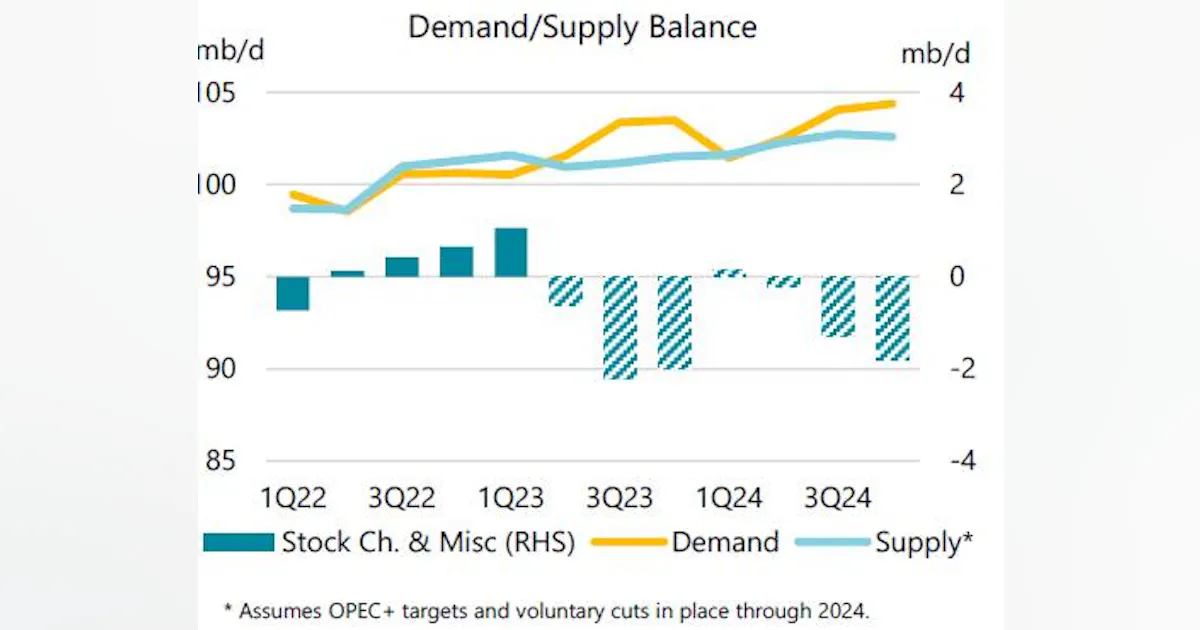
U.S. commercial crude oil inventories (excluding those in the Strategic Petroleum Reserve) decreased by 3.7 million barrels from the previous week. At 436.5 million barrels, U.S. crude oil inventories are about 5% below the five-year average for this time of year U.S. crude oil refinery inputs averaged 16.4 million barrels per day during the week ending July 19, 2024, which was 521 thousand barrels per day less than the previous week’s average. Refineries operated at 91.6% of their operable capacity last week. Gasoline production increased last week, averaging 10.2 million barrels per day. Distillate fuel production decreased last week, averaging 4.9 million barrels per day.
U.S. crude oil imports averaged 6.9 million barrels per day last week, decreased by 166 thousand barrels per day from the previous week. Over the past four weeks, crude oil imports averaged about 6.8 million barrels per day, 2.9% more than the same four-week period last year. Total motor gasoline imports (including both finished gasoline and gasoline blending components) last week averaged 778 thousand barrels per day, and distillate fuel imports averaged 112 thousand barrels per day.
. Total motor gasoline inventories decreased by 5.6 million barrels from last week and are about 2% below the five year average for this time of year. Both finished gasoline and blending components inventories decreased last week. Distillate fuel inventories decreased by 2.8 million barrels last week and are about 9% below the five year average for this time of year. Propane/propylene inventories
increased by 1.8 million barrels from last week and are 15% above the five year average for this time of year. Total commercial petroleum inventories decreased by 4.6 million barrels last week. Total products supplied over the last four-week period averaged 20.6 million barrels a day, up by 0.4% from the same period last year. Over the past four weeks, motor gasoline product supplied averaged 9.3 million barrels a day, up by 2.5% from the same period last year. Distillate fuel product supplied averaged 3.7 million barrels a day over the past four weeks, up by 3.2% from
the same period last year. Jet fuel product supplied was up 3.8% compared with the same four week period last year.
Iraqi militia reportedly attacks Israeli city
The Islamic Resistance in Iraq, a Shiite militia group backed by Iran, announced a drone strike on the southern Israeli port city of Eilat, according to Al Jazeera Arabic. This group frequently collaborates with factions like Hezbollah and the Houthis in their clashes with Israel from Lebanon and Gaza. One such attack in Tel Aviv recently resulted in a fatality. In retaliation, Israel launched an airstrike inside Yemen, targeting fuel depots and oil refineries at the port of Al-Hudaydah, a Houthi-controlled area. The strike led to fires in fuel storage tanks, with local media reporting casualties as a result of the strike.
Harris Presidency Will Be Bad News for Oil and The World
- Harris has a history of prosecuting oil companies for environmental crimes and supports climate initiatives like the Green New Deal and a fracking ban.
- Harris could have difficulty winning votes in important energy-focused states swing-state like Pennsylvania.
- In the case of a Democratic presidency with Harris in the White House, the federal government will be going after Big Oil.
Kamala Harris looks like the frontrunner for the Democratic nomination for the November vote. Based on her track record as California attorney general and vice president, this is going to be bad news for the oil industry. Overviews of her career that have flooded the media space note her lawsuits against oil companies including Chevron, which she prosecuted for hazardous materials mishandling. Plains All-American Pipeline also became a target for California’s AG back in 2015 for an oil spill off the state’s coast. Interestingly, Harris’ claim that she also sued Exxon, which she made during the run-up to the 2020 elections appears to be inaccurate, according to Inside Climate News. What is accurate, however, is that she does appear to be an even more dedicated transition champion than Joe Biden. Back in the early 2000s, when she was a district attorney for San Francisco, Harris set up what she dubbed the first environmental justice unit in her department to handle crimes such as hazardous waste and other environmental crimes. In 2020, she said she opposed fracking and offshore drilling, and would ban fossil fuel leases on public lands if president “Crimes against the environment are crimes against communities, people who are often poor and disenfranchised,” Harris said in 2005, as quoted by the publication. “The people who live in those communities often have no other choice but to live there.” The former California attorney general, who then became state senator, was also a strong supporter of the Green New Deal that has made the state a poster child for the transition despite its steep cost. Harris has also publicly stated she was in favor of a ban on fracking, which has made her popular among climate activists.
“She is the kind of leader who will hold the fossil fuel industry accountable. “She would absolutely carry on and build on the success of the Biden administration on climate and clean energy.” Back in 2019, during the primaries, Harris spoke in favor of not only a fracking ban but also of a carbon tax—a transition tool that is not exactly popular among voters. She called it a “climate pollution fee”, to slap on the oil and gas industry “as far upstream as possible” and then use the money to advance the transition.“While we have yet to see the first case where a fossil fuel company is held liable for damages from climate change, the prospect of a DOJ-led lawsuit would increase the chances of finding liability, with an increase in the potential for damages, litigation costs and reputational risk,” consultancy Rapidan Energy Group told clients in a note this week, as quoted by Bloomberg.
U.S. Crude Oil Inventories Continue to Fall
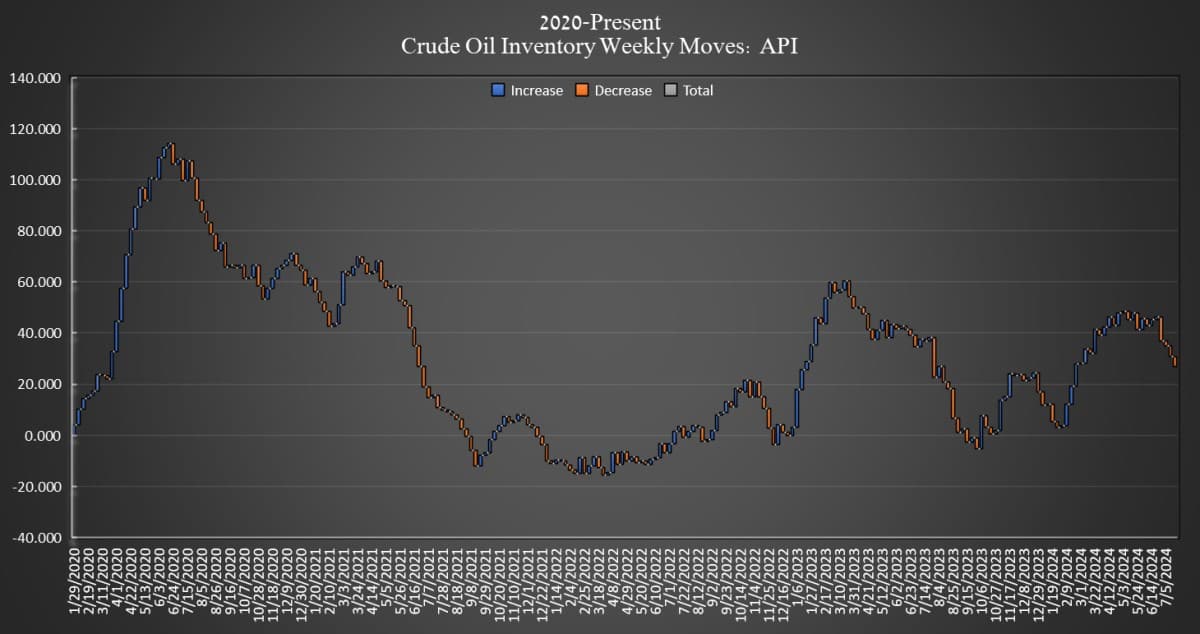
Crude oil inventories in the United States fell again this week, this time by 3.9 million barrels for the week ending July 19, according to The American Petroleum Institute (API). The reality was a far cry from analyst predictions which pegged the inventory move at a 700,000-barrel build for the week. For the week prior, the API reported a 4.44 million barrel draw in crude inventories.
This week marks the fourth week in a row of API-estimated inventory draws for crude oil, for a total loss of 19.4 million barrels during that time.
On Monday, the Department of Energy (DoE) reported that crude oil inventories in the Strategic Petroleum Reserve (SPR) rose by 0.7 million barrels as of July 19. Inventories are now at 374.4 million barrels—the highest level since December 2022, but still well below the 656 million barrels in inventory in June 2020. Oil prices were trading substantially down after the API data release on Tuesday.
As of the publishing of this story Brent crude was trading down $0.98 (-1.19%) on the day at $81.42—down about $2.40 per barrel from this time last week. The U.S. benchmark WTI was also trading down on the day by $1.04 (-1.33%) at $77.36—down roughly $3.40 per barrel from this time last week.
Gasoline inventories also fell this week, by 2.8 million barrels, more than offsetting last week’s 365,000-barrel increase. As of last week, gasoline inventories are slightly above the five-year average for this time of year, according to the latest EIA data. Distillate inventories shrunk this week by 1.5 million barrels, compared to last week’s 4.92-million-barrel increase. Distillates were about 7% below the five-year average for the week ending May July 12, the latest EIA data shows. Cushing inventories rounded out this week’s losses, losing 1.6 million barrels, according to API data, added on to the 746,000 barrel drop in the previous week. NN: As predicted demand continues to outstrip supply. despite and Algo traders spin. We get the IEA inventory report today at 11:00 AM.
I am not so sure peace in the valley will soon come.