Oil Ends Week Near Three Month Lows


  • WTI for July delivery rose 85 cents to settle at $77.72 a barrel in New York.
  • Brent for July settlement gained 76 cents to settle at $82.12 a barrel.
    • The prompt spread was 26 cents in backwardation, compared with 65 cents at the start of the month.

Oil hovered near the lowest in three months as traders weighed decreased geopolitical risks and signs that global markets are sufficiently supplied ahead of next month’s OPEC+ meeting.  Global benchmark Brent crude’s prompt spread is at 26 cents, closely approaching a bearish contango structure that signals ample supplies in the near future. While both Brent and West Texas Intermediate futures settled higher Friday, they posted weekly declines of more than 2% and are near their lowest prices since February. Bearish sentiment has permeated the market after a “pricing out of the geopolitical premium and growing concern on the supply and demand balance,” said Arne Lohmann Rasmussen, head of research at A/S Global Risk Management. Traders will be seeking further visibility into fuel demand in the days ahead as the Memorial Day holiday weekend kicks off the start of the peak driving period in the US. Brent is still up about 7% up this year, in part due to OPEC+’s 2 million barrels a day of production cuts as well as persistent geopolitical risks. Still, oil has fallen since mid-April as the conflict in the Middle East has yet to disrupt crude supplies. The OPEC+ alliance meets on June 2, a day later than initially planned, and is widely expected to prolong output cuts into the second half of 2024. Its decision to hold the meeting online supports the expectation that cuts will continue, according to Viktor Katona, head crude analyst at market intelligence firm Kpler Ltd.

UNCONFIRMED REPORT: Houthis Bomb 3 ‘Israeli’ Ships In A Day

Houthis claim missile attacks on three ships (MSC Alexandria in the Arabian Sea, Yannis in the Red Sea, and Essex in the Mediterranean). The Essex manager denies the incident. U.S. Central Command confirms missile launches in the Red Sea. The attacks are part of a campaign against regional shipping, supporting Palestine, causing disruptions.

Nasdaq 100 closes at all-time-high

Major stock markets in the United States ended Friday’s session mostly higher with the Nasdaq 100 closing with a record value of 18,808.347. The Nasdaq 100 advanced by 0.99%, with Ross Stores Inc. skyrocketing 7.79%, Constellation Energy Corporation surging 4.28% and Qualcomm Inc. climbing 4.26%. Within the same index and after exceeding the $2.57 trillion of market capitalization following a remarkable earnings report for its first quarter, Nvidia Corporation closed the week gaining 14.82% compared to the previous one, showing investors enthusiasm. The S&P 500 gained 0.70%, as Deckers Outdoor soared 14.18%. The Dow Jones Industrial Average index closed flat. The euro was 0.31% higher against the dollar at 3:58 pm ET, to sell for $1.08431. NN: Like i have been telling you this market is not ready to short just yet.

Gasoline Prices Ahead of Memorial Day Are 1% Higher Than a Year Ago

  • Gas prices are down slightly from recent highs but still above 2023’s Memorial Day prices.
  • A record number of Americans plan road trips this summer, with many traveling long distances.
  • AAA forecasts record-breaking travel numbers over the Memorial Day weekend despite mid-range gas prices.

The average retail price of a gallon of regular gasoline in the United States was $3.58 on the Monday before Memorial Day, which was 1% higher than last year’s pre-Memorial Day gas price, the U.S. Energy Information Administration (EIA) said on Thursday.

Over the past five weeks, Middle East tensions have eased, while U.S. refinery activity has increased after the end of seasonal maintenance, contributing to a 2% decline in average retail gasoline prices, the administration noted.   A near-record number of Americans plan road trips this summer as gasoline prices continue to drop ahead of Memorial Day weekend, the start to summer travel, the 2024 Summer Travel Survey of fuel savings platform GasBuddy showed on Tuesday. A total of 76% of Americans plan to take at least one road trip between Memorial Day and Labor Day weekends, the GasBuddy survey showed. That’s 18% higher than last year. The average American traveler has two road trips planned, with many venturing far – 49% expect to drive 5 or more hours to reach their destination, according to the survey. GasBuddy expects the national average price of gasoline will hold in the mid-$3 per gallon range for much of the summer, with potentially tens of thousands of stations falling below $3 per gallon throughout the next several months. GasBuddy forecasts that gas prices will average $3.58 per gallon nationally between Memorial Day and Labor Day. AAA estimates showed last week that road trips during Memorial Day weekend are to set hit a record-high—38.4 million people are set to travel by car over Memorial Day weekend, the highest number for that holiday since AAA began tracking in 2000. AAA expects 43.8 million Americans to head 50 miles or more from home by all means of transportation over the Memorial Day holiday travel period between Thursday, May 23, and Monday, May 27, 2024. This would be the highest in nearly two decades, AAA said.  

OPEC+ to Hold Key Policy Meeting Online

The OPEC+ alliance will hold its meeting in early June a day later than initially planned and via a video conference instead of in person, OPEC said on Friday. All meetings previously planned to take place in person in Vienna on June 1 will now be held online on June 2. The three key meetings that will be now held via video conference are the meeting of the Joint Ministerial Monitoring Committee (JMMC), the panel monitoring market developments and potentially recommending actions to the ministers to take, the meeting of the OPEC ministers, and finally, the meeting of the ministers of the wider OPEC+ coalition.

The meetings are “expected to be smooth,” delegates told Amena Bakr, Senior Research Analyst at Energy Intelligence, on Friday.

The fact that the OPEC+ meetings will be held online suggests that the producers in the pact have more or less reached an agreement about how to proceed with the current oil production cuts, analysts say.

OPEC+ is currently keeping around 2.2 million barrels per day (bpd) off the market in a deal expiring at the end of June. The alliance will decide at the meetings on June 2 whether to roll over all or part of the production cuts into the second half of the year.  The OPEC+ group is likely to fully roll over the current cuts until the end of the year, analysts reckon, as oil prices are still rangebound, with Brent Crude stuck in the low $80s, after the slide in the past five weeks due to eased tensions in the Middle East.  “Crude oil prices continue to drift lower, trading near a three-month low amid signs of demand weakness,” Saxo Bank said in a market commentary note early on Friday, adding that “a rollover of current production cuts remains the most likely outcome” of the OPEC+ meeting.

ICJ: Israel must ‘immediately’ halt any military ops in Rafah

The International Court of Justice (ICJ) ruled on Friday that Israel must “immediately” halt any military operations and any other actions in Rafah according to obligations under the Genocide Convention. The country was given one month to submit a report detailing all the measures it has taken to comply with the court’s latest order. President of the ICJ Nawaf Salam stressed that the humanitarian situation in Rafah has “deteriorated further” since March when the court issued an order. He went on to say that the humanitarian situation in the area can now be categorized as “disastrous.” “The court is not convinced that the evacuation efforts and the related measures that Israel affirms to have undertaken to enhance the security of civilians in the Gaza Strip and in particular those recently displaced from Rafah governorate are sufficient to alleviate the immense risk which the Palestinian population is exposed to as a result of the military offensive in Rafah,” he underlined further. NN: This will do nothing.

Another Oil Rally is Coming…… Thankyou OPEC

  • Oil markets continue to be lackluster compared with the strength displayed by metals and gas markets.
  • StanChart has predicted that the bearish sentiment coupled with low market volatility are likely to persist until OPEC+ announces its new policy.
  • Experts have predicted that positive developments by OPEC+ could trigger another oil price rally. 
  • The 37th OPEC and non-OPEC Ministerial Meeting is scheduled to be held on June 1, 2024 in Vienna

Dynamics in the global oil markets have shown little change over the past couple of weeks with pessimism still high and hedge funds still leaning towards the short side of the market. Over the past week, Brent prices remained range-bound in the $83.45-83.60/bbl range with the prolonged sideways price movement pushing volatility lower.  The realized annualized 30-trading-day front-month Brent volatility clocked in at just 16.9% at settlement on 20 May, a 2.1 ppt w/w reduction while the 10-trading-day volatility measure came in 7.4 ppt w/w lower at just 12.5%. Front-month Brent settled at $83.71/bbl on 20 May, good for a 0.35/bbl w/w increase but considerably lower than the $1.44/bbl increase predicted by Standard Chartered’s machine-learning oil price modeling tool, SCORPIO.  Oil markets continue to be lackluster compared with the strength displayed by metals and gas markets. StanChart has predicted that the bearish sentiment coupled with low market volatility are likely to persist until OPEC+ announces its new policy during its next meeting scheduled for early June. However, StanChart notes that the exact timing of that unilateral announcement is uncertain because voluntary cuts are outside the scope of the OPEC+ ministerial meeting.

The experts have predicted that positive developments by OPEC+ could trigger another oil price rally.

The end of the early-year oil price rally has forced energy stocks to give up some gains. The sector has lost 5% over the past six weeks bringing its gains in the year-to-date to 11.46%. That said, Wall Street largely remains bullish on oil and gas stocks.

EIA Confirms Small Crude Inventory Build, Gasoline Draw

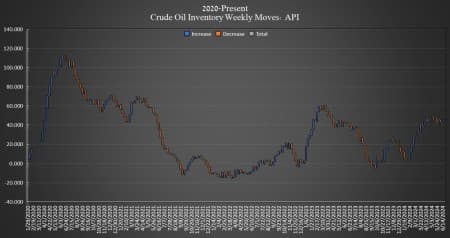
WTI crude oil traded below $78 today after the U.S. Energy Information Administration reported an estimated inventory increase of 1.8 million barrels for the week to May 17. This compared with a draw of 2.5 million barrels for the previous week that pushed benchmarks higher last week as it came after an API estimate that also pointed to a draw and it was the second weekly draw in a row, suggesting demand picking up. According to the Energy Information Administration, gasoline inventories shed 900,000 barrels in the week to May 17, with production averaging 10 million barrels daily. This compared with a draw of 200,000 barrels for the previous week when production averaged 9.7 million barrels daily. Middle distillate stocks rose by 400,000 barrels in the week to May 17, with production averaging 5.1 million barrels daily. This compared with a minor inventory decline for the previous week and a production rate of an average of 4.8 million barrels daily. The EIA report may contribute to oil market sentiment already dominated by pessimism about consumption after the latest signals from the Fed, which essentially come down to extra caution about rates. In short, the Fed has no intention of cutting these in the immediately observable future, waiting for inflation to come down closer to its target of 2%. Fed officials made this clear this week, as they advised the ultimate decision-makers to refrain from rate cuts for at least another few months, Reuters reported. Oil prices have been trending down since the start of the week, meanwhile, on the back of grim demand expectations because of persistently high interest rates. NN: All these numbers will be meaningless when the new leadership in Iran attacks……. again

US releases 1M barrels of gasoline to lower prices

The U.S. Department of Energy (DOE) has announced the sale of 1 million barrels (42 million gallons) of gasoline from the Northeast Gasoline Supply Reserve (NGSR) aimed at alleviating gasoline prices as Americans gear up for the summer driving season and ahead of U.S. elections this fall. “The Biden-Harris Administration is laser-focused on lowering prices at the pump for American families, especially as drivers hit the road for summer driving season,” said U.S. Secretary of Energy Jennifer M. Granholm. By releasing this reserve between Memorial Day and July 4th, the administration aims to ensure a steady fuel supply in the Northeast during a peak travel period. The gasoline will be sold in increments of 100,000 barrels to encourage competitive bidding among retailers and terminal operators. The DOE has designated storage sites in Port Reading, NJ (900,000 barrels), and South Portland, ME (98,824 barrels) for this release. Successful bidders will receive their allocations by June 30, 2024, ensuring ample supply before the July 4th holiday. Bids are due by 11:00 a.m. Central Time on May 28, 2024, with revenues from the sale directed to the U.S. Treasury. This initiative is part of a broader strategy to effectively manage the country’s petroleum reserves and ensure energy security. By introducing nearly 1 million barrels of gasoline into the commercial market, the DOE hopes to stabilize prices and provide relief to consumers. The Department of Energy established in 2014 the Northeast Gasoline Supply Reserve (NGSR)—the first federal, regional, refined petroleum product reserve containing gasoline—following the 2012 Superstorm Sandy in the northeastern United States. The NGSR holds one million barrels of gasoline, including 700,000 barrels located in the New York Harbor area, 200,000 barrels in the Boston area, and 100,000 barrels in South Portland, Maine.

NN audio file

Every day, America increasingly resembles a banana republic.

Oil Prices Under Pressure as Demand Pessimism Grows

Crude oil prices have weakened this week, as expectations of higher rates for longer in the U.S. were seen depressing demand for everything including oil. Lower volatility on oil markets as traders cut their bullish positions on crude also helped push oil lower earlier today—a trend that Bloomberg sees extending, as it cited yet another report of a drone attack on a Russian refinery as failing to produce any effect on international oil benchmarks. Since the start of the year, Brent crude has gained some 9% but the rate of increase has slowed down significantly since the middle of April with a few weeks of losses. Now, traders are waiting for the OPEC+ meeting on June 1 to see whether the cartel’s members would extend their output cuts into the second half of the year. This is the meeting’s outcome widely seen as most likely. The U.S. Fed, meanwhile remains reluctant to start cutting interest rates, with senior officials citing their lack of conviction that inflation has been put firmly under control, which would justify the rate cuts. Meanwhile, the news of the death of Iran’s president and the bad health of Saudi Arabia’s king also failed to affect prices in a positive way. According to some analysts, this is because the consequences of these events are yet to manifest themselves. “While there has been an up move over some uncertainty in Iran, prices have since pared back some gains, as investors price for the status quo in terms of policies for now and that any wider regional conflict remains off the table,” IG analyst Yeap Jun Rong told Reuters. “Dented demand prospects are casting a shadow over the oil markets,” Priyanka Sachdeva, senior market analyst at Phillip Nova, told Bloomberg. “Whatever support we see in oil prices is purely a function of an anticipatory disruption in supplies, and it’s becoming tougher day by day to justify that premium.”