Recent reports indicate that Iran intends to disrupt operations in the Strait of Hormuz, Dryad Global stated in its latest Maritime Security Threat Advisory (MSTA), which was released on April 22. “The most recent incident, the seizure of the MSC Aries, demonstrates that Iran, despite being preoccupied with missile operations against Israel, continues to interdict and control vessel movement in the Strait of Hormuz, Persian Gulf, and Arabian Sea,” Dryad noted in the MSTA. “While Iran has repeatedly stated that it has the capability to shut down the choke point, doing so has appeared unfavorable because it would enrage its neighboring Arab nations,” it added. In the MSTA, Dryad said Iran’s most recent missile attack on Israel “was more theatrical than genuine military operations, knowing that Israel’s defense systems could easily defeat its drone and missile barrage”. “Iran is likely to intensify its operations in more easily controlled territory, such as the Strait of Hormuz, posing a significant threat to Israeli and NATO-affiliated commercial vessels,” it added. In a release sent to Rigzone earlier this month, Xeneta, which describes itself as the leading ocean freight rate benchmarking and intelligence platform, said the seizure of a container ship by Iran in the Strait of Hormuz on April 13 “is extremely concerning and threatens to put trade lanes in the Middle East at risk”. “It has been reported that the MSC Aries was seized by Iran Revolutionary Guards 50 nautical miles (92km) northeast of Fujairah, an area close to the Strait of Hormuz that forms the entrance to the Arabian Gulf,” Xeneta noted in the release. “The latest incident follows ongoing conflict in the Red Sea region – the gateway to the Suez Canal – which has seen ocean freight container ships avoiding the area due to missile attacks by Houthi militia,” it added. Peter Sand, a Chief Analyst at Xeneta, said in the release, “an already bad situation in the Red Sea and Gulf of Aden has just got worse and could put ocean freight container imports and oil exports in the Middle East at risk”. On its site, Dryad describes the Strait of Hormuz as a narrow 21 mile wide channel separating Iran from the Arabia Peninsula. “It is used to transport a fifth of the world’s petroleum liquids which is around 21 million barrels or $1.2 billion worth of oil every day,” Dryad states on its site. “The majority of Saudi Arabia’s crude exports pass through the Strait of Hormuz, meaning much of the oil-dependent economy’s wealth is situated there, similarly, 10 percent of the U.S.’s total oil imports per month transit the straits,” it adds. “Further, a quarter of the world’s LNG is also transported through the channel. This makes the Strait of Hormuz not only the world’s busiest shipping lane but also the most strategically important choke point for the world’s oil supply because there are limited alternatives to bypass the strait,” it continues. In a gas and LNG market update sent to Rigzone on April 17, Rystad Energy Senior Analyst Lu Ming Pang said, “the strategic significance of the Straits of Hormuz cannot be overstated and market participants will be closely monitoring developments in the region”. Pang described the straits as “a crucial artery for Qatar and the UAE to reach both European and Asian markets”. “As tensions simmer, global energy dynamics have a lot at stake, knowing that any added disruption could send energy prices shooting upward,” Pang added. “At the moment, fundamentals in the gas and LNG markets have not changed despite the retaliatory strike by Iran on Israel and prices in the global markets continue to reflect that. Nevertheless, the situation is fluid,” Pang continued. In a research note sent to Rigzone on April 20, analysts at J.P. Morgan said, “the closure of Hormuz is a low-risk event as Iran will be shooting itself in the foot both economically and politically by irritating its main customer”. In a statement posted on its website on April 13, the Norwegian Maritime Authority (NMA) warned of “enhanced tension and threat in the Persian Gulf, Strait of Hormuz, Gulf of Oman, and Arabian Sea”. “Due to the latest information and incidents, the NMA urge Norwegian vessels in the area to be cautious and to enhance vigilance operating in the area,” the NMA said in the statement. “CSO and SSO should seek information from reliable sources on the development in the area, and take necessary action as required,” it added. “The development is monitored closely from our side and the security level in the area may change on short notice,” it continued.
IDF preparing to start Rafah operation ‘very soon’
Initially, the US had expressed firm opposition to an operation in Rafah, in fear of worsening the humanitarian crisis in Gaza, however now they are willing to move forward with the operation.
Palestinians will reportedly be required to evacuate in the next four to five weeks to tent complexes that international aid organizations have set up. The plan for the Rafah operation has been presented to American officials as well as other agencies in the region, KAN noted. According to the plan, the operation will move forward in stages, based on a regional division of the Gazan city into defined areas. At each stage, the IDF will inform the local population before they advance into each area so the local population can evacuate before the IDF moves forward. The IDF approved the latest plan for the Rafah operation at the beginning of this week after three previous plans were suggested. The US government has expressed firm opposition to an operation in Rafah without a credible plan to protect civilians.
However, an Israeli security official said that the US understands the need for the operation and is no longer opposed, according to the Kan report.
“We are preparing to establish a joint operation with the United States. We understand the concern, but we will not be able to complete the mission without entering Rafah, which could also help relieve pressure on the hostage issue,” the official stated. Amid the preparations for the Rafah operation, government officials reportedly continue to discuss potential changes to Israel’s side of the hostage deal negotiations to ensure the deal’s advancement. NN: Israel is amassing troops for a invasion.
US Senate approves $95 billion aid package with TikTok provision
The United States Senate green-lit a $95 billion aid package aimed at assisting Ukraine, Israel and Taiwan.
Of particular interest is a provision within the bill concerning TikTok. It included a clause that would compel ByteDance, the owner of TikTok, to either sell the popular social media platform or face a ban in the United States.
This bipartisan effort comes after months of deliberation and delay. The vote, which stood at 79-18, saw a notable increase in Republican support compared to earlier considerations. Thirty-one Republicans aligned with 48 Democrats to ensure the passage of the bill, marking a bipartisan triumph. However, two Democrats, Senators Merkley and Welch, along with independent Senator Bernie Sanders, joined 15 Republicans in voting against the legislation.
Oil up 1% on geopolitical concerns
Prices of oil futures rose by more than 1% on Tuesday as markets remained wary of the potential spillover of Israel’s conflict with Iran to other parts of the Middle East, apparently resulting in market fears about the future of the global oil supply.
West Texas Intermediate (WTI) for settlements in Jun rose by 1.14% at 4:43 am ET to sell for $82.84 per barrel. At that minute, Brent for June’s deliveries gained 1.14% to go for $88.00 per barrel.
U.S. Crude Oil And Gasoline Inventories FALLING
Crude oil inventories in the United States fell this week by 3.23 million barrels for the week ending April 19, according to The American Petroleum Institute (API). Analysts had estimated a 1.8 million barrel build for crude oil. For the week prior, the API reported a 4.09 million barrel build in crude inventories.
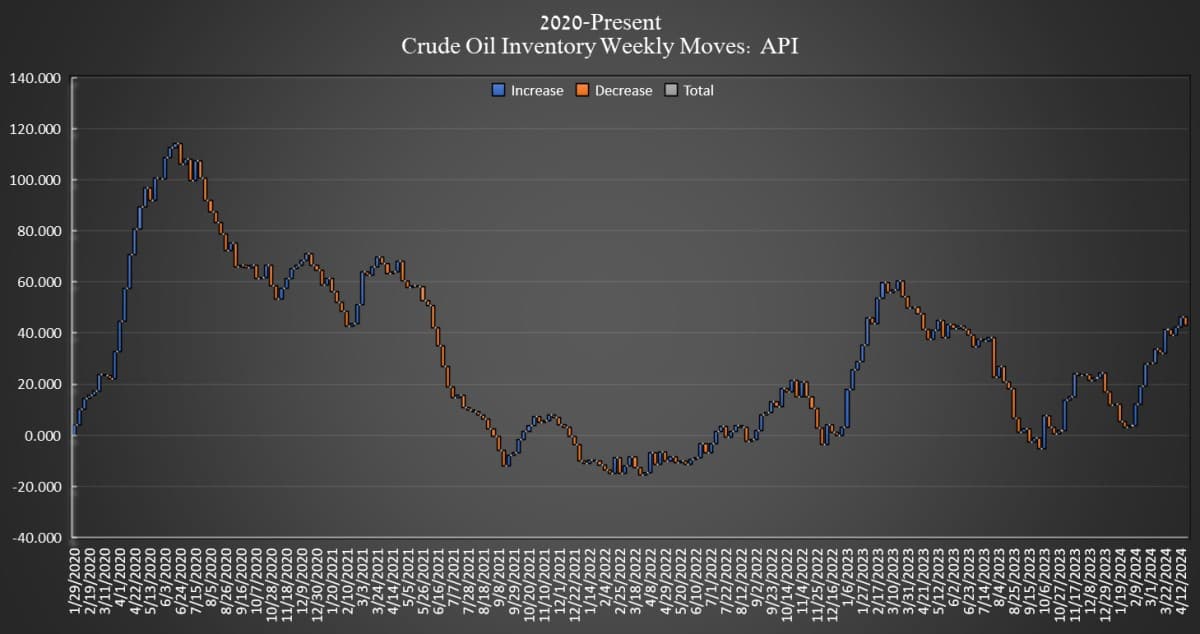
On Tuesday, the Department of Energy (DoE) reported that crude oil inventories in the Strategic Petroleum Reserve (SPR) rose by 0.8 million barrels as of April 19. Inventories are now at 365.7 million barrels—the highest point since last April.Oil prices were trading up ahead of the API data release on Tuesday, buoyed in part by the falling U.S. dollar index as business activity slumped to a multi-month low. Gasoline inventories also fell this week, by 595,000 barrels, after falling by 2.51 million barrels in the week prior. As of last week, gasoline inventories were about 4% below the five-year average for this time of year, according to the latest EIA data. Distillate inventories rose this week by 724,000 barrels, after last week’s 427,000-barrel dropoff. Distillates were 7% below the five-year average for the week ending April 12, the latest EIA data shows. Cushing inventories saw a draw this week, according to API data, falling by 898,000 barrels after falling by 169,000 barrels in the previous week.
Israel hit Iran with a half-ton supersonic ‘Rampage’ missile
Israel Used The ‘Rampage’ Missile During The Weekend Strike On An Iranian Military Base In Isfahan, Kan Reported. The Supersonic Missile Is Reportedly Designed To Strike Ground Targets Like Military Bases. On April 19, U.S. Media Reported An Israeli Missile Attack On A Military Base In Isfahan. However, Iran Downplayed The Incident, Saying No Israeli Missile Entered Its Airspace. Israel used a long-range, supersonic missile in its strike on Iran last week, Israeli broadcaster Kan reported, per The Times of Israel. US officials said Israel carried out a missile strike on a military base near the city of Isfahan on Friday. Israel has not confirmed the reports, while Iran has sought to downplay the incident, only referencing small drones used in the attack, which, in an interview with NBC News, its foreign minister Hossein Amirabdollahian said were “like toys our children play with.” While it remains unclear what weapons were used in the strike, Israel’s national broadcaster Kan reported that Israel used a “Rampage” air-to-surface missile, claiming it was identified in photos and that damage caused by the attack was consistent with a Rampage strike, per The Times of Israel. The Rampage was designed by Israel Aerospace Industries (IAI) for use against targets such as “communication and command centers, air forces bases, maintenance centers and infrastructure,” according to the company’s website. The company describes the missile, which weighs 1,250 pounds, as “a long-range, air-to-ground, seekerless, precision strike weapon.” Other reports, however, have pointed to another type of missile being used in the attack.
Iran is producing nukes. Soon their will be proof as Israel glows in the dark
Tensions between Israel and Iran have turned the spotlight on Tehran’s nuclear capabilities. The West accuses Iran of using its civil nuclear program as a cover for developing weapons — which it denies. The head of the United Nations’ nuclear watchdog, Rafael Mariano Grossi, warns that Iran ‘is not cooperating with us in the way they should’ regarding its atomic program
Hezbollah rockets strike Northern Israel
Thirty-five rockets were fired from Lebanon towards Safed in northern Israel, with most landing in open areas and causing no harm, according to the Israeli military.
The Lebanese armed group Hezbollah claimed responsibility for the attack, adding to the escalating tensions between Israel and Hezbollah along the border.
Since October 8, there has been a surge in exchanges of fire between the two sides, with an increase in both severity and frequency of attacks in recent months.
NN: The markets believe middle east tensions are winding down….This will soon proven wrong.
Crude prices slip 1% as Israel-Iran tensions falter
Prices of crude oil for future contracts declined on Monday as tensions between Israel and Iran seemed to calm down, seemingly providing some breathing room for commodity prices as no oil supply was directly threatened by recent developments in the Middle East. Over the weekend, Israel reportedly carried out a “limited” attack on Iran, to which Tehran has not responded. This strike was in retaliation for Tehran’s drone and missile attacks on April 13, which were themselves a response to Israeli airstrikes on Iran’s consulate building in Damascus earlier this month. For June deliveries, West Texas Intermediate (WTI) fell 1.08% to sell at $81.36 per barrel at 7:47 am CET. Brent for the same month’s settlements slipped 1.03% to $86.39 a barrel.
Israel used radar-evading missile to hit S-300 defenses near Natanz nuke site ……. Iran mocks Israel, describes its weapons as ‘toys’
NYT says attack was ‘calibrated’ to show Israel’s capability to dodge Iran’s air defenses, make Tehran ‘think twice’ before another assault; Iran’s FM claims it merely faced ‘toys’
The alleged Israeli strike overnight Thursday-Friday on Iranian air defenses near the Natanz nuclear site used a high-tech missile that was able to evade Iran’s radar systems, in a move “calibrated to make Iran think twice” before launching another direct attack on Israel, The New York Times reported on Saturday.
Two unnamed Western officials cited by the newspaper said the missile aimed to show Tehran that Israel is able to dodge and neutralize its defenses.
Two Iranian officials said the strike hit a Russian-made S-300 air defense system. They told the newspaper that Iran had not detected intrusions into its airspace from drones, missiles or aircraft. The newspaper said the missile was from a warplane fired “far from Israeli or Iranian airspace.” The report also said that neither the plane nor the missile entered Jordanian airspace — a calculated move to keep Amman out of any potential ramifications for the reprisal strike, after it helped shoot down some of the hundreds of drones and missiles fired by Iran at Israel last weekend.
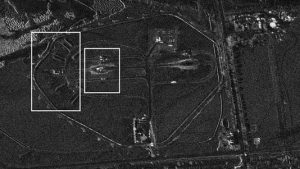
Satellite imagery seen by the Times of Israel showed damage to the radar of an S-300 system at the Eighth Shekari Air Base in Isfahan, said to be part of an array defending the nearby top-secret Natanz nuclear site. The imagery was not immediately permitted for publication, per the policy of the agency that took the photo.
Additional synthetic aperture radar satellite images taken Friday also showed evidence that the radar site was targeted. The New York Times said the strike was deliberately designed to send a message on how a wider attack could look, with Israel able to penetrate Iranian defenses undetected. US defense officials also told The New York Times that there was concern the precedent set by the nations’ direct exchanges of blows this week could encourage further rounds of violence in the future. Other effects could be an Iranian effort to better protect its nuclear assets and make them harder to attack, as well a potential push to move weaponry closer to Israel in case of another confrontation, experts told the paper. US media reported Friday that the alleged Israeli strike in Iran went beyond the scope of several small drones described by Tehran. ABC news was the first to report that the air defenses at Isfahan were part of an array defending the nearby top-secret Natanz site. “The Israelis hit what they intended to strike,” one of the sources told Fox News, adding that there was one main target that was hit multiple times and that Iran’s Russian-made air defense system was proven ineffective. Iran had claimed earlier that three small drones were involved in the attack on Isfahan. Iranian state TV said that the small aircraft were destroyed by air defenses, and it made no mention of any missiles or damage in the attack. Israel has not officially commented on the strike. Despite the reports, Iran continued to insist that only several small drones were launched and that they had not caused any damage. Iranian Foreign Minister Hossein Amir-Abdollahian, in New York to attend a United Nations Security Council meeting on the Middle East, likened the strike on Friday to child’s play. Speaking to NBC News through a translator, Amir-Abdollahian said the drones had taken off from inside Iran and flew for a few hundred meters before being downed.
“What happened last night was no attack,” said Amir-Abdollahian. “It was the flight of two or three quad-copters, which are at the level of toys that our children use in Iran.”
However, the reports that Israel had fired at least one missile appear to correlate with debris found in Iraq in the morning after residents of Baghdad reported hearing sounds of explosions. Images showed what appeared to be parts of a two-stage standoff air-to-surface missile near Latifiya, southwest of Baghdad, which would have fallen away after the missile launch, although this remains unconfirmed. Israel has several types of these munitions available for its air force, raising the possibility it was fired as part of the attack. Also, around the time of the incident in Iran, Syria’s state-run SANA news agency quoted a military statement saying Israel carried out a missile strike targeting a southern air defense unit and causing damage. The Britain-based Syrian Observatory for Human Rights, an opposition war monitor of unclear funding, said the strike hit a military radar for government forces. That area of Syria is directly west of Isfahan, some 1,500 kilometers (932 miles) away and east of Israel, and could provide an indication of the route taken by Israeli jets. The facility at Isfahan operates three small Chinese-supplied research reactors, as well as handling fuel production and other activities for Iran’s nuclear program. The deeply fortified underground Natanz enrichment site, meanwhile, has been repeatedly targeted by suspected Israeli sabotage attacks. Iran’s nuclear program has rapidly advanced to producing enriched uranium at nearly weapons-grade levels since the collapse of its atomic deal with world powers, after then-US president Donald Trump withdrew America from the accord in 2018. While Iran insists its program is for peaceful purposes, Western nations and the IAEA say Tehran operated a secret military weapons program until 2003. The IAEA has warned that Iran now holds enough enriched uranium to build several nuclear weapons if it chose to do so — though the US intelligence community maintains Tehran is not actively seeking the bomb.
Iran’s insistence that the strike was carried out by drones and caused no damage appeared to be part of an effort to play down the severity of the attack.
Iran has no plan for immediate retaliation against Israel, a senior Iranian official said. The Iranian official also cast doubt on whether Israel was behind the attack in Isfahan. Israel has for years operated under a strategy of plausible deniability regarding its attacks on Iranian interests in Syria, declining to take responsibility or speak publicly about specific sorties and giving Iran and its proxies an out to avoid retaliation. The strategy has limits though. Israel has not taken responsibility for a strike on Iran’s consulate compound in Damascus on April 1 that killed several members of the Islamic Revolutionary Guards Corp, including a top officer. Nonetheless, Iran responded on April 13-14 by lobbing over 300 cruise missiles, ballistic missiles and armed drones at Israel. Nearly the whole barrage was shot down by Israel, with help from the US, UK, France and Jordan. An Israeli girl who was the only victim in the attack was badly injured by falling shrapnel; the targeted Nevatim air base also suffered light damage, according to Israeli officials.
Iran mocks Israel, describes its weapons as ‘toys’
Iranian Foreign Minister Hossein Amir-Abdollahian (pictured) told NBC News in an interview that Israel’s weapons used in the attack on Tehran resembled “toys that our children play with, not drones.” “As long as there is no new adventurism by Israel against our interests, then we are not going to have any new reactions,” the Iranian official stated. He added, however, that should Israel strike again, “our response will be immediate and to the maximum and will cause them to regret it.” Friday, Israel carried out a retaliatory attack against Iran.