OPEC revises 2023 global growth estimates up to 2.9%……. EIA: US crude inventories down by 4.3 million barrels

The Organization of Petroleum Exporting Countries (OPEC) revised up its 2023 global economic growth forecast by 0.1 percentage points to 2.9%, according to its monthly report released on Wednesday. The 2024 global economic growth projections were left unchanged at 2.6%. The United States gross domestic product (GDP) growth is anticipated to stand at 2.4% in 2023, and 1% in 2024, up 0.1 percentage points from previous estimates. The euro area GDP growth prospects were left unchanged at 0.2% for 2023 and 0.5% for 2024. China’s 2023 economic growth forecast also remained the same at 5.2% for 2023, and 4.8% for the next year. Russia’s economy is expected to grow by 2.2% this year, and 1.3% in 2024, up 0.3 percentage points and 0.1 percentage points from the previous estimates, respectively.

“Near-term support for global economic growth may arise from a less pronounced inflationary environment, enabling major central banks to consider relatively more accommodative monetary policies … A potentially more robust growth trajectory in China, supported by further government-led stimulus measures, has the potential to support global economic growth in the near term,” it was noted in the report.

EIA: US crude inventories down by 4.3 million barrels

Commercial crude oil inventories in the United States, not considering those in the Strategic Petroleum Reserve (SPR), decreased by 4.3 million barrels to 440.8 million barrels in the week ending December 8, the Energy Information Administration (EIA) stated in its report published on Wednesday.

Oil refinery inputs averaged 16.1 million barrels per day (bpd) during the week ending December 8, falling by 104,000 bpd compared to the previous week’s average. Refineries operated at 90.2% of their operable capacity. Meanwhile, gasoline production increased and averaged 9.5 million bpd. Crude oil imports decreased by 1 million bpd week-on-week to average 6.5 million bpd. Total commercial petroleum inventories decreased by 10 million barrels last week.

Oil Rebounds as DOE Looks To Buy 3 Million Barrels For SPR In March

With oil plunging an (almost) unprecedented 7 weeks in a row, the longest such stretch since 2018… and many momentum chasing experts – the same ones who two months ago were calling for triple digit oil – already predicting that Saudi Arabia will soon be forced to do what it did in March 2020 when it flooded the market with oil to crush higher cost competitors, this morning we got a reminder of just why oil isn’t trading far, far higher. For those confused, the reason why oil is not in the triple digits is the drain of more than 300 million of barrels of oil from the SPR under the Biden administration which slammed oil prices during late 2022 and early 2023 as the initial shock from the Ukraine war faded and as the US slashed its emergency reserve to offset declining global stockpiles as well as to flood the market. The problem is that having eliminated roughly half of the US strategic petroleum reserve at a time when China has tactically built up its own to over 1 billion barrels (why oh why, would China be doing this, the narrator asked rhetorically), has left the US not only exposed to any true emergency (and there will be plenty) but also threatens to collapse the salt caverns which make up the SPR and which have not been this empty since the 1980s. It’s also why there has been pressure on Biden to at least start refilling the SPR. And today, Biden’s DOE announced that it was seeking 3 million barrels for the Strategic Petroleum Reserve for delivery in March, according to a solicitation Friday. The news pushed oil to session highs, above $71, after trading as low as $68.8 yesterday, the lowest price since July. And while we applaud the DOE initiative to at least pretend to refill the SPR, we point out that there is a reason why the refilling process is so slow: if 3 million barrels bought over 1 month is enough to push the price of oil almost $2 higher, the DOE – whose primary mandate is to not push oil, and thus gasoline, prices higher in the election 2024 year – may just get cold feet after this latest solicitation and shelve any future refills. And even if the current pace of refilling continues, assuming 3 million barrels per month, it will take 96 months, or just about 8 years, for the SPR to go back to where it was at the start of the Biden administration.

Iran warns of escalation in Middle East after US veto…… Saudi FM to Blinken: Int’l peace threatened by war in Gaza

Iranian Foreign Minister Hossein Amir-Abdollahian (pictured) on Saturday warned about the situation in the Gaza Strip, citing the risk of an “uncontrollable explosion” after the US vetoed a UN Security Council resolution for a ceasefire, the Agence France-Presse reported. The diplomat reportedly called for an immediate opening of the Rafah border crossing for humanitarian aid to Gaza, and emphasized the potential for a regional crisis as long as the US supports what Iran calls the “crimes of the Zionist regime.” NN: take a minute and listen to the news conferee. posted above,  the pro terrorists for the most part media refuse to publish,

Saudi FM to Blinken: Int’l peace threatened by war in Gaza

Saudi Arabia’s Foreign Minister Prince Faisal bin Farhan Al-saud (pictured) told United States Secretary of State Antony Blinken that the war in Gaza is threatening international peace and security. In a statement posted on the ministry’s X account, released after the two diplomats met in Washington, the foreign minister underlined that it is important to take “all urgent steps to achieve a ceasefire in Gaza,” while also making an effort “to reduce the pace of escalation and ensure that the violence does not expand.” The Saudi diplomat further underscored that the safety of relief corridors must be ensured so that humanitarian aid can be delivered to Gaza. NN: . Do not be fooled. Their is a great chance of Mohammad’s terrorists spreading the conflict throughout the middle east. And the oil rich regions

Putin in Abu Dhabi Saudi Arabia for crises Discussions on Oil

  • Putin arrives in Riyadh to meet MbS
  • Putin met Sheikh Mohammed Bin Zayed Al Nahyan in UAE
  • Russian fighters escort Putin’s plane
  • Oil, OPEC+, Gaza, Ukraine on agenda of rare foreign trip
  • Putin to meet Iran President Raisi in Moscow

RIYADH, Dec 6 (Reuters) – Russian President Vladimir Putin landed in Saudi Arabia on Wednesday and immediately began hastily arranged talks with Crown Prince Mohammed bin Salman on oil, Gaza and Ukraine. It was not immediately clear what Putin, who has rarely left Russia since the start of the Ukraine war, intended to raise specifically about oil or geopolitics in a meeting with the crown prince of the world’s largest crude exporter. The meeting with MbS, as the prince is widely known, comes after a fall in oil prices despite a pledge by OPEC+, which groups the Organization of the Petroleum Exporting Countries (OPEC) and allies led by Russia, to further cut output. In introductory remarks shown on Russian television, Putin thanked the crown prince for his invitation, saying he had originally expected MbS to visit Moscow, “but there were changes to plans”. Putin’s delegation included top oil, economy, foreign affairs, space and nuclear energy officials. During Putin’s first stop in Abu Dhabi, President Sheikh Mohammed Bin Zayed Al Nahyan welcomed his “dear friend”, while a fly-past of UAE jets trailed the colours the Russian flag. “Our relations, largely due to your position, have reached an unprecedentedly high level,” Putin told him. “The UAE is Russia’s main trading partner in the Arab world.”

Putin said Russia and the UAE cooperated as part of OPEC+, whose members pump more than 40% of the world’s oil, adding that they would discuss the Israeli-Hamas conflict and Ukraine.

He then headed to Riyadh for his first face-to-face talks with MbS since October 2019. The trip, only days after a key OPEC+ meeting was delayed, appeared hastily arranged. NN:  They canot stand $70 oil

Russia Says OPEC+ Ready To Deepen Oil Output Cuts If Needed

  • Novak: “The timely actions of OPEC+, thanks to which about 2.2 million barrels per day will be held off the market in the first quarter of next year, will allow the period of low demand to pass painlessly in the first quarter of 2024,”.
  • The OPEC+ supply decision, which the market found unconvincing, will likely erase the expected deficit early next year.
  • Prince Abdulaziz bin Salman: “I honestly believe that the 2.2 million will overcome the usual inventory build that usually happens in the first quarter,”.

The OPEC+ group is ready to take additional measures and deepen the oil production cuts in the first quarter of 2024 to avoid volatility and speculation on the market, Russia’s Deputy Prime Minister Alexander Novak said on Tuesday.

“The timely actions of OPEC+, thanks to which about 2.2 million barrels per day will be held off the market in the first quarter of next year, will allow the period of low demand to pass painlessly in the first quarter of 2024,” Novak told Russian news agency TASS.

“I would also like to note that if the current actions are not enough, OPEC+ countries are ready to take additional actions to eliminate speculation and volatility,” Novak added.  

Last week, OPEC+ announced 2.2 million bpd of cuts for the first quarter of 2024, but these include Saudi Arabia rolling over its voluntary cut, Russia deepening crude and fuel export cuts by 200,000 bpd, and several other OPEC+ members announcing voluntary production reductions for the first quarter of 2024. Novak’s comments  follow remarks from Saudi Arabia’s Energy Minister Prince Abdulaziz bin Salman, who told Bloomberg on Monday that the OPEC+ production cuts could extend beyond March 2024 if the market requires it, criticizing commentators for failing to understand the output deal. The Saudi energy minister suggested that this would change once “people see the reality of the deal”.“I honestly believe that the 2.2 million will overcome the usual inventory build  that usually happens in the first quarter,” Prince Abdulaziz bin Salman told Bloomberg. NN: Oil in the sixties is a non starter for OPEC.

Voluntary cuts by OPEC+ disappoint traders

Blackmask blog: dangerous Markets:
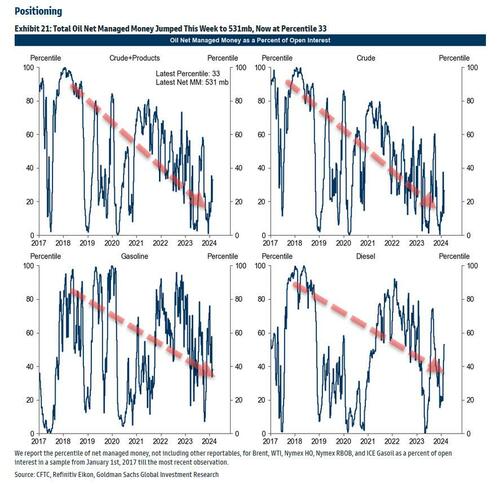
The benchmark Brent crude, which had initially rallied on the news close to $85.00 a barrel, plunged  into the $78 a barrel area, close to a $7.00 a barrel plunge in panic liquidation

Crude oil prices  plunged Friday after the Organization of Petroleum Exporting Countries and their allies (OPEC+) voluntarily agreed on a fresh production cut of nearly 1 million barrel a day by early 2024. Bringing total cuts close to  a whopping 3 milion barrels per day. The move failed to enthuse traders and, instead, drew scepticism on the group’s ability to achieve supply cuts target.

Hedge Funds remain unconvinced about the implementation of the supply cuts as the OPEC+ cartel, that consists of  80% of the world’s major oil-exporting nations, announced additional ‘voluntary cuts’ starting January 1 until the end of March 2024. The cuts were announced by each member country and not the group as a whole,  (which is not that unusual) drawing uncertainty on the group’s ability to maintain the cuts.

OPEC officials said additional voluntary cuts, designed to take the total reduction above 2.2 million barrels a day (bpd) or about 2 percent of the world supply, would be announced by individual members in due course rather than the secretariat, Financial Times reported.

In spite of Hegde fund AI spin,  global oil demand growth continues to remain strong defying challenges from high interest rates, stubborn inflation, slow economic growth and geo-political tensions. This growth is driven by demand normalization and China’s re-opening our binary trade.

Oil Drop on an OPEC+ Output Cut

OPEC+ Agrees on Significant Output Cuts Amid Market Uncertainty In a decisive move, OPEC+ members, led by Saudi Arabia, have agreed to substantial voluntary output cuts totaling about 2.2 million barrels per day (bpd) for early next year. This announcement, which emerged from the group’s online meeting, has sent ripples through the global oil markets. Despite the sizeable cut, benchmark global oil prices settled down by around 2%. This reaction is attributed to the voluntary nature of the reductions and prior investor expectations of even deeper cuts.

The total curbs, amounting to 2.2 million bpd, include an extension of the existing voluntary cuts by Saudi Arabia and Russia of 1.3 million bpd. The additional 900,000 bpd of cuts include 200,000 bpd of fuel export reductions from Russia, with the rest being divided among six other OPEC+ members. Saudi Arabia, Russia, the UAE, Iraq, Kuwait, Kazakhstan, and Algeria are among the producers who have agreed to unwind these cuts gradually after the first quarter of next year, depending on market conditions. Brazil Joins OPEC+, Boosts Bloc’s Clout Amid Cut Skepticism

The meeting also focused on discussing output for 2024, amidst forecasts of potential market surplus and weaker economic growth. The decision to invite Brazil, a top 10 producer, to join OPEC+ signifies a strengthening of the group’s influence in global oil production. NN: Their is everything to like here. You saw massive hedge fund computer driven market manipulation. Lest it run its course. OPEC  has spoken. The market is not listening. Every time they have done so its ended in tears.

Israel-Hamas ceasefire expires, rockets reported….. Netanyahu’s office: Israel committed to war goals

The ceasefire between Israel and Hamas expired on Friday with neither side confirming another extension. Meanwhile, Palestinian media reported explosions and gunfire in northern Gaza, and rocket sirens sounded in southern Israel. Hamas-controlled Palestinian Interior Ministry said Israeli “aircraft fly over Gaza and its vehicles open fire in the northwest of the Strip.” Hamas also said “intense armed clashes have renewed” in the northern Gaza Strip. On Thursday, Israeli Defense Minister Yoav Gallant said Israel “will resume fierce fighting across the whole Gaza Strip” as soon as the effort to return hostages is “maximized.”

Netanyahu’s office: Israel committed to war goals

Israeli Prime Minister Benjamin Netanyahu’s office said on Friday that with the return to fighting, Israel stands ready to achieve its war’s goals, which include the elimination of Hamas, the safe return of hostages, and ensuring that Gaza no longer poses a threat to Israeli residents. “The terrorist organization Hamas-ISIS violated the plan, did not live up to its duty to release all the kidnapped women today, and launched rockets at the citizens of Israel,” the prime minister’s office said in the statement. Namely, the days-long humanitarian pause between Israel and Hamas ended this morning with neither side confirming the extension of the agreement. The Israeli military confirmed the resumption of the aerial bombardment of the Gaza Strip. NN: My read is its only a matter of time before the war begins again. Israel is committed to wiping Hamas of the face of the earth.

Netanyahu: Nothing will stop Israel from destroying Hamas

Israeli Prime Minister Benjamin Netanyahu told United States Secretary of State Antony Blinken on Thursday that they “swore to destroy Hamas, and nothing is going to stop” Israel from that.

The remark came ahead of a meeting between both parties in Tel Aviv to discuss the latest developments in the war. Furthermore, Netanyahu told reporters that he was also going to discuss more details about “the next phase” of the fighting against Hamas with Blinken.

In addition to this meeting, Blinken, who is on a Middle East tour, also met with Palestinian Authority President Mahmoud Abbas and Israeli Opposition Leader Yair Lapid to discuss the war and “additional regional issues,” as quoted by Lapid’s office.

OPEC+ cuts total 2.2 million barrels per day

The Organization of the Petroleum Exporting Countries formally confirmed on Thursday that total voluntary cuts to the joint total production of the group and its allies will amount to 2.2 million barrels per day until the end of March 2024.

Saudi Arabia’s one million bpd and Russia with 500,000 bpd will be leading the way, followed by Iraq with 223,000 bpd, the United Arab Emirates with 163,000 bpd, Kuwait with 135,000 bpd, Kazakhstan with 82,000 bpd, Algeria with 51,000 bpd and Oman with 42,000 bpd.

“These voluntary cuts are calculated from the 2024 required production level as per the 35th OPEC Ministerial Meeting held on June 4 2023, and are in addition to the voluntary cuts previously announced in April 2023 and later extended until the end of 2024… Afterwards, in order to support market stability, these voluntary cuts will be returned gradually subject to market conditions,” OPEC pointed out.