Markets remain on edge, as data on inflation reinforced expectations of a Federal Reserve interest rate hike next week, and possibly in June. The personal consumption expenditures price index excluding food and energy, one of the Fed’s preferred inflation gauges, rose 0.3% in March for a second month. Compared with a year ago, the measure was up 4.6%. The overall PCE price index increased 0.1% from the prior month, restrained by a decline in energy costs, Commerce Department data showed Friday. “What looks like sticky contemporaneous inflation remains an issue, preventing the market from getting too carried away on the rate-cutting phase to come in subsequent quarters,”’ wrote Padhraic Garvey, head of global debt and rates strategy at ING Financial Markets. In Europe, an uptick in consumer-price gains points to more rate increases by the European Central Bank, which also meets next week. Seema Shah, chief global strategist at Principal Asset Management, sees stagflation as “by far” the worst case scenario for risk assets as says there is a “meaningful chance” for further rate hikes from the Federal Reserve beyond May. She speaks with Lisa Abramowicz on “Bloomberg Surveillance.” Analysts at Berenberg said equities’ strong year-to-date gains had been driven by resilient earnings and receding pessimism on economic growth, but “risks are skewed to the downside over the coming months, with headwinds from tighter policy, margin headwinds and US recession.
U.S. officials are coordinating urgent talks to rescue First Republic Bank (FRC.N) as private-sector efforts led by the bank’s advisers have yet to reach a deal, according to three sources familiar with the situation. The Federal Deposit Insurance Corporation (FDIC), the Treasury Department and the Federal Reserve are among government bodies that have in recent days started to orchestrate meetings with financial companies about putting together a solution for the troubled lender, the sources said. While the government has been in contact with First Republic and its advisers for weeks, its new involvement is helping bring more parties, including banks and private equity firms, to the negotiating table, one of the sources added. It is unclear whether the U.S. government is considering participating in a private-sector rescue of First Republic. The government’s engagement, however, has emboldened First Republic executives as they scramble to put together a deal that would avoid a takeover by U.S. regulators, one of the sources said. First Republic became the epicenter of the U.S. regional banking crisis in March after the wealthy clients it courted to fuel its breakneck growth started withdrawing deposits and left the bank reeling. U.S. officials view a private-sector deal as preferable to First Republic falling into FDIC receivership, two of the sources said. But many of the options proposed – including selling assets or the creation of a “bad bank” that would isolate its underwater assets – have so far failed to yield a deal, the sources added. Any solution would have to come with coverage for the losses First Republic or a potential acquirer of the bank would assume if there was a transaction. These losses would stem from First Republic’s loan book and fixed-income portfolio, whose low-yielding assets would be marked down to account for a rise in interest rates. The deal structure that stands the best chance of rescuing First Republic is a special purpose vehicle that would carve out some of the lender’s assets for other banks to buy, two sources familiar with the discussions said. Banks have been reluctant to purchase these assets at a market discount, and First Republic is hoping that U.S. officials can convince them to participate or provide some kind of government backstop for a deal, one of the sources said. CNBC reported on Friday, citing sources, that the government talks are now focused on preparing to put First Republic into FDIC receivership, and that such an outcome was likely. In receivership, an FDIC fund would assume any losses incurred through taking over First Republic’s underwater assets. The FDIC would then recoup those losses from all the banks contributing to its insurance scheme, without a hit on U.S. taxpayers. The sources requested anonymity because the discussions are confidential. “We are engaged in discussions with multiple parties about our strategic options while continuing to serve our clients,” First Republic said in a statement. The Treasury Department, Federal Reserve and FDIC declined to comment. Discussions for a deal took on new urgency this week after First Republic on Monday revealed it had deposit outflows of more than $100 billion in the first quarter. Although the bank said its deposits had stabilized, it disclosed that it was losing money because it had to replace the withdrawn deposits with interest-bearing funding from the Federal Reserve. First Republic is contemplating a major hit, and even a total loss for shareholders, as part of the options that would prevent U.S. regulators from taking it over, one of the sources said. First Republic shares have lost 95% of their value since the regional banking crisis started on March 8.
JPMorgan, PNC reportedly seek to buy First Republic
JPMorgan Chase & Co. and PNC Financial Services Group Inc. are in negotiations to acquire First Republic Bank, the Wall Street Journal reported. Earlier reports suggested that the embattled bank is likely to be taken into receivership by the United States Federal Deposit Insurance Corporation (FDIC). The sale could be announced “as soon as this weekend,” according to sources familiar with the matter. First Republic has lost over 74% of its stock value in a month and it revealed that its deposits plunged 40.8% in the first quarter compared to the previous trimester.
azon cloud warning takes shine off robust tech reports
Core PCE Inflation reinforces case for another Fed rate hike
US equity futures retreated as a rally in tech stocks lost steam and persistent inflationary pressures cemented expectations for higher rates in the US and Europe. Treasuries advanced. Contracts on the S&P 500 and the Nasdaq 100 slipped as Amazon.com Inc.’s warning after the market close on growth in its key cloud computing business soured the mood. Treasuries recouped some of Thursday’s losses, with the 10-year benchmark yield falling about seven basis points. The policy-sensitive two-year rate remained above 4%. Markets remain on edge, as data on inflation reinforced expectations of a Federal Reserve interest rate hike next week, and possibly in June.
The personal consumption expenditures price index excluding food and energy, one of the Fed’s preferred inflation gauges, rose 0.3% in March for a second month. Compared with a year ago, the measure was up 4.6%.
“What looks like sticky contemporaneous inflation remains an issue, preventing the market from getting too carried away on the rate-cutting phase to come in subsequent quarters,”’ wrote Padhraic Garvey, head of global debt and rates strategy at ING Financial Markets. In Europe, an uptick in consumer-price gains points to more rate increases by the European Central Bank, which also meets next week. Principal’s Shah Sees Prospect for Fed Hikes Beyond May Seema Shah, chief global strategist at Principal Asset Management, sees stagflation as “by far” the worst case scenario for risk assets as says there is a “meaningful chance” for further rate hikes from the Federal Reserve beyond May. She speaks with Lisa Abramowicz on “Bloomberg Surveillance.” Analysts at Berenberg said equities’ strong year-to-date gains had been driven by resilient earnings and receding pessimism on economic growth, but “risks are skewed to the downside over the coming months, with headwinds from tighter policy, margin headwinds and US recession.” On Thursday, US equities enjoyed the biggest daily gain since January, thanks to solid earnings from technology firms, including Meta Platforms Inc. and Intel Corp. That was before the Amazon warning and disappointing results from Snap Inc. and Pinterest.
S&P 500 futures fell 0.3% as of 8:40 a.m. New York time
Nasdaq 100 futures fell 0.2%
Futures on the Dow Jones Industrial Average fell 0.4%
The Stoxx Europe 600 was little changed
The MSCI World index was little change
The Bloomberg Dollar Spot Index rose 0.5%
The euro fell 0.6% to $1.0965
The British pound fell 0.3% to $1.2464
The Japanese yen fell 1.6% to 136.15 per dollar
The yield on 10-year Treasuries declined seven basis points to 3.45%
Germany’s 10-year yield declined 12 basis points to 2.34%
Britain’s 10-year yield declined seven basis points to 3.72%
West Texas Intermediate crude rose 0.8% to $75.38 a barrel
Personal consumption expenditures (PCE) increased by $8.2 billion in the United States in February compared to the previous month, the Bureau of Economic Analysis said on Friday. Personal income grew by $67.9 billion or 0.3% on a monthly basis. The PCE price index rose by 0.1% from February and 4.2% compared to March 2022. The PCE price index, excluding food and energy, also added 0.3% month-on-month and 4.6% annually. NN: Inflation is not dead. Inflation its not even wounded……
OPEC replied to a warning from the IEA to not cut production too much.
On Tuesday, OPEC issued a warning of its own to the IEA: your calls to stop investing in oil and gas is what could lead to future price volatility.
IEA Chief Birol said on Wednesday that the global economy is in a very fragile stage and that high oil prices were “the last thing that we want.
In response to the IEA’s warning made on Wednesday that OPEC should be careful not to cut too much production lest they jack up prices too high, the Organization of the Petroleum Exporting Countries (OPEC) issued a warning of its own to the IEA: your calls to stop investing in oil and gas is what could lead to future price volatility, OPEC said in a Thursday statement.
The IEA’s warning was simple: OPEC should be careful not to cut production too much, lest crude oil prices rise to the point where it stifles economic growth and pressures consumers into moving away from costly fossil fuels to renewable energy and EVs.
“The global economy is in a very fragile stage,” Birol said on Wednesday, adding that higher oil prices were “the last thing that we want.” Meanwhile, the IEA has spent the last few years becoming an unofficial champion of the energy transition movement.
OPEC declined to take the warning in stride, lashing out at the IEA with a press statement, arguing that “finger pointing and misrepresenting OPEC and OPEC+ actions is counterproductive,” stressing that blaming oil for inflation was erroneous and technically incorrect.
“The IEA knows very well that there are a confluence of factors that impact markets.” OPEC Secretary General Haitham Al Ghais said on Thursday. “The knock-on effects of Covid-19, monetary policies, stock movements, algorithm trading, commodity trading advisors and SPR releases (coordinated or uncoordinated), geopolitics, to name a few.”
“If anything will lead to future volatility, it is the IEA’s repeated calls to stop investing in oil, knowing that all data-driven outlooks envisage the need for more of this precious commodity to fuel global economic growth and prosperity in the decades to come, especially in the developing world.”
West Texas Intermediate steadied near $75 a barrel after closing 0.6 percent higher on Thursday. Investors see US inflation continuing to accelerate, bolstering expectations the Federal Reserve will be forced to keep raising rates, making a recession more likely. Falling refiner profit margins in Asia are also signaling demand weakness in the biggest oil-importing region. Crude has been whipsawed in April, rising sharply after the Organization of Petroleum Exporting Countries and its allies announced an output cut, but then giving up all those gains as the outlook deteriorated. A hoped-for major rebound in China is still yet to eventuate, while supply from Russia has remained surprisingly resilient despite sanctions and a price cap.
Traders will be on the lookout for first-quarter earnings from oil majors including Exxon Mobil Corp. and Chevron Corp. — due later Friday — which could provide commentary on the outlook for the global market.
Novak: OPEC+ sees no need for more oil production cuts
Russian Deputy Prime Minister Alexander Novak told reporters on Thursday that, at the moment, the Organization of the Petroleum Exporting Countries and its partners (OPEC+) don’t see a need for further slashes in the oil output. “We only made a decision [to cut the output] a month ago, and it will come into force from May for those countries that have joined,” Novak said answering one of the journalist’s questions and adding that OPEC+ can always adjust the volume of oil production if necessary. Previously, Saudi Arabia and other major oil suppliers announced surprise cuts that will start in May and last throughout the end of the year, slashing the output by roughly 1.15 million barrels per day. In addition, Russia revealed it would be extending its own cuts. BlackMask Pod Cast:
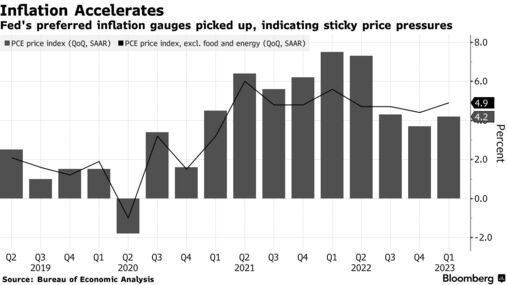
United States Treasury yields rose on Thursday after the latest GDP report showed that the personal consumption expenditures (PCE) price index rose by 4.2% in the first quarter of 2023 compared to a 3.7% increase documented in the fourth quarter of 2022.
The core PCE inflation, which the Federal Reserve uses as its main indicator of price growth, stood at 4.9% in the first trimester, up 0.5 percentage points from the final three months of 2022, further pointing to the possibility of another interest rate hike next week.
The return on the 10-year Treasury note was up 8.5 basis points to 3.515% at 12:44 pm ET. The yield on the two-year note soared 14.2 basis points to 4.066% at the same time. The return on the 30-year bond rose by 6.7 basis points to 3.756% at 12:45 pm ET.
Inventories dented GDP, tempering surge in consumer spending
Fed’s preferred underlying price gauge rose more than forecast
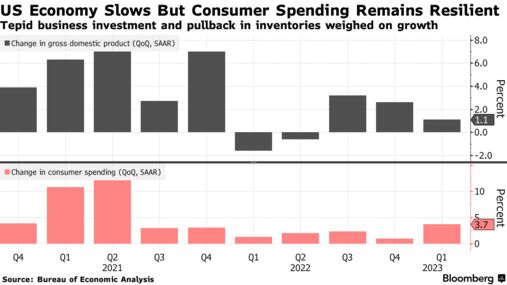
US economic growth slowed in the first quarter by more than expected as tepid business investment and a pullback in inventories tempered a pickup in consumer spending.
Gross domestic product rose at a 1.1% annualized rate on the back of the strongest consumer spending in nearly two years, the Commerce Department’s initial estimate showed Thursday. The Federal Reserve’s preferred underlying inflation metric accelerated to a one-year high. The 3.7% increase in consumer spending reflected gains in both goods and services, including a surge in purchases of motor vehicles. Business investment in equipment posted the biggest drop since the start of the pandemic and inventories subtracted the most from GDP in two years.
The figures illustrate economic growth that is gradually downshifting under the weight of Fed interest-rate hikes and elevated inflation. While the economy bounded ahead at the start of the year, helped in part by unseasonably warm weather, households and businesses pulled back on spending as the quarter progressed. The outlook depends largely on the resiliency of the job market. Low unemployment and persistent wage gains have so far allowed consumers to weather high inflation and keep spending.
The personal consumption expenditures price index grew at an 4.2% annualized pace in the January to March period. Excluding food and energy, the index rose 4.9%, faster than forecast and the most in a year.
March data will be released Friday. Services inflation remained hot while prices of non-durable goods accelerated. The inflation and consumer spending figures likely keep the Fed on track to raise interest rates by a quarter percentage point next week. First Republic Bank’s continuing struggles, however, do raise the possibility that the central bank could pause.
“Inflation remains stubborn, and along with the continued strength in the labor market, it should keep the Fed on pace for a May and potentially a June rate hike,” said Cliff Hodge of Cornerstone Wealth. The median projection in a Bloomberg survey of economists called for 1.9% GDP growth and a 4% annualized gain in personal consumption. The S&P 500 opened higher, Treasury yields jumped and the dollar strengthened after the release. Separate data out Thursday showed applications for unemployment benefits fell for the first time in three weeks. Continuing claims, which can offer insight into how quickly out-of-work Americans are able to find a new job, were largely unchanged. While a recession isn’t assured, many economists — including those at the Fed — expect the cumulative effect of monetary tightening, a retrenchment in business investment, a slowdown in consumer spending and tightening credit conditions to ultimately tip the economy into a downturn. “Recent data signal that soft economic growth continues into the second quarter,” said Kathy Bostjancic, chief economist at Nationwide.
“Meanwhile inflation, especially at the core services level remains elevated and sticky – an unfavorable mix of slower growth but still high inflation.”
The GDP data showed services spending rose at a 2.3% annualized rate, led by health care and restaurants and hotels. Outlays on goods increased at a 6.5% rate, the most in nearly two years. Inflation-adjusted spending data for March, and any revisions to prior months, will also be released Friday.
What Bloomberg Economics Says…
“The US economy is stronger than meets the eye, with consumers continuing to spend on both goods and services. While GDP grew just 1.1% overall in the first quarter, final sales to domestic purchasers rose a much stronger 3.2%, dispelling recessionary fears for now.”
— Eliza Winger, economist
The slowdown in business investment reflected a drop in equipment purchases and the smallest gain in intellectual property outlays in nearly three years. Many companies are dialing back investment plans in the face of tighter credit conditions and recession concerns. Economists generally see a significant pullback in capital spending as a key factor of any downturn this year. Stripping out those components, inflation-adjusted final sales to private domestic purchasers — a key gauge of underlying demand — increased by the most since the second quarter of 2021 after stagnating at the end of last year. The figure was boosted by strong consumer spending. NN: inventories subtracted 2.26 percentage points from GDP during the period. If we take out the flukey inventory slow down and GDP was up 3.3%. Core inflation as measured by the Feds FAVORITE INDEX the PCE shows inflation increasing and running at whopping 4.9%.
U.S. consumer confidence falls to nine-month low in April
Russian refineries increase output as fuel exports rise
Oil prices rose slightly on Thursday, finding some support after heavy losses in the previous two sessions that were driven by fears of a U.S. recession and an increase in Russian oil exports which dulled the impact of OPEC production cuts. Oil prices dropped almost 4% on Wednesday extending sharp losses in the previous session with recession fears overshadowing a bigger-than-expected fall in U.S. crude inventories. As of Wednesday’s close, Brent is down 4.9% for the week while WTI has lost 4.6%. “Crude prices remain heavy following the plunge below the $80 level as too much demand destruction hit the US economic outlook,” said Edward Moya, an analyst at OANDA, adding that the OPEC was right to cut output earlier this month. “Oil is trying to find a floor and the only thing that could provide some support is technical buying,” Moya said. New orders for key U.S.-manufactured capital goods fell more than expected in March and shipments declined, indicating that depressed business spending on equipment likely pulled back economic growth in the first quarter. OPEC’s share of India’s oil imports fell at the fastest pace in 2022/23 to its lowest in at least 22 years as intake of cheaper Russian oil surged, while China is also ramping up buying of Russia’s Urals oil. Oil loading from Russia’s western ports in April will be the highest since 2019, above 2.4 million barrels per day, despite Moscow’s pledge to cut output. Energy Information Administration (EIA) data showing U.S. crude inventories fell last week by 5.1 million barrels to 460.9 million barrels helped to limit the price fall, far exceeding analyst forecasts of a 1.5 million drop in a Reuters poll. Gasoline and distillate stocks also drew down, sinking by 2.4 million barrels to 221.1 million barrels and almost 600,000 barrels to 111.5 million barrels, respectively, the EIA said.
“The complex appears more focused on a recession rather than some current EIA statistics that have generally been tilting bullish,” said Jim Ritterbusch of consultancy Ritterbusch and Associates.
A forecast of higher refinery activity, but lower crude exports, will continue a push and pull for weeks. “Refinery runs are set to climb in the weeks ahead, boosting the demand side of the ledger, but countering this is the expectation of lower crude exports, as the tightening of the Brent-WTI spread weighs on buying appetite,” Matt Smith, lead oil analyst for the Americas at Kpler, said. Oil prices have erased all their gains since the Organization of the Petroleum Exporting Countries (OPEC) and producer allies such as Russia, known collectively as OPEC+, announced in early April an additional output reduction until the end of the year. Russian Deputy Prime Minister Alexander Novak said on Wednesday that OPEC+ remains an efficient tool for coordination. Oil prices fell more than 2% on Tuesday as lingering economic concerns and expectations of further interest rate hikes that could curtail fuel demand growth countered signs of improving short-term consumption gains. Investors also are concerned potential interest rate hikes by inflation-fighting central banks could slow economic growth and dent energy demand in the United States, Britain and the European Union. The U.S. Federal Reserve, the Bank of England and the European Central Bank are all expected to raise rates at their coming meetings. The Fed meets over May 2-3. NN: Despite all the blow and go the US and for that matter the global economy is not in a recession. In fact global GDP is up in all civilized countries.. AND demand and consumption is increasing… I jut sit aside and watch the circus and pick off as much cheap oil as i can…. Lets ride this bucking bronco. Ride them cow boy!