The OPEC+ group is studying the causes of the decline in world oil prices, will monitor the situation to understand the reasons, Russian Deputy Prime Minister Alexander Novak said on Wednesday
MINERALNYE VODY (UrduPoint News / Sputnik – 03rd May, 2023) The OPEC+ group is studying the causes of the decline in world oil prices, will monitor the situation to understand the reasons, Russian Deputy Prime Minister Alexander Novak said on Wednesday. “We will monitor the market. We will monitor the situation. We need to understand the reasons, the prospects. How it will develop further, it may be short-term,” Novak said, commenting on the question about the current situation with world oil prices on the sidelines of the Caucasian Investment Exhibition.
The Federal Open Market Committee (FOMC) of the United States Federal Reserve announced on Wednesday that it will raise the federal funds rate target range by a quarter percentage point to between 5% to 5.25%.
“The Committee would be prepared to adjust the stance of monetary policy as appropriate if risks emerge that could impede the attainment of the Committee’s goals,” the policymakers underscored in the statement, adding that the economic activity in the country moderately expanded during the first quarter, but warned that inflation still remains “elevated.” “Job gains have been robust in recent months, and the unemployment rate has remained low,” the policymakers added.
Treasury yields remained lower on Wednesday after Federal Reserve policy makers delivered a widely expected quarter percentage point interest rate hike that pushed its policy rate above 5% and left the door open for additional action if needed.
Crude oil prices continued lower after the Energy Information Administration reported yet another weekly inventory draw on crude oil inventories. The report came a day after the American Petroleum Institute estimated inventories had shrunk by almost 4 million barrels in the week to April 28. The EIA estimated inventories had shed 1.3 million barrels in the period, which compares with a draw of 5.1 million barrels for the previous week. Whatever the size of the draw, it was unlikely to move prices, however, as worry about the U.S. economy appears to currently be the dominant mood on the oil market and a build in gasoline stocks didn’t help. The Fed is expected to announce another rate hike later today and Congress is locked in debt ceiling negotiations, neither of which is bullish for oil prices. A decline in diesel demand is also not bullish, as it suggests a slowdown in U.S. economic growth. On the flip side, it has brought some relief to those worrying about a middle distillate shortage. Now, there are signs that gasoline demand may be on its way down, too, with driving season around the corner. In the week to April 28, gasoline inventories rose by 1.7 million barrels, with production averaging 9.4 million barrels. This compared with an inventory draw of 2.4 million barrels for the previous week and average daily production of 10 million barrels. In middle distillates, the EIA said, inventories had shed 1.2 million barrels in the week to April 28, with production averaging 4.6 million barrels daily. In the previous week, middle distillate inventories saw a modest draw of 600,000 barrels, with production averaging 4.7 million barrels daily. Meanwhile, oil prices continued lower, with West Texas Intermediate dipping below $69 per barrel at the time of writing, and Brent crude a little over $72 per barrel. While some argue that the next Fed rate hike has already been factored in oil prices—and it may well be—the recent collapse of First Republic Bank did nothing to change a pessimistic sentiment as fears were reignited of a knock-on effect across the banking industry. This is naturally weighing on crude oil prices, which means they may yet fall further despite OPEC+’s production control measures.
While some analysts started talking about $100 after the surprise OPEC+ cuts, Morgan Stanley is cutting its price forecasts for this year and next, viewing the latest move as a probable admission from the biggest producers in OPEC+ that demand may not be doing too well in the coming months. “OPEC probably needs to do this to stand still,” Martijn Rats, chief commodity strategist at Morgan Stanley, says, as carried by Forexlive. However, the decision “reveals something, it gives a signal of where we are in the oil market. And look, let’s be honest about this, when demand is roaring…then OPEC doesn’t need to cut,” Rats noted. So the U.S. bank cut its Brent Crude forecast for the second quarter of 2023 to $85 from $90 a barrel previously expected. The third-quarter forecast was also cut by $5 a barrel—to $90 from $95, while the fourth-quarter price estimate was slashed to $87.50 from $95 per barrel. Morgan Stanley also slashed its forecast for Brent’s 2024 average to $85 from $95 a barrel. Citigroup doesn’t see $100 oil soon, either. Oil prices are not going anywhere near $100 per barrel despite the latest production cuts announced by members of the OPEC+ group, as U.S. supply growth and uncertainty in the Chinese demand growth path will keep the market fairly balanced, Ed Morse, global head of commodities research at Citigroup, told Bloomberg on Monday. While Citi and Morgan Stanley are more bearish on oil, Goldman Sachs and Energy Aspects have turned more bullish after the shock OPEC+ announcement.
The surprise OPEC+ cuts are making oil balances look “insanely bullish” for later this year, provided that the global economy holds up, Amrita Sen, founder and director of research at Energy Aspects, told CNBC on Monday.
Goldman Sachs, for its part, on Monday raised its Brent Crude forecast to $95 from $90 at the end of the year. The bank also raised its Brent Crude forecast for 2024, now seeing it at $100 at the end of the year from an earlier projection of $97. NN:For the record i believe oil will be at $100 before the end of the year..
Iraq slumps 250,000 barrels a day amid spat with Kurds
Nigeria rebound fizzles as Exxon reneges on shipments
Iran oil workers join nation wide strick
OPEC’s oil production fell last month as Iraq’s exports were reduced by a pipeline suspension while a labor strike cut shipments from Nigeria.
Output from the Organization of Petroleum Exporting Countries declined by 310,000 barrels a day to an average of 28.8 million, the lowest level in almost a year, according to a Bloomberg survey.
OPEC and its allies have announced new production cutbacks starting this month to shore up global oil markets, but the biggest supply changes in April were unintentional. Iraq accounted for about 80% of the drop. A political spat between the central government in Baghdad and the semi-autonomous Kurdistan region has led to the halt of a pipeline that normally carries 500,000 barrels a day to international markets via Turkey. In Nigeria, a production recovery seen in the run-up to presidential elections has fizzled, with industrial action forcing Exxon Mobil Corp. to renege on shipments from several terminals last month.
Still, the supply losses by OPEC and its allies — both deliberate and accidental — are barely propping up an oil market that’s being roiled by fears over economic growth in China and the wider world.
Crude futures briefly sank below $72 a barrel in New York on Tuesday to the lowest since March. While group leader Saudi Arabia drew another rebuke from the White House when the latest curbs were unveiled April 2, the move is looking increasingly prescient as oil prices sag. Production from the full 23-nation OPEC+ alliance should decline by another 1.2 million barrels a day this month as those new curbs take effect. Russia, another member of the OPEC+ coalition, also announced cutbacks in response to sanctions over its invasion of Ukraine, but the implementation so far remains unclear. In terms of supplies in April, the largest adjustments were involuntary. Iraq’s output slumped by 250,000 barrels a day to 4.13 million — the lowest since late 2021 — after Turkey suspended the northern pipeline following a ruling by an international business tribunal. While Baghdad and Kurdish authorities have struck a temporary deal to get oil flowing again, “technical matters” are delaying the restart. Nigeria retreated by 120,000 barrels a day to 1.32 million, the survey showed, reversing a surge seen earlier this year when the country reached an accord with a former warlord in the oil-rich Niger Delta region. Workers at Exxon Mobil facilities in the country returned to work last week, allowing production and exports to resume after a two-week industrial action. Bloomberg’s survey is based on ship-tracking data, information from officials and estimates from consultants including Kpler Ltd., Rapidan Energy Group and Rystad Energy. OPEC+ is due to meet June 4 to review production levels for the second half of the year. NN: Oil inventories continue to drop. We are still in refinery maintenance season. As usual the markets got it wrong. Hopefully we can stand this latest plunge, What the FED does and says will have a impact
IMF Says China Has Space to Keep Monetary, Fiscal Policy Loose
China has scope to keep monetary and fiscal policy supportive to help strengthen the economy’s recovery, a top International Monetary Fund official said. “China has the policy space to keep monetary policy accommodative because inflation is very much muted,” Krishna Srinivasan, the IMF’s director for Asia Pacific, told reporters in Hong Kong on Tuesday. “It also has the fiscal space to provide support.” The world’s second-largest economy grew at the fastest pace in a year in the first quarter, although more recent data for April shows the recovery may have lost some steam, particularly in manufacturing. Analysts have been debating whether the economy needs more stimulus or if the rebound in growth will prompt policymakers to begin scaling back support. Chinese leaders signaled last week they’ll stick to their relatively loose stance for now. Srinivasan cautioned against reading too much into the weekly or monthly economic data, adding that the “dynamism of China’s economy is pretty strong.” Beyond that, though, policymakers will need to address longer-term challenges, especially in the property market, he said. Thomas Helbling, deputy director for the IMF’s Asia Pacific department, said China’s support for real estate developers have benefited the stronger ones, and “what remains to be addressed are the weaker developers, which are still softening.” The IMF has called on the government to do more to “pro-actively support restructuring of weak developers,” he said.
JPMorgan Chase & Co. will protect all insured and uninsured deposits for customers at First Republic Bank as part of its acquisition of the bank, the merging financial institutions said Monday.
As JPMorgan Chase JPM announced its win in a government-led auction of First Republic Bank, the bank said it would step in starting Monday to serve all of the clients of the bank and protect its deposits. NN: Talk about a sweetheart insider deal. All together they take over 500 billion with assets and no liabilities……. 50 billion in FDIC preferred infusion of financing at a fr 7 years free money rate for 7 years…
The deal allows for an orderly failure of First Republic and avoids regulators having to insure all the bank’s deposits, as they had to do when two others collapsed in March. First Republic disclosed last week that it had suffered more than $100 billion in outflows in the first quarter and was exploring options, increasing stress in the banking sector. Global banking has been rocked by the closure of Silicon Valley Bank and Signature Bank in March, while Switzerland’s Credit Suisse had to be rescued by rival UBS. First Republic shares tumbled 43.3% in premarket trading on Monday before they were halted. The bank’s stock has lost 97% of its value this year. JPMorgan shares rose 2.7%. “When it was just SVB, it was easy to blame management. However, now that we see the pattern it is evident that the Fed has moved too far, too fast and is breaking things,” said Thomas J. Hayes, Chairman and Managing Member, Great Hill Capital. The U.S. Federal Reserve has been persistently raising its benchmark interest rate since last year, despite calls for a pause after the banking turmoil in March. Investors have priced in a 90% chance of another 25 basis point rate hike after the central bank’s two-day policy meeting on Wednesday, according to CME Group’s FedWatch tool. JPMorgan was one of several interested buyers including PNC Financial Services Group, and Citizens Financial Group Inc, which submitted final bids on Sunday in an auction by U.S. regulators, sources familiar with the matter said. PNC shares were 2.5% lower in premarket trading. The California Department of Financial Protection and Innovation said it had taken possession of First Republic and the FDIC would act as its receiver. The FDIC estimated in a statement that the cost to the Deposit Insurance Fund (DIF) would be about $13 billion. The final cost will be known when the FDIC ends the receivership. The U.S. Treasury Department welcomed the resolution, saying it was done at “least cost” to the DIF. JPMorgan has assumed all of the bank’s deposits, it said, and will repay $25 billion of the $30 billion big banks deposited with First Republic in March. New York-based JPMorgan will take on $173 billion of loans, $30 billion of securities and $92 billion of deposits. The acquired businesses will be overseen by JPMorgan’s Consumer and Community Banking (CCB) Co-CEOs, Marianne Lake and Jennifer Piepszak, it said in a statement. The rescue comes less than two months after a deposit flight from U.S. lenders forced the Fed to step in with emergency measures to stabilize markets. Those failures came after crypto-focused Silvergate voluntarily liquidated. “Our government invited us and others to step up, and we did,” said Jamie Dimon, JPMorgan Chairman and CEO. “Our financial strength, capabilities and business model allowed us to develop a bid to execute the transaction in a way to minimize costs to the Deposit Insurance Fund.” JPMorgan said it expected to achieve a one-time, post-tax gain of approximately $2.6 billion after the deal which did not reflect an estimated $2 billion dollars of post-tax restructuring costs likely over the next 18 months. It said the bank would be “very well-capitalized” with a common equity tier one (CET1) ratio consistent with its 13.5% first quarter 2024 target and keep healthy liquidity buffers. The failed bank’s 84 offices in eight states will reopen as branches of JPMorgan Chase Bank from Monday, it added JPMorgan has been on a buying spree since 2021, acquiring more than 30 companies in deals totaling more than $5 billion. U.S. regulators have been slow to approve large bank deals in recent years, while the Biden administration has also cracked down on anti-competitive practices.
Dimon: First Republic takeover doesn’t change recession odds
JPMorgan Chase & Co. CEO Jamie Dimon said on Monday during a media call that the acquisition of the First Republic Bank “hasn’t changed the odds of a recession” in the United States. However, the agreement “has stabilized the system,” he went on to say, adding that it is now “very very sound.” Dimon noted that he expects more consolidation in the banking sector. The JPMorgan chief previously revealed in a statement that upon the request of the US government to “step up,” his company did exactly that. “Our financial strength, capabilities and business model allowed us to develop a bid to execute the transaction in a way to minimize costs to the Deposit Insurance Fund,” Dimon commented. The Federal Deposit Insurance Corporation (FDIC) earlier estimated that this cost will amount to approximately $13 billion. NN: This is not over;;;; All they did was buy some time. And they paid a lot of money to accomplish that.
Banks are saddled with bad loans, signaling trouble ahead in the US commercial property market, Berkshire Hathaway Inc.’s Charlie Munger told the Financial Times in an interview. Despite Berkshire’s long history of supporting US banks in times of turmoil, the company stayed on the sidelines after the collapse of Silicon Valley Bank and Signature Bank. Some of the reticence came from risks lurking in banks’ large portfolios of commercial property loans, he said. “A lot of real estate isn’t so good any more,” the Berkshire vice-chair told the Financial Times. “We have a lot of troubled office buildings, a lot of troubled shopping centers, a lot of troubled other properties. There’s a lot of agony out there.” “Every bank in the country is way tighter on real estate loans today than they were six months ago,” Munger added.
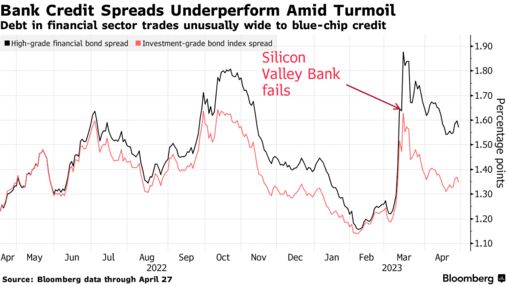
The third domino is falling First Republic Bank has lit up the radar screen. Like most dump shit bankers they locked in their capital at 1% interest rates… To show how fucked in the head they are as they sought gender equality and rescue people trapped in the wrong body. They forgot their job was to manage a bank. They saw inflation soar and the FED raise rates at the fastest rates in 50 years they were caufght at climate change rally. Think about it… Did they say to theselves mabe we should hedge our interest rate wise exposure? SO they locked in their capital for 10 years at under 1 percent. And lent long avaerage 7 years at 3%. Now their cost of funs is 5% an not only are they under water but they are 1000 feet underwater. Their solution is to increased emergency borrowing from the Federal Reserve for the second week in a row in a sign of the ongoing stress in the system. Last week, the New York Fed reported that financial conditions in its region had deteriorated sharply. This is proof that a credit crunch is underway. And it further complicates the plan for next week’s Fed policy meeting, where officials have to figure out how to balance the risks of tighter borrowing conditions against stubbornly high inflation. Below are six charts that help explain why and how borrowing is getting harder in vast parts of the economy: “Lending from U.S. banks is poised to contract over the next few quarters,” Amanda Lynam, head of macro credit research at BlackRock Financial Management wrote in a note on Thursday. Headwinds to profitability including higher deposit costs have seen bank spreads underperform relative to non-financials, she wrote.
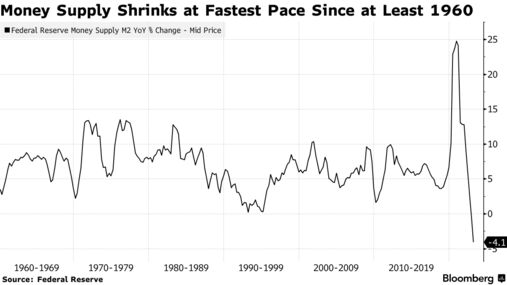
The blow to credit availability comes as the money supply shrinks, a sign that the spike in interest rates by the Fed is causing money to exit the banking system, shrinking the availability of loans. That could slow the economy, with monetarist economists suggesting it could herald a crash and deflation. The Dallas Fed and the San Francisco Fed last week reported pressure on funding in their geographic regions, with projects being canceled and nonperforming loans expected to increase.
Banks that posted quarterly results this month said they boosted provisions on bad consumer loans to levels not seen since the early days of the pandemic. For example, Capital One Financial Corp. increased its provision for credit card losses by more than 300% to $2.26 billion compared with a year earlier. The firms have generally said the rising provisions are just consumers returning to pre-pandemic norms.
Banks are writing off bad debt and setting aside additional reserves amid worsening macroeconomic conditions
Source: Bloomberg data
Capital One also set aside more money to cover souring office loans, as vacancies rise and many workers choose to work from home. Morgan Stanley has previously estimated that office property valuations could fall as much as 40% from peak to trough, increasing the risk of defaults.
The lenders are the biggest credit provider in each real estate category
Source: MSCI
Another emerging source of stress in credit is the leveraged loan market as corporate borrowers with floating-rate debt struggle to keep pace with higher borrowing costs. The amount of loans trading at distressed prices, defined as below 80% of face value, has jumped 26% to about $127 billion since the end of February, according to data compiled by Bloomberg. That compares with a 10% increase for bonds to about $488 billion. “We believe the loan market, which has historically had a lower default rate than the high yield bond market, will record a higher rate during this cycle,” Armen Panossian and Danielle Poli, managing directors at Oaktree Capital Management LP, wrote in a memo last week. “This is due to the covenant-lite nature of most loans and the rising prevalence of loan-only capital structures.”
You can expect defaults to rise especially in leveraged loan market
Sources: Moody’s Investors Service, Bloomberg
Company executives worldwide, meanwhile, are talking about credit on conference calls at the highest rate since the pandemic hit, according to data compiled by Bloomberg News. Some mentions include Evercore Inc.’s Chief Executive Officer John Weinberg noting an increase in restructuring and liability management business and Peabody Energy Corp. investor relations vice president Karla Kimrey saying the company has positioned itself to avoid uncertain credit markets.
Bosses Are Talking About Credit Like They Did at Start of Pandemic
Source: Bloomberg analysis of calls including earnings, sales and M&A
What to watch in the days ahead:
Dealers surveyed by Bloomberg are expecting $30 billion to $35 billion of US high-grade corporate bond sales this coming week. In Europe, 61% of survey respondents expect sales to be more than €20 billion ($22 billion).
The Federal Reserve announces its latest interest-rate policy decision on May 3, and the European Central Bank on May 4.
The Milken Institute’s global conference kicks off Sunday, April 30, in Beverly Hills, California.
For an in-depth look at the data and events around the world that could impact market sentiment this week, see this on the Bloomberg terminal and choose a region.
The leveraged finance market is springing back to life in the US and Europe, as yields show signs of calming down and investors clamor for debt to buy. Recent issuance of loans and high yield bonds in Europe made for the busiest two-week period since February 2022, according to data from Goldman Sachs Group Inc.
Italian lender UniCredit SpA is exercising its option to redeem an additional tier 1 bond early — marking the first major test for a market shaken by the historic writedown of Credit Suisse Group AG notes. The bank will repay the €1.25 billion ($1.38 billion) note at face value on June 3, sticking with the market convention of calling such bonds at the first opportunity.
China Evergrande Group’s long-awaited offshore debt restructuring plan has yet to win enough support, leading the firm to extend by three weeks a deadline for debtholders to receive compensation for backing the plan.
As its bonds drop to new lows, Dalian Wanda Group’s chairman acknowledged during a management gathering difficulties facing the conglomerate, including a delayed initial public offering of its mall operator unit. Fitch placed Wanda’s rating on negative watch Friday, citing uncertainty of the IPO.
The rising cost of borrowing over the last year has pushed even investment-grade US companies to look at convertible bond sales. More than a quarter of US convertible issuance in the first quarter was from high-grade issuers, up from 7% in the same period last year.