U.S. Official Calls For Higher Global Oil Production

  • Speaking on the sidelines of CERA Week, a State Department official said that the United States wants an increase in global oil production.
  • While oil prices have fallen significantly in recent months, prices remain higher than they were before the pandemic.
  • The biggest problem for global oil markets appears to be a lack of spare capacity, and the U.S. is also struggling with very low strategic reserves.

The United States wants to see the world producing more crude oil, including OPEC members. This is what a State Department official said on the sidelines of CERAWeek, noting that the global economy is recovering and more supply is necessary to meet demand.

“As world economies recover, we’ll see more consumption. And therefore we’d like to see supply meet demand,” Jose Fernandez, Undersecretary of State for Economic Affairs, Energy and the Environment, said, as quoted by the AFP.

He then went on to add that this included output from OPEC+, which last year agreed to slash production by around 1 million bpd and has signaled it has no immediate plans to reconsider that agreement. The AFP report notes that although oil prices have retreated from highs reached last year in the first months after Russia’s invasion of Ukraine, they are still quite a bit higher than they were before the pandemic. The Biden administration released close to 200 million barrels from the strategic petroleum reserve to counter the price rally, which caused a spike in retail fuel prices – a move that prompted various reactions from experts.

Now, the SPR is at 40-year lows and needs to be replenished but prices are too high for the U.S. federal government. The bigger and more global problem, however, is spare production capacity.

This capacity was among the issues that U.S. energy executives and OPEC delegates discussed on the first day of CERAWeek. According to a Reuters report quoting one attendee, both executives and OPEC officials were concerned about spare oil production capacity and its sufficiency to meet growing oil demand.

Some analysts have forecast that the global oil market will swing into a deficit in the second half of the year,

driven by China’s recovery, which will push global demand higher while supply lags behind. NN: its a

BINARY Trade

Saudi Aramco Hikes Oil Prices Once Again

Saudi Aramco raised the official selling price for the crude oil it exports to Asia and Europe for yet another month, with the flagship Arab Light to sell in April for $0.50 more than in March.

The price hike for Arab Heavy was even more pronounced, at $2.50 per barrel, moving the crude blend from a discount to the Oman/Dubai average to a premium. In a report, Reuters noted that the price hikes come as several new refineries in Saudi Arabia are set to soon begin operating, and this would shrink the amount of crude available for exports. This is the second consecutive month with higher prices for Saudi crude. Last month’s hike came as a surprise as it was the first time in six months that Aramco had hiked prices for its crude. The March price hike also came amid falling crude oil prices on international markets, which was what made the move surprising, along with the fact that a month ago Aramco had reduced prices. Yet now, despite continued concern for the state of the global economy, China is beginning to return to normal operation, eyeing economic growth of 5% this year, which has motivated a return of optimism among oil bulls. Oil prices, meanwhile, started the week with a decline. One reason for this was the fact that analysts had expected China to set itself a higher growth target for the year. Another was the anticipation of a testimony Fed’s chairman Jerome Powell will be delivering to Congress later this week, in which he will signal if there will be further rate hikes this year. “Crude remains in a tug-of-war between optimism over Chinese reopening and nervousness over a hawkish Fed hurting the U.S. economy,” energy analyst Vandana Hari told Reuters. NN: This is a easy trade and a binary one. The markets job is to add confusion. Simple China is increasing its consumption by 1 million barrels per day. And the FED has failed, rates are not high enough yet to shut down the run away inflating economy. The BINARY trade is obvious.


Forget Peak Oil Demand: A Thirst for Barrels Puts $100 in View

  • China’s consumption is soaring as Covid restrictions ease
  • Global oil demand heads for a record despite energy transition

As Covid-19 lockdowns gripped the world in 2020, Bernard Looney, chief executive officer of BP Plc, made a startling admission: He thought that oil demand might never return to its pre-pandemic peak. But recently, Looney has done an about-face. After announcing ambitious plans to cut emissions, BP, one of the world’s top crude producers, is now plowing more money into fossil fuels. Oil consumption is heading for a record this year, according to the International Energy Agency, which advises major economies. Supply — buffeted by Russia’s invasion of Ukraine, a slowdown in US shale growth and lackluster investment in production — can’t keep up.It all comes down to China: The world’s second-biggest oil consumer is snapping up crude after reversing its strict Covid-19 policies. Against a backdrop of tight supply, the demand boost has everyone from Goldman Sachs Group Inc. to trading powerhouse Vitol Group predicting a rally to $100 a barrel later this year.

The demand from China is very strong,” Amin Nasser, CEO of Saudi Aramco — the world’s biggest oil company — said in a March 1 interview in Riyadh. 

By the second half of the year, analysts say, the market will face a shortage — a scenario that will loom over the industry leaders meeting this week in Houston for CERAWeek by S&P Global, a major annual energy conference. The impending crunch shows that even as the world embraces cleaner sources of energy, the thirst for oil is hard to slake. While the supply pinch has been a boon for crude producers and their investors, it’s hammering consumers and complicating central banks’ efforts to tame inflation. “My view, short hand, is maybe people are underestimating demand and overestimating US production,” Saad Rahim, chief economist at trader Trafigura Group, said on the sidelines of the International Energy Week conference in London last week.

Oil Demand in China Seen at Record in 2023 In the wake of its abrupt reversal of Covid Zero — the policy requiring mass lockdowns, travel quarantines and testing and tracing — China’s economy is resurgent, boosting oil demand. Manufacturing posted its biggest improvement in more than a decade last month, services activity is climbing and the housing market is stabilizing.

The reopening means Chinese oil consumption is poised to hit a record this year. Daily demand will reach an all-time high of 16 million barrels a day after contracting in 2022, according to the median estimate of 11 China-focused consultants surveyed by Bloomberg News earlier this year.  It’s not just China. India and other countries across the Asia-Pacific region are consuming more oil as borders reopen, helping propel global demand to a record 101.9 million barrels a day this year and potentially plunging the market into a deficit by the second half, according to the IEA. Air traffic is recovering, boosting jet-fuel use. And the appetite for crude in the US and Europe has also rebounded. The revival of international travel with China’s reemergence will be one of the “engines that will drive demand going forward,” Christopher Bake, a member of Vitol’s executive committee, said at the International Energy Week conference. “I think we’ll see that progress over the next few months.” Supply is no match for the uptick in demand. Though Russia’s oil exports by sea remained resilient last month, market watchers are looking for signs of disruption after the European Union and the majority of Group of Seven nations banned waterborne imports of oil and fuel following the invasion of Ukraine. Russia’s shipments are under threat as India, a top buyer, faces mounting pressure from bankers to show that its cargoes comply with the $60-a-barrel price cap imposed by the G7. OPEC, meanwhile, isn’t budging from the production targets it set back in October. Saudi Arabian Energy Minister Prince Abdulaziz bin Salman has said the targets will remain unchanged for the rest of the year.

OPEC Supply Slips From Last Year's High

And the US isn’t coming to the rescue. Output from shale basins is growing at a slower pace as producers run out of prime areas to drill. US production tumbled at the start of the pandemic and is still about 800,000 barrels a day below the record 13.1 million reached in early 2020. This year, growth is likely to be around 560,000 barrels a day, according to research firm Enverus.  The deceleration comes even as Exxon Mobil Corp., Chevron Corp. and their peers pump more oil from the Permian Basin of West Texas and New Mexico. Chevron CEO Mike Wirth told Bloomberg Television March 1 that global spare production capacity is tight and US shale supply growth is unlikely to make up the shortfall if demand picks up later this year, leaving OPEC as the world’s swing producer. “As we get into the second half of this year the risks to the upside begin to accumulate,” Wirth said.  Potential headwinds for oil demand are lurking, however. Fears of a global recession are lingering as central banks tighten monetary policy in their quest to tackle inflation. Though Natasha Kaneva, JPMorgan’s global head of commodities research and strategy, is bullish on China’s crude consumption, she predicts the increase in prices could be a “very slow grind.” In late February, some Wall Street analysts tempered their predictions of a price spike this year. Morgan Stanley cut its forecasts for the second half and softened its view that Brent crude will surge past $100 a barrel, while Bank of America Corp. says it sees less risk of a price jump due to the strength of oil flows from Russia. Brent, the global benchmark, traded near $85 a barrel on Friday.  Even so, analysts see crude prices advancing in the second half of the year, with many predicting a return to triple-digit levels for Brent for the first time since August. China’s reopening will strain global spare production capacity, sending prices to $100 a barrel in the fourth quarter as inventories decline and money supply stabilizes, Jeff Currie, Goldman’s head of commodities research, said in a Bloomberg Television interview March 1.  “As China comes back, we’re going to lose that spare capacity,” Currie said. “My confidence that we’ll see another price spike in the next 12-18 months is quite high.”

All eyes on Powell testimony and jobs report

  • Federal Reserve Chair Jerome Powell testifies before Congress twice next week — and what he says will be followed closely for any signal on whether geopolitical events are likely to affect rate hikes.
  • The February jobs report is expected Friday, and it should show the labor market remains strong.

Federal Reserve Chair Jerome Powell testifies before Congress in the week ahead, and markets will hang on what he says regarding upcoming economic reports could affect Fed policy. Powell will deliver his testimony on the economy to the House Committee on Financial Services on Wednesday morning, and then again to the Senate Banking Committee on Thursday. The important February employment report is to be released on Friday. NN: Its he ball is in their court….


Russian Fuel Exports Dropped By 20% In February

Russian oil product exports dropped by 20 percent last month, hitting the lowest level since May last year, BNE IntelliNews reported, citing data from S&P Global. The February average was also 24% lower than the average pre-war level of oil product exports. The data follows an earlier report that crude oil exports from Russia had remained relatively stable despite the pileup of sanctions, including an embargo on both oil and oil products in the European Union. According to cargo tracking data from Kpler, Russian oil and fuel exports last month averaged 7.32 million barrels daily, almost unchanged from December before the fuel embargo kicked in. What’s more, according to fresh research from the Institute of International Finance, Columbia University, and the University of California, Russia has been selling its crude oil at higher prices than the cap of $60 per barrel that the G7 in partnership with the EU imposed on those exports last year. The average selling price for Russian crude, according to the researchers, has been $74 per barrel for the four weeks following the imposition of the crude oil export embargo by the EU on December 5. Meanwhile, Russia has said it would reduce oil production by half a million barrels daily this month in response to sanctions, a move that may affect the level of its oil and fuel exports. According to JP Morgan, Russian fuel exports could slip by 300,000 bpd as a result of the EU embargo but the bank added Russia could maintain production of crude oil at pre-war levels. It would be harder, however, to return to pre-pandemic levels of production, JP Morgan also said. Pre-war production stood at 10.8 million bpd, while production rates before the pandemic averaged 11.3 million bpd, according to the bank

Key reports this month will reveal the FED is not done

Four major events over the next 13 trading sessions will be the key catalysts in determining whether this year’s stock-market revival gets derailed or starts rolling again after a February slump. It all begins Tuesday, when Federal Reserve Chair Jerome Powell delivers his two-day biannual monetary policy testimony on Capitol Hill. With the S&P 500 Index coming off its best week in a month, investors will be searching for any hint on the central bank’s interest-rate hiking path.  “The market is clinging to every single positive thing Powell says,” Emily Hill, founding partner at Bowersock Capital, said. “The minute the word ‘disinflation’ left his lips in a speech earlier this year, the market soared.”

Indeed, the rally at the end of last week was spurred by Atlanta Fed chief Raphael Bostic saying the central bank could pause this summer. 

After Powell, comes the February jobs report on March 10 and consumer-price index on March 14. Another hot reading on employment growth and inflation could dash any hopes that the Fed will pullback soon. “There are such conflicting signals in the economy,” Hill said. “So you’re going to see overreactions from investors to the upcoming data.” Then, on March 22, the Fed will give its policy decision and quarterly interest-rate projections, and Powell will hold his press conference. After that, investors should have a pretty clear idea of whether the central bank will halt its rate hikes some time in the coming months. Investors are anxious about most of this. Forward implied volatility is back in the low 30s for the consumer-price-index day and nearing 40 for Fed rate-decision day later, meaning traders are betting on some big swings, data compiled by Citigroup show. However, a forward implied volatility reading of 26 on jobs data day indicates the market is underpricing that risk, according to Stuart Kaiser, Citigroup’s head of US equity trading strategy. As for the stock market itself, the prevailing sense has been calm. The S&P 500 posted a daily move of less than 0.5% in either direction for the three-trading days ending March 1, a streak of tranquility last seen in January when investors boosted their bets that the US economy may avert a recession as inflation ebbs.

Jobs Report

The labor market was strong in January. That’s an important driver of inflation, because wage growth can keep prices higher. And it’s a risk for stock prices because sticky inflation would prevent the Fed from pausing rate hikes. Economists predict that the February unemployment rate will come in at 3.4%, unchanged from January. Nonfarm payrolls growth is expected to drop to 215,000 after a surprising burst of 517,000 jobs a month earlier. But ultimately the data comes down to wages and whether the Fed thinks they’re slowing fast enough to drive inflation lower.

Inflation Data

The February consumer price index reading is crucial, after it jumped to start the year. Any sign of persistent inflation could push the Fed to raise rates even higher than already expected. The forecast for February’s CPI is 6%, an improvement from January’s 6.4%. Core CPI, which strips out the volatile food and energy components and is seen as a better underlying indicator than the headline measure, is projected to rise 5.4% from February 2022 and 0.4% from a month earlier. The Fed’s inflation target, which takes in more than just the CPI reading, is 2%.

Fed Decision

The market is pricing in a September peak in interest rates at 5.4%, nearly a percentage point above the current effective federal funds rate. Traders are preparing for the possibility of the Fed returning to jumbo rate hikes, with overnight index swaps pricing in about 31 basis points of tightening later this month.

Of course, the Fed’s forward expectations and Powell’s comments after the decision will affect market sentiment. But it’s about big misses, like inflation readings coming in much hotter than expected, that would derail the stock market’s recovery attempts, according to Michael Antonelli, market strategist at Baird. “If the terminal rate goes from 5% to 5.5%, that will be a headwind, but it won’t crater the stock market the way it did last year,” Antonelli said in a phone interview. “Last year, we didn’t know what the worse-case scenarios was going to look like, but this year the window of potential outcomes is much narrower. And investors like that.” NN: Inflation is not being contained. In fact its raising its ugly head again. The fastest FED rate increases in history are NOT WORKING!  On the coming moths their will be no denying the fact that the FED is way way behind where it needs to be.

Fed’s Barkin ‘doubtful’ inflation will fall quickly……. Fed expects more monetary policy tightening

Federal Reserve Bank of Richmond President Tom Barkin said on Friday that the Fed is aiming to bring inflation down to its 2% target and expressed confidence it will manage to do so but stressed he is “doubtful the process will be quick.” “The Fed is the organization charged with fighting inflation, and we have made our resolve clear,” Barkin stated at the 2023 SIEPR Annual Economic Summit at Stanford. “If you back off on inflation too soon, it comes back stronger, requiring the Fed to do even more, with even more damage. I’d like to avoid that,” he added. The central banker pointed out that inflation has likely passed its peak but warned the Fed still has “work to do,” adding more rate hikes are likely and rate cuts are not expected this year.

Fed expects more monetary policy tightening

United States Federal Reserve expects “ongoing increases” in the federal funds rate and a “period of below-trend growth” as it continues its efforts to knock inflation down to 2%, the Fed’s Board of Governors stated in its latest Monetary Policy Report on Friday. Inflation in the services sector, excluding housing, “remains elevated, and prospects for slowing inflation may depend in part on an easing of tight labor market conditions,” the board underlined. Fed governors noted that recent data suggest that “high inflation is not becoming entrenched,” but added that the jobs market is still “extremely tight” due to a “significant labor supply shortfall.” “Financial conditions have tightened further” since the previous report in June 2022, and rate hikes have “weighed on financing activity,” according to the Fed. “Real gross domestic product (GDP) growth picked up in the second half of 2022, although the underlying momentum in the economy likely remains subdued,” the board also wrote.

A perfect storm of recession, debt and out of control inflation is coming

A “perfect storm” is brewing, and markets this year are going to get hit with a recession, a debt crisis, and out-of-control inflation, the economist Nouriel “Dr. Doom” Roubini said. Roubini, one of the first economists to call the 2008 recession, has been warning for months of a stagflationary debt crisis, which would combine the worst aspects of ’70s-style stagflation and the ’08 debt crisis. “I do believe that a stagflationary crisis is going to emerge this year,” Roubini said Thursday in an interview with Australia’s ABC. With consumer inflation still sticky at 6.4%, Roubini said he estimated that the Federal Reserve would need to lift benchmark rates “well above” 6% for inflation to fall back to its 2% target. That could spark a severe recession, a stock-market crash, and an explosion in debt defaults, leaving the Fed with no choice but to back off its inflation fight and let prices spiral out of control, he added. The result would be a steep recession, anyway, followed by more debt and inflation problems.

“Now we’re facing the perfect storm: inflation, stagflation, recession, and a potential debt crisis,” Roubini said.

He has remained ultrabearish on the economy, despite the market’s growing hope that the US could skirt a recession this year. Though more bullish commentators are making the case for a healthy rebound in the S&P 500, which fell 20% last year, Roubini has previously said the benchmark stock index could slide another 30% as investors battled extreme macro conditions. “They will continue to go down,” he said of stocks, pointing to the recent sell-off as investors priced in higher interest rates from the Fed. “The market is already correcting: Black Mask Blog

destiny dated

Fed expects more monetary policy tightening

United States Federal Reserve expects “ongoing increases” in the federal funds rate and a “period of below-trend growth” as it continues its efforts to knock inflation down to 2%, the Fed’s Board of Governors stated in its latest Monetary Policy Report on Friday. Inflation in the services sector, excluding housing, “remains elevated, and prospects for slowing inflation may depend in part on an easing of tight labor market conditions,” the board underlined. Fed governors noted that recent data suggest that “high inflation is not becoming entrenched,” but added that the jobs market is still “extremely tight” due to a “significant labor supply shortfall.””Financial conditions have tightened further” since the previous report in June 2022, and rate hikes have “weighed on financing activity,” according to the Fed. “Real gross domestic product (GDP) growth picked up in the second half of 2022, although the underlying momentum in the economy likely remains subdued,” the board also wrote.

Oil drops over 2% amid reports UAE could leave OPEC…….. UAE Officials Say Privately No Plans to Leave OPEC

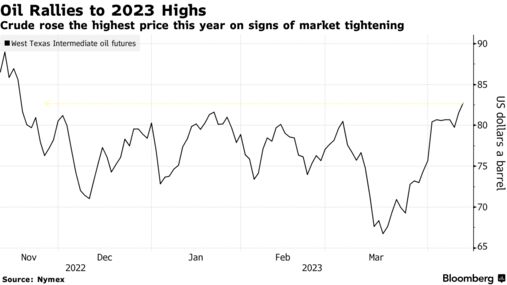
Crude futures slid more than 2% on Friday after reports emerged that the United Arab Emirates is considering leaving the Organization of the Petroleum Exporting Countries (OPEC). According to a report by the Wall Street Journal, the Middle Eastern country has pushed the cartel to allow it to produce more oil and Emirate officials are now having an internal debate on whether to leave OPEC amid disagreements over output cuts with Saudi Arabia. International benchmark Brent for settlements in May dropped 2.36% to sell for $82.36 per barrel at 9:01 am ET and West Texas Intermediate (WTI) for April delivery slid 2.59% to go for $75.92 per barrel at the same time.NN: nothing to get excited about here…

UAE Officials Say Privately No Plans to Leave OPEC

The United Arab Emirates has no plans to leave the OPEC oil alliance, according to officials speaking on condition of anonymity. The Wall Street Journal reported earlier that a growing rift with Saudi Arabia means the UAE is having internal discussions about quitting the producer group, a move that could potentially leave it free to lift output.

The UAE has said publicly and privately it is sticking to the current OPEC deal for at least this year.

The major producer has for some years been contemplating what alliances best suit its long-term interests, as the country seeks to monetize recent expansion in its production capacity. In a previous OPEC+ dispute with Saudi Arabia, the group’s policy decision was held up for weeks, though in the end a compromise was found. NN:It will be no different this time/