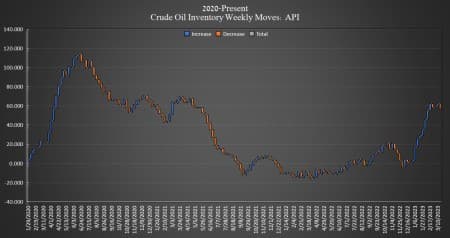
Commercial crude oil inventories in the United States, went downby 7.5 million barrels to 473.7 million barrels in the week ending March 24, the US Energy Information Administration (EIA) stated in its report issued on Wednesday. The crude oil refinery inputs averaged 15.8 million barrels per day (bpd) during the same week, up by 437,000 barrels compared to the previous seven-day’s average. Refineries operated at 90.3% of their capacity. Gasoline production rose, averaging 10 million bpd. NB: up 2% since last week. Reflecting the fact refineries are slowly coming back on line. As they return as you are seeing inventories of crude decline.
Crude oil imports averaged 5.3 million bpd, dropping by 847,000 bpd compared to the previous week.
Meanwhile, total commercial petroleum inventories went down by 10.7 million barrels.
U.S. crude oil production rose to 12.3 million bpd for week ending March 17.
U.S. production is now 800,000 bpd lower than the peak production seen in March 2020
With the large draw in crude oil inventories came product draws as well. Gasoline inventories fellby 5.891 million barrels, on top of last week’s draw of 1.09 million barrels. Distillate inventories rose 548,000 barrels after decreasing by 1.84 million bpd in the week prior.
Inventories at Cushing, Oklahoma, decreased by 2.388 million barrels—after falling 760,000 barrels last week.
The only certainty an oil industry observer can bank on right now is that no one understands the markets. The extreme end of globalization has introduced so many variables that market analysts can no longer effectively predict the non-linear ripples. Right now is a case in point. We have a clean cut dividing line between key markets analysis, with those who fear a banking failure contagion threatening oil demand, and those who say there is no systemic catastrophe and oil will be bulldozing its way back to $100 in no time. Neither narrative can catch oil prices, however, which have had an extremely volatile couple of weeks. Just over two weeks ago, oil prices crashed as fears of contagion following the sudden collapse of Silicon Valley Bank (SVB) and signature bank. That was followed by the share crash at Credit Suisse, which suggested that the initial failures with small, regional U.S. banks perhaps had a global financial crisis aspect. By the week of March 20th, oil prices were clawing back some of those losses, and by the week of March 27th, we saw a major rally (on Monday, the 27th, alone, oil prices gained ~5%). Still, oil rests in the $77 range for Brent and the $72 range for WTI. This, recession fears, and what to expect from Chinese oil demand, rule the key narratives that are so divided on what oil prices will look like for the rest of this year, and beyond. The bulls’ camp includes Goldman Sachs, Barclays and ING. While all three have cut their oil price forecasts for this year after crude lost 10% two weeks ago, their target prices for this year run from $80-$96 per barrel. For the bulls, it’s all about China right now, and they are fairly confident that commodities markets will be spared from the banking sector’s problems. They don’t see this as a financial crisis along the lines of 2008-2009. While Goldman revised its $100 oil price target to $94 in the next 12 months, and $97 next year, it’s still quite bullish. “Oil prices have plunged despite the China demand boom given banking stress, recession fears, and an exodus of investor flows,” Goldman said in a note last week, as quoted by Bloomberg. “Historically, after such scarring events, positioning and prices recover only gradually, especially long-dated prices.” But even the bulls are following the herd mentality. With their pens, big oil traders are calling an imminent oil price rally, but with their trades they are selling-off in a temporary panic because everyone else is. The bulls are betting on a long-term market rally on one hand, but on the other hand, they are taking part in the near-term sell-off. Rebecca Babin, a senior energy trader at CIBC Private Wealth, explained it to Bloomberg like this: Traders “can still have a bullish thesis but realize surviving the next month is mission critical. Many investors are in survival mode here.” So, they’re all rushing for the exits while predicting a bright future for oil prices, and the herd mentality takes over for all animals. NB: I BUY PANIC ANS SELL EUPHORIA Another way to interpret this is that no one really has a handle on what oil prices will look like for the rest of this year, and to be safe, they’re all playing it bearish in the immediate term. Ed Moya, OANDA senior market analyst, calls the nature of this market “Jekyll and Hyde”, warning in a podcast cited by SP Global on Monday that while he was optimistic that oil would be spared from the banking crisis, the market could turn on a dime. Again, it’s another way of saying we find it impossible to hedge our bets on oil prices. NN: I buy fear especially when its fucking bankers running around like a chicken with its head cut off…. this is just the start…..BlackMask Pod Cast:
Running around like a bunch of bankers with their head cut off
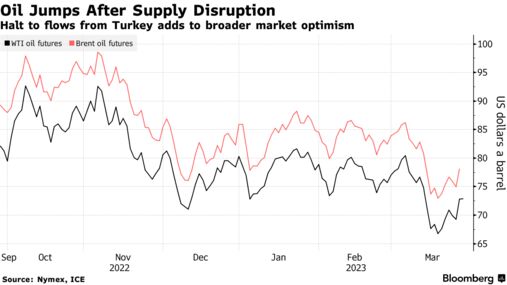
Oil extended its biggest rally of the year as a clash between Iraq and its Kurdish region curtailed exports, while fears over a fallout from the banking crisis receded. West Texas Intermediate futures rose as much as 1%, after jumping above 5% on Monday in the steepest surge since October. A legal dispute between Iraq, its semi-autonomous region of Kurdistan and Turkey have halted around 400,000 barrels a day of flows from Ceyhan port. Meanwhile, optimism that the worst of the banking turmoil may be over is driving up broader markets.
“Speculators drove the selloff and now they might be forced to support the recovery,” said Ole Sloth Hansen, head of commodity strategy at Saxo Bank. “The Iraq dispute has given support to prices, but it’s ultimately helped push a ball that was already rolling. Sentiment in the market has been improving as the banking crisis fades.” Oil nonetheless remains on track for a fifth monthly decline following concerns over a potential US recession and resilient Russian energy flows. Most market watchers are still betting that China’s recovery will accelerate and boost prices later this year, with a top producer in the country forecasting a surge in demand. Investors will be watching comments from several US Federal Reserve officials and a key measure of US inflation this week for clues on the path forward for monetary policy. Interest-rate hikes have added to bearish sentiment.
Amid extreme volatility, crude oil prices rallied sharply on Monday recording their biggest gains in months after a banking crisis seemed to lose steam. At 4:42 p.m. EST, Brent crude was trading up 4.21%, for a $3.16 increase on the day, at $78.15 per barrel. West Texas Intermediate (WTI) was trading up 5.30%, for a $3.67 increase on the day, at $72.93 per barrel. Oil stocks were riding the wave as well, with Exxon (NYSE:XOM) up nearly 2.2% at the same time, and shares of Chevron (NYSE:CVX) up over 1%. Apache Corporation (NASDAQ:APA) was up over 2.5%, and Marathon Petroleum Corp (NYSE:MPC) was up nearly 3.4%. ConocoPhillips (NYSE:COP) was up 2.15% on the day. While some media are attributing the rally to Iraq’s move to shut off the pipeline from Iraqi Kurdistan to Turkey following an international arbitration ruling, the amount of barrels in question here should not have been enough to move the oil price needle so sharply. There has been some speculation that shutting the taps off on 400,000 bpd from the Kurdistan Region of Iraq (KRG) could balance out the market’s anticipated loss of 500,000 bpd of Russian oil pledged under an output cut that does not yet seem to have materialized. Also driving oil price volatility is the weekend announcement by Russian President Vladimir Putin that Moscow would turn Belarus into a station for tactical nuclear weapons. The general sentiment in the oil market now seems to be that the fears of a wider financial crisis due to bank collapses and buyouts has somewhat eased. The easing of concerns follows an announcement by First Citizens that it would acquire deposits and loans from failed Silicon Valley Bank (SVB) to stabilize markets. NN; This is the start of a what i believe is powerfuk rally. You saw massive bank panic liquidation. A great buying opportunity. I buy blood in the streets even if some of it is mine. If i am breathing i am trading….
There haven’t been many twists and turns when it comes to the Federal Reserve’s efforts to cool inflation: It promised to raise interest rates and that’s exactly what it’s done for eight straight months. Forecasts by futures and options traders have fluctuated based on the central bank’s comments about high inflation, the recent collapse of Silicon Valley Bank (SVB) and Signature Bank and the distressed sale of Credit Suisse to UBS raising concerns about a potential global banking crisis. While the Fed is likely to raise rates again, according to Wall Street experts, another potential outcome is a pause on further rate hikes, which would mean the interest charged for loans and credit card debt wouldn’t get more expensive. Here’s a look at what traders are predicting.
Fed rate hike expectations keep shifting, but a hike is likely
Powell has said that continued rate hikes will be made on a “meeting by meeting” basis, and that the Fed is also “prepared to increase the pace of rate hikes” until inflation drops down to its benchmark rate of 2%. Just days before SVB collapsed, Powell said the road to lower inflation was “likely to be bumpy.“ If another rate hike does occur, the cost of borrowing could keep increasing throughout 2023, driving up the cost of loans, auto financing and credit card debt.
For some borrowers, interest rates on loans have nearly doubled in the last year, increasing the burden for consumers reeling from high inflation.
With a hike, the average interest rate charged on credit card debt will have grown by nearly 5% since a year ago, to over 20%. Rate hikes are typically reflected in loans and credit cards within weeks of the announcement.
The China reopening effect that’s been highly anticipated — and at times, perhaps dangerously so — around the world is starting to emerge. Some promising readings in the forward-looking purchasing managers’ indexes show that factory managers are seeing a healthy flow of orders ahead, and putting the quirks of the Lunar New Year season behind them. All four sentiment gauges on the Bloomberg Trade Tracker improved in February, including a remarkable surge in China’s new exports measure into above-average territory. That means five of 10 measures on the dashboard were in normal territory as of early March, with the other half in below-normal range against long-run averages. That’s much brighter than the landscape at the start of the year, when all but one gauge was underperforming. A weaker infection wave upon reopening, which is said to have even surprised Chinese officials, has helped make way for greater demand from the world’s No. 2 economy. And it’s a relief for critical ports worldwide, which are seeing some easing of supply-chain stresses and preparing for at least a small jolt in demand in the months to come. NN: Their is NO global slow down. Now for now. Which means all is well on our Binary oil trade. Global supplies will not meet 3rd and 4th quarter demand. Time to get your money chute ready to fill your money bags!
After a major decline that saw oil prices fall to multi-year lows, oil markets have bottomed out and begun an ascent higher. Over the past two weeks, a general bearish and risk-off sentiment cut across asset markets and triggered a lengthy unwind of speculative positions in oil futures. A top commodity analyst blamed the unusually steep decline to significant selling by banks in response to gamma-effects as prices closed in a concentration of producer puts around USD 75/bbl for Brent and USD 70/bbl for WTI crude. Luckily for the bulls, in the current week, oil prices have staged a remarkable turnaround, with Brent climbing from a two-year low around $70 per barrel that’s a nearly 10% rally in the space of just three days. And now commodity experts at Standard Chartered are saying that the path of least resistance for oil prices at this point is higher, not lower. Previously, the analysts had said that the unwinding of speculative length appears to be complete at this juncture, thus lowering selling pressure, but had warned that prices might retest the lows if the FOMC hikes its policy rate by more than the widely expected margin of 25bps. Thankfully, the markets have successfully scaled that wall of worry after the Fed’s hike on Wednesday came in-line with expectations. StanChart expects last week’s gamma effects to reverse course with banks buying back positions thus reinforcing the short-term rebound. Beyond that, StanChart says oil prices will largely be dictated by OPEC’s and consuming countries’ strategic inventory policy shifts. Specifically, the experts have predicted the current surplus will persist till early Q2; however, they expect the rest of the year to be in a modest deficit.
Goldman Sachs’ Jeffrey Currie has acknowledged that the unexpected banking crisis has soured the macroeconomic outlook significantly and weighed heavily on oil prices, calling the situation a “big, scarring event.” Still, the analyst expects prices to rally from here, and has only lowered his 2023 end-of-year target from $100 to $94 a barrel.
According to Currie, fundamentals in the oil markets remain largely unchanged thus supporting the previous bull case. He has pointed out that key physical indicators, such as refining margins and time spreads, have remained stable, a positive sign that in-use demand remains strong and is likely to continue driving the physical market higher. Currie has also argued that the banking crisis will only have short-lived effects but very limited impact over the long-term,
“I think the key message here is fundamentally we haven’t seen a big significant shift,” he said. “Physical markets are going to have to drive this market higher.”
However, he has warned that the turmoil will result in a “… a longer path forward.”
Hedge fund manager Pierre Andurand of Andurand Capital is not a mere bull but an ultra-bull: Andurand has predicted that crude will hit $140/bbl by the end of the year.
Just like Currie, Andrurand argues that the recent oil price crash due to banking jitters was purely speculative. Further, he expects crude oil demand to peak around 2030, but “even when we peak, oil demand won’t fall down so fast. We will reach peak demand towards 110M bbl/day and then a slow decline from there.” BlackMask Podcast:
‘The possibility of a Minsky moment in markets and geopolitics has increased. Even if central bankers successfully contain contagion, credit conditions look set to tighten more rapidly because of pressure from both markets and regulators.’
— Marko Kolanovic, JPMorgan
That was a team of JPMorgan Chase & Co. strategists, led by Marko Kolanovic, weighing in on recent stress in the banking sector, which they say has piled more pressure on credit markets as central banks have raised interest rates to combat inflation.
Named after economist Harold Minsky, a “Minsky moment” refers to a sudden market crash caused by a sharp fall in investor confidence, which also marks the end of a growth phase for credit or business activity.
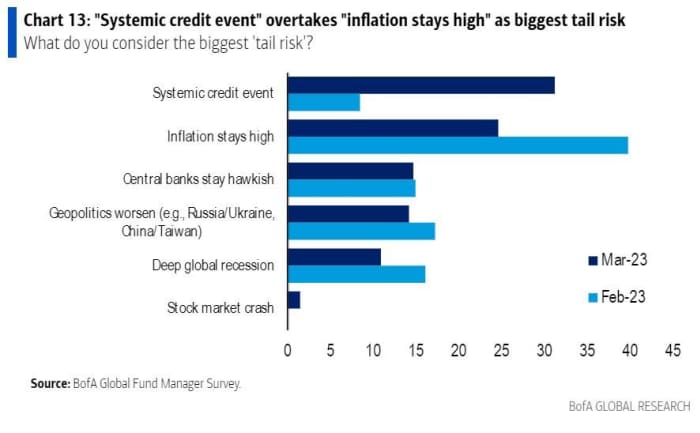
The banking crisis of the past week has indeed increased nervousness. Bank of America’s March survey of global fund managers, out Tuesday, revealed that a “systemic credit event” is now seen as the biggest threat to markets. Stresses in U.S. shadow banking and corporate debt and developed-market real estate could trigger such an event, said strategists.
Kolanovic, the bank’s chief global markets strategist, said the outbreak of stress in the banking sector will likely affect central banks for some time, as it has shifted the risks in their outlooks. A case in point, he said, was the European Central Bank, which, in addition to raising its key interest rate by 50 basis points, dropped its forward guidance and announced a higher core-inflation forecast last week. Due to announce an interest-rate decision on Wednesday, the Federal Reserve is “already past the point of no return — a soft landing now looks unlikely, with the airplane in a tailspin (lack of market confidence) and engines about to turn off (bank lending),” he said.
The Crises is hyper inflation that will never happen.. Because the FED will not back away from interest rate hikes. Despite wallstreets wishful thinking. A Minsky moment put them at least in the poor house, And many of them in jail if they do not get lynched first.
Federal Reserve Bank of St. Louis President James Bullard said that he had raised his forecast for peak interest rates this year amid ongoing economic strength, based on an assumption that banking-sector strains will prove temporary.
“I had previously been at 5-3/8, now I’m at 5-5/8, so a little bit higher — 25 basis points higher — in reaction to the stronger economic news,” he told reporters via conference call Friday after a speech. Bullard added that the upgrade was “also under the assumption that the financial stress abates in the weeks and months ahead.”
“There could a downside scenario where financial stress gets worse, but I didn’t make that my base case,” he said, adding that he viewed only a 20% chance of that pessimistic outcome playing out.
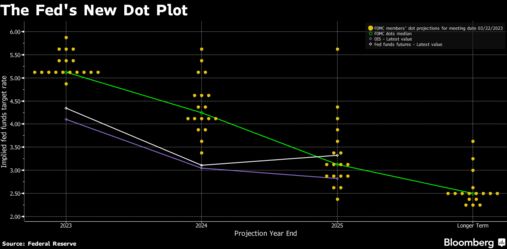
Fed officials raised their benchmark policy rate by 25 basis points on Wednesday to a 4.75% to 5% target range and projected rates rising to 5.1% by the end of the year, according to the median forecast of the 18 policymakers.
The Fed’s so-called “dot plot” of rate forecasts indicated that two other officials shared Bullard’s estimate of 5.625%, and one was higher at 5.875%.
Such forecasts are roughly 2 percentage points higher than where traders are betting Fed rates will be in January. Investors are betting the Fed will cut rates starting in June.
Policymakers must balance the imperative of bringing inflation back down to their 2% target — it rose 5.4% in the 12 months through January — with the danger that their actions could make strains in the banking sector worse. The US government stepped in to guarantee deposits at two failed US banks and after the Fed introduced a new emergency lending program meant to backstop other institutions. The Fed also worked to boost international access to dollars by enhancing swap lines with its key central bank counterparts after tensions spread to Europe. Swiss authorities at the weekend oversaw the shotgun marriage of Credit Suisse Group AG and its neighbor and rival UBS Group AG. In an interview earlier Friday with NPR News, Atlanta Fed President Raphael Bostic also expressed confidence in the financial system and said that the decision to raise interest rates by 25 basis points this week in the midst of a banking crisis was not taken lightly.
“There was a lot of debate, this wasn’t a straight-forward decision, but at the end of the day, what we decided was there’s clear signs that the banking system is sound and resilient,” Bostic said. “And with that as a backdrop, inflation is still too high.”
Fed Chair Jerome Powell said a press conference Wednesday that the question of a pause had been considered in the days before the meeting, but during the gathering the consensus for an increase was strong. Powell also emphasized that the US banking system was “sound and resilient.” NN: Even if the banking system is NOT sound and resilient they still have time. The FED has no choice but to fight inflation time is running out.. This is not Sophie’s choice or King Solomon splitting the baby. It is clear they have a out of control inflation crises. And the FED is the big boy in the room and they damn well know it. With 400 PhD’s on the payroll surely some of them has figured it out. The dead broke zombie banks were created 20 years ago. The solution is simple…. Let dead broke banks go broke and stay broke. And let stupid depositors like it or not kicking and screaming along the way lose their money. If they do not know how to buy treasuries (which pays more interest then banks..) let them cake. Friendly BOB at the local credit union will wipe them out and he will go broke too. Its a cold hard world.
Federal Reserve Bank of St. Louis President James Bullard said on Friday during a meeting that inflation in the country remains “too high,” while the real economic data in the first trimester of 2023 “have been stronger than expected.” “Headline inflation has declined, but it can be inordinately influenced by fluctuations in volatile prices,” the Fed official noted. With regard to inflation expectations, Bullard shared that they “are now relatively low in part due to front-loaded Fed policy during 2022,” which bodes well “for the disinflationary process in 2023.” Meanwhile, talking about the financial crisis that recently swept the United States, Bullard stated that the macroprudential response was “strong” and that the authorities will act with additional measures if needed.
HSBC Economist expects the Fed to raise rates at the next two meeting