Federal Reserve Bank of Atlanta President Raphael Bostic warned on Wednesday that should the central bank dip into the easing of monetary policy too soon, this could lead to inflation flaring up anew. In an article posted on Atlanta Fed’s website, Bostic wrote that “amid some signs that price pressures could be receding, a narrative has gained momentum among some commentators that the Fed should consider reversing its course of raising the federal funds rate lest we go too far and cause undue economic hardship.” Although he understands such concerns, he cautioned that the last time the Fed loosened its monetary policy “prematurely,” back in the 1970s, it took 15 years for it to get inflation back to the target 2%. “We don’t want a repeat, so we must defeat inflation now,” Bostic stressed. He reiterated that the rate should be hiked to between 5% and 5.25% and remain there “until well into 2024.” NN: Wall street are you listening?
Plunging Gas Prices stop $40 Billion In Deals
- Dealmaking in the U.S. oil and gas patch declined last year to the lowest level since 2005.
- Recently, M&A activity fell even further along with a slide in gas prices.
- Rystad Energy data suggests that $40 billion in energy deals may remain unsold.
Last year, mergers and acquisitions in the U.S. oil and gas industry declined to the lowest level since 2005, with 160 deals completed despite booming oil and gas prices. Yet most of these deals were for top-quality assets at top prices. The industry was doing well and could afford billion-dollar mergers. Now, things are changing.The Wall Street Journal reported recently that merger and acquisition activity in the U.S. oil and gas space had dropped off a cliff as natural gas prices plummeted. The predominantly warm winter and abundant supply thanks to strong overseas demand have combined to push benchmark prices to below $3 since December and, according to industry insiders, planned deals are being canceled or delayed. According to Rystad Energy data cited by the Wall Street Journal, there are currently some 15 deals in the U.S. oil and gas space that face an uncertain future. Their combined value is $40 billion, and some of them may well remain unsold—especially if they focus on natural gas. “I am well aware of multiple transactions that were in the works and stalled because gas prices have gone down. There were a lot of exits planned for this year and I think many of those may get delayed,” Guggenheim Securities senior managing director Muhammad Laghari told the WSJ. One would think that with prices down, the companies put up for sale would agree to a lower price, but it appears that the sellers are not offering discounts while buyers are getting anxious about the future trajectory of gas prices. As a result, one planned acquisition of a U.S. gas company, Rockliff Energy, by a subsidiary of Tokyo Gas fell through. It would have been worth $4.6 billion had it gone through, but the drop in gas prices apparently put an end to it. Private equity is also canceling its M&A plans in the U.S. natural gas space because of the price drop. It seems the cheaper natural gas is, the lower appetite buyers have for gas assets despite the upbeat outlook for future demand, specifically for U.S. natural gas. Wood Mackenzie, for instance, recently forecasted that the U.S. could see new LNG export capacity worth $100 billion get built over the next five years. The consultancy said that “based on the combination of projects already under construction and momentum of potential projects, US LNG capacity could grow between 70 mmtpa and 190 mmtpa before the end of the decade, potentially more than doubling current exports.” This certainly sounds like guaranteed long-term demand for that very same gas that currently sells for a little over $2 per million British thermal units and that last year hit $9 per mmBtu. Even with that guaranteed long-term demand, however, potential buyers remain reluctant to commit. Because uncertainty has always been the name of the game, but now it’s greater than ever. The biggest source of guaranteed demand for U.S. LNG is currently Europe. Eager to switch its gas dependence on Russia to a dependence on the U.S., Europe is heavily leaning on liquefied gas, which it is buying on the spot market. While there have been several long-term deals closed by European buyers of U.S. LNG, most of the volumes that the continent receives are sourced in the spot market. That’s because Europe, and the European Union specifically, has a reputation to uphold, and that’s the reputation of a bloc entirely dedicated to a net-zero future in which there is no place for fossil fuels. This is the source of the uncertainty that has become the new normal in oil and gas. Despite clear evidence that the world still needs massive amounts of both oil and gas—and plenty of coal, too—the net-zero push of European and North American governments is casting a shadow over the long-term prospects of the industry and sapping acquisition appetite. The oil and gas industry is a cyclical one, like all resource industries. A downturn is a great time to buy some quality assets on the cheap, normally. But in addition to the future uncertainty about demand, what with the West’s transition ambitions, there’s a much more immediate problem: financing. The Fed’s aggressive take on inflation has led to much higher borrowing costs for buyers at a time when that same inflation is hurting sellers by pushing their costs higher. Sellers won’t sell on the cheap. Buyers can’t get cheap loans to buy expensive assets. It’s an interesting situation that will likely get resolved when gas prices stabilize, according to the experts interviewed by the WSJ. When and at what level this could happen remains to be seen. NN: It will be resolved at a price a hell of a lot higher then $2 per million British thermal units. At least 3x that price.
Crude prices rise, WTI jumps over 2.5%…… Russian Oil Output Cut Will Help Balance The Market
Russia’s decision to reduce its oil production by 500,000 barrels per day (bpd) in March will help balance the global oil market, which is in a surplus now, Alexander Dyukov, chief executive of Russian oil company Gazprom Neft, said on Tuesday “Currently the market is in a surplus, so the Russian government’s decision to cut supply is aimed at rebalancing it,” Dyukov told reporters today, as carried by Russian news agency Interfax. Russian Deputy Prime Minister Alexander Novak said in early February that Russia, a member of OPEC+, would voluntarily cut its oil production by 500,000 bpd in March as a result of the Western sanctions and the price cap on Russian crude oil. The Russian production cut could be “a sign that Moscow may be struggling to place all of its barrels,” or “may be an attempt to shore up oil prices,” the International Energy Agency (IEA) said in its Oil Market Report for February. The attempt at an oil-price boost has failed so far—prices have been pressured this month by signs that the Fed could raise interest rates to a higher endpoint and hold them there for longer to fight sticky inflation.
Speaking to reporters today, Gazprom Neft’s Dyukov also said that oil prices would be volatile this year, too, and could be in the range of $80-$110 per barrel.
On the one hand, there is a surplus on the market, but on the other hand, Russia’s crude and oil products are being redirected to new markets, which leads to higher transportation costs, reflected in the prices, Interfax quoted Dyukov as saying. “This is a consequence, among other things, of the sanctions pressure on Russia,” Dyukov said. Market volatility will be high, but there are tools to temper the volatility, especially from the OPEC+ group, he added. “OPEC+ is one of the key mechanisms that could reduce market volatility…Time will tell, but OPEC+ has proven to be an effective tool,” Dyukov said. Immediately after the Russian announcement of the cut for March, OPEC+ signaled the group doesn’t plan to change the course in its oil production targets. NN: Anyway you do the math the conclusion you come to is another oil crises is on the way. In our BINARY trade China is coming on like gang busters. And even though oil inventories are climbing for NOW oil is up $5.00 from its February lows. We are now into the lowest demand time of the year. Heating oil season is over. Refineries are shutting down for maintenance and driving season has not started yet.
Citi Strategists Say Traders Are Piling Up Short Bets on Stocks
Investor sentiment toward stocks is becoming more pessimistic as they build short bets in both US and European equity futures, according to Citigroup Inc. strategists. In a “markedly more bearish” swing last week, traders added nearly $3 billion of new shorts to S&P 500 futures positioning and pulled a net $5.1 billion from exchange-traded funds, the team led by Chris Montagu said. In Europe, wagers on a decline in the Euro Stoxx 50 tripled, albeit from a low base, they said. Overall positioning remains “moderately” positive, suggesting there is potential for the bets on a downturn in markets to increase, should the momentum in flows gather pace, the strategists wrote in a note dated Feb. 27. On the other hand, the picture right now could also indicate that investors “are not convinced about the recent bearish turn,” they said.
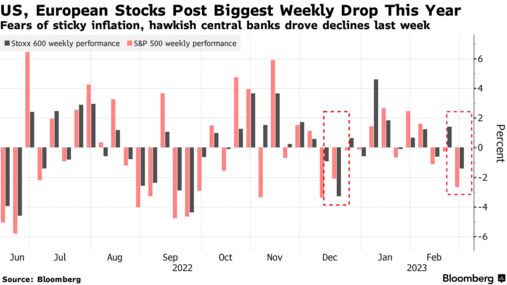
After a sharp rally at the start of 2023, both US and European stocks ended last week with their biggest five-day drop this year as signs of sticky inflation fueled concerns that central banks will remain staunchly hawkish. Other market strategists including Morgan Stanley’s Michael Wilson have also warned that equities face pressure in March from faltering earnings and higher valuations. “Current net positioning is positive, but this net long position has reduced — this suggests that sentiment and conviction is starting to turn,” Montagu said separately in an emailed response to questions. “From our model, we can’t tell whether this is the start of new trend or a one-off.” JPMorgan Chase & Co. strategists said in a note on Monday that the risk-reward for equities remains poor. Max Kettner at HSBC Bank Plc, on the other hand, said he sees a higher chance of a relief rally amid resilient economic growth and as expectations of higher rates are priced in. Still, he recommended equity hedges including cheaper, co-called value sectors or non-rate sensitive defensive sectors and industries.
US experts FINALLY reveal Wuhan lab leak caused Covid pandemic,
The Department of Energy in the United States, which is responsible for a network of national research laboratories, has changed its mind about the biggest scientific mystery of our time. When it comes to the origin of the Covid-19 pandemic, it now says the most likely scenario is that it began in a Chinese laboratory — and not in a wet market in the city of Wuhan. It has stopped short of divulging what new evidence this U-turn is based on, but in reporting its change of heart to the White House and Congress, the Department implies something significant has been uncovered. This follows similar findings by the FBI, reportedly issued with ‘moderate confidence’. Following the failure by Chinese officials to find any early evidence of infected animals in the wet market, and the failure of The Wuhan Institute of Virology to release the database of coronaviruses it was working on, alternative explanations are now impossible to ignore. NN: It has long been our published opinion that the COVID pandemic virus was created in a Chinese bio lab. We also published our belief that it “escaped” And when that occurred China sent infected “Tourists” to major cities world wide.. And the and the US government damn well new it. And development work on genetically modified deadly viruses by China continues.
Oil Prices To Enter The $90-$100 Range
- The CEO of Vitol Group believes oil prices could trade in the $90-$100 per barrel range in the second half of the year.
- With oil demand set to rise by 2.2 million barrels per day this year while supply remains limited, there is a good chance of a price rally.
- The Vitol Group has added its voice to a chorus of banks and analysts that see oil prices climbing toward the $100 mark in the second half of 2023.
Oil prices could hit the $90-$100 per barrel range in the second half of this year as global demand is set to reach record levels amid constrained supply, Russell Hardy, CEO at the world’s largest independent oil trader, Vitol Group, told Bloomberg Television on Monday.
According to Hardy, global oil demand will rise by 2.2 million barrels per day (bpd) in 2023 compared to 2022 and will reach a record level, driven by a jump in diesel, naphtha, and liquid petroleum gas (LPG) demand.
“You don’t have much room on the supply side is the reality, so the potential for a rally is certainly there,” Hardy told Bloomberg. Peak oil demand is expected to come around the end of this decade amid rapid decarbonization, but investment in oil supply will still be needed, Vitol’s top executive said. Major U.S. shale operator Pioneer Natural Resources also sees $100 per barrel by the end of the year. With a significant pickup in Chinese demand, Brent Crude prices “will break $90 this summer and climb back up to $100 sometime in the second half of the year,” Pioneer CEO Scott Sheffield said earlier this month. Goldman Sachs is one of the most bullish Wall Street banks on crude oil and commodities in general. Goldman continues to believe that there is a new supercycle in the making. NN: Damn right!
Russia Selling Oil Way Over Price Cap
Russia raked in significantly more money from its crude oil sales than previously thought, a group of academics have said. Russia took in more money in the weeks that followed the oil price cap implemented on December 5 last year, calculations from academics at the Institute of International Finance, Columbia University, and the University of California show. The calculations show that Russia sold its crude oil for about $74 per barrel on average, according to the paper “Assessing the Impact of International Sanctions on Russian Oil Exports” published on the Social Science Research Network. The paper studied two things: the effects of the EU embargo and the G7 price cap on Russian seaborne crude oil. “We find that Russia was able to redirect crude oil exports from Europe to alternative markets such as India, China, and Turkey but that export earnings were curbed substantially by the sizable discounts that Russian exporters had to accept in market segments where the impending EU embargo lowered demand.” “However,” the report goes on to say, “we do not find crude oil discounts as large as those reflected in Urals prices toward the end of 2022. In particular, prices in market segments that are unaffected by lower European demand, e.g., exports from Russia’s Pacific Ocean ports, have not dropped in a meaningful way and shipments do not appear to comply with the price cap.” “Moreover, our surprising finding of a significant share of Russian crude oil being sold well-above the price cap level of $60 a barrel urgently calls for further investigation of these transactions and reinforces the need for stepped-up enforcement,” the authors said, and recommended that ‘the price caps on crude oil should be lowered as soon as possible.” The analysis covered the four weeks following the implementation of the price cap. NN: I am telling you no matter how hard they try to shake you out of the market. Understand that their is not enough oil to meet demand. An sooner or later kicking and screaming along the way oil will be at $120 a barrel. In the mean time enjoy!
Russia cuts oil shipments to Poland
Polish oil refiner PKN Orlen on Saturday announced that Russia halted crude exports to Poland through the Druzhba pipeline. According to CEO Daniel Obajtek, the move was something the petroleum company was prepared for. “Only 10% of the raw material came from Russia and we will replace it with oil from other directions. This is the effect of diversification that we have carried out in recent years,” Obajtek stated. The Soviet-built Druzhba pipeline remains exempt from European Union’s sanctions against Moscow. NN: The energy wars are far from over. The only thing holding oil down is the fact their are so many people long.
Native Americans Urge Biden To Halt Offshore Wind
The National Congress of American Indians (NCAI) is calling on the Biden Administration to halt all permitting and scoping for offshore wind projects until a comprehensive procedure to protect tribal interests is in place. NCAI adopted this week a resolution that “strongly urges the Department of the Interior and the Bureau of Ocean Energy Management to halt all scoping and permitting for offshore wind projects until completion of a comprehensive and transparent procedure adequately protecting tribal environmental and sovereign interests is developed and implemented.” Native Americans also demand that Tribal Nations be included in the management, permitting, and development of power purchase agreements and both consulted and included in determining the terms and conditions of the agreements. This should also include “negotiating fair compensation for the use of their lands and resources, inclusion in any revenues associated with such development of their traditional resources as well as ensuring that the development does not harm their environment or cultural heritage,” NCAI said in its resolution. Offshore wind is one of the key pillars of the Biden Administration to reach a goal the United States set in 2021—to reach 100 percent carbon pollution-free electricity by 2035.Earlier this week, the White House said that the Administration will propose the first-ever Gulf of Mexico offshore wind lease sale as part of additional steps to boost the sector. The proposed sale includes a 102,480-acre area offshore Lake Charles, Louisiana, and two areas offshore Galveston, Texas, one comprising 102,480 acres and the other comprising 96,786 acres, the Department of the Interior said on Wednesday. The Bureau of Ocean Energy Management (BOEM) is now seeking public comments on which, if any, of the two lease areas offshore Galveston should be offered in the Final Sale Notice. These areas have the potential to power almost 1.3 million homes with clean energy, the Department of the Interior said. NN: Give me a break. Power grab anyone….. I guess their ancestors were great mariners and would not want them stumbling over off shore wind mills.
The stock market’s rally was a head fake
Below i publish a story of the simplistic peoples way of looking at a market. The fundamentals show us a major stock market crash is on the near horizion….. that takes a lot of work. Lines on a chart a monkey can do!
S&P 500’s support is at 3900, then 3760 — the December 2022 low
The stock market, as measured by the S&P 500 Index SPX, +0.53%, has fallen below the 4100 level. That is significant because there previously was triple resistance at that level, and when SPX broke out above that level in late January, it seemed as if the next leg of the “new” bull market was underway. Yet SPX has not only fallen below that supposed support level, it’s confirmed the pullback by trading all the way down to 4000. It appears that breakout above 4100 was a false one. Those are dangerous in bear markets (we last saw one in January 2022). So, now there is resistance at 4200 (the early February highs), and while there might be some small support levels just below current levels, the major support is at 3900, and then 3760-3850. If SPX falls below 3760 (the December low) that would be an extremely negative development.
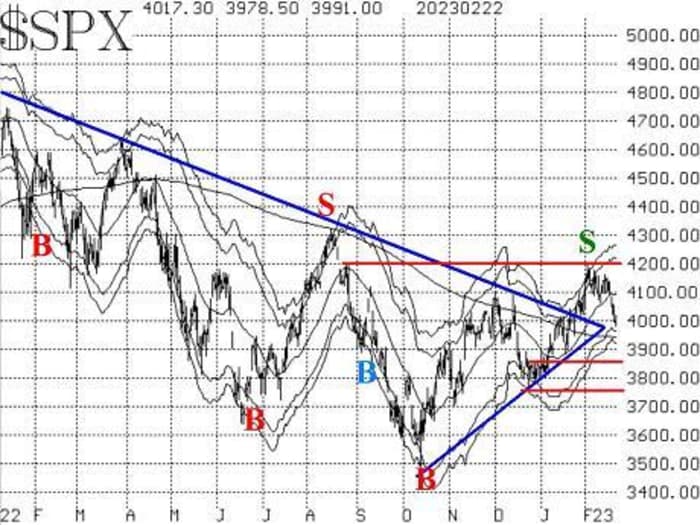
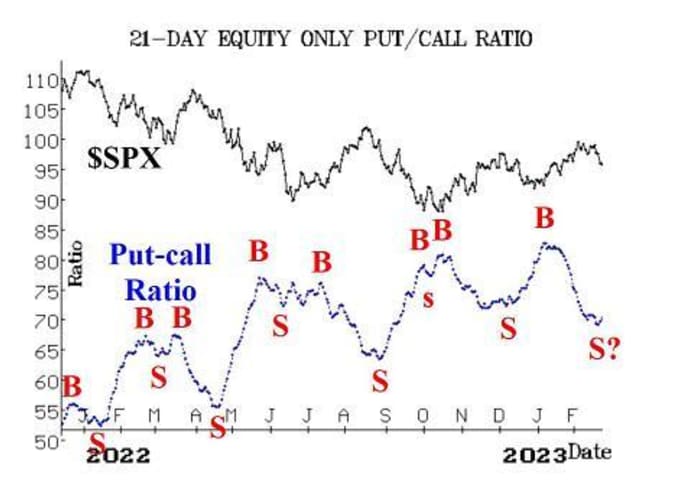
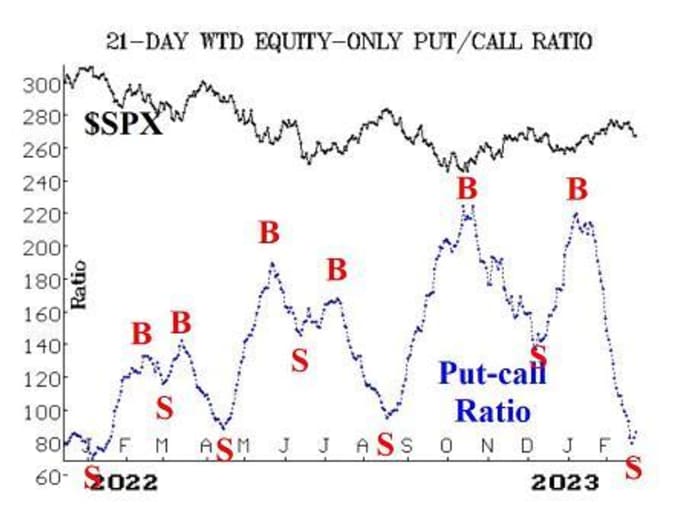
The McMillan Volatility Band (MVB) sell signal that was issued in early February remains in place. Its target is the -4σ “modified Bollinger Band” which is currently at about 3920, but is falling. Equity-only put-call ratios are beginning to weaken as well. The weighted ratio is now on a sell signal, according to our computer analysis programs (as well as the naked eye). This sell signal is emanating from a very low (i.e., overbought) level, and the last two from this level were sell signals in April and August of 2022 — both strong sell signals. Meanwhile, the standard ratio has also curled upward, but our computer analysis programs are not yet “saying” that this is a sell signal. This latest rise has a question mark on the accompanying chart.
Market breadth, which had been a stalwart of the bullish indicator on the way up in December and January, has weakened considerably. Both breadth oscillators generated confirmed sell signals as of February 17th. The decline since then has been swift, and breadth has been very negative, including one 90% down day. That means that the breadth oscillators have already reached oversold status. Still, the market can decline while these oscillators are oversold, so “oversold does not mean buy.” We need to wait for a confirmed buy signal here before acting. Another indicator that has been bullish for quite some time is “New 52-week Highs vs. New 52-week Lows.” This buy signal is in jeopardy of being stopped out, although even if that happens, a new sell signal is not necessarily in place. On Feb. 22, for the first time this year, New Lows outnumbered New Highs on the NYSE. If that happens again, this indicator’s buy signal would be stopped out, and the indicator would return to neutral status. A sell signal requires that New Lows outnumber New Highs for two consecutive days, and that the number of New Lows is greater than 100 on each of those two days. The volatility complex indicators are weakening but have not turned bearish yet. First, VIX VIX, 1.23% has returned to “spiking” mode — meaning that it has risen more than 3.0 points over a three-day (or shorter) time frame. That is an oversold condition. Market breadth, which had been a stalwart of the bullish indicator on the way up in December and January, has weakened considerably. Both breadth oscillators generated confirmed sell signals as of February 17th. The decline since then has been swift, and breadth has been very negative, including one 90% down day. That means that the breadth oscillators have already reached oversold status. Still, the market can decline while these oscillators are oversold, so “oversold does not mean buy.” We need to wait for a confirmed buy signal here before acting. Another indicator that has been bullish for quite some time is “New 52-week Highs vs. New 52-week Lows.” This buy signal is in jeopardy of being stopped out, although even if that happens, a new sell signal is not necessarily in place. On Feb. 22, for the first time this year, New Lows outnumbered New Highs on the NYSE. If that happens again, this indicator’s buy signal would be stopped out, and the indicator would return to neutral status. A sell signal requires that New Lows outnumber New Highs for two consecutive days, and that the number of New Lows is greater than 100 on each of those two days. NN: Gobbledygook…. Self fulfilling prophecies. If they spend a trillion dollars chasing this shit… for a while anyway it appears to work…