Fed’s Waller: Sees Several 50bp hike rate raises going into next year…… Fed’s Daly: We want to see the economy slow. She warned that pausing interest rate hikes is “off the table”……. KC Federal Reserve President sees some painful outcomes

  • The Federal Open Market Committee may need to push through one or more 50-basis-point interest rate hikes this year to get inflation under control, Fed Governor Christopher Waller.
  • “I really favor front-loading our rate hikes, that we need to do more withdrawal of accommodation now if we want to have an impact on inflation later this year and next year,” said Waller.
  • The central bank should also start to reduce its almost $9T in bond holdings soon, he added. He’d prefer to start that process “in the next meeting or two.”
  • Waller said there are major differences between this tightening cycle and the last. “We have a much bigger balance sheet, the economy’s in a much different position. Inflation is raging. So we’re in a position where we could actually draw down a large amount of liquidity out of the system without really doing much damage,” he said.

Member of the Board of Governors of the United States Federal Reserve Christopher Waller said on Wednesday, at an event in Phoenix said that “inflation remains too high” and that he will not be “head-faked by one report.” He plans to further focus on the “data between now and December” before making a decision on what the next monetary policy move should be. Waller reiterated that more interest rate hikes should ensue in order for inflation to fall back to the 2% target as “policy is barely in restrictive territory today.” He proclaimed that he sees the rate raises going “into next year.” “We still have ways to go,” Waller concluded.

Fed’s Daly: We want to see economy slow

Kansas City Federal Reserve President Esther George said on Wednesday that monetary policy tightening, together with overheating in the labor market, is likely to result in “some real slowing,” and possibly a recession. “I have not in my 40 years with the Fed seen a time of this kind of tightening that you didn’t get some painful outcomes,” she told the Wall Street Journal. While the recent inflation report is a “good start,” George warned against considering ending interest rate hikes due to ongoing “strong price pressures in labor-intensive service sectors.” She suggested the Federal Reserve could revert to 25-basis-point hikes next year.

Zelensky insists missile was not Ukrainan…… Whatever the verdict, Russia ‘ultimately responsible’ – US

Ukrainian President Volodymyr Zelensky claimed on Wednesday that he has “no doubt that it was not our missile or our missile strike” that resulted in an explosion that killed two Polish civilians yesterday. He told reporters that he believes that Russia launched the missile in question, citing Ukrainian military reports that he “can’t help but trust.” Zelensky called for a full investigation into the events in Poland with Ukrainian participation, adding that conclusions should be announced only after the probe is finished. Russia denied any responsibility for the deaths of Polish civilians, while NATO, the United States and Poland all confirmed that Kiev’s forces hit Polish territory.

Whatever the verdict, Russia ‘ultimately responsible’ – US

United States National Security Council spokesperson Adrienne Watson underlined on Wednesday in a statement that “whatever the final conclusions may be,” with regard to the explosions in Poland, “it is clear that the party ultimately responsible for this tragic incident is Russia.” Watson stressed that Ukraine “has every right to defend itself,” as Russia launched numerous missiles into the country, targetting civilian infrastructure. The spokesperson explained that Washington has not seen any contradictions with Polish President Andrzej Duda’s statement, which noted that the missile landing was most likely a result of an “unfortunate accident,” and was not fired by Russia. The two sides proceed to be in close touch as they “are still gathering information,” Watson said. Meanwhile, Ukrainian President Volodymyr Zelensky continued to insist that Moscow was behind the missile attacks, saying that he has “no doubt that it was not our missile or our missile strike.” NN: Kicking and screaming along the way NATO will be dragged into this conflict!

EIA: US crude inventories down by 5.4 million barrels

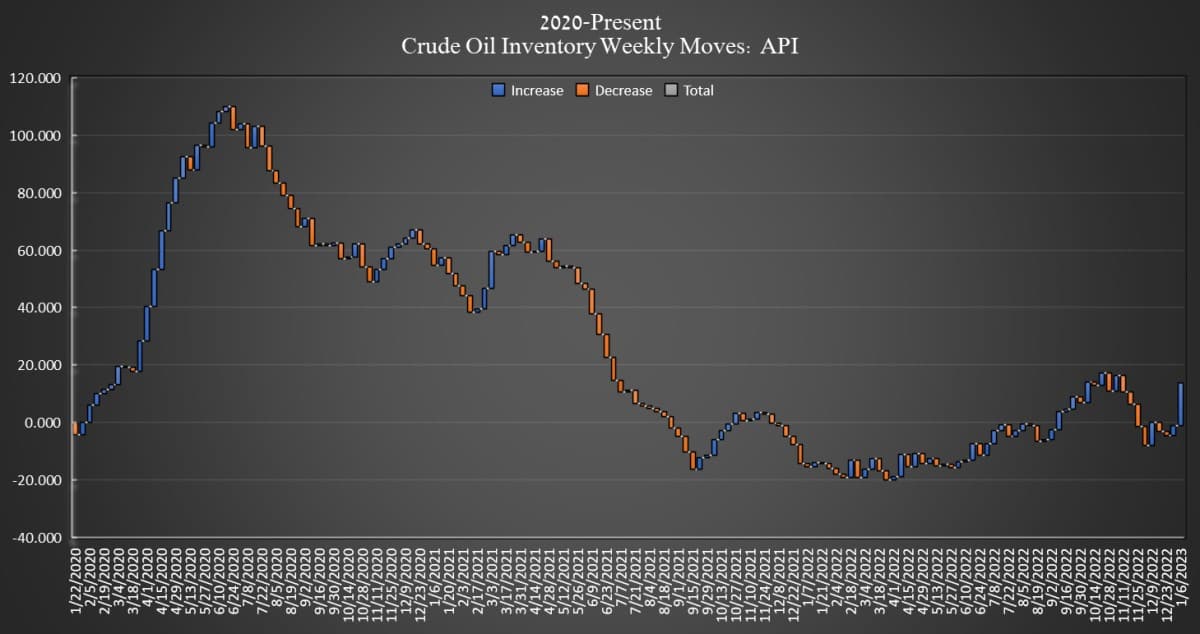
The U.S. Energy Information Administration reported an inventory decline of 5.4 million barrels for the week to November 11. This compares with an inventory build of 3.9 million barrels for the previous week, which pushed prices lower last week. In fuels, the EIA reported inventory builds. Gasoline inventories added 2.2 million barrels over the week to November 11, with production averaging 9.8 million barrels per day, up slightly on the week. This compared with an inventory draw of 900,000 barrels for the previous week and production of 9.8 million barrels daily. Gasoline prices across most of the United States have continued trending lower despite inventory movements. In middle distillates, the EIA estimated an inventory increase of 1.1 million barrels for the week to November 11. This compared with a draw of 500,000 barrels for the previous week. Middle distillate production averaged 5.1 million barrels daily last week, which compared with 5.2 million barrels daily for the previous week.

Middle distillate inventories in the United States are at a multi-decade low, causing concern about the security of heating oil supply for the winter, especially in the Northeast, where several million households rely on heating oil for their winter needs.

In fact, the concern is so serious that Energy Secretary Jennifer Granholm said this week that fuel export controls may need to be implemented to ensure domestic supply. Meanwhile, the International Energy Agency warned of significant uncertainties on the oil market, noting China’s weak economy, Europe’s energy crisis, surging product cracks, and the strong U.S. dollar are all weighing heavily on consumption. At the same time, the IEA pointed out that “The approaching EU embargoes on Russian crude and oil product imports and a ban on maritime services will add further pressure on global oil balances, and, in particular, on already exceptionally tight diesel markets,” deepening already significant concern about the global supply of middle distillates. NN: The day or reckoning is coming….. And they will have to pay the piper at least $150 a barrel for oil. Please note the enormous draw down and remember Biden is still pissing away emergency oil supplies.

Fed’s Daly: We want to see economy slow…… pausing interest rate hikes is “off the table”

Fed’s Daly: Range of 4.75%-5.25% is reasonable for policy rate end-point

San Francisco Fed President Mary Daly said on Wednesday that the Federal Reserve wants to see the economy slow as it attempts to get it “back to a sustainable pace of growth.” She added that consumers are “stepping back” and preparing for a slowdown, which should help bring down inflation.

Daly told CNBC that pausing interest rate hikes is “off the table” but that the Fed is focusing on the level of rates and the terminal rate. She estimated that the rate between 4.75% and 5.25% is “reasonable” and that, after determining the high, the Fed will have to decide how long to hold it. NN: this is settled business. The FED is not not NOT going to tapper. AND we are convinced they will raise interest rates to 5.5% AT LEAST>>>>> Fed Funds are trading at 3.8% with a target rates of 4%. Far from done we are in for a further 150 bases point increase in rates.

Still a way to go in wind industry, Siemens Energy CEO says

The newly-spun off Siemens Energy aims to be the “go to institution for combating climate change” with the scale to lead on- and offshore wind markets, said its CEO-designate who added that “the jury’s out” on the role of large-scale gas in the new company. The pure-play energy business will have the focus needed to succeed in onshore wind – where India is tipped as the biggest future market – and in the face of new competition offshore, said Michael Sen, who is line to lead Siemens Energy towards a stock exchange listing next year. The new company will wrap up the current Siemens Gas & Power operating unit, Siemens’ power transmission operation, and will also own the 59% of wind turbine OEM Siemens Gamesa Renewable Energy (SGRE) currently held by the German industrial giant itself. Sen told the BNEF Summit in London: “In today’s world … industries need focus, they need to be pure play in their own distinct sector.” He said Siemens Energy will have the scale needed to succeed in terms of innovation, resources and geographical reach in key renewables markets such as the wind power sector. “Today we see onshore for example the biggest market is going to be India, so we have a strong footprint there, where in other markets it may go down a little bit,” Sen said. Geographical reach and “innovation power” will also help it face down growing competition offshore, where Siemens Gamesa is currently market leader, from the likes of GE and MHI Vestas, he claimed.

Siemens Gamesa buys key Senvion European wind businesses The Siemens executive – who was famously quoted predicting ‘Darwinian’ consolidation in the wind industry – said this week’s acquisition of parts of the stricken turbine OEM Senvion gave Siemens Gamesa the chance to acquire some “very attractive assets”, including service contracts “behind which there is a customer”. Sen told the event the issues facing Senvion were part of a consolidation occurring as wind power moves from being “almost garage manufacturing” not long go to a major industrialised sector. Questioned about the role of gas in the Siemens Energy portfolio, Sen admitted: “That’s the most relevant strategic question. To some extent the jury’s out, not so much [on] distributed energy, smaller gas and steam turbines … the question is more about large gas turbines.” Like other players in the large gas sector such as GE of the US, Siemens has been hit by plunging demand as the global power sector looks to decarbonise its operations.

However, Sen said the world’s energy system “is not going to change overnight” and claimed gas “has some resilience as a bridging technology” to renewables. He added that Siemens Energy would explore ‘clean gas’ options such as hydrogen and synthetic fuels. Sen claimed the newly-formed business would “help shape the energy transition. I would make the proposition that we can be the go-to institution for combating climate change”. NN: Siemens and GE have never figured out how to make wind pay. Without ongoing  massive government subsidies no one ever made a profit in wind.

Bets On $200 Oil Surge As Traders Eye Extreme Volatility

  • Lower demand forecasts could materialize if China doesn’t fully reopen.
  • The European Union is preparing to implement an oil import embargo on Russian crude oil next month and on fuels two months later.
  • Bets on $200 oil are increasing at a fast pace.
  A week ago, the U.S. Energy Information Administration cut its crude oil demand outlook for 2023 by 320,000 bpd, with supply also falling, by 300,000. This week, OPEC also revised down its oil demand forecast for next year by 100,000 bpd, citing economic challenges on the global oil scene. It also warned supply might become more problematic.

The chief factor behind the demand outlook appears to be the situation with Covid in China. Updates on that situation have pushed oil prices up or down on a daily basis, depending on their content, and are likely to continue doing it next year as well.

On the supply side, however, clouds are gathering. The European Union is preparing to implement an oil import embargo on Russian crude oil next month and on fuels two months later.

The G7 is meanwhile putting the finishing touches of a price cap on Russian oil purchases in a bid to achieve two normally irreconcilable goals: keep Russian oil flowing into international markets and reduce the country’s oil revenues. According to OPEC, the EU embargo will create “additional energy-supply disruptions” and contribute to the economic slowdown in the bloc. At the same time, the G7 price cap is also coming into effect on December 5, like the EU embargo, with a lot of questions around it still without an answer, such as how the cap will be enforced and compliance monitored. Even without these questions, however, its expected effect on the global oil supply balance may be a little exaggerated. Six of the seven members of the G7 already have bans on the imports of Russian oil in place or are members of the European Union, which means they would be covered by the embargo. Japan is the one G7 member that has been granted an exemption from the sanction action because it is overwhelmingly dependent on imported energy and Russian oil and gas is, for now, indispensable for its energy security. The actual idea of the G7 price cap was to get India and China on board with the idea because they are the two countries importing most of Russia’s oil that the West has shunned since February this year. Neither, however, has been sold on the idea, and they will likely continue to buy crude directly from Russia, organizing the insurance and shipping between themselves to avoid breaching the cap scheme. While the price cap may turn out to be a smaller challenge to global oil supply than expected, it would certainly contribute to oil market uncertainties. For some, these uncertainties are so significant that they are betting that oil could reach $200 per barrel. An option to buy Brent crude for $200 per barrel in March 2023 at one point last week became the most traded contract on the market, signaling that despite concern about Chinese demand, expectations of tighter supply were still going strong. In fact, according to Bloomberg data cited by Barron’s, options traders have become more aggressive than usual, with the ratio between bullish and bearish bets on crude at the widest ever recorded. According to analysts, the EU oil embargo and the G7 price cap on Russian crude could reduce global supply by about a million barrels daily from December. That would come on top of the OPEC+ output reduction of the same size and slowing growth in U.S. shale production. In this context, prices do indeed have a strong upward potential. Still, downward pressure remains considerable as well, both from China’s Covid situation and from the very fact that the higher the price of oil goes, the closer demand destruction creeps, however inelastic demand for the most traded commodity in the world happens to be. NN: China has to reopen and will. And the global recession is at least a year away. AND sanctions, the war and increasing demand that is outstripping supply will play hell with the market.

Biden calls ’emergency’ NATO meeting after Russian missile hits Poland

Accident my ass. It was indeed a Russian missle. Just because it was not fired from”Russia”…. it WAS fired from Russian controlled territory in the besieged Ukraine.In fact they ha ha ha ha fired by “accident” not one but two missiles!!!

President Joe Biden called an “emergency” meeting of G7 and NATO leaders in Indonesia Wednesday morning for consultations after NATO-ally Poland said a “Russian-made” missile killed two people in the eastern part of its country near the Ukraine border. Biden, who was awakened overnight by staff with the news of the missile explosion, called Polish President Andrzej Duda early Wednesday to express his “deep condolences” for the loss of life. The U.S. president promised “full U.S support for and assistance with Poland’s investigation,” and “reaffirmed the United States’ ironclad commitment to NATO.” A statement from the Polish Foreign Ministry identified the missile as being made in Russia. But Poland’s president, Duda, was more cautious about its origin, saying that officials did not know for sure who fired it or where it was made. He said it was “most probably” Russian-made, but that is being still verified. If confirmed, it would be the first time since the invasion of Ukraine that a Russian weapon came down on a NATO country.

The foundation of the NATO alliance is the principle that an attack against one member is an attack on them all.

NN: Simple the COWARDS at NATO can solve that thorny issue  that ” an attack against one member is an attack on them all”  by calling the two missle attack not an attack. Russia is watching and laughing. They sent a message to the cowards in Poland. Stop supplying weapons to the Ukraine…..


US producer prices grow by 0.2% in October…..


I believe its premature to declare the war on inflation over never mind won. Today’s PPI report was  UP: Producer prices in the United States increased by 0.2% in October compared to September, the Bureau of Labor Statistics said in a report on Tuesday. Compared to October 2021, the Producer Price Index (PPI) rose by 8% year over year. Tell me how is this a good report?  Well it the old Wall Street trick. Raise negative expectations  beyond what the report will show. And when the report comes in “lower” then “expectations” (even if inflation was up) declare it a win for the inflation is dead theory and rally the shit out of the stock market. The PPI for goods grew by 0.6%, while the index for services fell by 0.1%. Producer prices less foods, energy, (core) and trade services were up by 0.2% on a monthly basis and 5.4% annually. See i call this inflation still rising, sure as shit not moderating and get this the FED is not going to relent. So in my humble uneducated full of shit opinion this pink champagne party they are throwing at the Hotel Wall Street means the peoples money can go in but never leave. So i see this as a great big fools rally in a bear market and i want to short the shit out of it. Come to think of it we ARE shorting this insanity.

NATO: Putin aims to leave Ukraine cold and dark and hungry

In an effort to help the Ukrainian military hold ground over the coming winter months, NATO and the U.S. have sped up the transfer of warm clothing, arms, and technology to counter drone strikes to Ukrainian forces. A NATO official told reporters, “The Ukrainians are on their front foot, and they certainly feel prepared for the winter campaign,” the official went on to say that the foreign assistance that is being provided is focused on the arrival of winter. Despite the certainty of snow and ice and then mud as winter thaws, U.S. Defense Secretary Lloyd Austin believes that Ukraine troops will still be able to launch counter-offensive attacks against the Russians saying, “I expect that Ukraine will continue to do everything it can throughout the winter to regain its territory and to be effective on the battlefield.” A large part if not all of the military supplies are going to the war against the Russian invasion. The winter will likely cause greater hardship for individual soldiers, however if the ground freezes up, it will mean greater cross country mobility for heavy equipment such as tanks and artillery, so likely the pace of military operations will increase as winter sets in. Southern Ukraine likely will not see as cold temperatures as northern Ukraine, due to proximity to the Black Sea.
The Ukrainians are developing some of their own military equipment which doesn’t have the range limitations of the HIMARs rockets (80 Km), so the war may spread.
Likely there will be a dam rupture in the Kherson front, as well as a dirty bomb or a nuclear event.
This will be the Russian initiative to use nuclear weapons without actually setting on a tactical nuclear bomb.
The Ukrainians need to remain dispersed, to avoid presenting a tempting target for the Russian nuclear forces.
The mid-term elections in the US likely will have an effect on the outcome of the Russian invasion.
If Ukraine doesn’t develop its own arms industry, certainly repair and recovery facilities, likely the war will draw to a close, not so much a negotiated settlement as opposing armies not being able to establish a breakthrough, such as happened with Ukraine on the northern front recently, stalemate.
The US likely will cut back on economic and military support, due to economic and voter exhaustion. The war has become a political force within the US, and will effect the next Presidential election, similarly to the Korean war, when Eisenhower won victory by running on a platform of ending the Korean war. This would mean negotiated settlement, so if the Ukrainians can’t turn the tide in the next two years, Russia will take permanent control of territories it has gained through military conquest and will likely become a dominant influence in the world wide energy and materials economies.
Russian hasn’t been able to break through Ukrainian defenses without extreme casualties, so expect Russia to resort to using a “dirty bomb” and blaming the Ukrainians for it, in able to break through Ukrainian defenses.
This has become and existential threat for Putin, in that if Russia loses, and is thrown back from it’s invasion, he could be deposed, or alternatively, Russia is turned into a Stalinist authoritarian state, becoming a cookie cutter copy of North Korea, while selling cheap gas and oil to Western Europe. Actually, this is a victory for Putin, who manages then to become a complete dictator of Russia, without any chance of any alternate leadership coming forward.
It could result in civil war in Russia, but civil war in Russia would mean strategic use of nuclear weapons, with world wide nuclear fallout

Russia’s Oil Output Set To Fall By 1.5 Million Bpd In December

Under the new sanctions to begin in December this loophole will be closed

Russia’s oil production could drop to as low as 9 million barrels per day (bpd) in December when the EU embargo on imports of Russian crude oil enters into force, Russian news agency TASS reported on Wednesday, citing analysts at the Energy Development Center. “We expect that production in December will fall by 1.5-1.7 mln barrels per day compared to the June-October average, or 14%,” according to a report from the Energy Development Center cited by TASS. The expected sharp drop in Russia’s oil production will lead to a spike in international oil prices, also considering that the OPEC+ group is reducing the target production as of November, the experts said. Russia’s oil production, excluding condensate, for October came in well below its production quota for the month, at just 9.9 million bpd, Russian Deputy Prime Minister Alexander Novak said earlier this month. Russia’s October production was 1.1 million bpd below its quota of 11 million bpd assigned under the OPEC+ agreement, but mostly in line with Novak’s estimates made last month. For November, Russia’s oil production quota under the OPEC+ pact will drop from 11 million bpd to 10.5 million bpd. In October, Russian oil production, including condensate, was 1.47 million tons of oil per day, or 10.78 million bpd. The October production was slightly down from the 10.8 million bpd reported for September However, the production decline could accelerate from November as the EU prepares to introduce an embargo on imports of Russian crude from December 5, Russian business daily Kommersant reported at the end of October, quoting sources familiar with the situation. Analysts have estimated that around 2 million bpd-3 million bpd of Russian oil and products may have to find new homes after the EU embargo enters into force. Russia has redirected a large part of its flows eastwards to Asia, but it may not be able to accommodate immediately and find willing buyers for the trade flows previously going to Europe, especially with the ban on services handling Russian oil cargoes unless the oil is sold at or below a certain price cap. NN: If people want rugs they will get drugs… And if they want oil they will get oil.. Its simply a matter of price and supply.