Fed’s Barkin: Data don’t show recession

WASHINGTON (Reuters) – The U.S. economy may be primed for several years of above-trend growth as families spend perhaps $2 trillion in excess savings banked during the pandemic, Richmond Federal Reserve President Tom Barkin said, and inflation will head higher for a while.

But Barkin in a Reuters interview late Wednesday would not detail how he expects that strong outlook to influence the Fed’s interest rate or bondbuying policies, saying he would only make and discuss those decisions as data show the economy either meeting or falling short of the Fed’s stated goals. Investors and journalists may be interested in where he put his “dot” – or estimated target interest rate – in the set of projections issued by Fed officials last week, but Barkin, a voting member of the Federal Open Market Committee this year, said that distracts from the central bank’s intent to let outcomes, not forecasts, drive monetary policy.

“I don’t think it matters. I think what matters is the outcomes we actually get,” Barkin said.

The Fed’s pledge not to raise rates or curb $120 billion in monthly bond purchases until the economy more clearly recovers “is quite explicit and outcome based,” Barkin said. “When we hit the guidance I want to normalize as much as the next guy. But I want to hit the guidance.”In an economy revved to boom, the Fed’s likely path to “normalization” is a key question for investors analyzing bond and stock prices and households wondering where interest rates are heading as they plan major purchases. Fed officials have shown a disparate willingness to pin down their views, leaving some investors and economists flummoxed at what they do not know about the central bank’s collective “reaction function.” Essentially, what is its tolerance for higher inflation, its working notion of “maximum employment” and its definition of words like “substantial” that are important to understanding what the Fed might do and, importantly, when? Barkin said the demand for details set against the calendar – something bond markets clamor for to price securities influenced by Fed interest rate decisions – amount to a “gotcha game” at a time when the central bank wants to be more deliberate about reaching its goals, particularly a healed job market, before changing policy. For example the Fed has said it would not consider reducing its crisis-era $120 billion in bond purchases until there was “substantial further progress” in restoring the labor market and ensuring inflation hits its 2% target. That is just one of the phrases Fed officials contend are easy to understand but market participants see as imprecise. Barkin said it was possible that sort of progress could be achieved this year, at least opening the door for the start of a policy discussion. “I hope so,” he said. With pandemic supply bottlenecks feeding price hikes and post-pandemic demand expected to surge in the service sector, “it is pretty straightforward for me to imagine we are going to make substantial further progress on the pricing front.” It should not change the “paradigm” of pricing and inflation, he said, but could help coax inflation expectations to the Fed’s 2% target. On employment, “I would like to hope we have a pretty strong spring and summer.” But even that is just the start of a conversation. Top Fed officials have emphasized they are in no rush to curb help for the economy until it is clear damage from the pandemic recession is substantially repaired. As to rate hikes, in the most recent projections 11 officials said they did not think a rate increases would be appropriate until at least 2024; four said it might need to happen next year, and three others joined them to see likely increases in 2023.Barkin would not claim his group, saying events could push him in any number of directions. “There are various outcomes that I would eagerly embrace as opportunities to begin the process of normalization. There are outcomes I would eagerly embrace the need to wait,” Barkin said. “I don’t have a religious principle” regarding when rates need to increase. NN: The FED is scared to death to remove stimulus. And rate hikes alone will not put out the fire. In other words they are royally screwed. Their is no good outcomes here

Oil prices fall on reports S. Arabia might increase output

(Reuters) – Saudi Arabia is prepared to raise its oil production if Russia’s output falls substantially because of the western sanctions imposed on it, the Financial Times reported on Wednesday, citing sources.

Discussions had been held about an immediate increase in production from Saudi Arabia and the United Arab Emirates, which could be announced at Thursday’s OPEC+ meeting, according to the report

OPEC+ comprises of members of the Organization of the Petroleum Exporting Countries and their allies led by Russia. Production increases that are scheduled for September would be brought forward to July and August, the source said. Saudi Arabia, the top producer in OPEC, has previously rebuffed calls by Washington to boost oil output by more than the gradual increases it has agreed to as a member of the OPEC+ group which includes Russia. Saudi agreed to shift its stance and raise output to calm oil prices as part of a rapprochement with Biden administration, the report said, citing people familiar with the talks. The country has also assured to eventually respond by raising production should a supply crunch hit the oil market, the report added. NN: Now you can see why we took profits and stood aside in the oil trade. Oil hit $120 this week and dropped $8 bucks… I am out of the oil business for now. I believe the Saudi’s will increase production to give Biden a bone.

Treasury yields rise on Fed remarks

The U.S. 10-year Treasury yield climbed Wednesday on the first day of June, with investors focused on rising inflation and interest rate hikes. The yield on the benchmark 10-year Treasury note gained 8.7 basis points at 2.931% as of 2:51 p.m. ET. The yield on the 30-year Treasury bond moved 1.8 basis points higher to 3.076%. Yields move inversely to prices and 1 basis point is equal to 0.01%. Rising prices around the world remain a key concern for investors, with euro zone inflation hitting 8.1% in May, according to data released on Tuesday. The effect of central bank interest rate hikes on economic growth also continues to worry investors. Federal Reserve Governor Christopher Waller said in remarks delivered in Frankfurt, Germany, on Monday that he isn’t “taking 50-basis-point hikes off the table” until he sees inflation come back closer to the central bank’s 2% target. Will Hobbs, chief investment officer at Barclays Wealth & Investments, told CNBC’s “Squawk Box Europe” on Wednesday that looking at a number of inflation forecasts for a year from now, “the range from top to bottom is as wide as we’ve seen since the early 80s.” “So you’ve got that huge uncertainty about the inflation outlook, people are just not yet sure quite whether central banks are going to do enough, whether we’re in this new paradigm for inflation and that creates extra uncertainty on top of a global economy which is being buffeted by gigantic forces,” he said. In terms of data releases due out on Wednesday, April’s Job Openings and Labor Turnover Survey is set to come out at 10 a.m. ET. May’s manufacturing data, along with April construction spending figures, are also slated for release at 10 a.m. ET.


U.S. manufacturing sector regains speed in May-ISM

WASHINGTON, June 1 (Reuters) – U.S. manufacturing activity picked up in May as demand for goods remains strong, which could further allay fears of an imminent recession, but a measure of factory employment contracted for the first time in nearly a year.

The Institute for Supply Management (ISM) said on Wednesday that its index of national factory activity rebounded to a reading of 56.1 last month from 55.4 in April. A reading above 50 indicates expansion in manufacturing, which accounts for 12% of the U.S. economy.

Economists polled by Reuters had forecast the index falling to 54.5. The survey followed a report last Friday showing consumer spending increasing strongly in April.

The nation has been gripped by fears of a recession as the Federal Reserve aggressively raises interest rates to tame inflation. The U.S. central bank has increased its policy interest rate by 75 basis points since March. The Fed is expected to hike the overnight rate by half a percentage point at each of its next meetings this month and in July.

Demand for goods remains resilient even as spending is shifting back to services like travel, dining out and recreation. Goods spending surged as the COVID-19 pandemic restricted movement.

The ISM survey’s forward-looking new orders sub-index increased to 55.1 from 53.5 in April. Manufacturing has been constrained by snarled supply chains, which have been further entangled by Russia’s unprovoked war against Ukraine and new shutdowns in China as part of Beijing’s zero COVID-19 policy.

The ISM’s measure of supplier deliveries slipped to 65.7 last month from 67.2 in April. A reading above 50% indicates slower deliveries to factories. The survey’s gauge of order backlogs rose to a reading of 58.7 from 56.0 in April.

News on the inflation front was encouraging. A measure of prices paid by manufacturers dropped to a reading of 82.2 from 84.6 in April, supporting views that inflation has probably peaked.

But manufacturers are struggling to find workers, with the survey’s measure of factory employment falling to 49.6 from 50.9 in April. Amid tighter financial conditions, the first decline below 50 since last August could also be a potential red flag. With a record 11.5 million unfilled jobs across the economy at the end of March, however, worker shortages appear to be the culprit for the pullback in factory employment.

Spreading the bear-market bounce

Bear market bounces are violent yet short-lived. The latest excuse for an oversold rally was provided by JP Morgan’s Jamie Dimon. The bank’s CEO stated at Morgan’s Investor Day Conference on Monday, May 23rd, that the US economy remains strong despite gathering storm clouds. He said, “I’m calling it storm clouds because they’re storm clouds. They may dissipate.” S&P Global US Composite PMI Output, which tracks the manufacturing and services sectors, fell to a reading of 53.8 in May, from a 56.0 reading in April, which means the economy is fast approaching contraction territory in Q2. A slew of manufacturing PMIs also supports the view that the US and, indeed the entire global economy is faltering. The plunging numbers on home purchases and refinancing activity indicate danger is ahead. Nevertheless, despite a parade of sharply declining economic data, the financial media is promoting the view of Wall Street analysts that earnings growth is actually going to be robust this year and next.  This is one reason why the bottom of the bear market isn’t yet in sight. In fact, if the stock market were to return to a more normal valuation, one where the total market cap of equities was equal to annual total output of the economy, it would have to decline by 37% from the current level. But bear markets seldom, if ever, just decline to fair valuations; they usually slice through that level and find support once the market displays a broad array of metrics that indicate it is undervalued. So, despite a brutal bear market, the grand reconciliation of asset prices should continue on.  Vanda research recently reported that the average retail portfolio is down 32% this year. And this bloodbath isn’t limited to stocks. The flagship crypto (BTC) is down 55% since November of last year, long-duration Treasuries are down 20% YTD, and the housing bubble is the next in the queue to implode. Indeed, the evidence of an incipient real estate debacle can be found in the 6 straight months of decline in the Pending Home Sales Index. The bear market should continue until a sufficient amount of disinflation is manifest, which can then give Chair Powell the economic and political cover to turn dovish. But this probably won’t occur until around September or October. However, in the next four months Powell will have raised the Fed Funds Rate by an additional 125- 150 bps and destroyed $250 billion from the base money supply.  In response to the upcoming recession, expect the Fed, Treasury, and D.C. to coordinate the monetization of trillions upon trillions in helicopter money. The US now has record-high inflation while also enjoying a tremendous dollar bull market over the past year. But just imagine how destructive that inflation will become once the Fed’s balance sheet vaults over $10 trillion and then quickly races towards 100% of GDP; with no end in sight. And, at the same time, the dollar crashes–not only against goods and services like what is happening now, but against our major trading partners–causing import prices to surge.  In conclusion, the bear market has many innings to go, the Fed pivot is still months away, and that turn towards a more dovish policy isn’t going to solve all the economic and market problems. Indeed, it will make them much worse. NN: We are in a spread trade with the bias to the upside in the NASDAQ 100. Rational is I expect sometime this month a BIG rally. This is a rally in a bear market. I am looking for a velocity break out to the upside and then a quick fast reversal….. Very tricky volatile trading to say the least

OPEC considering axing Russia from production deal

Exempting Russia from the OPEC+ alliance’s oil-production agreements is being discussed by some members of the Organization of Petroleum Exporting Countries, the Wall Street Journal reported. Such a move would have major ramifications for global oil supply. Russia is one of the world’s top three crude producers — along with Saudi Arabia and the US — but it’s struggling to maintain output and exports in the face of increasing sanctions.

By removing Russia from the monthly supply quota system, it could give other OPEC+ members, particularly the Saudis and United Arab Emirates, scope to pump more to stem surging oil prices that topped $120 a barrel this week. It also comes as US President Joe Biden mulls a visit to Riyadh to try and repair frayed diplomatic relations.

Here’s what analysts had to say about the possibility of a Russian exemption and the impact on global oil markets:

SPI Asset Management

“I think there’s a good chance (for a break up), as there appears to be some friendly table-setting ahead of Biden’s visit to the Middle East,” said Stephen Innes, managing partner at SPI Asset Management. “I don’t think the Persian Gulf members could open up a more friendlier welcome card that would include bringing more barrels to market in these hyper-inflationary times. If OPEC makes up for Russia’s shortfall, then oil prices will drop further, whereas prices will continue its increase if OPEC holds onto their current production levels even without Russia.”

RBC

“There’s been too much shuttle diplomacy for this to be smoke and mirrors about a US-Saudi reset,” Helima Croft, a strategist at RBC Capital Markets LLC, said in an interview. A change to the pact would allow Saudi Arabia to bring back barrels earlier than scheduled, and the kingdom would likely attach conditions to any changes as it seeks to rehabilitate its partnership with the US, she said.

ING Groep NV

“It would make sense that Russia receives an exemption, given their output will likely fall in the months ahead due to sanctions,” said Warren Patterson, head of commodities strategy at ING Groep NV. “If this opens the door for others to potentially increase output more aggressively, the headlines may weigh on sentiment. But I struggle to see it resulting in significantly more output growth, given the performance we have seen from the group over the last several months. The Saudis and the UAE haven’t responded to the higher-price environment. They probably won’t, unless we see significantly higher prices.”

Oanda

“It makes complete sense for OPEC to do this, as with Russian oil exports curbed the production quotas become impossible to meet,” said Jeffrey Halley, a senior market analyst at Oanda Asia Pacific Pte. “This will allow swing producers like Saudi Arabia, the UAE, and possibly Iraq, to ramp up production, easing the tight crude market globally. That should cap prices in Brent above $120 a barrel, although with the supply squeeze on refined products globally showing no signs of easing, I doubt we’ll see Brent back below $100 a barrel.”

VI Investment Corp.

“With the details of the EU’s Russian oil embargo in place, there’s also a need for OPEC+ to come up with a plan as oil prices are likely to keep surging and inflationary pressure is mounting,” said Will Sungchil Yun, a senior commodities analyst at VI Investment Corp. in Seoul. If there’s any confirmation from OPEC delegates that exempting Russia is being discussed, oil prices could fall to as low as $100 a barrel, he said. NN: None of this theatrics changes the equation. Their is not enough fossil fuels to go around. Their are enough fossil fuels. The problem is lack of drilling, pumping, pipelines and refineries are the issue. And that is a matter of government policy in conspiracy against oil.

IEA: Current Energy Crisis Is “Much Bigger” Than 1970s Oil Crunch

The world faces a “much bigger” energy crisis than the one of the 1970s, the Executive Director of the International Energy Agency (IEA), Fatih Birol, told German daily Der Spiegel in an interview published on Tuesday. “Back then it was just about oil,” Birol told the news outlet. “Now we have an oil crisis, a gas crisis and an electricity crisis simultaneously,” said the head of the international agency created after the 1970s shock of the Arab oil embargo. The energy crisis started in the autumn of last year, but the Russian invasion of Ukraine made it much worse as the markets fear disruption to energy supply out of Russia, while Western governments are imposing increasingly restrictive sanctions on Moscow over the war in Ukraine. The EU agreed late on Monday to ban most of the imports of Russian oil, leaving pipeline supply exempted from the embargo, for now. This will further tighten already tight crude and product markets. The world, especially Europe, could face a summer of shortages of gasoline, fuel, and jet fuel, the IEA’s Birol told Der Spiegel. Fuel demand is set to rise as the main holiday season in Europe and the United States begins, Birol added. Upended crude oil flows add to reduced global refinery capacity resulting in low inventories of products, including in the United States. Refinery capacity for supply, globally and in the U.S, that is now a few million barrels per day lower than it was before the pandemic. Some 1 million bpd of refinery capacity in the U.S. has been shut permanently since the start of the pandemic, as refiners have opted to either close losing facilities or convert some of them into biofuel production sites. Globally, refinery capacity is also stretched thin, especially after Western buyers—including in the U.S.—are no longer importing Russian vacuum gas oil (VGO) and other intermediate products necessary for refining crude into gasoline, diesel, and jet fuel. The fuel market is extremely tight in Europe, too, and is set to tighten further after the EU ban on most Russian imports. NN: A energy crises was engineered by the refusal of world “leaders” to listen to the science. Realty is their end game is to make fossil fuel energy scarce and expensive AND tax the shit out of it. People will starve, go hungry and economies will collapse. All this to force the greeneeewinieee agenda. No drilling, no pipelines no refineries = no abundant cheap energy. And their is no replacement in sight… NO alternative….. So you created needless human suffering. AND the dictators of the world who have drilled, piped and refined fossel fuels own your ass. I cannot begin to describe the vast global wealth that is being transferred to the middle east and non democratic countries.. Putin is making more money then ever…Their are consequences.

50 bps rates hike on table till inflation hits target – Fed’s Waller

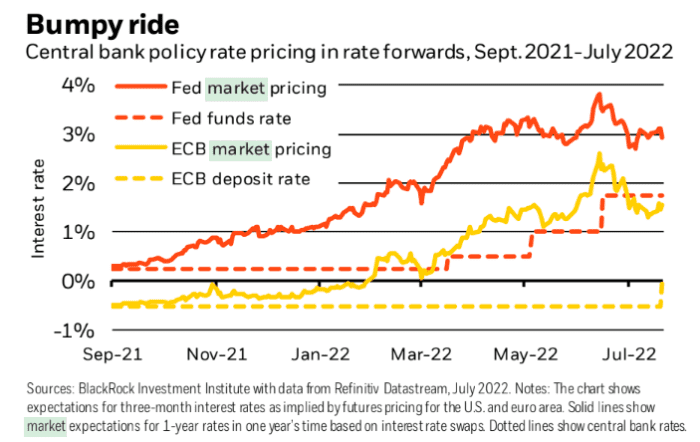
May 30 (Reuters) – The U.S. Federal Reserve should raise interest rates by a half percentage point each time at more than its next two meetings, Fed Governor Christopher Waller said on Monday, underscoring tensions at the central bank about how aggressively to tighten policy as it battles to bring down high inflation. “I support tightening policy by another 50 basis points for several meetings,” Waller said in prepared remarks to the Institute for Monetary and Financial Stability in Frankfurt, Germany. “In particular, I am not taking 50 basis-point hikes off the table until I see inflation coming down closer to our 2 percent target.” The Fed raised its benchmark policy rate by half a percentage point earlier this month, to a target range of between 0.75% and 1%, and plans further increases of the same size at its next two meetings in June and July. Debate at the Fed has shifted to the interest rate hikes required for the remainder of the year. Most policymakers have said they want to wait and see how much inflation comes down over the summer before deciding whether they need to increase of reduce the size of an interest rate hike in September.

One policymaker though, Atlanta Fed President Raphael Bostic, said last week that he was in favor of a “pause” at the September meeting to allow time to assess the impact of the Fed’s moves on the economy and inflation.

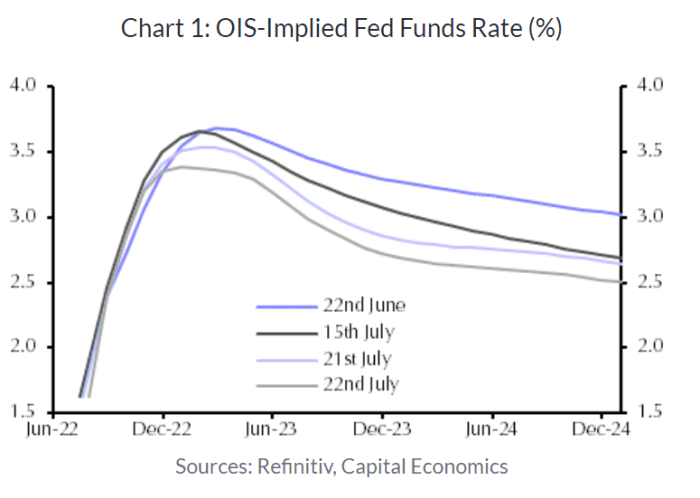
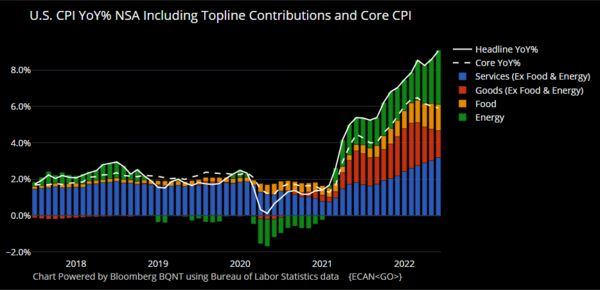
By contrast, St. Louis Fed President James Bullard has said he wants the Fed to hike rates to 3.5% by year’s end, which would involve half percentage-point increases at all the Fed’s remaining meetings. Waller said he wants to see the central bank raising its policy rate above neutral – the level that neither stimulates nor constrains economic growth – by the end of this year but appeared less aggressive than Bullard. Investors currently see the federal funds rate in a range between 2.50% and 2.75% by year’s end, Waller said, noting his plan for rate hikes was not radically different. The Fed’s moves so far have been met with an equities sell-off and surge in U.S. Treasury yields and the dollar amid fears its more aggressive stance could cause a recession. Fears of an economic downturn have also been exacerbated by Russia’s war in Ukraine as well as China’s zero COVID-19 policy, which have further entangled supply chains. Waller said he is optimistic the strong labor market can handle higher rates without a significant increase in unemployment and added that should inflation remain stubbornly high he is prepared to act more aggressively on rates. There are already signs inflation has peaked. In the 12 months through April, the personal consumption expenditures (PCE) price index, the Fed’s preferred gauge of inflation, advanced 6.3% after jumping 6.6% in March, the Commerce Department reported on Friday. So-called core PCE prices increased 4.9% year-on-year in April after rising 5.2% in March. It was the second straight month that the rate of increase reflected in the annual core PCE price index decelerated.

But Waller remained unmoved by those readings. “No matter which measure is considered…headline inflation has come in above 4% for about a year and core inflation is not coming down enough to meet the Fed’s target anytime soon.”

NN: The FED is so screwed they make a cork screw look like a straight piece of metal. Their is no escape from a recession that will turn into a depression….

Bear Market Rally

Bear market bounces are violent yet short-lived. The latest excuse for an oversold rally was provided by JP Morgan’s Jamie Dimon. The bank’s CEO stated at Morgan’s Investor Day Conference on Monday, May 23rd, that the US economy remains strong despite gathering storm clouds. He said, “I’m calling it storm clouds because they’re storm clouds. They may dissipate.” This was indicative of the typical vapid speech of the optimistic bank CEO. While he was at it, he also raised the bank’s outlook for Net Interest Margin at the bank’s conference, causing the usual parade of Dimon groupies to celebrate with orgasmic delight about his confidence in the economy.  Perhaps Dimon is compelled to do his impression of PT Barnum because shares of JPM have lost 30% of their value so far this year. But before you believe Dimon is some economic oracle, listen to what he predicted about US economic growth on Jan. 11th when he publicly proclaimed his 2022 outlook, “We’re going to have the best growth year we’ve ever had this year, I think, since maybe sometime after the Great Depression.” He said this during a quarter that would later show to have shrunk at a 1.4% annualized rate. And that bad economic data didn’t cease at the end of Q1. S&P Global US Composite PMI Output, which tracks the manufacturing and services sectors, fell to a reading of 53.8 in May, from a 56.0 reading in April, which means the economy is fast approaching contraction territory in Q2. A slew of manufacturing PMIs also supports the view that the US and, indeed the entire global economy is faltering.

This is one reason why the bottom of the bear market isn’t yet in sight. In fact, if the stock market were to return to a more normal valuation, one where the total market cap of equities was equal to annual total output of the economy, it would have to decline by 37% from the current level. But bear markets seldom, if ever, just decline to fair valuations; they usually slice through that level and find support once the market displays a broad array of metrics that indicate it is undervalued. So, despite a brutal bear market, the grand reconciliation of asset prices should continue on. 

Vanda research recently reported that the average retail portfolio is down 32% this year. And this bloodbath isn’t limited to stocks. The flagship crypto (BTC) is down 55% since November of last year, long-duration Treasuries are down 20% YTD, and the housing bubble is the next in the queue to implode. Indeed, the evidence of an incipient real estate debacle can be found in the 6 straight months of decline in the Pending Home Sales Index.

The bear market should continue until a sufficient amount of disinflation is manifest, which can then give Chair Powell the economic and political cover to turn dovish. But this probably won’t occur until around September or October. However, in the next four months Powell will have raised the Fed Funds Rate by an additional 125- 150 bps and destroyed $250 billion from the base money supply. 

In response to the upcoming recession, expect the Fed, Treasury, and D.C. to coordinate the monetization of trillions upon trillions in helicopter money. But think twice if you believe that will fix everything. Just imagine the consequences of turning back towards a massive inflationary policy while the sting of destabilizing inflation is still raw in the minds of consumers and investors. The US now has record-high inflation while also enjoying a tremendous dollar bull market over the past year. But just imagine how destructive that inflation will become once the Fed’s balance sheet vaults over $10 trillion and then quickly races towards 100% of GDP; with no end in sight. And, at the same time, the dollar crashes–not only against goods and services like what is happening now, but against our major trading partners–causing import prices to surge. 

NN: the bear market has many innings to go, the Fed pivot is still months away, and that turn towards a more dovish policy isn’t going to solve all the economic and market problems. Indeed, it will make them much worse. This is why the buying and holding of a typical 60/40 portfolio no longer works. And why an Inflation/Deflation investment strategy is growing more crucial to successful investing

U.S. stock futures rise in holiday trade as Shanghai sets reopening plans

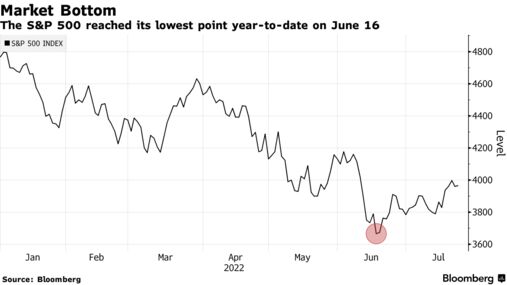
U.S. stock futures rose on Monday in light holiday volume, helped by plans from the world’s number-two economy to lift some restrictions as it fights COVID more aggressively than the rest of the world. While U.S. stock exchanges are closed in observance of Memorial Day, electronic futures trading continues. On Friday, the Dow Jones Industrial Average rose 576 points, or 1.76%, to 33213, the S&P 500 increased 100 points, or 2.47%, to 4158, and the Nasdaq Composite gained 390 points, or 3.33%, to 12131. Shanghai over the weekend said it would lift restrictions on businesses and offer tax rebates, and Beijing reopened some public transportation, signs of a loosening of the zero-COVID policies that have limited output in China. “The easing is mainly an issue for domestic demand–Chinese exports continued to grow during the restrictions. However, some international companies produce in China for Chinese consumption, so the easing has relevance for some global equities,” said Paul Donovan, chief economist at UBS Global Wealth Management. European-listed luxury producers that sell into China, including LVMH Moet Hennessy , advanced. The Shanghai Composite rose 0.6%, and the Hang Seng rallied over 2% in Hong Kong. There’s a big slate of U.S. economic data on tap this week, including Wednesday’s release of the Institute for Supply Management manufacturing index, and Friday’s release of nonfarm payrolls. NN: this is a full blown rally back that should last a month or two. We have spread our positions getting out of the way of this monster. I am predicting a 14500 NASDAQ before the next plunge to under 10,000. If we  can guess lucky this could be a really good trade.