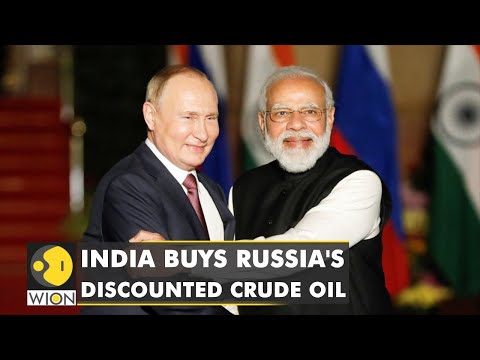
Biden Open to Sanctions on Russian Oil, Gas: Ukraine Update

President Joe Biden, who used his first State of the Union address to label Vladimir Putin a “dictator,” signaled Wednesday that he’s open to imposing restrictions on oil and gas imports to the U.S. Russia’s military advance continued, with its Defense Ministry saying it captured the Black Sea port city of Kherson as units moved further into southern Ukraine. A top Russian official warned that increased weapons supplies to Ukraine could raise the risk of an inadvertent conflict with NATO. For its part, Ukraine said a second round of talks were possible as early as Wednesday. Russian markets continued to be roiled, with investors scrambling to find out whether the country’s bonds are in default. European natural gas hit a new record, alongside soaring prices for wheat and corn.

Key Developments

  • Commodities Hit New Highs as Traders Shun Russian Purchases
  • Russian Markets Break Down With Cash Frozen at the Border
  • Russian Default Angst Lingers Despite Ruble Bond Coupon Payment
  • Fog of Cyberwar Grips Ukraine and Russia With Only Bad Outcomes
  • Ukraine to Hike Interest Rates Sharply in Face of Russia War
  • U.S. Task Force to Target Oligarchs’ Assets

The U.S. Justice Department announced details of a new task force designed to enforce sanctions and export restrictions and to seize luxury assets belonging to Russia’s wealthiest citizens. The “KleptoCapture” task force will gather experts in sanctions and export control enforcement, anti-corruption, asset forfeiture, anti-money laundering, tax enforcement, national security investigations, and foreign evidence collection, DOJ said in a statement on Wednesday. “To those bolstering the Russian regime through corruption and sanctions evasion: We will deprive you of safe haven and hold you accountable,” Deputy Attorney General Lisa Monaco said. “Oligarchs be warned: we will use every tool to freeze and seize your criminal proceeds.” Biden Says U.S. Is Open to Banning Russian Oil, Gas.

President Biden said he’s open to implementing a ban on importing Russian oil and gas, a move that may force up already high prices for American consumers.

“Nothing is off the table,” Biden said as he departed the White House for a trip to Wisconsin. The leaders of Estonia, Latvia and Lithuania called on the public not to punish their countries’ ethnic-Russian minorities for the Kremlin-led invasion of Ukraine. Estonian Prime Minister Kaja Kallas warned against stoking tensions with Estonia’s large Russian-speaking population, saying “this is Putin’s war and the Russian people should not be punished for it.” Lithuanian Prime Minister Ingrida Simonyte called her country’s Russian-speaking residents patriots and Latvian Prime Minister Krisjanis Karins said “if we start to turn against the Russians as a people, we will be shooting ourselves in the foot.” The European Union is looking at ways to limit access to its ports and waters for Russian vessels, according to people familiar with the discussions, who asked not to be identified because the talks are private. The EU’s trade chief, Valdis Dombrovskis, told European lawmakers on Monday that there was “some work ongoing” to explore sanctions on Russia’s maritime sector, without giving any details as these measures are not part of his dossier. European natural gas prices eased after soaring as much as 60% and crude oil topped $110 a barrel amid concerns over Russian supply. OPEC and its allies essentially disregarded the issue at a meeting Wednesday, with delegates saying there was no mention of Russian oil supplies being disrupted. The risks of inadvertent conflict between Russia and NATO are rising with increased supplies of weapons to Ukraine by alliance members, Deputy Foreign Minister Alexander Grushko said, according to Interfax. “There’s no guarantee that there won’t be some kind of incident, there’s no guarantee that an incident might not escalate,” Grushko told state television.

OPEC+ to raise oil output by 400k bpd in April

The OPEC+ group decided on Wednesday to rubberstamp another 400,000 barrels per day (bpd) increase in its collective oil production in April, despite soaring oil prices after a key member of the pact, Russia, invaded Ukraine. During a short ministerial meeting of OPEC+, the ministers decided to proceed with the monthly increase agreed upon last summer, in a move widely expected by analysts. In the days before the meeting, sources at OPEC+ and analysts signaled there would be no change in the pact’s production plan, regardless of surging oil prices that are now well beyond comfortable for major oil-consuming nations, including the United States.   The issue with ramping up production more than planned—even if OPEC+ wanted to—is that only Saudi Arabia and the UAE actually have the capacity to do so, but a major bump in production from those two influential OPEC members would mean critically thin spare production capacity globally. Others mostly lack capacity to pump to their quotas, and the gap between the monthly 400,000-bpd nominal increase and the actual increase has been growing, to as much as 900,000 bpd in January, per the International Energy Agency’s estimates. The OPEC+ meeting on Wednesday decided to leave the plan as-is and didn’t mention the Russian war in Ukraine, which was the reason why oil prices jumped last week to above $100 per barrel for the first time since 2014 and continued to rally to $111 early today. OPEC+ noted in its press release after a record-short meeting that “it was noted that current oil market fundamentals and the consensus on its outlook pointed to a well-balanced market, and that current volatility is not caused by changes in market fundamentals but by current geopolitical developments.” According to the production schedule for April provided by OPEC, the OPEC+ alliance’s collective quota is 41.697 million bpd. The leaders of the pact, Saudi Arabia and Russia, each have a quota of 10.436 million bpd for April. Oil prices continued to rally, with Brent hitting $112 and WTI Crude at $110 per barrel half an hour after OPEC+ concluded the meeting.

We can bear sanctions, talks could happen tonight – Kremlin

Kremlin spokesperson Dmitry Peskov said on Wednesday that Russia is capable of withstanding sanctions, and is prepared for all possible scenarios regardless of the severity of measures. Speaking to reporters, Peskov added that it is unclear whether the Ukrainian side will show up for negotiations later during the day, and stressed that Moscow’s representatives are ready to meet them. In a separate address, Russia’s top diplomat, Sergey Lavrov, accused Kiev of postponing the talks at the request of the United States.

Chevron: Biden Can Lower High Crude Prices If He Supports U.S. Oil

The Biden Administration could couple releases from the Strategic Petroleum Reserve (SPR) with a longer-term policy to support the U.S. oil industry if it wants to reduce the soaring gasoline and oil prices and ensure America’s energy security, Mike Wirth, chief executive at supermajor Chevron, said on Tuesday. The U.S. Administration is discussing another SPR release to ease the upward pressure on oil prices which shot up to over $100 per barrel after Russia invaded Ukraine. According to Chevron, an SPR release is a short-term remedy, while ensuring a long-term energy security—especially in light of Putin’s war in Ukraine—could be achieved through a “balanced and pragmatic conversation.” A new SPR release would best serve energy security if it is accompanied by “an attitude to support investment in U.S. resource development,” Wirth said on a call during Chevron’s investor day, as carried by Bloomberg. Support to the domestic oil and gas industry would “ensure that this country remains strong from an energy security standpoint,” Chevron’s top executive said. The Biden Administration continues to press for a green energy transition and has called several times on the OPEC+ group over the past months to ramp up production more than planned to tame surging oil prices and support the economic recovery from the pandemic. U.S. oil executives, however, have felt ignored. Earlier this week, Devon Energy’s chief executive Rick Muncrief told Bloomberg, “I’m a little mystified that there hasn’t been some dialog,” referring to the lack of dialogue between the U.S. Administration and the U.S. oil industry. “If they were to reach out and maybe be a little more collaborative, it might provide some cover,” Muncrief said. Yet, White House press secretary Jen Psaki said earlier this week that a proposal by Republican lawmakers to increase U.S. crude oil production amid the fast-deteriorating conflict in Ukraine that could compromise the security of energy flows was a “misdiagnosis.” NN: Come November the democrats will be thrown out on their ass unless oil prices and gasoline comes way way down in pricwe and they damn well know it…. By August this rally will be OVER!

White House Quietly Calls On U.S. Oil Companies To Increase Production

  • Short of an official request, the White House is now encouraging U.S. drillers to produce more crude.
  • The White House has received a lot of pushback in recent days for not tapping what many see as at least a partial solution to the headache that is high oil prices—U.S. shale.nnnnIn a move that likely angered his environment-conscious base, the White House has issued a muted request for U.S. oil companies to increase crude oil production in the wake of high crude oil and gasoline prices.  Though words are different than deeds—and President Joe Biden’s deeds have been decisively anti-fossil fuel expansion—a White House official told U.S. oil companies on Tuesday that they could increase production if they want. “Prices are quite high, the price signal is strong. If folks want to produce more, they can and they should,” White House National Economic Council Deputy Director Bharat Ramamurti said in an interview today. While the words fell short of an official request to U.S. oil companies to increase production, it is decidedly different from ignoring U.S. oil companies’ production plans altogether while asking OPEC+ to do the heavy lifting when it comes to oil production—to no avail, no less. Ramamurti also dispelled the notion that the U.S. Administration was somehow curtailing crude oil production. But U.S. oil companies have long held that while the Administration hasn’t directly restricted U.S. output, the energy policies flowing out of the White House have put a damper not only on the attitude involving crude oil production but has made it far more difficult for oil companies to ramp up.
     The White House has received a lot of pushback in recent days for not tapping what many see as at least a partial solution to the headache that is high oil prices—U.S. shale. Oil companies such as Devon Energy have said they have been perplexed that the White House has not called on them directly to ramp up oil production. And Ramamurti’s comments today still do not rise to the level of asking U.S. producers for more oil. NN: Its the power of the greenieewinnies. Politicians are afraid of them. Thy are single biggest creator of the global energy crises. In essence by killing the openng up of new oil sources globally AND shutting down Nuclear reactors and stopping power generation by natural gas has create this crises. If resources were deployed correctly we could tell Russia to kiss our rosy red rectum (RRR)… Putin has staked his claim to former soviet territories. Has he over played his hand… MAYBE. But this will not be resolved anytime soon….. Sanctions without stopping his cash cow his exports of oil and natural gas will not be effective.

Oil continues to rise, gains 7% amid Ukraine crisis

Russian invasion of Ukraine fuels near-40% rise in gas price and oil to over $11o per barrel as European stock markets tumble

Prices of oil futures continued to increase on Wednesday and added 7% as the situation in Ukraine escalated, further inciting supply worries. Ukrainian president estimated that 6,000 Russian soldiers were killed since the hostilities started. Russia’s Defense Ministry claimed that it has assumed control over the city of Kherson. Brent for May deliveries rose 7.13% to $112.45 per barrel at 2:59 am ET after briefly touching the $113 mark a minute earlier. West Texas Intermediate for settlements in April jumped 7.23%, selling for $110.89 a barrel, with $111.49 being the highest price for the contract earlier today. Both benchmarks were at their 7-year highest.

Russian military convoy north of Kyiv stretches for 40 miles

A Russian military convoy moving towards Kyiv is more than double the size of original estimates as troops attempt to lay siege to the capital, a satellite company has warned. Tanks and armoured vehicles were said to stretch for 17 miles early on Monday – but are now believed to be 40 miles long, according to US private firm Maxar Technologies. The convoy expands from the Antonov airbase, just 17 miles north of Kyiv’s city centre to just north of the Ukrainian town of Pribyrs’k, which is near the Belarus border. This is roughly the same as the distance from Manchester to Leeds. US officials told CNN they are not only concerned by the size of the convoy, but also by the increase in violence, civilian casualties and indiscriminate killings over the past few days. Shocking footage this morning shows the bombardment of Kharkiv, Ukraine’s second-largest city, with President Volodymyr Zelensky claiming Russians are deliberately targeting civilians. Vladimir Putin has been accused of war crimes after allegedly using devastating vacuum bombs and cluster munitions during the invasion. The advance on Kyiv has made little progress over the past 24 hours likely due to continuing logistical difficulties, the British defence ministry has said. But multiple U.S. intelligence officials have cautioned that the huge numbers of Russian troops are likely to crush the Ukrainian resistance – amid claims Belarus troops have crossed the border to join Putin’s invasion. Mayor of Kyiv Vitali Klitchsko said on Monday his people ‘never were so patriotic’ and the city would hold out ‘so long as we can survive’. ‘I have never been so proud of our soldiers. Our soldiers are heroes. Civilians are building defenses’, he said. ‘People are taking weapons and are ready to defend our homes, defend our families, our future and our country. ‘I am really proud. The army is not interested in how strong the Russian army is; we are ready to fight, and ready to die for our home. ‘Because it is our future. Somebody wants to come to our home and steal our future from us.’ One image released by Maxar Technologies shows hundreds of military vehicles extending for more than 3.25 miles. It’s unknown whether they are all travelling to the same destination or whether they will eventually split up to surround a particular area. ‘Russian forces have increased their use of artillery north of Kyiv and in vicinities of Kharkiv and Chernihiv’, the British defence ministry briefing said. ‘The use of heavy artillery in densely populated urban areas greatly increases the risk of civilian casualties. ‘Russia has failed to gain control of the airspace over Ukraine prompting a shift to night operations in an attempt to reduce their losses.’ NN:  This is going VERY badly for the brave Ukrainians. Putin is a wild man. He will not be deterred…… Prepare yourself for the coming slaughter…… Unless the EU, Us or NATO comes to their rescue……. Not likely

Goldman: Oil Markets Haven’t Fully Priced In Geopolitical Risk Premium

  • Goldman Sachs: geopolitical premium over the war in Ukraine is even higher than current oil prices.
  • Goldman Sachs strategists: The market may be underestimating the risks of tighter supply on oil pricing.
  • Goldman Sachs: Market may have started to overestimate the potential of the war to significantly change Fed’s monetary tightening schedule.

Oil prices rallied early on Tuesday, with the U.S. benchmark WTI Crude topping $100 a barrel for the first time since July 2014, as the market scrambles to assess the potential loss of supply from Russia after the SWIFT ban for Russian banks over Putin’s invasion of Ukraine. And the geopolitical premium over the war in Ukraine is even higher than current oil prices, according to Goldman Sachs. As of 9:26 a.m. ET on Tuesday, WTI Crude was rallying 5.10% at $100.86, and Brent Crude was trading above $103 per barrel, up 5.34% at $103.51, as the Russian war in Ukraine continues. Banks have started to pull out financing for the purchase of Russian commodities, including oil, after selected Russian banks were banned from the SWIFT banking messaging system over the weekend.

“The market may be underestimating the risks of tighter supply on oil pricing, which remains a key risk from the ongoing conflict — so we think the ‘risk premium’ here should probably be larger,” Goldman Sachs strategists led by Dominic Wilson wrote in a note to clients on Monday, as carried by Bloomberg.

However, the market may have started to overestimate the potential of the war to significantly change Fed’s monetary tightening schedule, Goldman’s analysts said.  On Sunday, Goldman Sachs said that only demand destruction could stop oil from rising to $115 over the next month due to the difficulties Russia will have in payments for its energy exports. “Commodity markets need to reflect not only these difficulties in paying for Russia’s exports but, with little left to sanction, the risk that Russian commodities eventually fall under Western restrictions,” Goldman’s strategists said. Reports that OPEC+ will be staying the course of 400,000-bpd monthly increase for April despite $105 oil also supported oil prices on Tuesday, a day ahead of the OPEC+ group’s meeting on Wednesday. NN: I see oilpotientialy going to $120 a barrel. And we can trade that giving us a average of $105 to $110. An the flood gates will open and $60 oil here we come….. Party… I love this guy Putin…..I do not love what he is  doing…..  But she asked for it…..

Iran Is “Tantalizingly Close” To A Nuclear Deal That Could Drag Oil Prices Down

  • A new iteration of the Joint Comprehensive Plan of Action (JCPOA) – is “tantalizingly close to being done”.
  • The prize for a full new iteration of the JCPOA to be signed and put into effect will be at least an immediate 5-10 percent drop in oil prices in the short- to medium-term.
  • Kpler analyst: Iran could see an 80 percent recovery of full production within six months and a 100 percent recovery within 12 months.

The spike in crude oil prices last week in the aftermath of Russia’s invasion of Ukraine has lent further urgency to the long-running efforts to bring Iranian oil back into the global oil market in order to bring prices back down to levels that do not cause so much damage to major economies. According to sources closely connected to the current negotiations between the ‘P5+1’ group of nations (U.S., U.K., France, China, and Russia, plus Germany) and Iran.  The mechanism to achieve this – a new iteration of the Joint Comprehensive Plan of Action (JCPOA) – is “tantalizingly close to being done.” However, the most senior source added, not only will Iran have to make significant nuclear and missile concessions first but, even more problematic for both sides albeit for different reasons, Iran will be committed initially to aligning itself with the full rules and regulations of the Financial Action Task Force (FATF) and then to becoming a fully-regulated and constantly-monitored FATF member.  Iranian crude oil and condensate production could bounce back very quickly after a new iteration of has been signed and Iran’s Petroleum Ministry orders the National Iranian Oil Company (NIOC) to ramp up production. According to a senior analyst  in this scenario Iran could see an 80 percent recovery of full production within six months and a 100 percent recovery within 12 months. “[As at the beginning of Q4 2021] Iranian crude oil production capacity stood at 3.9 to 4.0 million barrels per day [bpd] according to the NIOC with current output holding near 2.4 million, of which 1.7-1.8 million is consumed in domestic refineries, and close to 1 million barrels per day of condensate and natural gas liquids are also being produced at present, primarily from the South Pars gas field, although total condensate and NGL production capacity stands at around 1 3 million barrels per day,” . NN: I am looking for a spike up and then i want to begin operations… In as little as 6 months oil will be coming back down to earth. We just need to VERY VERY SOON start operations.

BP to Sell Rosneft Stake….. at fire sale prices

  • BP will sell its close to 20-percent stake in Russian oil giant Rosneft.
  • In addition to the Rosneft stake, BP will also leave three joint ventures in Russia.

BP will sell its close to 20-percent stake in Russian oil giant Rosneft, the supermajor said yesterday amid growing pressure from politicians for companies with Russian operations to leave the country. Besides the sale, BP’s chief executive Bernard Looney and former chief executive Bob Dudley will resign from Rosneft’s board of directors. The report on the news also said BP expects to book a one-time impairment charge on its Rosneft exit, to be reported in May. In addition to the Rosneft stake, BP will also leave three joint ventures in Russia. “Russia’s attack on Ukraine is an act of aggression which is having tragic consequences across the region,” said the company’s chairman Helge Lund. “bp has operated in Russia for over 30 years, working with brilliant Russian colleagues. However, this military action represents a fundamental change. It has led the bp board to conclude, after a thorough process, that our involvement with Rosneft, a state-owned enterprise, simply cannot continue.”The Wall Street Journal reported that the sale of the Rosneft stake could cost BP up to $25 billion, of which $14 billion for the sale itself and the rest coming from foreign exchange losses. It is, however, yet to be revealed how exactly BP will offload the Rosneft stake in the current chaos following the Russian invasion of Ukraine and the response of the West in the form of a wave of sanctions. The latest move against Moscow was the exclusion of several Russian banks from the SWIFT system. According to the Financial Times, it could write the holding off, sell it back to the Russian state major, or look for another buyer. Whatever it does, this would increase the pressure on other energy industry majors with Russian operations to pull out. These include TotalEnergies, Shell, and Exxon, as well as commodity trading majors Vitol and Trafigura. NN: Question what fucking imbecile thinks that foreing oil majore to sell their combined investments of 50 billion dollars in Russia a good thing. Especially when you consider the Oligarths will buy this assets at 10 cents on the dollar all on credit